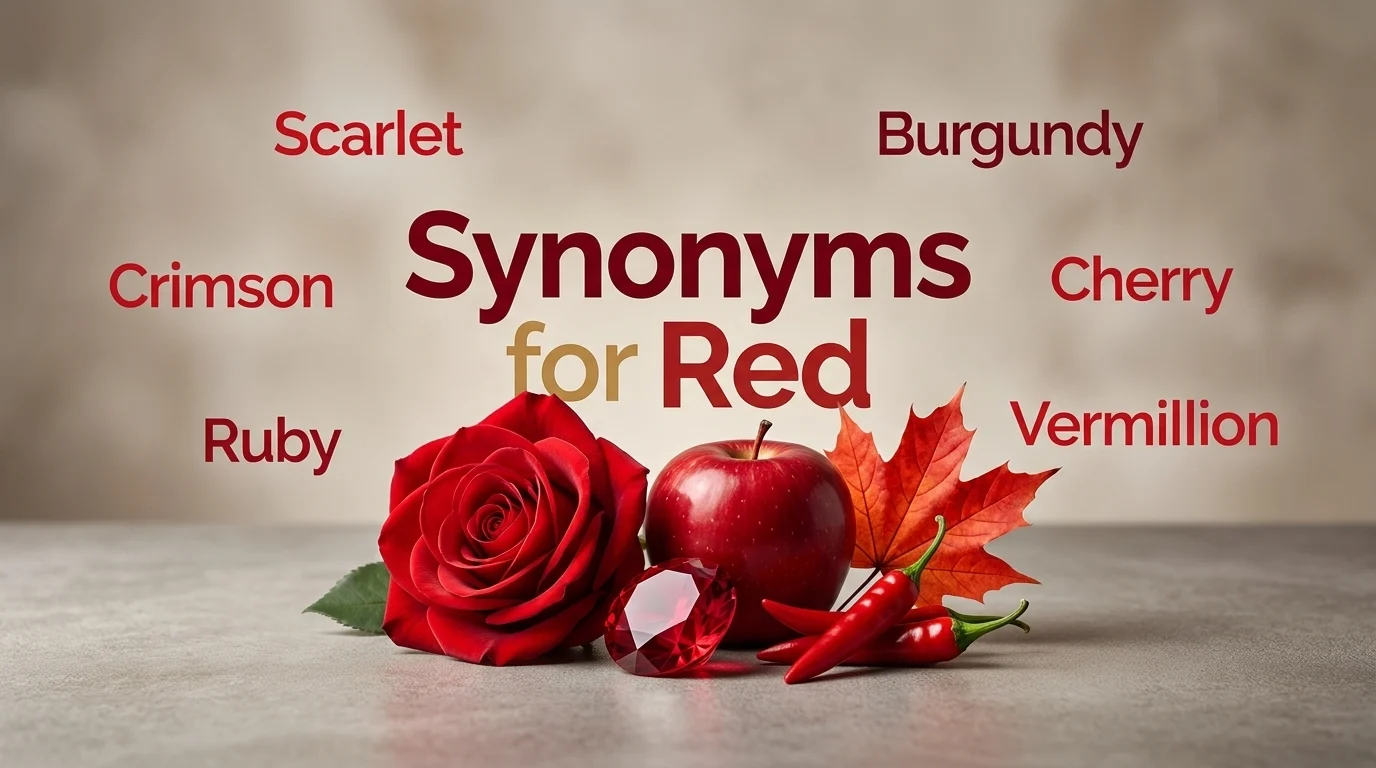
Do you keep using the word “red” in essays, creative writing, product descriptions, fashion content, or everyday conversation? While it is one of the most basic and powerful color words in English, repeating it can make your writing feel flat, repetitive, or imprecise.
The good news is that the best alternative depends on what you actually mean. You might be describing a bright scarlet dress, a deep crimson sunset, a flushed face, a reddish-brown autumn leaf, or a symbolic use of red for danger or passion.
This guide explains synonyms for “red” by meaning, tone, context, and usage. You will learn which alternatives work best in creative writing, fashion and design, academic writing, marketing content, and casual conversation.
Quick Answer: What Does “Red” Mean?
“Red” refers to the color at the long-wavelength end of the visible spectrum, appearing in shades from bright scarlet to deep burgundy. It can also describe flushed skin, reddish-brown tones, and symbolic meanings like danger, passion, love, anger, or importance. Depending on context, alternatives include scarlet, crimson, ruby, cherry, vermillion, burgundy, maroon, flushed, ruddy, and auburn.
Meaning, Tone, and Context
Simple Definition
“Red” generally refers to:
- The color: the primary color between orange and violet on the spectrum
- Skin tones: flushed, blushing, or inflamed skin
- Hair colors: reddish-brown, auburn, or ginger tones
- Symbolic meanings: danger, passion, love, anger, importance, or luck
Part of Speech
“Red” functions primarily as an adjective and a noun.
Adjective Examples:
- “She wore a red dress.”
- “His face was red with embarrassment.”
Noun Examples:
- “Red is my favorite color.”
- “The painting was dominated by deep reds and oranges.”
Related Forms:
- Red (adjective/noun): the color
- Reddish (adjective): somewhat red
- Redden (verb): to make or become red
- Redness (noun): the quality of being red
- Ruddily (adverb): in a ruddy manner
Positive, Negative, or Neutral Tone
“Red” is generally neutral, but it carries strong symbolic associations depending on context.
Positive associations:
- “She looked radiant in red.” (fashion, beauty)
- “The red lanterns symbolized good luck.” (cultural, positive)
Negative associations:
- “His face was red with anger.” (emotion)
- “The red warning light flashed.” (danger)
Neutral contexts:
- “The car is red.” (factual)
Formality Level
“Red” is a standard word that works in both formal and informal English. However, in creative writing, fashion, design, and art contexts, more specific color names add richness and precision.
Common Use Cases
“Red” commonly refers to:
- Fashion and design: clothing, accessories, interior decor
- Nature: sunsets, flowers, autumn leaves, birds
- Food and drink: wine, strawberries, tomatoes, chili peppers
- Emotions: anger, embarrassment, passion, love
- Symbols: danger, warning, importance, luck, revolution
- Health: flushed skin, inflammation, rashes, blood
Important Word Forms
- Red (adjective/noun): the color
- Reds (plural noun): multiple shades of red
- Reddish (adjective): somewhat red
- Redden (verb): to make or become red
- Redness (noun): the state of being red
- Redly (adverb): in a red manner (rare)
When and How to Use “Red”
Use “red” when describing the color, flushed skin, reddish hair, or symbolic meanings. Because the word is broad, more specific alternatives can add precision and depth.
Creative Writing
“The red sun sank slowly behind the mountains.”
A more evocative version:
“The crimson sun sank slowly behind the mountains.”
Fashion and Design
“She wore a red dress to the gala.”
A more precise version:
“She wore a scarlet gown to the gala.”
Nature
“The red leaves of autumn covered the ground.”
A more descriptive version:
“The russet leaves of autumn covered the ground.”
Emotions
“His face turned red with embarrassment.”
A more specific version:
“His face flushed crimson with embarrassment.”
Marketing and Branding
“The red logo stood out on the shelf.”
A more evocative version:
“The vibrant crimson logo stood out on the shelf.”
Health
“The patient’s skin was red and inflamed.”
A more clinical version:
“The patient’s skin was erythematous and inflamed.”
Another Word for “Red”
There is no single perfect synonym because “red” can refer to many different shades and contexts.
- Bright red shades: scarlet, vermillion, cherry, crimson, ruby
- Deep red shades: burgundy, maroon, wine, oxblood, garnet
- Orange-red shades: vermillion, cinnabar, terracotta, rust
- Pinkish red shades: rose, coral, salmon, blush
- Brownish red shades: auburn, russet, chestnut, mahogany, brick
- Flushed skin: flushed, ruddy, rosy, florid, crimson
- Hair colors: auburn, ginger, copper, titian
- Symbolic/figurative: bloody, fiery, blazing
If you need one broad alternative, “crimson” works for deep red, “scarlet” for bright red, and “ruddy” for flushed skin.
When Not to Use “Red”
“Red” can become too vague when you need to specify an exact shade or context.
Consider:
“She wore a red dress.”
This statement does not tell readers whether the dress was bright scarlet, deep burgundy, orange-red, or pinkish red.
A more precise sentence could be:
“She wore a deep burgundy velvet gown.”
Similarly, avoid using “red” when you mean “flushed”, “auburn”, or “crimson” in contexts where specificity matters.
Words Commonly Confused With “Red”
Red vs. Scarlet
Scarlet is a bright, vibrant red with a slight orange tint. Red is the broader category.
Example:
“She wore a scarlet coat.” (bright, vibrant)
“The sign was painted red.” (general)
Red vs. Crimson
Crimson is a deep, rich red with a slight blue or purple undertone.
Example:
“The sky turned crimson at sunset.” (deep, rich)
“The apple was red.” (general)
Red vs. Maroon
Maroon is a dark brownish-red or burgundy color.
Example:
“He wore a maroon sweater.” (dark brownish-red)
“The car is red.” (general)
Red vs. Flushed
Flushed describes reddened skin, often from embarrassment, heat, or exertion. Red is broader.
Example:
“Her cheeks were flushed after the run.” (skin)
“The rose is red.” (color)
Red vs. Auburn
Auburn describes reddish-brown hair. Red is broader.
Example:
“She has auburn hair.” (hair color)
“The leaves are red.” (general)
Red vs. Ruddy
Ruddy describes a healthy, reddish complexion. Red is broader.
Example:
“His ruddy cheeks showed he’d been outside.” (complexion)
“The brick is red.” (color)
Best Synonym by Context for “Red”
| Context | Best Synonym | Why It Works | Example |
|---|---|---|---|
| Bright red | Scarlet, vermillion, cherry | Vibrant and intense | She wore a scarlet dress to the party. |
| Deep red | Crimson, burgundy, ruby, garnet | Rich and sophisticated | The velvet curtains were deep crimson. |
| Dark brownish-red | Maroon, oxblood, mahogany | Dark and muted | He wore a maroon leather jacket. |
| Orange-red | Vermillion, cinnabar, terracotta, rust | Warm and earthy | The rust-colored leaves covered the ground. |
| Pinkish red | Rose, coral, salmon, blush | Soft and delicate | The coral sunset reflected on the water. |
| Brownish red (hair) | Auburn, ginger, copper, chestnut | Describes hair color | She has beautiful auburn hair. |
| Flushed skin | Flushed, ruddy, rosy, florid | Describes complexion | His face was flushed with embarrassment. |
| Symbolic danger | Blood-red, fiery, blazing | Emphasizes intensity | The blood-red sky warned of the coming storm. |
| Food and drink | Cherry, ruby, garnet | Describes food/drink | The ruby port glowed in the glass. |
| Creative writing | Crimson, vermillion, scarlet, sanguine | Literary and evocative | The sanguine sky blazed over the horizon. |
| Fashion/design | Scarlet, crimson, burgundy, cherry | Precise and stylish | The burgundy handbag completed her outfit. |
| Medical/health | Erythematous, inflamed, congested | Clinically accurate | The patient’s skin was erythematous. |
Which Synonym Should You Choose?
Start by identifying what kind of “red” you are describing.
- Bright, vibrant red: scarlet, vermillion, cherry, flame
- Deep, rich red: crimson, burgundy, ruby, garnet, wine
- Dark brownish-red: maroon, oxblood, mahogany, brick
- Orange-red: vermillion, cinnabar, terracotta, rust
- Pinkish red: rose, coral, salmon, blush
- Brownish red (hair): auburn, ginger, copper, chestnut, titian
- Flushed skin: flushed, ruddy, rosy, florid
- Symbolic/figurative: bloody, fiery, blazing, sanguine
- Food/drink: cherry, ruby, garnet, claret
10 Key Synonyms for “Red”
The table below includes accurate alternatives with clear meanings and usage contexts.
| Synonym | Simple Meaning | Best Used For | Example Sentence |
|---|---|---|---|
| Scarlet | Bright, vibrant red | Fashion, dramatic descriptions | She wore a scarlet dress to the event. |
| Crimson | Deep, rich red | Sunsets, velvet, emotion | The sky turned crimson at dusk. |
| Ruby | Deep, glowing red | Jewels, wine, rich descriptions | The ruby necklace sparkled in the light. |
| Cherry | Bright, glossy red | Food, cars, lips | She drove a cherry red convertible. |
| Burgundy | Dark, wine-like red | Fashion, wine, interiors | The burgundy curtains added elegance. |
| Maroon | Dark brownish-red | Clothing, leather, accents | He wore a maroon sweater. |
| Vermillion | Bright orange-red | Art, nature, dramatic scenes | The vermillion sunset painted the sky. |
| Auburn | Reddish-brown (hair) | Hair color, autumn leaves | She had beautiful auburn hair. |
| Flushed | Reddened skin | Embarrassment, health, emotion | His face was flushed with excitement. |
| Ruddy | Healthy reddish complexion | Complexion, health, outdoors | His ruddy cheeks showed he’d been hiking. |
Synonym Groups and Usage Differences
Professional vs. Personal Synonyms
Professional writing benefits from specific terms such as crimson, burgundy, scarlet, and vermilion in design, fashion, and marketing contexts.
Personal communication often uses red itself or casual alternatives like cherry or bright red.
Compare:
“She wore a red dress.” (personal)
“She wore a burgundy silk gown.” (professional)
Formal vs. Conversational Synonyms
Red works in both formal and conversational English.
Formal alternatives: crimson, vermillion, scarlet, sanguine
Conversational alternatives: cherry, bright red, fire-engine red
Examples:
“The artist used vermillion to create depth.” (formal)
“She painted her nails fire-engine red.” (conversational)
Academic and Scientific Synonyms
Academic writing in fields like medicine, art history, and color theory should distinguish between erythematous (medical), vermilion (pigment), crimson (spectral), and sanguine (historical).
For example:
“The patient presented with erythematous skin lesions.”
“The painting features a rare vermilion pigment.”
Professional and Business Synonyms
Business writing often benefits from precise terms such as scarlet, burgundy, crimson, and ruby in branding, product descriptions, and marketing.
Instead of:
“The logo is red.”
Consider:
“The logo features a vibrant crimson.”
Creative or Literary Synonyms
Creative writing can use crimson, vermilion, scarlet, sanguine, flame, and blazing depending on the mood.
For example:
“The sanguine sky blazed over the horizon.”
“Her scarlet lips parted in a smile.”
Slang or Modern Synonyms
Fire-engine red is a common informal term for bright red.
Cherry is slang for a pristine or bright red.
Blood red is an intense, dark red.
Examples:
“She painted her nails fire-engine red.” (casual)
“The car was cherry red.” (informal)
Strongest vs. Weaker Synonyms
“Red” synonyms vary in intensity:
Milder: rosy, pinkish, coral
Moderate: red, scarlet, cherry
Strong: crimson, vermillion, ruby
Very Strong: blood-red, fiery, blazing
Emotional vs. Neutral Synonyms
“Red” is generally neutral but can be emotional depending on context.
Emotional alternatives: flushed, fiery, blazing, blood-red
Neutral alternatives: crimson, scarlet, ruby, auburn
Examples:
“Her cheeks were flushed with excitement.” (emotional)
“The fabric was crimson.” (neutral)
Antonyms of “Red”
“Red” has several antonyms depending on context:
| Antonym | Context | Meaning | Example Sentence |
|---|---|---|---|
| Green | Color | The complementary color | The green leaves contrasted with the red flowers. |
| Blue | Color | The opposite on the spectrum | The blue sky was clear and bright. |
| Pale | Skin | Lacking color | Her face was pale with fear. |
| White | Skin/color | Lacking red tones | He turned white as a sheet. |
| Colorless | General | Without color | The solution was colorless. |
Comparison: “Red” vs. Similar Words
Red vs. Scarlet
Main difference: Scarlet is a specific bright, vibrant red with a slight orange tint. Red is the broader category.
Examples:
“She wore a scarlet coat.” (specific bright red)
“The sign was painted red.” (general)
Red vs. Crimson
Main difference: Crimson is a deep, rich red with a slight blue or purple undertone. Red is broader.
Examples:
“The sky turned crimson at sunset.” (deep, rich)
“The apple was red.” (general)
Red vs. Maroon
Main difference: Maroon is a dark brownish-red or burgundy color. Red is broader.
Examples:
“He wore a maroon sweater.” (dark brownish-red)
“The car is red.” (general)
Red vs. Flushed
Main difference: Flushed describes reddened skin, often from embarrassment, heat, or exertion. Red is broader.
Examples:
“Her cheeks were flushed after the run.” (skin)
“The rose is red.” (color)
Red vs. Auburn
Main difference: Auburn describes reddish-brown hair. Red is broader.
Examples:
“She has auburn hair.” (hair color)
“The leaves are red.” (general)
Red vs. Ruddy
Main difference: Ruddy describes a healthy, reddish complexion. Red is broader.
Examples:
“His ruddy cheeks showed he’d been outside.” (complexion)
“The brick is red.” (color)
Common Phrases and Expressions with “Red”
1. Red flag
Meaning:
A warning sign of danger or problem.
Example:
“The delay was a red flag for the project.”
2. Red herring
Meaning:
A misleading clue or distraction.
Example:
“The suspect’s alibi was a red herring.”
3. In the red
Meaning:
Owing money; operating at a loss.
Example:
“The company has been in the red for three years.”
4. Red carpet
Meaning:
Special treatment for important guests.
Example:
“They rolled out the red carpet for the celebrity.”
5. Red tape
Meaning:
Excessive bureaucracy or official procedures.
Example:
“The permit was delayed by government red tape.”
6. Red-letter day
Meaning:
A very important or memorable day.
Example:
“Graduation day was a red-letter day for the family.”
7. Caught red-handed
Meaning:
Caught in the act of doing something wrong.
Example:
“He was caught red-handed stealing the money.”
8. Red-eye
Meaning:
An overnight flight; also, red eyes from tiredness.
Example:
“She took the red-eye flight to New York.”
9. Red-hot
Meaning:
Extremely hot, popular, or intense.
Example:
“The new product is red-hot in the market.”
10. See red
Meaning:
To become very angry.
Example:
“When he heard the news, he saw red.”
Common Mistakes to Avoid
1. Using “red” when a more precise shade is available
If you mean crimson, scarlet, burgundy, or maroon, use the specific term.
Vague: “She wore a red dress.”
Precise: “She wore a crimson gown.”
2. Confusing “red” with “flushed” in health contexts
Flushed specifically describes reddened skin from embarrassment, heat, or exertion.
Incorrect: “Her skin was red with embarrassment.”
Correct: “Her skin was flushed with embarrassment.”
3. Using “red” in fashion when a specific shade is needed
Fashion and design contexts benefit from precise color names.
Vague: “The red handbag.”
Precise: “The burgundy handbag.”
4. Overusing “red” in creative writing
Repetition can make writing feel dull. Use a variety of alternatives such as crimson, scarlet, vermilion, ruby, and sanguine.
5. Choosing a synonym that changes the meaning
Do not replace red with pink unless you mean a lighter shade.
Do not replace red with orange unless you mean a warmer tone.
FAQs
What is the best synonym for “red”?
The best synonym depends on context. Scarlet works for bright red, crimson for deep red, burgundy for dark red, ruby for jewel tones, auburn for hair, and flushed for skin.
What is a formal synonym for “red”?
Crimson, vermillion, scarlet, sanguine, and ruby are formal alternatives. In medical contexts, erythematous is used.
What is an informal synonym for “red”?
Cherry, fire-engine red, and bright red are common informal alternatives.
What is another word for “red” in creative writing?
Crimson, vermilion, scarlet, sanguine, flame, and blazing work well in creative writing.
What is the difference between “red” and “scarlet”?
Scarlet is a specific bright, vibrant red with a slight orange tint. Red is the broader category.
What is the difference between “crimson” and “burgundy”?
Crimson is a deep, rich red with a slight blue or purple undertone. Burgundy is a darker, wine-like red with brown undertones.
What does “red” symbolize?
Red can symbolize danger, passion, love, anger, importance, luck (in some cultures), and revolution.
Conclusion
“Red” is a remarkably versatile word that can describe color, flushed skin, reddish hair, and symbolic meanings like danger, passion, and love. The best synonym depends on what you actually mean.
Choose scarlet for bright red, crimson for deep red, burgundy for dark red, ruby for jewel tones, auburn for hair, flushed for skin, and vermilion for orange-red.
Most importantly, do not replace “red” simply to avoid repetition. First identify what kind of red—bright, deep, dark, orange, pinkish, or symbolic—you are actually describing. Then choose the alternative that communicates that idea most clearly.
For academic, professional, and technical writing, precision is usually more valuable than vocabulary variety. A specific term such as crimson, scarlet, vermilion, or erythematous can tell readers much more than the broad word red.
Before publishing a vocabulary guide, verify definitions and usage with trusted dictionaries such as Cambridge, Oxford, Merriam-Webster, Collins, or Britannica. This helps ensure that each alternative accurately matches its intended meaning and context.
The practical takeaway is simple: when “red” feels too general, ask yourself what specific shade or context you are actually describing. Then use the most precise word available.
Discover More:-
- 50+ Synonyms for Essential: Meanings, Examples, and Best Alternatives
- 50+ Synonyms for Fight: Meanings, Examples, and Best Alternatives

1 thought on “50+ Synonyms for Red: Meanings, Examples, and Best Alternatives”