Do you keep using the word “confidence” in essays, business reports, motivational content, presentations, or everyday conversation? While it is a powerful and positive word, repeating it can make your writing feel monotonous or lack nuance.
The good news is that the best alternative depends on what you actually mean. You might be referring to self-assurance, belief in your abilities, trust in others, certainty about an outcome, or a bold and assertive attitude.
This guide explains synonyms for “confidence” by meaning, tone, context, and usage. You will learn which alternatives work best in academic writing, professional communication, creative expression, motivational content, and casual conversation.
Quick Answer: What Does “Confidence” Mean?
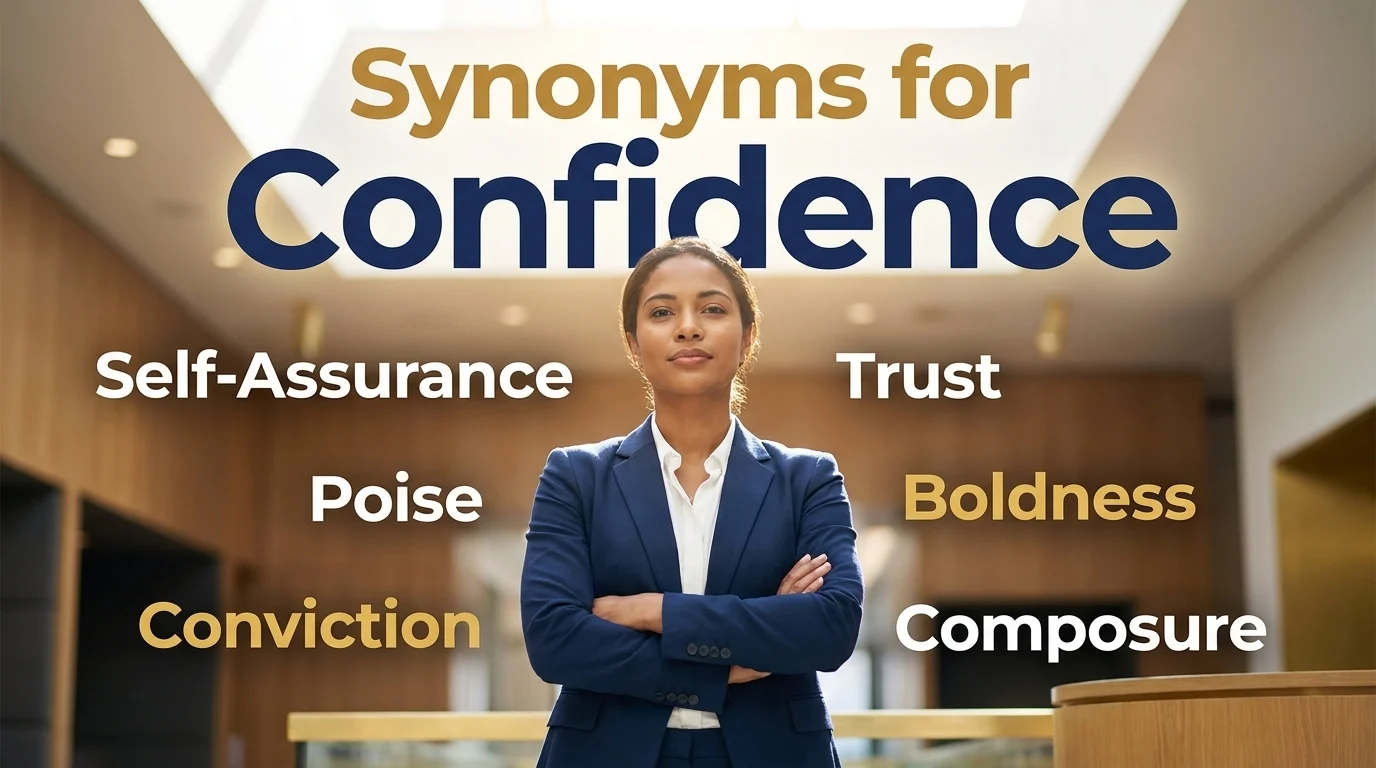
“Confidence” refers to a feeling of self-assurance arising from an appreciation of one’s own abilities or qualities. It can also mean trust or faith in someone or something, or a feeling of certainty about a fact or outcome. Depending on context, alternatives include self-assurance, assurance, poise, certainty, conviction, self-belief, boldness, trust, faith, and composure.
Meaning, Tone, and Context
Simple Definition
“Confidence” generally refers to:
- Self-assurance: belief in your own abilities, qualities, and judgment
- Trust: reliance on or faith in a person, organization, or system
- Certainty: a feeling of being sure about something; freedom from doubt
- Boldness: willingness to take risks or act assertively
- Composure: calm self-possession, especially in challenging situations
Part of Speech
“Confidence” is primarily a noun.
Examples:
- “She spoke with confidence during the interview.”
- “The team has confidence in its new manager.”
Related Forms:
- Confident (adjective): feeling or showing confidence
- Confidently (adverb): in a confident manner
- Confide (verb): to tell someone a secret, trusting them
- Confidential (adjective): meant to be kept secret or private
- Overconfident (adjective): excessively confident, often unrealistically
Positive, Negative, or Neutral Tone
“Confidence” is generally positive.
Positive associations:
- “Her confidence inspired the whole team.”
- “He walked onto the stage with quiet confidence.”
Neutral or critical contexts:
- “His overconfidence led to poor decisions.”
- “She had confidence in a plan that ultimately failed.”
Formality Level
“Confidence” is a standard word that works in both formal and informal English. It is appropriate in academic papers, business reports, casual conversation, and creative writing. However, more specific alternatives can add precision and variety.
Common Use Cases
“Confidence” commonly refers to:
- Personal self-assurance: belief in your own abilities
- Professional confidence: capability and authority in the workplace
- Trust in others: confidence in a person, team, or institution
- Certainty about outcomes: confidence in predictions or results
- Calm composure: confidence under pressure
- Public speaking: presenting with authority and self-possession
- Motivational content: building self-belief and empowerment
Important Word Forms
- Confidence (noun): the state or quality of being confident
- Confident (adjective): having or showing confidence
- Confidently (adverb): in a confident manner
- Confide (verb): to trust someone with private information
- Confidant/Confidante (noun): a person you trust with secrets
- Confidential (adjective): kept secret or private
- Self-confidence (noun): confidence in oneself
- Overconfidence (noun): excessive or misplaced confidence
When and How to Use “Confidence”
Use “confidence” when you want to describe self-assurance, trust, certainty, or composure. Because the word is broad, more specific alternatives can add precision depending on the context.
Professional
“She delivered the presentation with confidence.”
This works naturally in workplace communication.
Academic
“The study measures how confidence affects decision-making under uncertainty.”
The term is appropriate in academic research.
Personal
“I’ve gained a lot of confidence since starting this job.”
The word sounds natural in everyday conversation.
Business
“Consumer confidence has risen sharply this quarter.”
Here, “confidence” describes trust in the economy.
Motivational
“Building confidence is a journey, not a destination.”
The term is standard in motivational content.
Creative
“He moved through the crowd with the quiet confidence of a man who knew exactly who he was.”
The word can describe a character trait or atmosphere.
Another Word for “Confidence”
There is no single perfect synonym because “confidence” can refer to many different things.
- Self-assurance: assurance, self-belief, self-reliance, poise
- Trust in others: trust, faith, reliance, dependence
- Certainty: certainty, conviction, sureness, assurance
- Boldness: boldness, courage, assertiveness, audacity
- Calm composure: composure, poise, equanimity, self-possession
- Professional authority: authority, command, expertise, credibility
If you need one broad alternative, “assurance” works well in formal contexts, while “poise” works for composure, and “conviction” works for certainty.
When Not to Use “Confidence”
“Confidence” can become too vague when you need to specify what kind of confidence you mean.
Consider:
“She has a lot of confidence.”
This statement does not tell readers whether she is self-assured, trusted by others, certain about a specific outcome, or composed under pressure.
A more precise sentence could be:
“She has remarkable self-assurance when speaking in public.”
Similarly, avoid using “confidence” when you mean “certainty” in a scientific or logical context. Use “certainty” or “conviction” instead.
Words Commonly Confused With “Confidence”
Confidence vs. Arrogance
Arrogance is an exaggerated sense of one’s own importance, often with a dismissive attitude toward others. Confidence is a healthy belief in oneself.
Example:
“She spoke with confidence.” (positive)
“He was arrogant and dismissed everyone’s opinions.” (negative)
Confidence vs. Certainty
Certainty means being fully sure about something. Confidence can include some doubt.
Example:
“I have confidence in my team.” (belief, some uncertainty)
“I have certainty about the facts.” (no doubt)
Confidence vs. Courage
Courage is the ability to face fear or danger. Confidence is belief in oneself or trust in something.
Example:
“He showed courage by speaking up.” (facing fear)
“He showed confidence in his presentation.” (self-belief)
Confidence vs. Optimism
Optimism is a general expectation of positive outcomes. Confidence is more about belief in abilities or trust.
Example:
“She remains optimistic about the future.” (general outlook)
“She is confident about passing the exam.” (specific belief)
Confidence vs. Poise
Poise emphasizes calm and elegant composure. Confidence is broader.
Example:
“She handled the difficult questions with poise.” (composure)
“She has the confidence to lead the team.” (general self-belief)
Confidence vs. Self-esteem
Self-esteem is how you feel about yourself overall. Confidence is often about specific abilities or situations.
Example:
“He has high self-esteem.” (general self-worth)
“He has confidence in his writing skills.” (specific)
Best Synonym by Context for “Confidence”
| Context | Best Synonym | Why It Works | Example |
|---|---|---|---|
| Formal writing | Assurance, conviction | Sounds precise and professional | She acted with quiet assurance. |
| Academic writing | Self-efficacy, certainty | Psychologically precise | The study measured self-efficacy among students. |
| Professional/business | Authority, credibility | Emphasizes capability | She presented with authority. |
| Self-belief | Self-assurance, self-belief | Emphasizes belief in oneself | His self-assurance inspired the team. |
| Trust in others | Trust, faith, reliance | Emphasizes belief in others | We have complete trust in her judgment. |
| Certainty | Conviction, certitude, sureness | Emphasizes freedom from doubt | He spoke with conviction. |
| Calm composure | Poise, composure, equanimity | Emphasizes calmness under pressure | She responded with remarkable poise. |
| Boldness | Boldness, assertiveness, audacity | Emphasizes willingness to act | He approached the challenge with boldness. |
| Casual conversation | Confidence (itself), self-belief | Natural and concise | She’s got a lot of self-belief. |
| Motivational content | Self-belief, empowerment | Inspiring and positive | Self-belief is the foundation of success. |
| Public speaking | Poise, presence, command | Emphasizes stage presence | She spoke with real presence. |
Which Synonym Should You Choose?
Start by identifying what kind of confidence you are describing.
- Self-assurance: self-assurance, self-belief, self-reliance, self-possession
- Trust in others: trust, faith, reliance, dependence, belief
- Certainty: conviction, certitude, sureness, assurance
- Boldness: boldness, assertiveness, courage, audacity, daring
- Composure: poise, composure, equanimity, calmness
- Professional authority: authority, command, credibility, expertise
- Motivational: self-belief, empowerment, self-worth, resilience
10 Key Synonyms for “Confidence”
The table below includes accurate alternatives with clear meanings and usage contexts.
| Synonym | Simple Meaning | Best Used For | Example Sentence |
|---|---|---|---|
| Self-assurance | Belief in one’s own abilities | Personal, professional contexts | She spoke with quiet self-assurance. |
| Assurance | A positive declaration; confidence | Formal, professional writing | He gave his assurance that the work would be done. |
| Poise | Calm and elegant composure | Public speaking, social situations | She answered the difficult questions with poise. |
| Conviction | Strong belief or certainty | Moral, intellectual contexts | He spoke with deep conviction about his beliefs. |
| Certainty | Firm belief; freedom from doubt | Academic, logical contexts | There is no certainty in these predictions. |
| Self-belief | Belief in one’s own worth and abilities | Motivational, personal development | Self-belief is essential for achieving your goals. |
| Boldness | Willingness to take risks | Action-oriented contexts | She approached the challenge with boldness. |
| Trust | Reliance on someone or something | Relationships, business | Trust is the foundation of any good team. |
| Faith | Complete trust or confidence | Religious, personal contexts | She had faith in her team’s abilities. |
| Composure | Calm self-possession | Stressful situations | He maintained his composure under pressure. |
Synonym Groups and Usage Differences
Professional vs. Personal Synonyms
Professional writing benefits from specific terms such as assurance, authority, credibility, expertise, and self-efficacy.
Personal communication often uses confidence itself or casual alternatives like self-belief or poise.
Compare:
“She has a lot of confidence.” (personal)
“She demonstrates professional credibility and authority.” (professional)
Formal vs. Conversational Synonyms
Confidence works in both formal and conversational English.
Formal alternatives: assurance, conviction, certitude, equanimity
Conversational alternatives: self-belief, poise, guts, nerve
Examples:
“She spoke with assurance.” (formal)
“She’s got real poise.” (conversational)
Academic Synonyms
Academic writing should distinguish between self-efficacy (belief in one’s ability to succeed), certainty (freedom from doubt), conviction (strong belief), and trust (reliance on others).
For example, psychology papers often use “self-efficacy” to describe confidence in specific tasks.
Professional and Business Synonyms
Business writing often benefits from phrases such as professional credibility, executive presence, market confidence, and consumer trust.
Instead of:
“The CEO has confidence.”
Consider:
“The CEO projects executive presence and professional credibility.”
Creative or Literary Synonyms
Creative writing can use poise, assurance, aplomb, self-possession, boldness, and swagger depending on the character and tone.
For example:
“He walked into the room with the easy assurance of a man who had nothing to prove.”
“She faced her accusers with icy composure.”
Slang or Modern Synonyms
Guts means courage or nerve.
Nerve can mean boldness or audacity.
Swagger means confident, sometimes arrogant, style.
Mojo means personal magnetism or confidence.
Examples:
“She’s got the guts to speak up.” (courage)
“He walked in with real swagger.” (bold style)
“I’ve lost my mojo lately.” (confidence/motivation)
Strongest vs. Weaker Synonyms
“Confidence” synonyms vary in intensity:
Milder: self-belief, assurance, poise
Moderate: confidence, conviction, trust
Strong: certainty, boldness, authority
Very Strong: audacity, fearlessness, unshakeable conviction
Emotional vs. Neutral Synonyms
“Confidence” is generally positive and can be emotional.
Emotional alternatives: boldness, courage, inspiration, empowerment
Neutral alternatives: certainty, assurance, self-efficacy
Examples:
“She felt a surge of boldness.” (emotional)
“She measured her self-efficacy before the task.” (neutral, academic)
Antonyms of “Confidence”
“Confidence” has several antonyms depending on context:
| Antonym | Context | Meaning | Example Sentence |
|---|---|---|---|
| Insecurity | Emotional | Lack of confidence | He struggled with deep insecurity. |
| Doubt | Belief | Uncertainty about something | She had doubts about the plan. |
| Uncertainty | Knowledge | Lack of certainty | There is uncertainty about the outcome. |
| Timidity | Behavior | Lack of boldness | He spoke with noticeable timidity. |
| Hesitation | Action | Reluctance or delay | She showed hesitation before answering. |
| Distrust | Trust | Lack of trust | There was deep distrust between them. |
| Anxiety | Emotional | Worry or nervousness | He felt anxiety before the presentation. |
Comparison: “Confidence” vs. Similar Words
Confidence vs. Arrogance
Main difference: Confidence is healthy self-belief. Arrogance is an exaggerated sense of superiority, often with disrespect for others.
Examples:
“She spoke with confidence but remained humble.” (positive)
“He was arrogant and dismissed everyone’s ideas.” (negative)
Confidence vs. Certainty
Main difference: Confidence can coexist with some doubt. Certainty implies no doubt at all.
Examples:
“I’m confident the plan will work.” (belief, some uncertainty)
“I’m certain the plan will work.” (no doubt)
Confidence vs. Courage
Main difference: Courage is the ability to face fear or danger. Confidence is belief in oneself or trust.
Examples:
“She showed courage by speaking out against injustice.” (facing fear)
“She showed confidence during her presentation.” (self-belief)
Confidence vs. Optimism
Main difference: Optimism is a general expectation of positive outcomes. Confidence is about belief in abilities or trust.
Examples:
“He is optimistic about the future.” (general outlook)
“He is confident about passing the exam.” (specific belief)
Confidence vs. Poise
Main difference: Poise emphasizes calm and elegant composure. Confidence is broader and includes belief and trust.
Examples:
“She handled the difficult questions with poise.” (composure)
“She has confidence in her team’s abilities.” (belief)
Confidence vs. Self-esteem
Main difference: Self-esteem is your overall sense of self-worth. Confidence is often about specific abilities or situations.
Examples:
“He has high self-esteem.” (general self-worth)
“He has confidence in his public speaking.” (specific)
Common Phrases and Expressions with “Confidence”
1. Vote of confidence
Meaning:
An expression of support or trust.
Example:
“The board gave the CEO a vote of confidence.”
2. In confidence
Meaning:
Privately; with the expectation of secrecy.
Example:
“She told me in confidence that she was leaving.”
3. Confidence boost
Meaning:
Something that increases your confidence.
Example:
“Winning the award was a huge confidence boost.”
4. Confidence trick
Meaning:
A scam or swindle.
Example:
“He was the victim of a confidence trick.”
5. Take someone into your confidence
Meaning:
To trust someone with private information.
Example:
“She took me into her confidence about the situation.”
6. With confidence
Meaning:
In a self-assured manner.
Example:
“He answered all the questions with confidence.”
7. Have confidence in
Meaning:
To trust or believe in someone or something.
Example:
“I have confidence in your ability to lead.”
8. Lose confidence
Meaning:
To become less confident.
Example:
“She lost confidence after the mistake.”
9. Restore confidence
Meaning:
To bring back a feeling of confidence.
Example:
“The apology helped restore confidence.”
10. Quiet confidence
Meaning:
A calm, understated form of self-assurance.
Example:
“He led the team with quiet confidence.”
Common Mistakes to Avoid
1. Confusing confidence with arrogance
Confidence is a healthy belief in oneself. Arrogance is an exaggerated sense of superiority.
Positive: “She presented with confidence.”
Negative: “She was arrogant and condescending.”
2. Using “confidence” when “certainty” is more precise
If you are referring to complete absence of doubt, use certainty.
Vague: “I have confidence in the outcome.” (some doubt)
Precise: “I have certainty about the outcome.” (no doubt)
3. Using “confidence” for “trust” in relationships without context
Confidence and trust are related, but trust specifically involves reliance on others.
General: “She has confidence.” (self-belief)
Relational: “She has trust in her partner.” (reliance)
4. Overusing “confidence” in writing
Repetition can make content feel dull. Use alternatives such as self-assurance, poise, conviction, assurance, and composure depending on context.
5. Using “confidence” casually in a way that implies arrogance
In casual conversation, “confidence” is often used positively, but context matters.
Positive: “She has confidence.” (self-assured)
Negative implication: “He’s all confidence.” (could imply arrogance)
FAQs
What is the best synonym for “confidence”?
The best synonym depends on context. Self-assurance works for personal belief, trust for reliance on others, conviction for certainty, poise for composure, and boldness for willingness to act.
What is a formal synonym for “confidence”?
Assurance, conviction, certitude, and self-efficacy are formal synonyms. These work well in academic papers, business reports, and professional documents.
What is an informal synonym for “confidence”?
Self-belief, guts, nerve, swagger, and mojo are common informal alternatives.
What is another word for “confidence” in public speaking?
Poise, presence, command, and composure work well in public speaking contexts.
What is the difference between “confidence” and “arrogance”?
Confidence is a healthy belief in oneself. Arrogance is an exaggerated sense of superiority, often with disrespect for others.
What is the opposite of “confidence”?
Depending on context, opposites include insecurity, doubt, uncertainty, timidity, hesitation, and distrust.
What does “confidence” mean in a business context?
In business, confidence often refers to market confidence (trust in the economy), consumer confidence (trust in spending), or professional credibility (trust in a person’s abilities).
Conclusion
“Confidence” is a versatile word that can describe self-assurance, trust, certainty, boldness, and composure. The best synonym depends on what you actually mean.
Choose self-assurance for personal belief, trust for reliance on others, conviction for certainty, poise for composure, boldness for willingness to act, and authority for professional contexts.
Most importantly, do not replace “confidence” simply to avoid repetition. First identify what kind of confidence—self-belief, trust, certainty, or composure—you are actually describing. Then choose the alternative that communicates that idea most clearly.
For academic, professional, and formal writing, precision is usually more valuable than vocabulary variety. A specific term such as self-efficacy, conviction, or executive presence can tell readers much more than the broad word confidence.
Before publishing a vocabulary guide, verify definitions and usage with trusted dictionaries such as Cambridge, Oxford, Merriam-Webster, Collins, or Britannica. This helps ensure that each alternative accurately matches its intended meaning and context.
The practical takeaway is simple: when “confidence” feels too general, ask yourself what kind of self-belief, trust, or certainty you are actually describing. Then use the most precise word available.
Discover More:-
- 50+ Synonyms for Consistent: Meanings, Examples, and Best Alternatives
- 50+ Synonyms for Start: Meanings, Examples, and Best Alternatives

4 thoughts on “50+ Synonyms for Confidence: Meanings, Examples, and Best Alternatives”