Do you keep using the word “value” in business reports, essays, negotiations, creative writing, or everyday conversation? While it is one of the most useful words in modern English, repeating it can make your writing feel broad or predictable.
The good news is that the best alternative depends on what you actually mean. You might be referring to monetary worth, personal principles, usefulness, importance, or the quality of something.
This guide explains synonyms for value by meaning, tone, context, and usage. You will learn which alternatives work best in academic writing, professional communication, business content, casual conversation, and creative writing.
Quick Answer: What Does “Value” Mean?
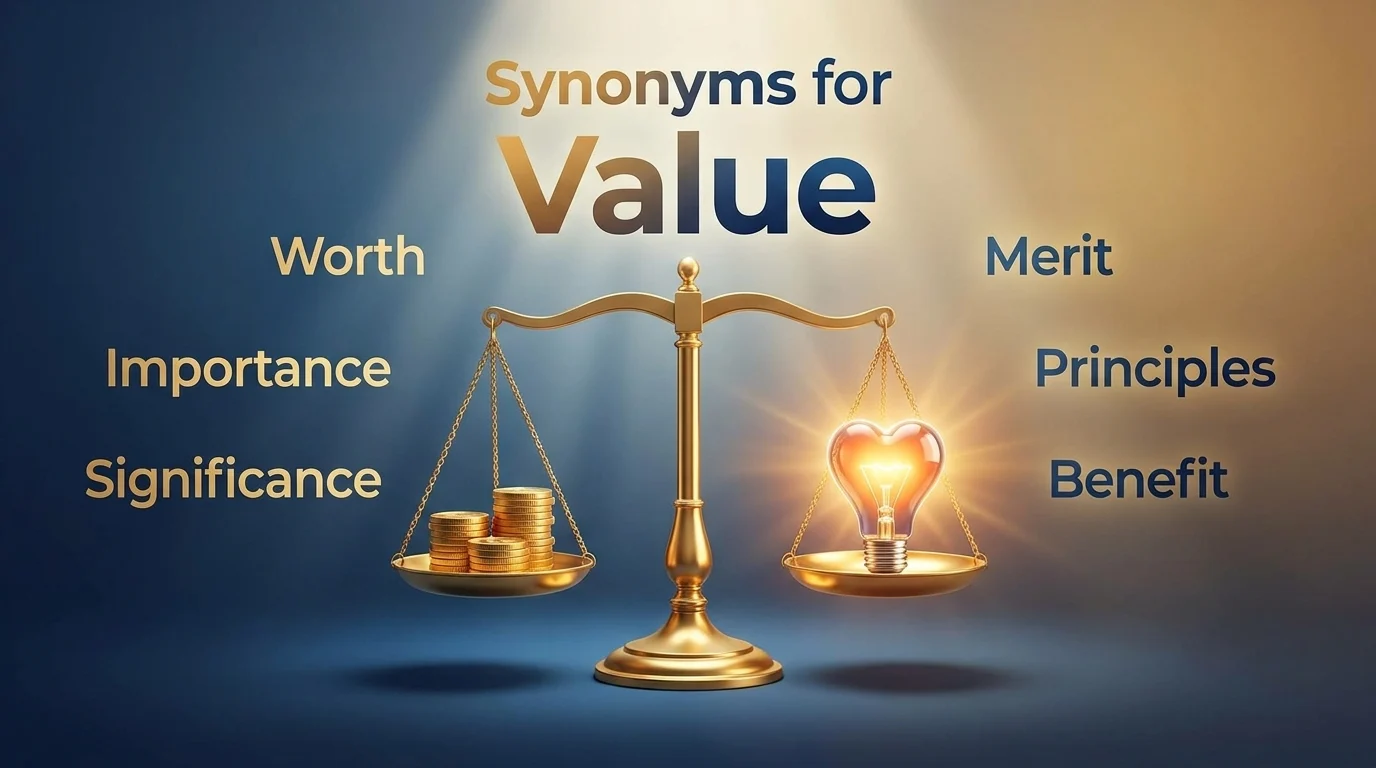
Value refers to the worth, importance, or usefulness of something. It can describe monetary worth, personal principles, the significance of an idea, or the quality of a product or service. Depending on context, alternatives include worth, importance, significance, merit, principles, usefulness, benefit, appreciation, and esteem.
Meaning, Tone, and Context
Simple Definition
Value generally refers to:
- The monetary worth of something (the value of a house)
- The importance or significance of something (the value of education)
- Personal principles or standards (family values)
- Usefulness or benefit (the value of exercise)
- The quality or merit of something (a product of great value)
Part of Speech
“Value” functions as both a noun and a verb.
Noun Examples:
- “The value of the painting increased over time.”
- “Honesty is one of her core values.”
Verb Examples:
- “I value your opinion.”
- “The company values its employees.”
Related Forms:
- Valuable (adjective): worth a lot; important
- Valued (adjective): considered important
- Valueless (adjective): having no value
- Valuation (noun): an estimation of worth
- Evaluate (verb): to assess the value of something
Positive, Negative, or Neutral Tone
Value is generally positive or neutral.
Positive associations:
- “She values honesty above all else.”
- “The value of education cannot be overstated.”
Neutral or technical contexts:
- “The market value of the property was assessed.”
- “The value of the variable was calculated.”
Formality Level
Value is a standard and widely accepted word in both formal and informal English. It works in academic papers, business reports, negotiations, resumes, and everyday conversation. Still, a more specific word can improve clarity when the context allows it.
Common Use Cases
Value commonly refers to:
- Monetary worth (property value, market value)
- Personal principles (core values, family values)
- Usefulness or benefit (value of exercise, value of teamwork)
- Importance (historical value, sentimental value)
- Quality or merit (a product of value)
- Mathematical or technical worth (numerical value, value of a variable)
Important Word Forms
- Value (noun/verb): worth or to consider important
- Valuable (adjective): worth a lot or important
- Valued (adjective): considered important
- Valueless (adjective): having no value
- Valuation (noun): the process of estimating worth
- Evaluate (verb): to assess or judge
- Devalue (verb): to reduce the value of something
When and How to Use “Value”
Use value when discussing worth, importance, principles, or usefulness. Because the word is broad, it is especially useful when discussing value as a general concept rather than a specific type.
Professional
“We provide excellent value to our customers.”
This works naturally in business communication.
Academic
“The study examines the value of early childhood education.”
The broad term is appropriate when discussing educational concepts generally.
Personal
“I value the time I spend with my family.”
The word sounds natural in everyday conversation.
Business
“The company’s market value has increased significantly.”
Here, value refers to monetary worth.
Creative
“The sentimental value of the old watch was immeasurable.”
The term works well when discussing emotional significance.
Social Media
“Values are what guide our decisions and actions.”
This concise wording is suitable for an educational or motivational post.
Another Word for “Value”
There is no single perfect synonym because value can refer to many different things.
- Monetary context: worth, price, market value, cost
- Importance context: significance, importance, weight, consequence
- Principles context: morals, ethics, standards, beliefs
- Usefulness context: benefit, utility, usefulness, advantage
- Quality context: merit, excellence, worth
- Emotional context: appreciation, esteem, regard, cherish
- Technical context: amount, quantity, number
If you need one broad alternative, worth can work when discussing monetary or personal value. However, worth is not a complete replacement for value. Value can refer to principles, while worth usually refers to monetary or personal significance.
When Not to Use “Value”
Value can become too broad when the reader needs to know exactly what you mean.
Consider:
“The company has great value.”
This statement does not tell readers whether the company is financially valuable, has strong principles, or provides useful products.
A more precise sentence could be:
“The company has a strong market valuation and a reputation for ethical practices.”
Similarly, avoid using value when you simply mean price. If you mean the cost, say price. If you mean the importance, say importance.
In technical writing, specific terms such as number, quantity, or variable are often more informative.
Words Commonly Confused With “Value”
Worth
Worth refers to the monetary or personal significance of something. Value is broader and can include principles and usefulness.
Example:
“The painting’s worth was estimated at one million dollars.” (monetary)
“Honesty is a core value in our family.” (principles)
Price
Price is the amount of money required to purchase something. Value is the perceived worth.
Example:
“The price of the car is $30,000.” (cost)
“The car offers excellent value for the price.” (worth)
Importance
Importance refers to the significance of something. Value can include importance but also refers to worth and principles.
Example:
“The importance of exercise cannot be overstated.” (significance)
“The value of the antique was determined by an expert.” (worth)
Merit
Merit refers to the quality of being good or worthy. Value is broader.
Example:
“The merit of the proposal was recognized by the committee.” (quality)
“The value of the proposal was clear.” (worth/significance)
Principles
Principles are personal beliefs or rules of conduct. Values are similar but broader, often encompassing principles.
Example:
“He is a man of strong principles.” (beliefs)
“Honesty is one of our core values.” (principles + worth)
Benefit
Benefit refers to an advantage or profit. Value can include benefit but also refers to worth and principles.
Example:
“The benefits of exercise are well documented.” (advantages)
“The value of exercise is widely recognized.” (worth/importance)
Best Synonym by Context for “Value”
| Context | Best Synonym | Why It Works | Example |
|---|---|---|---|
| Monetary context | Worth, price, market value | Clearly indicates financial worth | The worth of the property was assessed. |
| Importance context | Significance, importance, weight | Emphasizes importance | The significance of the discovery was immense. |
| Principles context | Morals, ethics, standards | Clearly indicates principles | Integrity is one of his core ethics. |
| Usefulness context | Benefit, utility, advantage | Emphasizes usefulness | The benefit of teamwork is undeniable. |
| Quality context | Merit, excellence, worth | Emphasizes quality | The merit of the proposal was recognized. |
| Emotional context | Appreciation, esteem, regard | Emphasizes emotional worth | She has great esteem for her mentor. |
| Business context | Worth, valuation, market value | Professional and precise | The company’s valuation increased. |
| Academic context | Significance, importance, merit | Formal and precise | The significance of the study is clear. |
| Creative writing | Worth, significance, preciousness | Evokes emotion | The preciousness of the moment was undeniable. |
| Resume context | Skills, strengths, assets | Emphasizes professional value | Her skills are a great asset to the team. |
| Technical context | Amount, quantity, number | Technical and precise | The amount was calculated accurately. |
| Negotiation context | Worth, price, terms | Practical and specific | We negotiated the worth of the contract. |
Which Synonym Should You Choose?
Start by identifying what kind of value you are discussing.
- Monetary worth: worth, price, market value, valuation, cost
- Importance: significance, importance, weight, consequence, gravity
- Principles: morals, ethics, standards, beliefs, ideals
- Usefulness: benefit, utility, usefulness, advantage, profit
- Quality: merit, excellence, worth, distinction
- Emotional worth: appreciation, esteem, regard, cherish, treasure
- Technical/numerical: amount, quantity, number, figure
If you mean new ideas or improvements, choose merit. When you mean programs or applications, use benefit.
For physical tools and devices, utility is often more accurate. For emotional significance, esteem or appreciation may be clearer.
In casual American English, worth is a natural alternative. However, formal writing usually benefits from using the full word value with a specific modifier.
25 Synonyms for “Value”
The table below includes accurate alternatives and related terms. Since value has a broad meaning, some choices work as contextual alternatives rather than exact replacements.
| Synonym | Simple Meaning | Best Used For | Example Sentence |
|---|---|---|---|
| Worth | Monetary or personal significance | Financial and personal contexts | The worth of the antique was appraised. |
| Importance | Significance or consequence | Academic and professional | The importance of education is undeniable. |
| Significance | Meaning or importance | Academic and formal | The significance of the discovery was immense. |
| Merit | Quality of being good or worthy | Academic and professional | The merit of the proposal was recognized. |
| Principles | Moral rules or beliefs | Personal and ethical | Honesty is one of her core principles. |
| Ethics | Moral principles | Professional and academic | The company’s ethics are beyond reproach. |
| Morals | Standards of behavior | Personal and social | His morals guide his decisions. |
| Standards | Accepted levels of quality | Professional and academic | The standards of the industry are high. |
| Usefulness | Quality of being useful | Practical and technical | The usefulness of the tool was evident. |
| Benefit | Advantage or profit | Practical and professional | The benefit of exercise is well known. |
| Utility | Usefulness or practical value | Technical and economic | The utility of the invention was clear. |
| Advantage | Favorable condition | Business and competitive | The advantage of early adoption is significant. |
| Worth | Value or merit | General and financial | The worth of the investment was questioned. |
| Price | Monetary cost | Financial and commercial | The price of the car was reasonable. |
| Valuation | Estimation of worth | Financial and business | The valuation of the company was high. |
| Appreciation | Recognition of value | Emotional and professional | Her appreciation for art grew over time. |
| Esteem | Respect and admiration | Personal and professional | He held her in high esteem. |
| Regard | Consideration or respect | Personal and professional | She has great regard for her colleagues. |
| Preciousness | Quality of being precious | Emotional and literary | The preciousness of the moment was unforgettable. |
| Treasure | Something valued highly | Emotional and literary | The treasure of friendship is priceless. |
| Amount | Quantity or number | Technical and mathematical | The amount was calculated accurately. |
| Quantity | Amount or number | Technical and scientific | The quantity of the sample was measured. |
| Number | Numerical value | Technical and mathematical | The number was recorded in the report. |
| Figure | Numerical value | Financial and technical | The figure was higher than expected. |
| Asset | Something valuable | Business and financial | Her skills are a great asset to the company. |
Synonym Groups and Usage Differences
Professional vs. Personal Synonyms
Professional writing benefits from specific terms such as worth, valuation, merit, significance, and asset.
Personal communication often uses value, appreciation, esteem, or regard.
Compare:
“We need to assess the value of the project.” (personal)
“We need to evaluate the worth and merit of the project.” (professional)
Formal vs. Conversational Synonyms
Value itself works in both formal and conversational English.
However, worth is more conversational, while significance and merit are more formal.
Examples:
“The value of the house increased.” (formal/neutral)
“The worth of the house went up.” (conversational)
Academic Synonyms
Academic writing should distinguish between value, significance, importance, merit, and worth.
For example, value refers to practical applications, while significance refers to the importance of a finding.
Therefore, replacing value with significance simply to avoid repetition can change the meaning.
Professional and Business Synonyms
Business writing often benefits from phrases such as market value, valuation, worth, asset, and competitive advantage.
Instead of:
“Our business provides great value.”
Consider:
“Our business provides exceptional worth and competitive advantage.”
Creative or Literary Synonyms
Creative writing can use preciousness, treasure, worth, significance, and esteem depending on the setting.
For example:
“The preciousness of the moment was undeniable.”
“The treasure of their friendship was priceless.”
Slang or Modern Synonyms
Worth is the most common informal alternative.
Bang for your buck is slang for value in terms of money.
Street cred is slang for reputation or value in a community.
Clout is modern slang for influence or value.
Examples:
“This product is worth the money.” (casual)
“You get a lot of bang for your buck.” (slang)
“He has a lot of clout in the industry.” (modern slang)
Strongest vs. Weaker Synonyms
Value does not have a simple intensity scale because its alternatives describe different categories.
A practical specificity scale is:
Broad: value
More focused: worth, importance
Specific: market value, significance
Highly specific: valuation, merit, principles
The more specific the word, the more information the reader receives.
Emotional vs. Neutral Synonyms
Value is generally neutral.
Appreciation, esteem, and preciousness can sound positive and emotional.
Worth, price, and valuation are usually factual and neutral.
Examples:
“The value of the property was assessed.” (neutral)
“She has great esteem for her mentor.” (emotional, positive)
Antonyms of “Value”
Value does not have exact antonyms because it describes a broad category rather than a single quality. However, depending on context, the following words represent opposites:
| Antonym | Meaning | Example Sentence |
|---|---|---|
| Worthlessness | Lack of value | The worthlessness of the item was evident. |
| Futility | Pointlessness | The futility of the effort was clear. |
| Insignificance | Lack of importance | The insignificance of the detail was noted. |
| Triviality | Lack of seriousness | The triviality of the matter was dismissed. |
| Disadvantage | Unfavorable condition | The disadvantage of the plan was obvious. |
| Detriment | Harm or damage | The detriment of the policy was clear. |
| Immorality | Lack of moral principles | The immorality of the action was condemned. |
| Dishonor | Loss of respect | The dishonor of the defeat was felt by all. |
| Disvalue | To undervalue | The disvalue of the contribution was unfair. |
Comparison: “Value” vs. Similar Words
Value vs. Worth
Main difference: Value refers broadly to worth, importance, principles, and usefulness. Worth emphasizes monetary or personal significance.
Examples:
“Honesty is a core value.” (principles)
“The worth of the painting was estimated.” (monetary)
Value vs. Price
Main difference: Price is the amount of money required to purchase something. Value is the perceived worth.
Examples:
“The price of the car is $30,000.” (cost)
“The car offers excellent value for the price.” (worth)
Value vs. Importance
Main difference: Importance refers to significance. Value can include importance but also refers to worth and principles.
Examples:
“The importance of exercise cannot be overstated.” (significance)
“The value of the antique was determined by an expert.” (worth)
Value vs. Merit
Main difference: Merit refers to the quality of being good or worthy. Value is broader.
Examples:
“The merit of the proposal was recognized.” (quality)
“The value of the proposal was clear.” (worth/significance)
Value vs. Principles
Main difference: Principles are personal beliefs or rules of conduct. Values are similar but broader.
Examples:
“He is a man of strong principles.” (beliefs)
“Honesty is one of our core values.” (principles + worth)
Value vs. Benefit
Main difference: Benefit refers to an advantage or profit. Value can include benefit but also refers to worth and principles.
Examples:
“The benefits of exercise are well documented.” (advantages)
“The value of exercise is widely recognized.” (worth/importance)
Common Phrases and Expressions with “Value”
1. Core values
Meaning:
Fundamental beliefs that guide behavior.
Example:
“Honesty and integrity are our core values.”
2. Value for money
Meaning:
Good quality relative to the price paid.
Example:
“The product offers excellent value for money.”
3. Market value
Meaning:
The price at which something can be sold in the current market.
Example:
“The market value of the property has increased.”
4. Sentimental value
Meaning:
Emotional significance rather than monetary worth.
Example:
“The old watch has great sentimental value.”
5. Value judgment
Meaning:
An assessment based on personal opinions and principles.
Example:
“We should avoid making value judgments about other cultures.”
6. Add value
Meaning:
To increase the worth or usefulness of something.
Example:
“Her insights added value to the discussion.”
7. Value proposition
Meaning:
A statement that explains the benefits of a product or service.
Example:
“The company’s value proposition is clear and compelling.”
8. Face value
Meaning:
The apparent worth or meaning of something.
Example:
“Don’t take his comments at face value.”
Common Mistakes to Avoid
1. Using “value” when a precise term is available
If you mean price, worth, importance, principles, or benefit, name the specific category.
Specific vocabulary makes writing more informative.
2. Confusing value with price
Not every value is a price. Value can refer to importance, principles, or usefulness.
An established system can still have value even if it has no price.
3. Confusing value with worth
Worth usually refers to monetary or personal significance. Value is broader and can include principles and usefulness.
Using one word in place of the other can change the meaning of your sentence.
4. Using “value” in formal writing without specificity
Value is natural in casual communication, but a more specific term is often better for academic papers, formal reports, and professional documents.
5. Using “value” for every principle
Not every principle is a value. Values are broader and can encompass principles, beliefs, and standards.
6. Repeating “value” throughout an article
Repetition can make content feel generic.
Instead, identify whether you mean worth, importance, principles, usefulness, or quality.
7. Choosing a synonym that changes the meaning
Do not replace value with price, importance, or principles simply because the words are related.
Always check whether the replacement communicates the same idea.
FAQs
What is the best synonym for “value”?
The best synonym depends on context. Worth works for monetary contexts, significance for importance, principles for moral contexts, benefit for usefulness, and merit for quality.
What is a formal synonym for “value”?
Significance, importance, merit, valuation, and worth can work as formal alternatives when they accurately describe the intended meaning.
What is an informal synonym for “value”?
“Worth” is a common informal synonym. It works naturally in casual conversations, texts, and everyday discussions.
What is another word for “value” in professional writing?
Worth, valuation, merit, significance, and asset can replace value in professional writing when the specific type of value is known.
What is the difference between “value” and “worth”?
Value refers broadly to worth, importance, principles, and usefulness. Worth emphasizes monetary or personal significance.
What is the opposite of “value”?
Value has no exact antonym. Depending on context, worthlessness, insignificance, triviality, disadvantage, and immorality can represent less valuable approaches.
What does “value” mean in a business context?
In business, value often refers to market value, worth, asset value, or the benefits provided to customers.
Conclusion
Value is a broad word that can describe monetary worth, personal principles, usefulness, importance, and quality.
The best synonym depends on what you actually mean. Choose worth for monetary contexts, significance for importance, principles for moral contexts, benefit for usefulness, and merit for quality.
Most importantly, do not replace value simply to avoid repetition. First identify the specific idea behind the word, then choose the alternative that communicates that idea most clearly.
For academic, professional, and technical writing, precision is usually more valuable than vocabulary variety. A specific term such as market value, significance, or merit can tell readers much more than the broad word value.
Before publishing a vocabulary guide, verify definitions and usage with trusted dictionaries such as Cambridge, Oxford, Merriam-Webster, Collins, or Britannica. This helps ensure that each alternative accurately matches its intended meaning and context.
The practical takeaway is simple: when value feels too general, ask yourself what type of worth, importance, principle, or usefulness you are actually describing. Then use the most precise word available.
Discover More:-
- 50+ Synonyms for Inspire: Meanings, Examples, and Best Alternatives
- 50+ Synonyms for Analyze: Meanings, Examples, and Best Alternatives

3 thoughts on “50+ Synonyms for Value: Meanings, Examples, and Best Alternatives”