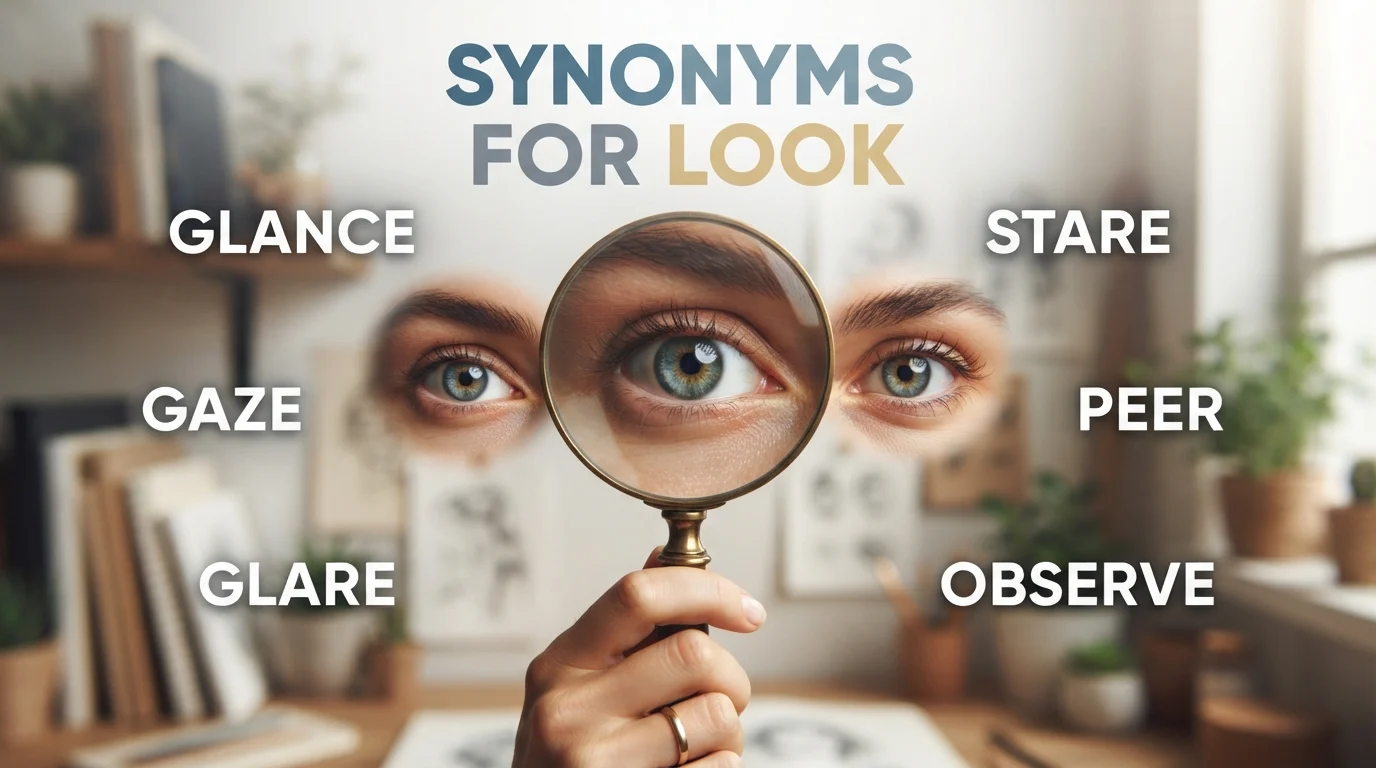
Do you keep using the word “look” in essays, business reports, creative writing, or everyday conversation? While it is one of the most common and flexible words in English, repeating it can make your writing feel flat, vague, or overly simplistic.
The good news is that the best alternative depends on what you actually mean. You might be describing a quick glance, a long stare, an appearance, a search, or a particular expression on someone’s face.
This guide explains synonyms for “look” by meaning, tone, context, and usage. You will learn which alternatives work best in academic writing, professional communication, creative expression, and casual conversation.
Quick Answer: What Does “Look” Mean?
“Look” can mean to direct your eyes toward something, to appear or seem a certain way, to search for something, or to have a particular appearance or expression. Depending on context, alternatives include glance, stare, gaze, peer, glare, glimpse, appearance, expression, search, and seem.
Meaning, Tone, and Context
Simple Definition
“Look” generally refers to:
- Directing the eyes: using your sight to see something
- Appearing or seeming: having a certain appearance
- Searching: trying to find something
- Expression: a particular facial expression or style
- Considering: examining or thinking about something
Part of Speech
“Look” functions primarily as a verb and a noun.
Verb Examples:
- “Look at the sunset.”
- “You look tired.”
Noun Examples:
- “She gave him a curious look.”
- “The house has a modern look.”
Related Forms:
- Looks (noun): appearance
- Looking (verb/noun): the act of directing the eyes
- Looker (noun, informal): an attractive person
Positive, Negative, or Neutral Tone
“Look” is generally neutral, but the tone can change depending on the synonym you choose.
- Glance – neutral, brief
- Stare – can be neutral, rude, or intense
- Gaze – often positive or romantic
- Glare – negative, angry
- Glimpse – neutral, brief
Formality Level
“Look” is a standard word that works in both formal and informal English. However, more specific alternatives like gaze, glance, observe, and perceive can add precision in formal or literary writing.
Common Use Cases
“Look” commonly refers to:
- Briefly seeing: glance, glimpse, peek, peep
- Looking intently: stare, gaze, gape, peer
- Looking angrily: glare, scowl
- Looking quickly: scan, skim, browse
- Appearing: seem, appear, look like
- Searching: search, seek, hunt, forage
- Expressions: expression, countenance, face
Important Word Forms
- Look (verb/noun): to direct the eyes; an act of looking
- Looks (noun): physical appearance
- Looking (verb/noun): the act of directing the eyes
- Looked (verb past tense): directed the eyes
- Looking glass (noun, archaic): a mirror
When and How to Use “Look”
Use “look” when you want to describe directing your eyes, appearing a certain way, searching for something, or having a particular expression. Because the word is broad, more specific alternatives can add precision depending on the context.
Professional
“Please look over the report before the meeting.”
This works naturally in business communication.
Academic
“The study looks at the relationship between sleep and memory.”
The term is appropriate in academic research.
Personal
“Look at that beautiful sunset!”
The word sounds natural in everyday conversation.
Creative
“She looked at him with eyes full of longing.”
The word creates a vivid, emotional image.
Searching
“I’m looking for my keys.”
This is standard in everyday language.
Appearing
“You look wonderful today.”
The word describes appearance.
Another Word for “Look”
There is no single perfect synonym because “look” can mean to see, to appear, to search, or to have an expression.
- Briefly seeing: glance, glimpse, peek, peep, squint
- Looking intently: stare, gaze, peer, gape, gawk
- Looking angrily: glare, scowl, frown
- Looking quickly: scan, skim, browse, flick through
- Appearing: seem, appear, look like, come across as
- Searching: search, seek, hunt, forage, rummage
- Expressions: expression, countenance, face, mien
If you need one broad alternative, “glance” works for a quick look, “stare” for a long look, and “seem” for appearance.
When Not to Use “Look”
“Look” can become too vague when you need to specify exactly what kind of look you are describing.
Consider:
“She looked at him.”
This statement does not tell readers whether she glanced briefly, stared intently, glared angrily, or gazed lovingly.
A more precise sentence could be:
“She gazed at him with admiration.”
Similarly, avoid using “look” when you mean “seem” in formal writing. Use “appear” or “seem” instead.
Words Commonly Confused With “Look”
Look vs. See
See means to perceive with the eyes, often without intention. Look means to direct your eyes intentionally.
Example:
“I see a bird in the tree.” (perceive)
“Look at the bird!” (direct your eyes)
Look vs. Watch
Watch means to look at something for a period of time, often something moving. Look is more general.
Example:
“I watched the movie.” (for a period)
“I looked at the clock.” (briefly)
Look vs. Glance
Glance means to look quickly. Look is more general.
Example:
“She glanced at her watch.” (quickly)
“She looked at the painting.” (general)
Look vs. Stare
Stare means to look for a long time, often rudely. Look is general.
Example:
“He stared at her in surprise.” (long)
“He looked at her.” (general)
Look vs. Seem
Seem means to appear a certain way. Look can also mean appear.
Example:
“She seems tired.” (appearance)
“She looks tired.” (appearance)
Look vs. Appear
Appear is more formal than look for describing appearance.
Example:
“He appears to be upset.” (formal)
“He looks upset.” (informal)
Best Synonym by Context for “Look”
| Context | Best Synonym | Why It Works | Example |
|---|---|---|---|
| Formal writing | Observe, perceive | Precise and professional | The committee observed the proceedings. |
| Academic writing | Examine, investigate | Standard academic usage | The study examines the effects of sleep. |
| Briefly seeing | Glance, glimpse, peek | Emphasizes brevity | She glanced at her phone. |
| Looking intently | Stare, gaze, peer | Emphasizes duration | He gazed at the stars. |
| Looking angrily | Glare, scowl | Emphasizes anger | She glared at him. |
| Appearing | Seem, appear | Describes appearance | He seems tired. |
| Searching | Search, seek, hunt | Emphasizes finding | I’m searching for my keys. |
| Creative writing | Gaze, peer, behold | Adds literary depth | She beheld the sunrise. |
| Casual conversation | Look (itself), check out | Natural and informal | Check out that car! |
| Expressions | Expression, countenance | Describes facial look | His expression was unreadable. |
| Quickly scanning | Scan, skim, browse | Emphasizes speed | She scanned the document. |
| Watching carefully | Observe, monitor | Emphasizes attention | The guard observed the crowd. |
Which Synonym Should You Choose?
Start by identifying what kind of “look” you are describing.
- Briefly seeing: glance, glimpse, peek, peep
- Looking intently: stare, gaze, peer, gape
- Looking angrily: glare, scowl, frown
- Looking quickly: scan, skim, browse
- Appearing: seem, appear, come across as
- Searching: search, seek, hunt, forage
- Expressions: expression, countenance, face
10 Key Synonyms for “Look”
The table below includes accurate alternatives with clear meanings and usage contexts.
| Synonym | Simple Meaning | Best Used For | Example Sentence |
|---|---|---|---|
| Glance | A quick look | Brief, casual | She glanced at her watch. |
| Stare | A long, fixed look | Surprise, rudeness | He stared at the painting. |
| Gaze | A long, steady look | Admiration, wonder | She gazed at the sunset. |
| Peer | To look closely | Difficulty seeing | He peered through the fog. |
| Glare | An angry look | Anger, warning | She glared at him. |
| Glimpse | A brief, partial look | Something passing | I caught a glimpse of the star. |
| Observe | To watch carefully | Formal, scientific | The scientist observed the reaction. |
| Seem | To appear | Appearance | You seem happy today. |
| Scan | To look over quickly | Searching, reading | He scanned the menu. |
| Expression | A facial look | Emotions, moods | Her expression was sad. |
Synonym Groups and Usage Differences
Professional vs. Personal Synonyms
Professional writing benefits from specific terms such as observe, examine, review, and monitor.
Personal communication often uses look itself or casual alternatives like check out, peek, or glance.
Compare:
“Check out this photo!” (personal)
“The committee will review the proposal.” (professional)
Formal vs. Conversational Synonyms
Look works in both formal and conversational English.
Formal alternatives: observe, perceive, examine, behold
Conversational alternatives: check out, peek, glance
Examples:
“The researcher observed the behavior.” (formal)
“Check out that sunset!” (conversational)
Academic Synonyms
Academic writing should distinguish between look (general), examine (detailed), observe (watching), investigate (researching), and analyze (breaking down).
For example:
“The study examines the relationship between diet and health.”
“The researcher observed the participants’ behavior.”
Professional and Business Synonyms
Business writing often benefits from phrases such as review, examine, monitor, evaluate, and assess.
Instead of:
“Please look at the report.”
Consider:
“Please review the report before the meeting.”
Creative or Literary Synonyms
Creative writing can use gaze, peer, behold, glimpse, survey, and contemplate depending on the context.
For example:
“She beheld the sunrise with wonder.”
“He peered into the darkness.”
Slang or Modern Synonyms
Check out is a common casual alternative.
Peep means to look quickly.
Scope out means to look at or examine.
Eyeball means to look at.
Examples:
“Check out that car!” (casual)
“Let me scope out the place first.” (slang)
Strongest vs. Weaker Synonyms
“Look” synonyms vary in intensity:
Milder: glance, peek, glimpse
Moderate: look, observe, view
Strong: stare, gaze, peer
Very Strong: glare, scrutinize, examine
Emotional vs. Neutral Synonyms
“Look” is generally neutral.
Emotional alternatives: gaze (romantic), glare (angry), stare (intense)
Neutral alternatives: look, glance, observe, view
Examples:
“She gazed at him lovingly.” (emotional)
“She looked at the clock.” (neutral)
Antonyms of “Look”
“Look” does not have exact antonyms, but depending on context, the following words represent opposites:
| Antonym | Context | Meaning | Example Sentence |
|---|---|---|---|
| Ignore | Attention | To pay no attention | He ignored the warning. |
| Overlook | Attention | To fail to notice | She overlooked the mistake. |
| Avoid | Attention | To stay away from | He avoided eye contact. |
| Avert | Direction | To turn away | She averted her gaze. |
| Miss | Perception | To fail to see | I missed the sign. |
Comparison: “Look” vs. Similar Words
Look vs. See
Main difference: See means to perceive with the eyes, often without intention. Look means to direct your eyes intentionally.
Examples:
“I see a bird in the tree.” (perceive)
“Look at the bird!” (direct your eyes)
Look vs. Watch
Main difference: Watch means to look at something for a period of time, often something moving. Look is more general.
Examples:
“I watched the movie.” (for a period)
“I looked at the clock.” (briefly)
Look vs. Glance
Main difference: Glance means to look quickly. Look is more general.
Examples:
“She glanced at her watch.” (quickly)
“She looked at the painting.” (general)
Look vs. Stare
Main difference: Stare means to look for a long time, often rudely. Look is general.
Examples:
“He stared at her in surprise.” (long)
“He looked at her.” (general)
Look vs. Seem
Main difference: Seem means to appear a certain way. Look can also mean appear.
Examples:
“She seems tired.” (appearance)
“She looks tired.” (appearance)
Look vs. Appear
Main difference: Appear is more formal than look for describing appearance.
Examples:
“He appears to be upset.” (formal)
“He looks upset.” (informal)
Common Phrases and Expressions with “Look”
1. Look after
Meaning:
To take care of.
Example:
“She looks after her younger brother.”
2. Look for
Meaning:
To search for.
Example:
“I’m looking for my keys.”
3. Look forward to
Meaning:
To anticipate with pleasure.
Example:
“I look forward to seeing you.”
4. Look up
Meaning:
To search for information; to improve.
Example:
“Look up the word in the dictionary.”
5. Look into
Meaning:
To investigate.
Example:
“We will look into the matter.”
6. Look out
Meaning:
To be careful; to watch.
Example:
“Look out for the ice!”
7. Look down on
Meaning:
To regard as inferior.
Example:
“She looks down on people who don’t read.”
8. Look up to
Meaning:
To admire.
Example:
“He looks up to his older brother.”
9. Look over
Meaning:
To review or examine.
Example:
“Please look over the report.”
10. Look the part
Meaning:
To appear suitable for a role.
Example:
“She really looks the part of a CEO.”
Common Mistakes to Avoid
1. Using “look” when a more precise term is available
If you mean glance, stare, gaze, peer, or glare, use the more specific word.
Vague: “She looked at him.”
Precise: “She glared at him.”
2. Confusing “look” with “see” or “watch”
See means to perceive. Watch means to look at for a period. Look means to direct your eyes.
Incorrect: “I looked the movie.” (if watched)
Correct: “I watched the movie.”
3. Using “look” in formal writing when “examine” or “observe” is better
Academic and professional writing often benefit from more formal alternatives.
Informal: “The study looks at the issue.”
Formal: “The study examines the issue.”
4. Overusing “look” in writing
Repetition can make content feel dull. Use alternatives such as glance, gaze, observe, examine, and survey.
5. Choosing a synonym that changes the meaning
Do not replace look with watch unless you mean looking at something for a period.
Do not replace look with stare unless you mean looking intensely.
FAQs
What is the best synonym for “look”?
The best synonym depends on context. Glance works for a quick look, stare for a long look, gaze for admiration, peer for difficulty seeing, glare for anger, and seem for appearance.
What is a formal synonym for “look”?
Observe, examine, perceive, behold, and review are formal synonyms.
What is an informal synonym for “look”?
Check out, peek, peep, and scope out are common informal alternatives.
What is another word for “look” in creative writing?
Gaze, peer, behold, glimpse, survey, and contemplate work well in creative writing.
What is the difference between “look” and “see”?
See means to perceive with the eyes, often without intention. Look means to direct your eyes intentionally.
What is the opposite of “look”?
Depending on context, opposites include ignore, overlook, avoid, avert, and miss.
What does “look” mean in a figurative context?
Figuratively, look can mean appear, seem, or give the impression of—as in “You look tired” or “It looks like rain.”
Conclusion
“Look” is a versatile word that can describe briefly seeing, looking intently, appearing a certain way, searching, or having a particular expression. The best synonym depends on what you actually mean.
Choose glance for a quick look, stare for a long look, gaze for admiration, peer for difficulty seeing, glare for anger, observe for formal contexts, and seem for appearance.
Most importantly, do not replace “look” simply to avoid repetition. First identify what kind of look—brief, intense, angry, or appearance—you are actually describing. Then choose the alternative that communicates that idea most clearly.
For academic, professional, and formal writing, precision is usually more valuable than vocabulary variety. A specific term such as examine, observe, review, or monitor can tell readers much more than the broad word look.
Before publishing a vocabulary guide, verify definitions and usage with trusted dictionaries such as Cambridge, Oxford, Merriam-Webster, Collins, or Britannica. This helps ensure that each alternative accurately matches its intended meaning and context.
The practical takeaway is simple: when “look” feels too general, ask yourself what kind of seeing, appearing, or searching you are actually describing. Then use the most precise word available.
Discover More:-
- 50+ Synonyms for Value: Meanings, Examples, and Best Alternatives
- 50+ Synonyms for Illustrate: Meanings, Examples, and Best Alternatives

2 thoughts on “50+ Synonyms for Look: Meanings, Examples, and Best Alternatives”