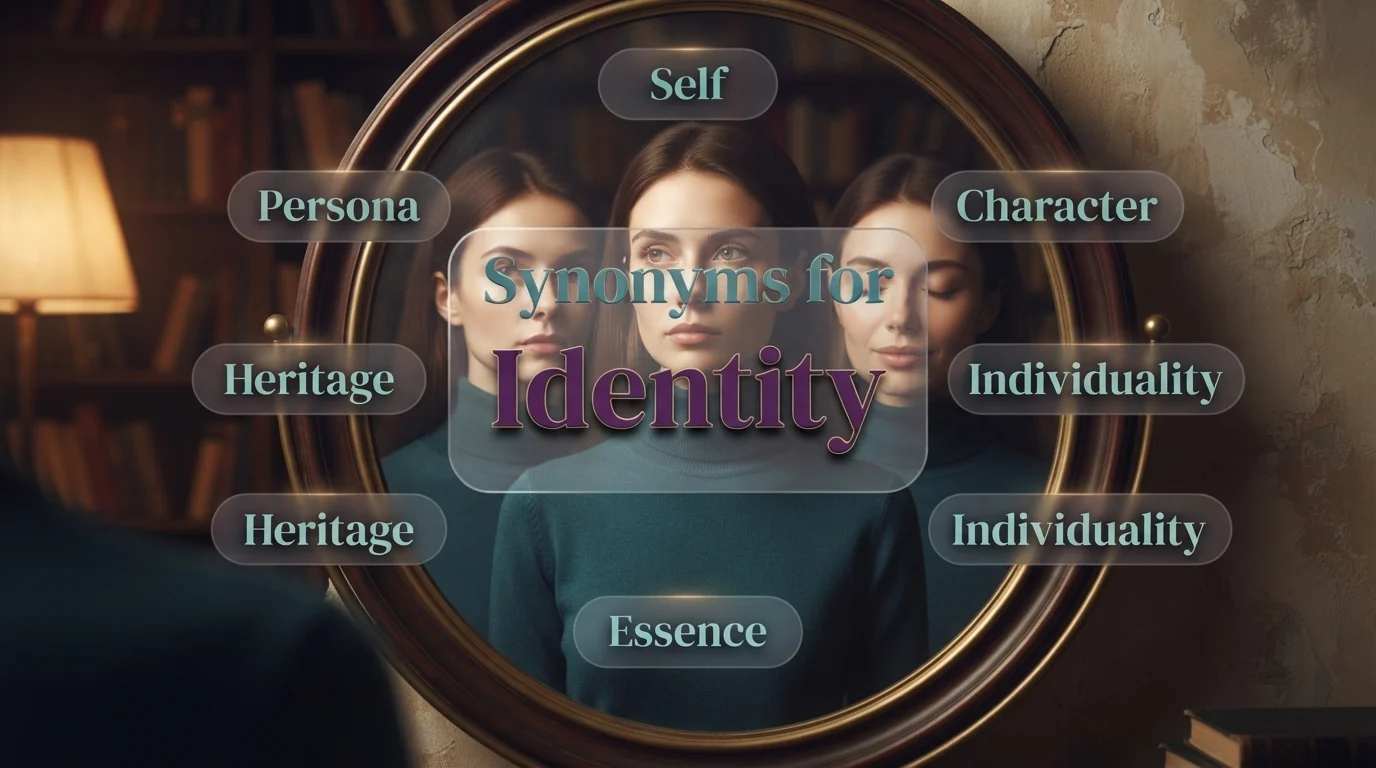
Do you keep using the word “identity” in essays, psychology papers, business reports, creative writing, or everyday conversation? While it is one of the most powerful and meaningful words in modern English, repeating it can make your writing feel flat, vague, or overly academic.
The good news is that the best alternative depends on what you actually mean. You might be referring to a person’s sense of self, a collective culture, a brand’s image, official credentials, or the unique character of something.
This guide explains synonyms for “identity” by meaning, tone, context, and usage. You will learn which alternatives work best in academic writing, professional communication, psychology, creative expression, and casual conversation.
Quick Answer: What Does “Identity” Mean?
“Identity” refers to who or what a person or thing is. It can describe a person’s sense of self, a group’s shared culture, a brand’s image, official credentials, or the distinct character of something. Depending on context, alternatives include self, selfhood, character, personality, individuality, persona, culture, image, credentials, and distinctiveness.
Meaning, Tone, and Context
Simple Definition
“Identity” generally refers to:
- Personal identity: who a person is; their sense of self
- Collective identity: shared culture, nationality, or group belonging
- Brand identity: the image and personality of a company or product
- Official identity: credentials, documents, or legal status
- Distinct character: the unique qualities of a person or thing
Part of Speech
“Identity” is primarily a noun.
Examples:
- “She struggled with her identity as an immigrant.”
- “The company rebranded to refresh its identity.”
Related Forms:
- Identical (adjective): exactly the same
- Identify (verb): to recognize or establish who someone is
- Identification (noun): the act of identifying; official documents
- Identifiable (adjective): able to be recognized
- Identity (noun): who or what someone or something is
Positive, Negative, or Neutral Tone
“Identity” is generally neutral, but it can be positive or negative depending on context.
Positive associations:
- “She embraced her cultural identity.”
- “The brand has a strong, distinctive identity.”
Negative contexts:
- “He experienced an identity crisis.”
- “Identity theft is a growing problem.”
Formality Level
“Identity” is a standard word that works in both formal and informal English. It is especially common in academic, psychological, cultural, and business contexts.
However, more specific alternatives can add precision and variety depending on the context.
Common Use Cases
“Identity” commonly refers to:
- Personal identity: self-concept, sense of self, individuality
- Cultural identity: heritage, ethnicity, nationality, traditions
- Gender identity: how a person identifies
- Brand identity: company image, logo, values, personality
- Corporate identity: organizational culture and image
- Official identity: name, documents, credentials
- National identity: shared history, values, symbols
Important Word Forms
- Identity (noun): who or what someone or something is
- Identical (adjective): exactly the same
- Identify (verb): to recognize or establish
- Identification (noun): the act of identifying; official documents
- Identifiable (adjective): able to be recognized
- Identifier (noun): a label or name
When and How to Use “Identity”
Use “identity” when you want to describe who or what someone or something is, or the qualities that make them distinct. Because the word is broad, more specific alternatives can add precision depending on the context.
Professional
“Our brand identity is built on trust and innovation.”
This works naturally in business and marketing communication.
Academic
“The study explored how adolescents form their identity.”
The term is appropriate in psychology and sociology.
Personal
“She is proud of her cultural identity.”
The word sounds natural in everyday conversation.
Business
“The company refreshed its visual identity with a new logo.”
This is appropriate in marketing and branding contexts.
Creative
“The protagonist’s search for identity drives the narrative.”
The word creates depth in creative writing.
Legal
“Please provide two forms of identification.”
This is standard in legal and official contexts.
Another Word for “Identity”
There is no single perfect synonym because “identity” can refer to personal selfhood, cultural belonging, brand image, official credentials, or distinct character.
- Personal identity: self, selfhood, individuality, personality, character
- Cultural identity: culture, heritage, ethnicity, nationality, roots
- Brand identity: image, brand, persona, reputation, character
- Official identity: credentials, documents, identification, papers
- Distinct character: essence, nature, distinctiveness, uniqueness
- Social identity: persona, role, status, affiliation
If you need one broad alternative, “self” works for personal identity, while “character” works for the qualities of a person or brand.
When Not to Use “Identity”
“Identity” can become too vague when you need to specify exactly what kind of identity you are describing.
Consider:
“She has a strong identity.”
This statement does not tell readers whether she has a strong cultural identity, personal identity, professional identity, or brand identity.
A more precise sentence could be:
“She has a strong cultural identity rooted in her family’s traditions.”
Similarly, avoid using “identity” when you mean “personality” in a simple character context. Use “personality” or “character” instead.
Words Commonly Confused With “Identity”
Identity vs. Personality
Personality refers to a person’s characteristic patterns of thinking and behavior. Identity is broader and includes self-concept.
Example:
“She has a warm personality.” (behavior)
“She is exploring her identity.” (self-concept)
Identity vs. Character
Character refers to moral qualities or distinctive traits. Identity refers to who someone is.
Example:
“He has strong moral character.” (moral qualities)
“He struggled with his identity.” (self-concept)
Identity vs. Self
Self is the totality of a person’s being. Identity is the answer to “who am I?”
Example:
“She discovered her true self.” (totality)
“She explored her identity.” (who she is)
Identity vs. Image
Image refers to how others perceive someone or something. Identity is who they actually are.
Example:
“The company has a polished image.” (perception)
“The company’s identity is based on innovation.” (actual qualities)
Identity vs. Persona
Persona refers to the aspect of someone’s character presented to others. Identity is broader.
Example:
“He adopted a confident persona at work.” (presented self)
“His true identity remained hidden.” (who he is)
Identity vs. Culture
Culture refers to shared customs, beliefs, and practices. Identity is who someone is, partly shaped by culture.
Example:
“She is proud of her culture.” (shared customs)
“She is proud of her cultural identity.” (self-concept)
Best Synonym by Context for “Identity”
| Context | Best Synonym | Why It Works | Example |
|---|---|---|---|
| Formal writing | Selfhood, character | Precise and professional | The novel explores the protagonist’s selfhood. |
| Academic writing | Self-concept, individuality | Standard academic usage | The study examined adolescent self-concept. |
| Psychology | Self, ego, selfhood | Psychological context | The patient struggled with her sense of self. |
| Cultural context | Heritage, culture, roots | Emphasizes belonging | She is proud of her cultural heritage. |
| Brand/marketing | Image, brand, persona | Professional and clear | The company refreshed its brand image. |
| Official/legal | Credentials, identification | Legally precise | Please provide two forms of identification. |
| Creative writing | Essence, character, persona | Adds literary depth | He searched for the essence of who he was. |
| National context | Nationality, patriotism, heritage | Emphasizes nationhood | National identity was central to the movement. |
| Social identity | Persona, role, status | Emphasizes social position | Her social persona differed from her private self. |
| Casual conversation | Identity (itself), who you are | Natural and informal | He’s figuring out who he really is. |
| Collective identity | Solidarity, belonging, community | Emphasizes group cohesion | The movement forged a strong collective identity. |
| Distinct character | Distinctiveness, uniqueness, essence | Emphasizes uniqueness | The restaurant has a distinct character. |
Which Synonym Should You Choose?
Start by identifying what kind of “identity” you are describing.
- Personal identity: self, selfhood, individuality, personality, character
- Cultural identity: culture, heritage, ethnicity, nationality, roots
- Brand identity: image, brand, persona, reputation, character
- Official identity: credentials, documents, identification, papers
- Distinct character: essence, nature, distinctiveness, uniqueness
- Social identity: persona, role, status, affiliation
- National identity: nationality, patriotism, heritage, sovereignty
10 Key Synonyms for “Identity”
The table below includes accurate alternatives with clear meanings and usage contexts.
| Synonym | Simple Meaning | Best Used For | Example Sentence |
|---|---|---|---|
| Self | A person’s essential being | Personal identity, psychology | She discovered her true self. |
| Character | Moral and mental qualities | General, literary | He has strong moral character. |
| Individuality | Distinctive personal qualities | Personal identity, psychology | She expressed her individuality through art. |
| Persona | The aspect of self presented to others | Social, literary | He adopted a confident persona at work. |
| Heritage | Traditions and culture passed down | Cultural identity | She is proud of her cultural heritage. |
| Image | How others perceive something | Brand, public relations | The company refreshed its public image. |
| Culture | Shared customs and beliefs | Cultural identity | The community celebrated its culture. |
| Credentials | Qualifications or documents | Official, legal | Please provide your credentials at the desk. |
| Essence | The intrinsic nature of something | Philosophical, literary | He searched for the essence of who he was. |
| Distinctiveness | The quality of being unique | General, branding | The brand’s distinctiveness sets it apart. |
Synonym Groups and Usage Differences
Professional vs. Personal Synonyms
Professional writing, especially in branding and marketing, benefits from specific terms such as image, brand, persona, and distinctiveness.
Personal communication often uses identity itself or casual alternatives like who you are or self.
Compare:
“He’s figuring out who he is.” (personal)
“The company is refreshing its brand identity.” (professional)
Formal vs. Conversational Synonyms
Identity works in both formal and conversational English.
Formal alternatives: selfhood, individuality, essence, character
Conversational alternatives: self, who you are, personality
Examples:
“The novel explores the protagonist’s selfhood.” (formal)
“He’s just trying to find himself.” (conversational)
Academic Synonyms
Academic writing should distinguish between identity (general), self-concept (psychological), individuality (distinctiveness), and subjectivity (personal perspective).
For example:
“The study examined adolescent identity formation.”
“The research focused on the development of self-concept.”
Professional and Business Synonyms
Business writing often benefits from phrases such as brand identity, corporate image, brand persona, and market position.
Instead of:
“We need to improve our identity.”
Consider:
“We need to strengthen our brand identity and market position.”
Creative or Literary Synonyms
Creative writing can use selfhood, persona, essence, psyche, and soul depending on the context.
For example:
“He searched for the essence of his being.”
“The protagonist’s persona masked her true self.”
Slang or Modern Synonyms
Self is common in modern psychology and casual speech.
Who you are is a natural casual phrase.
Vibe is modern slang for the character or feeling of a person or brand.
Examples:
“He’s figuring out who he really is.” (casual)
“The brand has a really cool vibe.” (modern slang)
Strongest vs. Weaker Synonyms
“Identity” synonyms vary in intensity:
Milder: role, status, affiliation
Moderate: identity, self, character
Strong: selfhood, individuality, essence
Very Strong: soul, psyche, being
Emotional vs. Neutral Synonyms
“Identity” is generally neutral but can be deeply emotional.
Emotional alternatives: selfhood, soul, essence, roots (positive)
Neutral alternatives: credentials, identification, status
Examples:
“She felt a deep connection to her ancestral roots.” (emotional)
“Please provide your identification.” (neutral)
Antonyms of “Identity”
“Identity” does not have exact antonyms, but depending on context, the following words represent opposites:
| Antonym | Context | Meaning | Example Sentence |
|---|---|---|---|
| Anonymity | Personal | Being unknown | He preferred the anonymity of the city. |
| Conformity | Individuality | Following the crowd | Conformity suppressed their individuality. |
| Sameness | Distinctiveness | Being identical | The sameness of the suburbs bored her. |
| Uniformity | Distinctiveness | Lack of variety | Uniformity replaced cultural diversity. |
| Alienation | Belonging | Feeling disconnected | He felt a deep sense of alienation. |
| Loss of self | Personal | Losing one’s identity | The character experienced a loss of self. |
Comparison: “Identity” vs. Similar Words
Identity vs. Personality
Main difference: Personality refers to characteristic patterns of thinking and behavior. Identity is broader and includes self-concept.
Examples:
“She has a warm personality.” (behavior)
“She is exploring her identity.” (self-concept)
Identity vs. Character
Main difference: Character refers to moral qualities or distinctive traits. Identity refers to who someone is.
Examples:
“He has strong moral character.” (moral qualities)
“He struggled with his identity.” (self-concept)
Identity vs. Self
Main difference: Self is the totality of a person’s being. Identity is the answer to “who am I?”
Examples:
“She discovered her true self.” (totality)
“She explored her identity.” (who she is)
Identity vs. Image
Main difference: Image refers to how others perceive someone or something. Identity is who they actually are.
Examples:
“The company has a polished image.” (perception)
“The company’s identity is based on innovation.” (actual qualities)
Identity vs. Persona
Main difference: Persona refers to the aspect of someone’s character presented to others. Identity is broader.
Examples:
“He adopted a confident persona at work.” (presented self)
“His true identity remained hidden.” (who he is)
Identity vs. Culture
Main difference: Culture refers to shared customs, beliefs, and practices. Identity is who someone is, partly shaped by culture.
Examples:
“She is proud of her culture.” (shared customs)
“She is proud of her cultural identity.” (self-concept)
Common Phrases and Expressions with “Identity”
1. Identity crisis
Meaning:
A period of uncertainty about who one is.
Example:
“He went through an identity crisis in his twenties.”
2. Sense of identity
Meaning:
A feeling of knowing who one is.
Example:
“Her sense of identity was rooted in her family.”
3. Cultural identity
Meaning:
A sense of belonging to a culture.
Example:
“He is proud of his cultural identity.”
4. Brand identity
Meaning:
The image and personality of a company or product.
Example:
“The brand identity was refreshed with a new logo.”
5. Identity theft
Meaning:
The fraudulent use of someone else’s personal information.
Example:
“Identity theft is a growing concern.”
6. National identity
Meaning:
A shared sense of belonging to a nation.
Example:
“The war strengthened national identity.”
7. Gender identity
Meaning:
A person’s internal sense of their gender.
Example:
“The clinic supports people exploring their gender identity.”
8. Identity politics
Meaning:
Political positions based on group identity.
Example:
“Identity politics has become a major topic.”
9. Forge an identity
Meaning:
To create or develop a sense of self.
Example:
“The community forged a new identity.”
10. Conceal one’s identity
Meaning:
To hide who one is.
Example:
“The witness concealed her identity.”
Common Mistakes to Avoid
1. Using “identity” when a more precise term is available
If you mean self, personality, brand, or image, use the more specific word.
Vague: “She has a strong identity.”
Precise: “She has a strong sense of self.”
2. Confusing “identity” with “personality”
Personality refers to behavior patterns. Identity is who someone is.
Incorrect: “He has a funny identity.”
Correct: “He has a funny personality.”
3. Using “identity” in branding when “image” is needed
Brand identity is who the brand is. Brand image is how others perceive it.
Specific: “The brand identity is based on sustainability.” (actual qualities)
Specific: “The brand image is positive among young consumers.” (perception)
4. Overusing “identity” in writing
Repetition can make content feel dull. Use alternatives such as self, character, individuality, persona, and heritage.
5. Choosing a synonym that changes the meaning
Do not replace identity with image unless you mean perception.
Do not replace identity with personality unless you mean behavior patterns.
FAQs
What is the best synonym for “identity”?
The best synonym depends on context. Self works for personal identity, heritage for cultural identity, image for brand identity, credentials for official identity, and character for distinct qualities.
What is a formal synonym for “identity”?
Selfhood, individuality, essence, and character are formal synonyms.
What is an informal synonym for “identity”?
Who you are, self, and vibe (modern slang) are common informal alternatives.
What is another word for “identity” in creative writing?
Selfhood, persona, essence, psyche, and soul work well in creative writing.
What is the difference between “identity” and “personality”?
Personality refers to characteristic patterns of thinking and behavior. Identity is broader and includes self-concept.
What is the opposite of “identity”?
Depending on context, opposites include anonymity, conformity, sameness, uniformity, and alienation.
What does “identity” mean in a business context?
In business, identity often refers to brand identity—the image, values, and personality of a company or product.
Conclusion
“Identity” is a powerful and versatile word that can describe personal selfhood, cultural belonging, brand image, official credentials, and distinct character. The best synonym depends on what you actually mean.
Choose self for personal identity, heritage for cultural identity, image for brand identity, credentials for official identity, and character for distinct qualities.
Most importantly, do not replace “identity” simply to avoid repetition. First identify what kind of identity—personal, cultural, brand, or official—you are actually describing. Then choose the alternative that communicates that idea most clearly.
For academic, professional, and formal writing, precision is usually more valuable than vocabulary variety. A specific term such as self-concept, brand image, heritage, or credentials can tell readers much more than the broad word identity.
Before publishing a vocabulary guide, verify definitions and usage with trusted dictionaries such as Cambridge, Oxford, Merriam-Webster, Collins, or Britannica. This helps ensure that each alternative accurately matches its intended meaning and context.
The practical takeaway is simple: when “identity” feels too general, ask yourself what kind of identity—personal, cultural, brand, or official—you are actually describing. Then use the most precise word available.
Discover More:-
- 50+ Synonyms for Inspire: Meanings, Examples, and Best Alternatives
- 50+ Synonyms for Crucial: Meanings, Examples, and Best Alternatives

4 thoughts on “50+ Synonyms for Identity: Meanings, Examples, and Best Alternatives”