Do you keep using the word “is” in essays, business reports, academic papers, or everyday writing? While it is the most common verb in the English language, overusing it can make your writing feel repetitive, vague, or uninspired.
The good news is that the best alternative depends on what you actually mean. “Is” serves many functions in English—it can describe existence, identity, location, equivalence, or state of being. By choosing more specific verbs, you can add precision, variety, and energy to your writing.
This guide explains synonyms for “is” by meaning, tone, context, and usage. You will learn which alternatives work best in academic writing, professional communication, creative writing, and everyday conversation.
Quick Answer: What Does “Is” Mean?
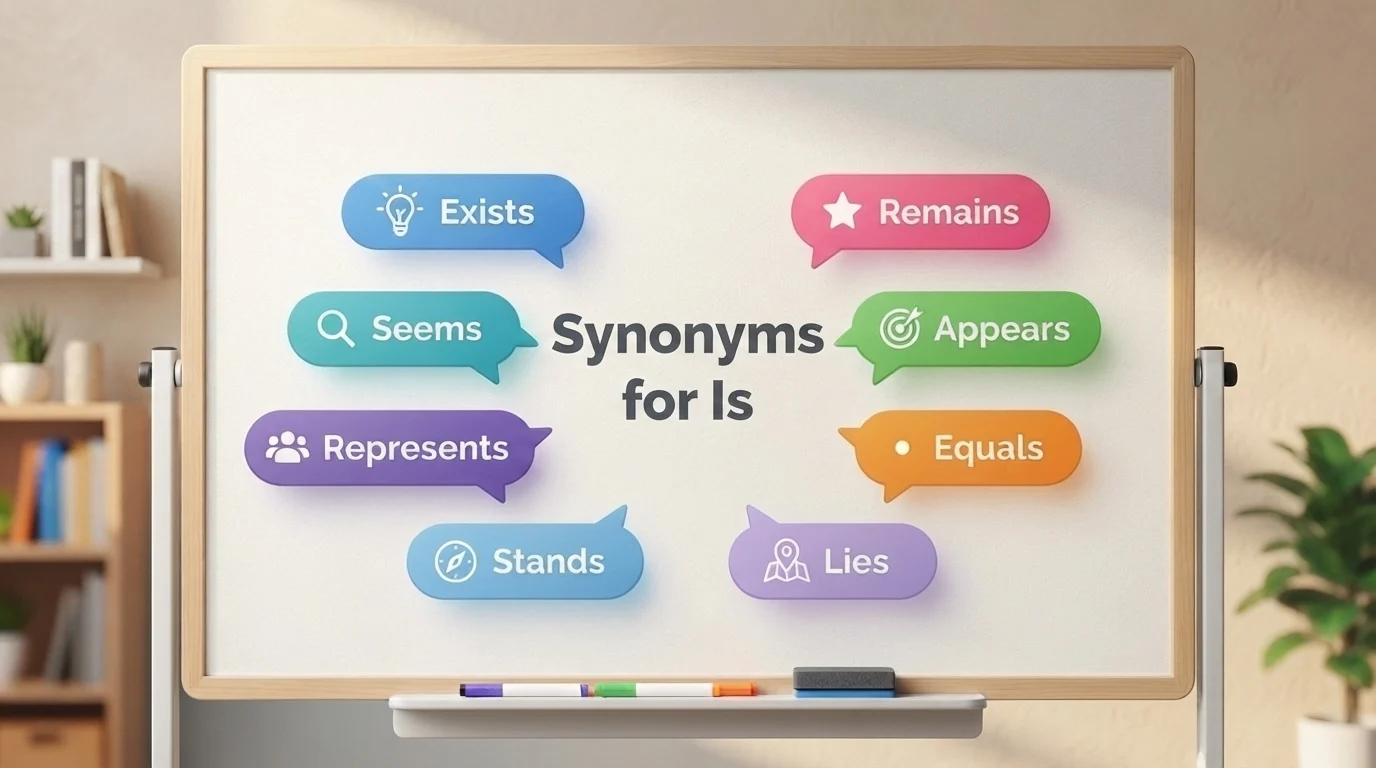
“Is” is the third-person singular present tense form of the verb “to be.” It serves as a linking verb that connects the subject of a sentence to a subject complement (a noun, pronoun, or adjective). Depending on context, alternatives include exists, remains, seems, appears, equals, constitutes, stands, and lies.
Meaning, Tone, and Context
Simple Definition
“Is” is used to:
- Describe existence or presence (“The book is on the table.”)
- Identify or equate (“She is the manager.”)
- Describe qualities or states (“The sky is blue.”)
- Indicate location (“The office is downtown.”)
- Express equivalence (“Two plus two is four.”)
- Describe what something is made of or consists of (“The committee is five members.”)
Part of Speech
“Is” functions as a verb (specifically, a linking verb or copula).
Examples:
“He is happy.” (linking verb connecting subject to adjective)
“Today is Monday.” (linking verb connecting subject to noun)
Positive, Negative, or Neutral Tone
“Is” is neutral and does not carry inherent positive or negative connotations. However, alternative synonyms can create specific tones:
- Exists – neutral, factual
- Seems – suggests perception or uncertainty
- Appears – suggests appearance or impression
- Remains – suggests continuity or persistence
- Lies – suggests position or location
Formality Level
“Is” is neutral and works in all contexts—from the most casual conversation to the most formal academic writing. However, using more specific verbs can elevate your writing and add sophistication.
Common Use Cases
“Is” commonly appears in:
- Descriptions and definitions (“The capital is Paris.”)
- Statements of fact (“Water is wet.”)
- Existential statements (“There is a problem.”)
- Location and position (“The book is on the shelf.”)
- Identity and equivalence (“She is a doctor.”)
Important Word Forms
- Be (base form)
- Is (third person singular present)
- Are (second person singular/plural present)
- Am (first person singular present)
- Was (past tense)
- Were (past tense plural)
- Been (past participle)
- Being (present participle)
When and How to Use “Is”
Use “is” in basic statements of fact, existence, identity, or description. It is the most straightforward way to connect a subject to its complement.
Professional
“The deadline is Friday.”
This works naturally in business communication.
Academic
“The experiment is significant for several reasons.”
The verb is standard in academic writing.
Personal
“My favorite color is blue.”
The word sounds natural in everyday conversation.
Business
“Our mission is to provide excellent customer service.”
Here, “is” defines the company’s purpose.
Creative
“The forest is ancient and full of secrets.”
The verb works well in descriptive writing.
Scientific
“Water is composed of hydrogen and oxygen.”
This maintains a neutral, factual tone.
Another Word for “Is”
There is no single perfect synonym because “is” has so many different functions. The best alternative depends on the specific meaning you want to convey.
- Existence: exists, lives, survives, endures, persists, abides
- Identity/Definition: equals, constitutes, represents, embodies, signifies
- Location: stands, lies, sits, rests, remains, stays, dwells
- State/Condition: seems, appears, looks, feels (when used as linking verbs)
- Continuity: continues, endures, persists, lasts, remains
- Composition: consists of, comprises, contains, includes
If you need one broad alternative, consider using a more specific verb that adds meaning, such as “exists” for existence or “remains” for continuity.
When Not to Use “Is”
“Is” can become too vague or overused when a more specific verb would add clarity or energy.
Consider:
“The solution is good.”
This statement does not tell readers why the solution is good or in what way.
A more precise sentence could be:
“The solution effectively solves the problem.”
Similarly, avoid using “is” repeatedly in the same paragraph. Varying your verbs improves readability and engagement.
Words Commonly Confused With “Is”
Is vs. Exists
“Exists” emphasizes the fact of being present or alive. “Is” is a broader linking verb.
Example:
“There is a problem.” (simple existence)
“There exists a problem that we must address.” (emphasizes presence)
Is vs. Seems
“Seems” suggests appearance or perception rather than objective fact. “Is” states fact.
Example:
“He is tired.” (factual)
“He seems tired.” (perception; he might not actually be tired)
Is vs. Appears
“Appears” suggests how something looks or seems. “Is” states reality.
Example:
“The solution is simple.” (factual)
“The solution appears simple.” (it looks simple, but might not be)
Is vs. Remains
“Remains” emphasizes continuity or persistence. “Is” is neutral.
Example:
“The store is open.” (current state)
“The store remains open despite the weather.” (emphasizes persistence)
Best Synonym by Context for “Is”
| Context | Best Synonym | Why It Works | Example |
|---|---|---|---|
| Existence | Exists, lives | Emphasizes presence or being | The problem exists in many communities. |
| Identity/Definition | Equals, represents | Clarifies equivalence or meaning | His work represents the best of modern art. |
| Location | Stands, lies, sits | Adds vividness and variety | The castle stands on the hill. |
| State/Condition | Seems, appears | Adds nuance and perception | The proposal appears feasible. |
| Continuity | Remains, persists | Emphasizes endurance | She remains optimistic despite challenges. |
| Composition | Consists of, comprises | Specifies components | The team consists of five members. |
| Formal Writing | Constitutes, embodies | Elevates tone and precision | The findings constitute a breakthrough. |
| Creative Writing | Dwells, rests, lingers | Adds atmosphere and emotion | The memory lingers in his mind. |
| Change/Event | Occurs, takes place | Replaces “is” in event contexts | The meeting takes place tomorrow. |
| Cost/Value | Costs, sells for, amounts to | Replaces “is” in pricing contexts | The investment amounts to $10 million. |
Which Synonym Should You Choose?
Start by identifying the function of “is” in your sentence.
- Existence: exists, lives, survives, abides, endures
- Identity: equals, represents, constitutes, embodies, signifies
- Location: stands, lies, sits, rests, remains, stays, dwells
- Perception: seems, appears, looks, feels
- Continuity: continues, endures, persists, remains, lasts
- Composition: consists of, comprises, contains, includes
- Event occurrence: occurs, happens, takes place, transpires, arises
- Cost/Value: costs, sells for, amounts to, equals
10 Key Synonyms for “Is”
The table below includes accurate alternatives with clear meanings and usage contexts.
Synonym Groups and Usage Differences
Professional vs. Personal Synonyms
Professional writing benefits from precise verbs such as remains, consists of, represents, and constitutes.
Personal communication often uses is, seems, or appears.
Compare:
“The project is the priority.” (personal)
“The project remains the top priority.” (professional)
Formal vs. Conversational Synonyms
“Is” works in all contexts.
Formal alternatives: constitutes, embodies, signifies, comprises
Conversational alternatives: seems, looks, appears
Examples:
“These findings constitute a major contribution.” (formal)
“This seems like a good solution.” (conversational)
Academic Synonyms
Academic writing should distinguish between equals, represents, constitutes, consists of, comprises, and exists.
Use comprises or consists of when describing composition. Use represents or constitutes when defining meaning or identity.
Professional and Business Synonyms
Business writing often benefits from amounts to, costs, remains, appears, and constitutes.
Instead of:
“The total cost is $100.”
Consider:
“The total cost amounts to $100.”
Creative or Literary Synonyms
Creative writing can use stands, lies, dwells, rests, lingers, endures, and persists to add atmosphere and variety.
For example:
“The ancient oak stands guard over the valley, its roots gripping the earth like stone fingers.”
Emotional vs. Neutral Synonyms
“Is” is neutral.
Emotional or emphatic alternatives: endures, persists, lingers, survives
Neutral alternatives: remains, exists, stands, lies
Antonyms of “Is”
“Is” does not have exact antonyms, but depending on context, the following expressions represent opposites:
| Antonym | Context | Meaning | Example Sentence |
|---|---|---|---|
| Is not / Isn’t | General | Negation | He is not the manager. |
| Ceases to exist | Existence | Stops being | The agreement ceases to exist. |
| Disappears | Existence | Vanishes | The evidence disappears. |
| Ends | Continuity | Stops | The debate ends here. |
| Changes | State | Becomes different | The situation changes. |
Common Phrases and Expressions with “Is”
1. The fact is
Meaning:
Used to emphasize a truth.
Example:
“The fact is, we need more time.”
2. Is it?
Meaning:
Used as a question tag or expression of surprise.
Example:
“It’s raining outside, is it?”
3. The thing is
Meaning:
Used to introduce a point or problem.
Example:
“The thing is, we don’t have enough resources.”
4. What is
Meaning:
Used to identify or define.
Example:
“What is the best course of action?”
Common Mistakes to Avoid
1. Overusing “is” in writing
Repetition can make content feel dull. Instead, use a variety of alternatives such as remains, appears, exists, and represents.
Repetitive: “The solution is simple. The problem is complex. The answer is clear.”
Improved: “The solution is simple. The problem remains complex. The answer appears clear.”
2. Using “is” when a stronger verb would add precision
Vague: “The manager is responsible.”
Precise: “The manager takes responsibility.”
3. Confusing “seems” with “is” when you mean fact
If you know something is true, use is. If you are describing an impression, use seems or appears.
Fact: “She is upset.” (you know she is)
Perception: “She seems upset.” (you are interpreting her behavior)
4. Choosing a synonym that changes the meaning
Do not replace is with seems, appears, or looks if you want to state a fact rather than an impression.
FAQs
What is the best synonym for “is”?
The best synonym depends on context. Exists works for existence, remains for continuity, seems for perception, equals for equivalence, and stands for location.
What is a formal synonym for “is”?
Constitutes, represents, comprises, exists, and persists are more formal alternatives. These words work well in academic and professional writing.
What can I use instead of “is” in essays?
In essays, use a variety of precise verbs such as represents, constitutes, exists, remains, appears, comprises, and equals depending on the meaning you want to convey.
How do I avoid overusing “is” in writing?
Identify the function of each “is” in your writing. Then replace it with a more specific verb that adds meaning—for example, remains for continuity, exists for presence, or represents for identity.
What is the difference between “is” and “seems”?
Is states a fact. Seems suggests perception or appearance rather than objective truth.
Conclusion
“Is” is the most common verb in English, but it can also be one of the most overused. The best synonym depends on what you actually mean: existence, identity, location, state, continuity, or composition.
Choose exists for existential statements, remains for continuity, seems for perception, equals for equivalence, stands for location, consists of for composition, and represents for identity.
Most importantly, do not replace “is” simply to avoid repetition. First identify what you are actually describing, then choose the alternative that communicates that idea most clearly. A specific verb can add precision, energy, and variety to your writing.
Conclusion
“Is” is the most common verb in English, but it can also be one of the most overused. The best synonym depends on what you actually mean: existence, identity, location, state, continuity, or composition.
Choose exists for existential statements, remains for continuity, seems for perception, equals for equivalence, stands for location, consists of for composition, and represents for identity.
Most importantly, do not replace “is” simply to avoid repetition. First identify what you are actually describing, then choose the alternative that communicates that idea most clearly. A specific verb can add precision, energy, and variety to your writing.
Discover More:-
- 50+ Synonyms for Disgusting: Meanings, Examples, and Best Alternatives
- 50+ Synonyms for Exciting: Meanings, Examples, and Best Alternatives

2 thoughts on “50+ Synonyms for “Is”: Meanings, Examples, and Best Alternatives”