Do you keep using the phrase “such as” in essays, business reports, academic papers, presentations, or everyday writing? While it is one of the most common and useful phrases for introducing examples, repeating it can make your writing feel predictable or overly formal.
The good news is that the best alternative depends on your context, tone, and what you want to emphasize. You might be introducing examples, specifying items in a list, highlighting particularly relevant cases, or indicating that your list is not exhaustive.
This guide explains synonyms for “such as” by meaning, tone, context, and usage. You will learn which alternatives work best in academic writing, professional communication, casual conversation, and creative content.
Quick Answer: What Does “Such As” Mean?
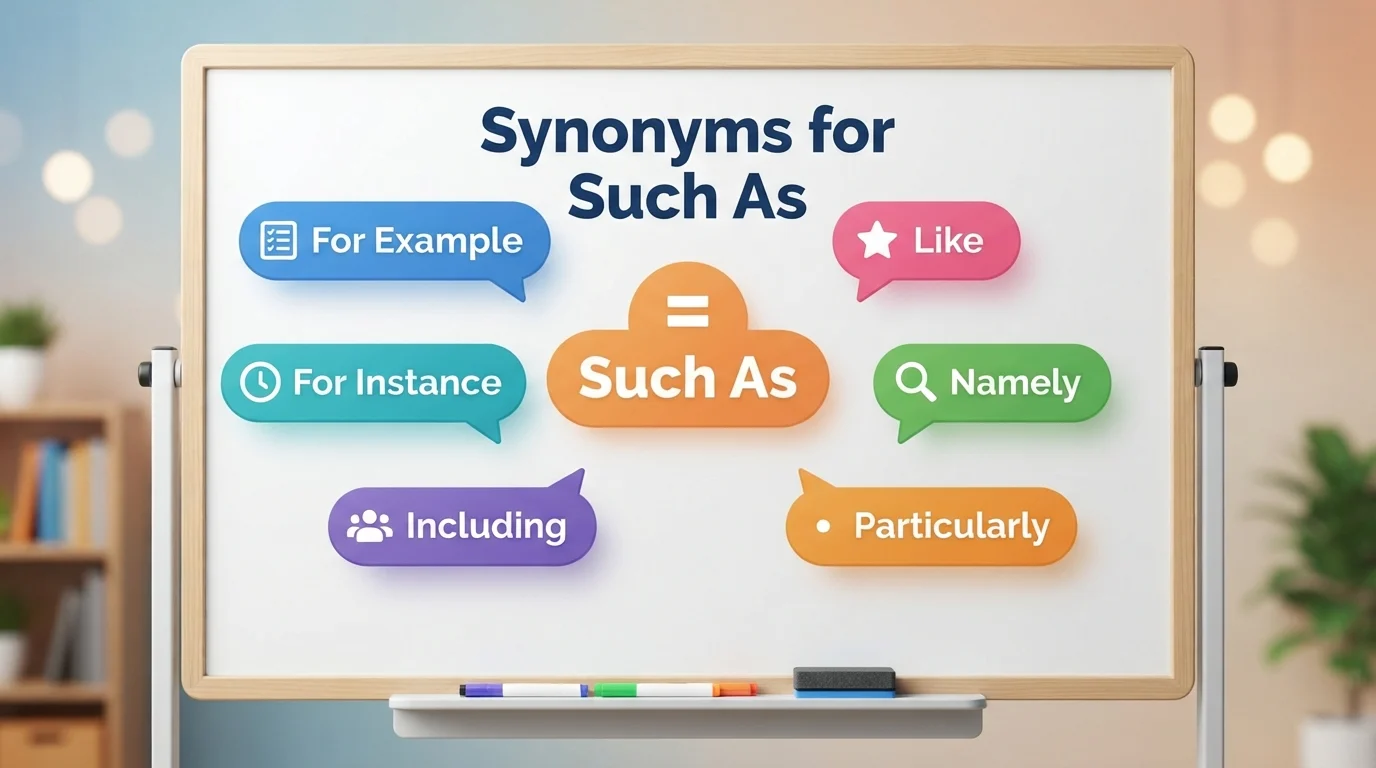
“Such as” is a common phrase used to introduce examples or specify a subset of items within a larger category. It indicates that the examples following are representative but not necessarily exhaustive. Depending on context, alternatives include for example, for instance, including, like, namely, particularly, and e.g.
Meaning, Tone, and Context
Simple Definition
“Such as” is used to:
- Introduce examples that illustrate a broader category or idea
- Specify particular items within a larger group
- Clarify a point by providing concrete instances
- Indicate that the list is partial rather than complete
Part of Speech
“Such as” functions as a preposition or adverb in sentences.
Example:
“The store sells many organic products, such as fruits, vegetables, and dairy items.”
Positive, Negative, or Neutral Tone
“Such as” is neutral and works across all contexts. However, the tone can vary depending on which synonym you choose:
- For example – neutral and universal
- Like – casual and informal
- Namely – formal and precise
- Including – neutral, suggests a more comprehensive list
Formality Level
“Such as” is considered formal English and is common in written English, academic papers, professional documents, and formal speeches. For informal contexts, alternatives like “like” or “say” may be more appropriate.
Common Use Cases
“Such as” commonly appears in:
- Academic writing (introducing research examples)
- Business reports (listing product categories or services)
- Professional communication (clarifying policies or procedures)
- Essays and articles (supporting arguments with examples)
- Everyday speech (giving examples in conversation)
Important Related Forms
- Such as but not limited to – formal way to indicate a non-exhaustive list
- Such as the following – used before a bulleted or numbered list
- E.g. – the Latin abbreviation meaning “for example”
- I.e. – a related abbreviation meaning “that is” (used for clarification rather than examples)
When and How to Use “Such As”
Use “such as” when you want to introduce examples that are part of a larger category. It is especially useful in formal writing and when the list is meant to be illustrative rather than complete.
Professional
“Customer service skills, such as active listening and empathy, are essential for this role.”
This works naturally in business communication.
Academic
“Ancient civilizations, such as the Romans and Greeks, developed advanced engineering techniques.”
The phrase is standard in academic writing.
Business
“We offer several services, such as consulting, training, and software development.”
Here, “such as” introduces a representative list of services.
Creative
“She was drawn to places that felt magical, such as old libraries and hidden gardens.”
The phrase works well in descriptive writing.
Formal Writing
“The policy applies to full-time employees, such as managers, supervisors, and staff.”
This maintains a professional tone in formal contexts.
Another Word for “Such As”
There is no single perfect synonym because “such as” can be used in different ways. The best alternative depends on tone, context, and whether you want to emphasize examples, inclusion, or specificity.
- Introducing examples: for example, for instance, as an example, to illustrate
- Listing items within a group: including, like, among them, suchlike
- Specifying exactly: namely, specifically, in particular, particularly
- Formal contexts: by way of illustration, e.g., inter alia
- Informal contexts: like, say, as in
If you need one broad alternative, “for example” is the safest replacement because it works in almost all contexts and maintains a neutral tone.
When Not to Use “Such As”
“Such as” can become too vague when you need to specify exact items without ambiguity.
Consider:
“The candidate has many skills, such as computer proficiency.”
This statement does not specify which computer skills the candidate has—word processing, programming, graphic design, or something else?
A more precise sentence could be:
“The candidate has many skills, including Microsoft Excel and data analysis.”
Similarly, avoid using “such as” when you need to provide a complete list. Use “namely” or “specifically” instead.
Words Commonly Confused With “Such As”
Such As vs. For Example
“Such as” implies a partial list of examples within a larger category. “For example” can be used for partial lists but also works well at the start of a sentence or before a complete example.
Example:
“The menu features several vegan options, such as tofu stir-fry and lentil soup.” (partial list)
“To maintain your health, you should engage in regular physical activity; for example, a daily thirty-minute walk can be very beneficial.” (sentence-starting example)
Such As vs. Like
“Such as” introduces examples that are part of a group. “Like” can imply similarity or comparison and is more informal.
Example:
“In this class, we will study various psychological disorders, such as depression, anxiety, and bipolar disorder.” (actual examples)
“Many aquatic animals, like dolphins and whales, are known for their intelligence.” (informal comparison)
Such As vs. Including
“Such as” indicates a non-exhaustive list. “Including” may imply a more comprehensive or exhaustive list.
Example:
“You can see many types of birds in this area, such as robins, sparrows, and crows.” (partial list)
“Our sports center offers a range of facilities, including a swimming pool, a gymnasium, and tennis courts.” (more comprehensive)
Such As vs. Namely
“Such as” introduces general examples. “Namely” is used to specify exact items with precision.
Example:
“The company needs to improve in several areas, such as customer service and marketing.” (general)
“The company needs to improve in two key areas, namely customer service and marketing.” (precise)
Best Synonym by Context for “Such As”
Which Synonym Should You Choose?
Start by identifying what you want to communicate with your examples.
- Neutral example introduction: for example, for instance, as an example
- Casual, conversational tone: like, say
- Formal, precise specification: namely, specifically, e.g.
- Emphasizing inclusion: including, among them, among others
- Highlighting importance: particularly, especially, in particular
- Showing non-exhaustive list: such as but not limited to, among others
- Creating emphasis or clarity: to illustrate, as an illustration, by way of illustration
10 Key Synonyms for “Such As”
The table below includes accurate alternatives with clear meanings and usage contexts.
Synonym Groups and Usage Differences
Professional vs. Personal Synonyms
Professional writing benefits from specific terms such as including, namely, particularly, and e.g.
Personal communication often uses like, say, or such as itself.
Compare:
“We need to improve several areas, such as efficiency and customer satisfaction.” (personal)
“We need to improve several areas, namely efficiency and customer satisfaction.” (professional)
Formal vs. Conversational Synonyms
Such as works in both formal and conversational English, though it is more common in writing.
Formal alternatives: for example, for instance, namely, to illustrate, e.g.
Conversational alternatives: like, say
Examples:
“The treatment is effective for various conditions, e.g., anxiety and depression.” (formal)
“Treatments like therapy and medication can help.” (conversational)
Academic Synonyms
Academic writing should distinguish between for example, for instance, e.g., including, and namely.
For example and for instance are widely used in research papers to introduce supporting evidence. Namely is used for exact specification. E.g. is useful in parenthetical citations.
Professional and Business Synonyms
Business writing often benefits from phrases such as including, particularly, specifically, and such as but not limited to.
Instead of:
“Our services include many offerings, such as consulting.”
Consider:
“Our services include consulting, training, and software development.”
Creative or Literary Synonyms
Creative writing can use for example, for instance, to illustrate, as an example, and particularly to maintain a polished style.
For more artistic variety:
“The garden was filled with enchanting blooms—lavender, jasmine, and roses, to name a few.”
Slang or Modern Synonyms
Like is the most common informal alternative in casual English.
Say is another casual option, as in “He’s good at many sports, say, basketball or soccer.”
Strongest vs. Weaker Synonyms
“Such as” synonyms vary in their level of specificity:
Broad: such as, like, for example
More focused: including, particularly, especially
Very specific: namely, specifically, e.g.
Emotional vs. Neutral Synonyms
“Such as” is generally neutral.
Emotional alternatives: especially, particularly (add emphasis)
Neutral alternatives: for example, including, among them
Examples:
“She loves many fruits, such as apples and oranges.” (neutral)
“She loves many fruits, especially apples.” (emphasizes preference)
Antonyms and Opposites
“Such as” does not have exact antonyms, but depending on context, the following words represent opposites:
| Antonym | Context | Meaning | Example Sentence |
|---|---|---|---|
| Excluding | Inclusion | Leaving out items | The package includes everything, excluding accessories. |
| Except for | Inclusion | Items not included | Everyone was invited, except for John. |
| Other than | Inclusion | Apart from | She likes no vegetables other than carrots. |
| Aside from | Inclusion | In addition to or excluding | Aside from sports, he enjoys reading. |
Comparison: “Such As” vs. Similar Words
Such As vs. For Example
Main difference: “Such as” implies a partial list of examples. “For example” can introduce a single example or a representative list and can start a sentence.
Examples:
“The menu features several vegan options, such as tofu stir-fry and lentil soup.” (partial list)
“To maintain your health, you should engage in regular physical activity; for example, a daily thirty-minute walk can be very beneficial.” (sentence-starting example)
Such As vs. Including
Main difference: “Such as” often indicates a non-exhaustive list, while “including” may imply the list is more exhaustive or complete.
Examples:
“You can see many types of birds in this area, such as robins, sparrows, and crows.” (partial list)
“Our sports center offers a range of facilities, including a swimming pool, a gymnasium, and tennis courts.” (more comprehensive)
Such As vs. Like
Main difference: “Such as” introduces actual examples that are part of a group. “Like” can imply similarity or comparison and is less formal.
Examples:
“In this class, we will study various psychological disorders, such as depression, anxiety, and bipolar disorder.” (actual examples)
“Many aquatic animals, like dolphins and whales, are known for their intelligence.” (informal comparison)
Such As vs. Namely
Main difference: “Such as” introduces general examples. “Namely” specifies exact items with precision.
Examples:
“The company needs to improve in several areas, such as customer service and marketing.” (general)
“The company needs to improve in two key areas, namely customer service and marketing.” (precise)
Common Phrases and Expressions with “Such As”
1. Such as but not limited to
Meaning:
Indicates that the examples provided are representative and not exhaustive.
Usage:
Common in legal, professional, and business writing.
Example:
“The job requires skills such as but not limited to communication, teamwork, and problem-solving.”
2. Such as the following
Meaning:
Used to introduce a list, often before bullet points or numbered items.
Usage:
Instructional or academic writing.
Example:
“The workshop will cover topics such as the following: budgeting, saving, and investing.”
3. Suchlike
Meaning:
Meaning “of that kind” or “similar things”.
Usage:
Informal contexts.
Example:
“She enjoys books, magazines, and suchlike.”
Common Mistakes to Avoid
1. Using “such as” when “like” is more appropriate in casual contexts
In informal writing or speech, “like” is more natural. Reserve “such as” for formal contexts.
Formal: “The store offers many organic products, such as fruits and vegetables.”
Informal: “The store offers many organic products, like fruits and vegetables.”
2. Using “for example” and “such as” interchangeably without context
“For example” can start a sentence; “such as” cannot.
Incorrect: “Such as, fruits and vegetables are healthy.” (incorrect)
Correct: “Fruits and vegetables, such as apples and spinach, are healthy.”
Correct: “Many foods are healthy. For example, fruits and vegetables are excellent choices.”
3. Confusing “e.g.” with “i.e.”
E.g. stands for exempli gratia and means “for example.” I.e. stands for id est and means “that is” (used for clarification).
Example:
“The menu includes citrus fruits (e.g., oranges, lemons).” (examples)
“The best fruit for breakfast (i.e., the one that provides the most energy) is an apple.” (specification)
4. Using “such as” when you mean a complete list
If your list is complete or exhaustive, use “namely” or “specifically” instead.
Incorrect: “The committee includes three members, such as John, Mary, and David.” (implies there may be more)
Correct: “The committee includes three members, namely John, Mary, and David.” (complete list)
5. Overusing “such as” in writing
Repetition can make content feel dull. Instead, use a variety of alternatives such as for instance, including, particularly, and to illustrate.
6. Placing the comma incorrectly
When using “for example” or “for instance” in the middle of a sentence, use commas before and after.
Correct: “Many fruits, for example, apples and oranges, are healthy.”
Incorrect: “Many fruits for example apples and oranges are healthy.”
FAQs
What is the best synonym for “such as”?
The best synonym depends on context. For example is the safest universal replacement. For instance works well in essays, including in professional contexts, like in casual speech, and namely in formal precise writing.
What is a formal synonym for “such as”?
Namely, by way of illustration, e.g., and for instance are formal synonyms. These work well in academic papers, business reports, and professional documents.
What is an informal synonym for “such as”?
Like is the most common informal alternative. Say is also used in casual conversation.
Can “such as” be used at the beginning of a sentence?
No, “such as” cannot begin a sentence. If you need a sentence-starting alternative, use for example or for instance.
What is the difference between “such as” and “for example”?
“Such as” implies a partial list of examples within a category. “For example” can introduce representative examples and can start a sentence.
What does “e.g.” mean?
E.g. is the abbreviation for the Latin exempli gratia, meaning “for example.” It is commonly used in formal written contexts.
What is the difference between “e.g.” and “i.e.”?
E.g. means “for example” and introduces examples. I.e. means “that is” and clarifies or restates a point more precisely.
Conclusion
“Such as” is a versatile and essential phrase for introducing examples and clarifying ideas. The best synonym depends on your context, tone, and what you want to emphasize.
Choose for example for universal contexts, for instance for academic writing, including for professional communication, like for casual conversation, namely for precise specification, and particularly for highlighting notable examples.
Most importantly, do not replace “such as” simply to avoid repetition. First identify whether you are introducing examples, specifying items, highlighting relevance, or indicating a non-exhaustive list. Then choose the alternative that communicates that idea most clearly.
For academic, professional, and formal writing, precision and appropriate tone are essential. A specific term such as namely, particularly, or including can provide greater clarity than the more general “such as.”
Before publishing a vocabulary guide, verify definitions and usage with trusted sources such as dictionaries and grammar guides. This helps ensure that each alternative accurately matches its intended meaning and context.
The practical takeaway is simple: when “such as” feels too repetitive, ask yourself what kind of examples you are giving and what tone you want to achieve. Then choose the most appropriate alternative.
Discover More:-
- 50+ Synonyms for Talk: Meanings, Examples, and Best Alternatives
- 50+ Synonyms for Poor: Meanings, Examples, and Best Alternatives

1 thought on “50+ Synonyms for “Such As”: Meanings, Examples, and Best Alternatives”