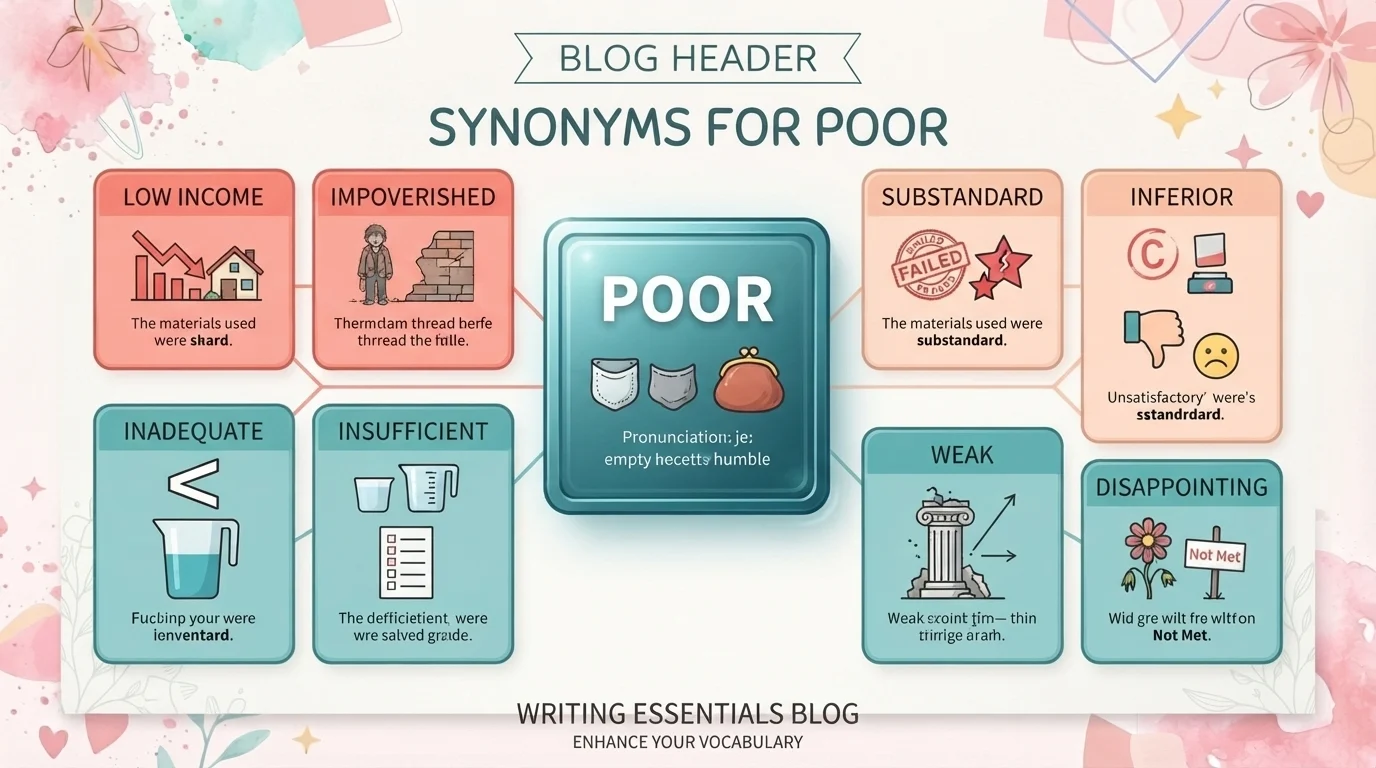
Do you keep using the word “poor” in essays, emails, reports, conversations, reviews, or everyday writing? The word is useful, but it has several meanings, so choosing the wrong synonym can change your message.
For example, poor can describe low quality, limited financial resources, weak performance, bad results, or an unfortunate person or situation. Therefore, the best alternative depends on what you actually mean.
This guide explains synonyms for poor by context, tone, formality, intensity, and usage. You will learn which words work best in academic writing, professional communication, casual conversation, creative writing, resumes, and everyday English.
Quick Answer: What Does “Poor” Mean?
“Poor” can mean having little money, being low in quality, producing weak results, or being unfortunate. Common alternatives include needy, impoverished, inadequate, inferior, weak, substandard, unsuccessful, unfortunate, and limited.
Meaning, Tone and Context
Simple definition
“Poor” has several meanings in English. Most commonly, it describes someone with limited financial resources or something that is below an expected standard.
For example, “a poor family” can refer to a family with limited financial resources. Meanwhile, “poor performance” means performance that does not meet expectations.
Part of speech
“Poor” is primarily an adjective.
Examples:
“She comes from a poor family.”
“The report received a poor rating.”
The related noun “poverty” refers to the condition of lacking sufficient financial resources.
Positive, negative, or neutral tone
The tone depends heavily on context.
When describing quality or performance, poor usually has a negative meaning. When describing financial hardship, the word can be factual, although some alternatives may sound more respectful or precise.
For example, “low income” is often more neutral than “poor” when discussing someone’s financial circumstances.
Formality level
Poor is a common, neutral English word. It appears in casual conversation, academic writing, professional reports, journalism, and everyday communication.
However, more precise language is often preferable when discussing sensitive subjects such as financial hardship or social conditions.
Common use cases
Poor can describe:
- Financial circumstances
- Quality
- Performance
- Results
- Judgment
- Decisions
- Health
- Conditions
- Skills
- Living conditions
Important word forms
Poor: an adjective describing limited resources, low quality, weak performance, or an unfortunate condition.
Poverty: a noun referring to a condition of severe financial hardship.
Poorly: an adverb meaning inadequately, unsuccessfully, or badly.
Impoverished: an adjective describing someone or something that has been made poor or deprived of resources.
When and How to Use “Poor”
Use poor when the context clearly communicates what kind of deficiency or hardship you mean.
Because the word has several meanings, the noun that follows it often determines the intended sense.
Professional
“The company delivered poor customer service.”
This means the service failed to meet an expected standard.
Personal
“He grew up in a poor neighborhood.”
Here, poor refers to limited economic resources in the area.
Academic
“The study found poor reading comprehension among the participants.”
In this context, poor indicates a low level of performance.
Emotional
“She felt poor after losing her job.”
This sentence can sound ambiguous because poor may refer to finances rather than emotions. A clearer alternative would be “She felt financially insecure.”
Creative
“The poor traveler had nowhere to sleep.”
Here, poor can mean unfortunate or deserving sympathy.
Social media
“The movie had poor reviews.”
This is a concise way to communicate that reviewers evaluated the movie negatively.
“Unfortunately, the poor connection affected the meeting.”
Here, poor means inadequate or unreliable.
Another Word for “Poor”
The best single replacement depends on which meaning of poor you intend.
- Financial hardship: low income or impoverished
- Low quality: substandard or inferior
- Weak performance: inadequate or unsuccessful
- Academic writing: deficient or inadequate
- Professional writing: below standard or inadequate
- Casual conversation: bad or weak
- Creative writing: unfortunate or miserable
- Resume or workplace use: underperforming or limited
- Social media: disappointing or weak
- Gentler wording: limited or financially disadvantaged
For sensitive discussions about people and finances, low income or financially disadvantaged can be more precise than simply saying poor.
For products, services, or performance, substandard, inadequate, or unsatisfactory may communicate the problem more clearly.
When Not to Use “Poor”
Poor can sound vague when you need to identify exactly what is wrong.
For example:
“The project had poor results.”
This sentence does not explain whether the results were inaccurate, incomplete, weak, or unsuccessful.
A more precise version would be:
“The project produced disappointing results.”
Similarly, “poor quality” is common but can often be replaced with substandard, inferior, defective, or inadequate, depending on the situation.
When discussing people experiencing financial hardship, avoid assuming that poverty defines the person’s identity. Terms such as low income, financially disadvantaged, or experiencing poverty can be more precise and respectful.
Words Commonly Confused With “Poor”
Poor vs. Poverty
Poor is an adjective, while poverty is a noun.
“She grew up poor.”
“She grew up in poverty.”
Poor vs. Impoverished
Poor is broader and more common. Impoverished usually emphasizes severe financial hardship or deprivation.
“The region is poor.”
“The region is severely impoverished.”
Poor vs. Inadequate
Poor can describe many kinds of deficiency. Inadequate specifically means not sufficient for a particular need or standard.
“The service was poor.”
“The service was inadequate for the number of customers.”
Poor vs. Inferior
Inferior means lower in quality, value, status, or performance compared with something else.
“The product was poor.”
“The product was inferior to the competing model.”
Poor vs. Bad
Bad is a broad informal word for something negative or undesirable. Poor can sound more measured in some contexts.
“The food was bad.”
“The food was of poor quality.”
Poor vs. Unfortunate
Unfortunate describes an undesirable or unlucky situation. It does not necessarily refer to financial hardship or low quality.
“The family was poor.”
“The family experienced an unfortunate event.”
Best Synonym by Context for “Poor”
| Context | Best Synonym | Why It Works | Example |
|---|---|---|---|
| Formal writing | Inadequate | Clearly indicates failure to meet a requirement | The available evidence was inadequate. |
| Academic writing | Deficient | Precisely describes a lack or weakness | The study identified deficient reading skills. |
| Professional or business use | Unsatisfactory | Clearly communicates that a standard was not met | The service was unsatisfactory. |
| Resume | Underperforming | Describes weak performance in a workplace context | The underperforming process required revision. |
| Financial circumstances | Low income | More specific and neutral than poor | The program supports low income households. |
| Casual conversation | Bad | Natural and widely understood | The service was bad. |
| Creative writing | Miserable | Can emphasize difficult or unhappy conditions | They lived through miserable conditions. |
| Low quality | Substandard | Clearly indicates quality below expectations | The materials were substandard. |
| Weak performance | Weak | Simple and direct | The team delivered a weak performance. |
| Social media | Disappointing | Expresses negative reaction without sounding overly formal | The movie was disappointing. |
| US usage | Poor | Common across everyday American English | The road was in poor condition. |
| UK usage | Poor | Also standard and widely understood | The service was poor. |
Which Synonym Should You Choose?
First, determine which meaning of poor applies to your sentence.
If you are discussing finances, consider low income, financially disadvantaged, needy, or impoverished. Choose the gentler option when the topic involves people and social conditions.
For quality problems, substandard, inferior, defective, or unsatisfactory may be more informative.
When describing performance, weak, inadequate, disappointing, or underperforming can identify the problem more clearly.
In academic writing, deficient, inadequate, limited, and insufficient often sound more precise.
For casual conversation, bad, weak, or disappointing may sound more natural.
Real Life Examples of “Poor” in Sentences
School
“The student received a poor grade on the first assignment.”
A more precise version could be:
“The student received a low grade on the first assignment.”
Workplace
“The department received poor customer feedback.”
A professional alternative is:
“The department received unfavorable customer feedback.”
Writing
“The article provides a poor explanation of the issue.”
A more precise alternative could be:
“The article provides an inadequate explanation of the issue.”
Conversation
“That was a poor decision.”
This means the speaker believes the decision was unwise or ineffective.
Social media
“The film received poor reviews.”
A more conversational alternative is:
“The film received disappointing reviews.”
Resume
“Improved a poor performing process.”
A stronger professional version is:
“Improved an underperforming process.”
“We apologize for the poor service you experienced.”
The wording is direct and appropriate for customer communication.
Storytelling
“The poor traveler wandered through the village alone.”
Here, poor means unfortunate rather than financially disadvantaged.
25 Synonyms for “Poor”
The following words represent different meanings of poor. They should not be treated as interchangeable in every sentence.
| Synonym | Simple Meaning | Best Used For | Example Sentence |
|---|---|---|---|
| Impoverished | Extremely poor or lacking resources | Serious financial hardship | The organization helps impoverished communities. |
| Needy | Lacking basic resources | People requiring financial assistance | The charity provides meals to needy families. |
| Underprivileged | Having fewer social or economic advantages | Social and educational contexts | The program supports underprivileged students. |
| Low income | Having limited earnings | Financial and social discussions | The program assists low income households. |
| Inadequate | Not sufficient or suitable | Performance, resources, services | The equipment was inadequate for the task. |
| Insufficient | Not enough | Resources, evidence, funding | The available funding was insufficient. |
| Deficient | Lacking something necessary | Academic and technical writing | The report was deficient in supporting evidence. |
| Substandard | Below an expected quality | Products, services, conditions | The building used substandard materials. |
| Inferior | Lower in quality or value | Comparisons | The cheaper material was inferior to the original. |
| Unsatisfactory | Not meeting expectations | Work, services, results | The final result was unsatisfactory. |
Synonym Groups and Usage Differences
Professional vs. Personal Synonyms
Professional writing should identify the specific problem instead of relying on the broad word poor.
For example, a manager might describe “unsatisfactory performance” rather than simply “poor work.”
Personal conversation allows simpler choices such as bad, weak, or disappointing.
When discussing financial hardship, professional and public facing communication should usually favor precise terms such as low income or financially disadvantaged.
Formal vs. Conversational Synonyms
Formal writing often uses inadequate, insufficient, deficient, substandard, or unsatisfactory.
Conversational English more commonly uses bad, weak, disappointing, or not good.
For example:
“The report contained insufficient evidence.”
A casual speaker might say:
“The report did not have enough evidence.”
Both communicate the idea, but the second sounds more conversational.
Academic Synonyms
Academic writing benefits from precise alternatives.
Words such as deficient, inadequate, insufficient, limited, and substandard can explain specific weaknesses without relying on vague criticism.
For example:
“The sample size was insufficient to support a reliable conclusion.”
This is more informative than:
“The sample size was poor.”
Professional and Business Synonyms
Business communication should usually focus on measurable problems.
Instead of “poor performance,” consider underperformance, unsatisfactory performance, declining results, or below standard performance when those descriptions are accurate.
Similarly, instead of “poor service,” customer service teams might use inadequate service, unsatisfactory service, or service that did not meet expectations.
Creative or Literary Synonyms
Creative writing offers more emotional alternatives.
Words such as miserable, unfortunate, wretched, destitute, and forlorn can create different emotional effects.
For example, “the poor traveler” can create sympathy, while “the destitute traveler” emphasizes severe financial hardship.
Choose carefully because these words can make a scene feel much more dramatic.
Slang or Modern Synonyms
Casual expressions such as bad, lousy, terrible, or rough can sometimes replace poor when describing quality or circumstances.
For example:
“That was a lousy performance.”
However, such wording is too casual for most academic writing and many professional documents.
Strongest vs. Weaker Synonyms
A general scale for low quality or performance might look like this:
Mild: below standard
Moderate: unsatisfactory
Strong: inadequate
Very strong: substandard
Very severe: unacceptable
For financial circumstances, intensity works differently. Low income is generally descriptive, while impoverished and destitute indicate much more serious hardship.
Emotional vs. Neutral Synonyms
Low income, limited, inadequate, and insufficient can be relatively neutral.
Miserable, wretched, unfortunate, and destitute carry stronger emotional associations.
Use neutral terms for reports and factual explanations. Reserve emotionally charged vocabulary for contexts where the emotional effect is intentional.
Antonyms of “Poor”
| Antonym | Meaning | Example Sentence |
|---|---|---|
| Rich | Having substantial financial resources | The region became rich through trade. |
| Wealthy | Having significant financial assets | She comes from a wealthy family. |
| Affluent | Having abundant financial resources | The area has an affluent population. |
| Prosperous | Financially successful or thriving | The town became prosperous after the new industry arrived. |
| Successful | Achieving desired results | The campaign was successful. |
| Excellent | Extremely high in quality | The restaurant received excellent reviews. |
| Superior | Higher in quality or value | This material is superior to the previous version. |
| Adequate | Sufficient for a purpose | The available resources were adequate. |
| Sufficient | Enough for a particular need | The evidence was sufficient to support the conclusion. |
| Effective | Producing the intended result | The new strategy was effective. |
| Strong | Performing well or having considerable ability | The team delivered a strong performance. |
| Outstanding | Exceptionally good | Her work was outstanding. |
| Exceptional | Far above the usual standard | The company provides exceptional service. |
| Satisfactory | Meeting expectations | The final result was satisfactory. |
| Prosperous | Successful and financially healthy | The business remained prosperous for decades. |
Comparison: “Poor” vs. Similar Words
Poor vs. Bad
Main difference: Both can express negative quality, but bad is broader and often more conversational.
Which one is stronger: Bad can sound stronger depending on context.
Which one is more formal: Poor can sound more measured in phrases such as poor quality or poor performance.
Examples:
“The service was poor.”
“The service was bad.”
Poor vs. Inadequate
Main difference: Inadequate specifically means insufficient or unable to meet a requirement.
Which one is stronger: Inadequate can communicate a more specific failure.
Which one is more formal: Inadequate is more formal.
Examples:
“The preparation was poor.”
“The preparation was inadequate for the examination.”
Poor vs. Impoverished
Main difference: Impoverished strongly emphasizes serious financial hardship.
Which one is stronger: Impoverished generally indicates greater financial deprivation.
Which one is more formal: Impoverished is more formal.
Examples:
“The family was poor.”
“The region was severely impoverished.”
Poor vs. Inferior
Main difference: Inferior means lower in quality, value, or status compared with another thing.
Which one is stronger: Inferior is more comparative.
Which one is more formal: Inferior is more formal.
Examples:
“The product was poor.”
“The replacement product was inferior to the original.”
Poor vs. Insufficient
Main difference: Insufficient means not enough, while poor can refer to low quality or weak performance.
Which one is stronger: Neither is universally stronger because they describe different problems.
Which one is more formal: Insufficient is more formal and precise.
Examples:
“The evidence was poor.”
“The evidence was insufficient to support the claim.”
Poor vs. Unfortunate
Main difference: Unfortunate describes bad luck or an undesirable situation rather than low quality or financial hardship.
Which one is stronger: Neither is stronger because they express different meanings.
Which one is more formal: Unfortunate works well in both formal and everyday writing.
Examples:
“He was poor.”
“He experienced an unfortunate situation.”
Common Phrases and Expressions with “Poor”
1. Poor quality
Meaning:
Something that does not meet an expected quality standard.
Example sentence:
“The store received complaints about poor quality products.”
2. Poor performance
Meaning:
Performance that falls below expectations.
Example sentence:
“The team was disappointed by its poor performance.”
3. Poor decision
Meaning:
A decision considered unwise, ineffective, or unsuitable.
Example sentence:
“Choosing to ignore the warning was a poor decision.”
4. Poor condition
Meaning:
A state of significant wear, damage, or deterioration.
Example sentence:
“The old building was in poor condition.”
5. Poor communication
Meaning:
Communication that is unclear, ineffective, incomplete, or unsuccessful.
Example sentence:
“Poor communication caused confusion among the team members.”
6. Poor health
Meaning:
A state of health that is not good.
Example sentence:
“Poor health prevented him from continuing the activity.”
7. Poor results
Meaning:
Results that are below expectations.
Example sentence:
“The campaign produced poor results during its first month.”
Common Mistakes to Avoid
1. Using “poor” without clarifying the meaning
Because poor has many meanings, readers may not know whether you mean financial hardship, low quality, weak performance, or bad circumstances.
2. Confusing “poor” with “poverty”
Poor is an adjective, while poverty is a noun.
Correct:
“They experienced poverty.”
“They were poor.”
3. Using a casual synonym in formal writing
Words such as lousy, terrible, or bad may sound too conversational in academic or professional contexts.
4. Using “impoverished” for every financially struggling person
Impoverished often suggests serious deprivation. Therefore, it can exaggerate a situation when someone simply has a low income.
5. Using “inferior” without a comparison
Inferior usually works best when something is being compared with another option.
For example, “This material is inferior to the original” is clearer than simply saying “This material is inferior.”
6. Using an overly emotional synonym
Words such as wretched, miserable, and destitute carry strong emotional meaning.
Use them only when the situation genuinely supports that tone.
7. Repeating “poor” throughout an article
If every sentence uses poor, the writing can become vague and repetitive.
Instead, identify the specific meaning and choose a suitable alternative.
FAQs
What is the best synonym for “poor”?
The best synonym depends on meaning. Use inadequate for insufficient quality, low income for finances, and substandard for something below an expected quality level.
What is a formal synonym for “poor”?
Formal alternatives include inadequate, insufficient, deficient, substandard, unsatisfactory, and impoverished, depending on the specific meaning.
What is an informal synonym for “poor”?
Bad, weak, lousy, disappointing, and not good can work in casual conversation, although some choices may sound too negative in sensitive situations.
What is another word for “poor” in professional writing?
In professional writing, use inadequate, unsatisfactory, below standard, underperforming, or insufficient when these words accurately describe the specific problem.
What is the difference between “poor” and “inadequate”?
Poor is broad and can describe low quality or weak performance, while inadequate specifically means something is insufficient for a particular purpose.
What is the opposite of “poor”?
The opposite depends on meaning. Wealthy or affluent contrasts with financial poverty, while excellent, superior, effective, or successful contrasts with poor quality or performance.
Conclusion
The word “poor” has several meanings, so the best synonym depends on the context. Financial hardship may call for low income or impoverished, while low quality may require substandard or inferior.
For weak performance, inadequate, unsatisfactory, or underperforming can provide greater precision. In academic writing, deficient and insufficient often communicate a specific limitation more clearly.
Most importantly, choose words according to meaning rather than simply searching for a stronger replacement. A precise synonym makes your writing clearer, more respectful, and more effective.
When discussing sensitive topics such as poverty, consider whether the language focuses on a person’s circumstances rather than defining the person by those circumstances. For final publication, verify definitions and usage with trusted dictionaries such as Cambridge, Oxford, Merriam Webster, Collins, or Britannica.

2 thoughts on “50+ Synonyms for Poor: Meanings, Examples, and Best Alternatives”