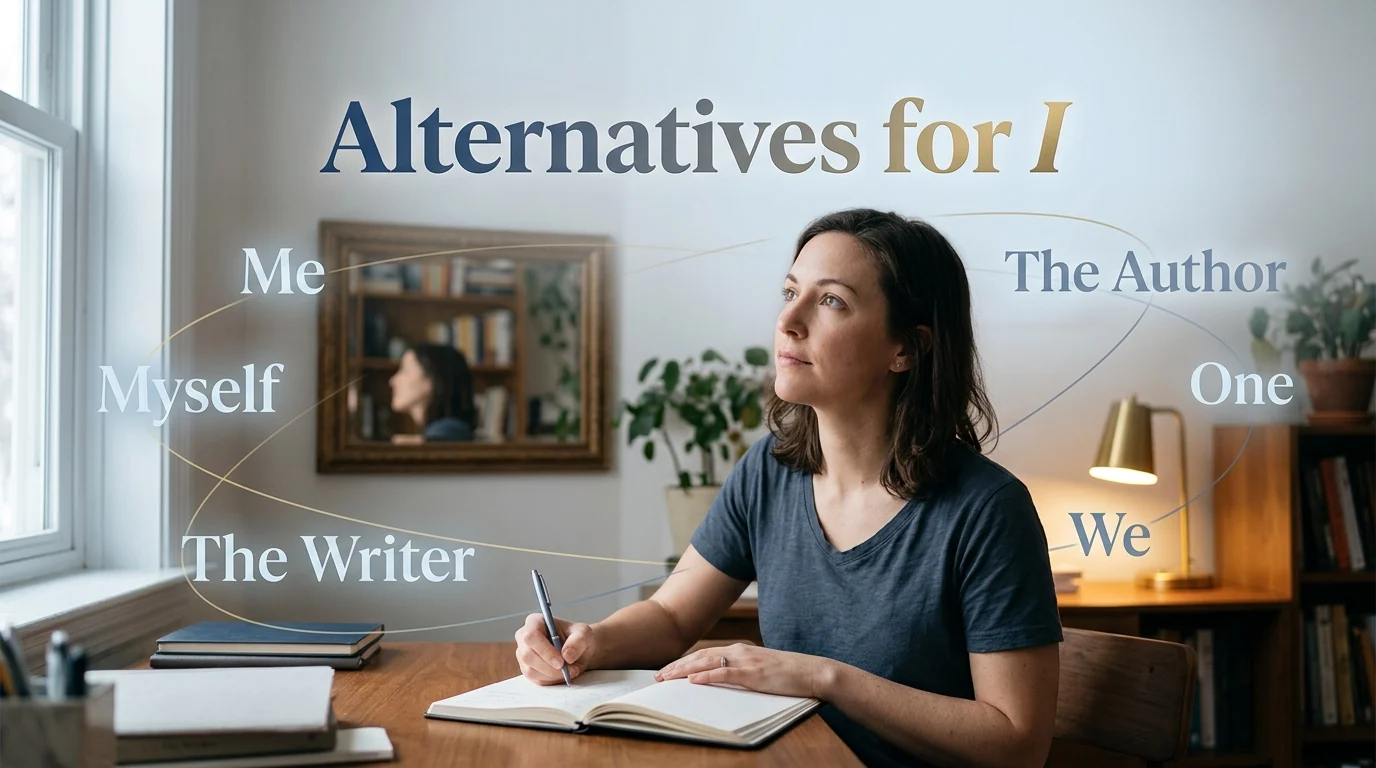
Do you keep using the word “I” in essays, emails, resumes, creative writing, or everyday conversation? While it is one of the most common and essential words in English, repeating it can make your writing feel repetitive, self-centered, or monotonous.
The good news is that the best alternative depends on what you actually mean and the context you are writing in. You might need to refer to yourself in formal writing, avoid first-person pronouns in academic work, add variety to creative writing, or replace “I” with more descriptive phrases.
This guide explains synonyms and alternatives for “I” by meaning, tone, context, and usage. You will learn which alternatives work best in academic writing, professional communication, resumes, creative expression, and casual conversation.
Quick Answer: What Does “I” Mean?
“I” is a first-person singular pronoun used by a speaker or writer to refer to themselves. It is the subject form of the first-person pronoun. Depending on context, alternatives include me, myself, my humble self, the writer, the author, this writer, yours truly, your correspondent, and one (formal British usage).
However, it is important to note that “I” has no true synonyms in the traditional sense—it is a grammatical pronoun. The alternatives below are contextual substitutes used to avoid repetition or to change tone and formality.
Meaning, Tone, and Context
Simple Definition
“I” generally refers to:
- The speaker: the person speaking or writing
- The self: the individual identity of the speaker
- The subject: the doer of an action in a sentence
Part of Speech
“I” is a first-person singular pronoun (specifically, a subject pronoun).
Examples:
- “I am going to the store.”
- “I believe that is correct.”
- “I have finished my work.”
Related Forms:
- Me (object pronoun): “She gave it to me.”
- My (possessive adjective): “This is my book.”
- Mine (possessive pronoun): “The book is mine.”
- Myself (reflexive pronoun): “I did it myself.”
- We (first-person plural): “We are going together.”
Positive, Negative, or Neutral Tone
“I” is neutral grammatically. However, its use can create different tones depending on context:
- Overuse of “I” can sound self-centered or egotistical
- Avoidance of “I” in academic writing can sound more objective
- Use of “I” in personal writing can sound authentic and vulnerable
- Use of “I” in professional writing can sound confident or unprofessional depending on context
Formality Level
“I” is a standard pronoun that works in both formal and informal English. However, in certain academic and formal contexts, avoiding “I” is preferred to maintain objectivity.
In creative writing, “I” is essential for first-person narration.
Common Use Cases
“I” commonly appears in:
- Personal writing: diaries, journals, personal essays
- Creative writing: first-person narration
- Professional communication: emails, reports (used sparingly)
- Academic writing: used sparingly or avoided
- Resumes: often avoided in favor of action verbs
- Everyday conversation: constantly used
Important Word Forms
- I (subject pronoun): “I am here.”
- Me (object pronoun): “She saw me.”
- My (possessive adjective): “This is my house.”
- Mine (possessive pronoun): “The house is mine.”
- Myself (reflexive pronoun): “I hurt myself.”
- We (first-person plural): “We are here.”
When and How to Use “I”
Use “I” when you are speaking or writing about yourself as the subject of a sentence. Because the word is so common, varying its use or avoiding it can improve your writing.
Personal
“I love spending time with my family.”
This is natural in everyday conversation and personal writing.
Professional
“I have reviewed the report and have some feedback.”
This works in professional emails, though it can be overused.
Academic
“I argue that the evidence supports this conclusion.”
In some academic fields, using “I” is acceptable. In others, it is avoided.
Creative
“I walked through the forest, listening to the birds.”
First-person narration is common in creative writing.
Resume
Avoid “I” in resumes. Instead, use action verbs.
Avoid: “I managed a team of ten.”
Use: “Managed a team of ten.”
Formal/Academic (Avoiding “I”)
Avoid: “I think the results are significant.”
Use: “The results appear to be significant.”
Another Word for “I”
There is no true synonym for “I” because it is a grammatical pronoun. However, there are contextual substitutes that can replace “I” in certain situations to avoid repetition or change tone.
- Formal/academic substitutions: the writer, the author, this writer, this researcher, one
- Humorous/archaic: yours truly, my humble self, your humble servant
- Journalistic: your correspondent, this reporter
- Royal/formal: we (the royal we), one
- Reflexive: myself (used for emphasis)
- Plural: we (when speaking for a group)
If you need one broad alternative, “the writer” works in formal writing, while “myself” works for emphasis in casual contexts.
When Not to Use “I”
“I” can become problematic when overused or used in inappropriate contexts.
Consider:
“I think I should probably say that I believe I have an idea that I think might work.”
This is repetitive and self-centered. A better version:
“One possible approach is…”
Similarly, avoid using “I” in:
- Academic writing where objectivity is valued (use passive voice or third person)
- Resumes (use action verbs instead)
- Business reports where a more objective tone is preferred
- Formal essays where first-person is discouraged
Words Commonly Confused With “I”
I vs. Me
I is a subject pronoun. Me is an object pronoun.
Example:
“I went to the store.” (subject)
“She gave the book to me.” (object)
I vs. Myself
Myself is a reflexive pronoun, used when the subject and object are the same.
Example:
“I hurt myself.” (reflexive)
“I did it myself.” (emphatic)
Incorrect: “She gave it to John and myself.”
Correct: “She gave it to John and me.”
I vs. We
We is first-person plural, used when speaking for a group.
Example:
“I am going.” (singular)
“We are going.” (plural)
I vs. One
One is a formal, impersonal pronoun used in British English.
Example:
“One does not simply walk into Mordor.” (formal/impersonal)
“I do not simply walk into Mordor.” (personal)
I vs. The Writer/Author
The writer/author is a third-person substitute for “I” in formal writing.
Example:
“The author argues that…” (formal)
“I argue that…” (personal)
Best Substitute by Context for “I”
| Context | Best Substitute | Why It Works | Example |
|---|---|---|---|
| Formal writing | The writer, the author | Objective and formal | The author contends that the evidence is clear. |
| Academic writing | This researcher, this study | Academic convention | This study examines the effects of climate change. |
| Academic writing (avoiding I) | Passive voice | Objective | The results were analyzed. |
| Business writing | We (if representing a company) | Professional | We recommend the following actions. |
| Resume | (No pronoun—use action verbs) | Professional | Managed a team of ten employees. |
| Creative writing (first person) | I | Natural for narration | I walked through the forest. |
| Creative writing (variety) | This narrator, your humble narrator | Literary, stylized | Your humble narrator witnessed it all. |
| Humorous/informal | Yours truly, my humble self | Playful and casual | Yours truly will be there. |
| Journalistic | Your correspondent, this reporter | Journalistic convention | Your correspondent visited the site. |
| Royal/formal | We, one | Formal, authoritative | We are not amused. |
| Emphatic | Myself | Emphasis | I myself will handle it. |
| Personal essay | I | Authentic and personal | I remember that day clearly. |
Which Substitute Should You Choose?
Start by identifying what kind of writing you are doing.
- Formal/academic writing: the writer, the author, this researcher, passive voice
- Business writing: we (if representing a company), passive voice
- Resume: no pronoun—use action verbs
- Creative writing (first person): I
- Creative writing (variety): this narrator, your humble narrator
- Humorous/informal: yours truly, my humble self
- Journalistic: your correspondent, this reporter
- Emphatic: myself
- Royal/formal: we, one
10 Key Alternatives for “I”
The table below includes accurate alternatives with clear meanings and usage contexts.
| Alternative | Simple Meaning | Best Used For | Example Sentence |
|---|---|---|---|
| Me | Object form of “I” | Object position in sentences | She gave the book to me. |
| Myself | Reflexive/emphatic form | Emphasis or reflexive action | I did it myself. |
| The writer | Formal substitute for “I” | Formal, academic writing | The writer argues that the evidence is clear. |
| The author | Formal substitute for “I” | Formal, academic writing | The author contends that the policy is flawed. |
| This researcher | Academic substitute for “I” | Academic writing | This researcher examined the effects of climate change. |
| One | Impersonal pronoun | Formal British English | One does not simply walk into Mordor. |
| We | First-person plural | Speaking for a group | We recommend the following actions. |
| Yours truly | Humorous/formal substitute | Informal, playful | Yours truly will be there. |
| Your correspondent | Journalistic substitute | News reporting | Your correspondent visited the site. |
| Your humble narrator | Literary substitute | Creative writing | Your humble narrator witnessed it all. |
Substitute Groups and Usage Differences
Professional vs. Personal Substitutes
Professional writing often avoids “I” entirely by using passive voice, third person, or “we” (if representing a company).
Personal writing uses “I” naturally and authentically.
Compare:
“I completed the analysis.” (personal)
“The analysis was completed.” (professional, passive)
“We completed the analysis.” (professional, company voice)
Formal vs. Conversational Substitutes
I works in both formal and conversational English, but formal writing often avoids it.
Formal alternatives: the writer, the author, this researcher, one
Conversational alternatives: I, me, myself
Examples:
“The author argues that…” (formal)
“I think that…” (conversational)
Academic Substitutes
Academic writing often avoids “I” to maintain objectivity. Common substitutes include:
- Passive voice: “The experiment was conducted…”
- Third person: “The study examines…”
- This researcher/this study: “This study examines…”
- The author: “The author argues…”
Professional and Business Substitutes
Business writing often uses:
- We (if representing a company): “We recommend…”
- Passive voice: “The report was reviewed…”
- Third person: “The team completed the project…”
Creative or Literary Substitutes
Creative writing uses “I” naturally in first-person narration. For variety, writers might use:
- This narrator: “This narrator witnessed it all.”
- Your humble narrator: “Your humble narrator will now tell the tale.”
- I (directly): “I walked through the forest.”
Slang or Modern Substitutes
Yours truly is a common humorous substitute.
This guy/girl is casual: “This guy is tired.”
Your boy/girl is slang: “Your boy got the job.”
Me, myself, and I is emphatic: “Me, myself, and I will handle it.”
Strongest vs. Weaker Substitutes
“I” has no intensity scale, but substitutes vary in formality:
Most formal: one, the writer, the author, this researcher
Formal: we, passive voice
Neutral: I, me
Informal: yours truly, this guy
Emphatic: myself, me, myself, and I
Emotional vs. Neutral Substitutes
“I” is neutral, but its use can be emotional.
Emotional alternatives: I, me, myself (personal, authentic)
Neutral alternatives: the writer, the author, passive voice (objective)
Examples:
“I feel so strongly about this.” (emotional)
“The writer feels strongly about this.” (neutral, formal)
Antonyms and Contrasts of “I”
“I” does not have exact antonyms, but the following pronouns contrast with it:
| Contrast | Context | Meaning | Example Sentence |
|---|---|---|---|
| You | Second person | The person being addressed | You are going to the store. |
| He | Third person (male) | Another person | He is going to the store. |
| She | Third person (female) | Another person | She is going to the store. |
| It | Third person (neutral) | A thing or animal | It is going to the store. |
| We | First person plural | A group including the speaker | We are going to the store. |
| They | Third person plural | Other people | They are going to the store. |
Comparison: “I” vs. Similar Pronouns
I vs. Me
Main difference: I is a subject pronoun. Me is an object pronoun.
Examples:
“I went to the store.” (subject)
“She gave the book to me.” (object)
I vs. Myself
Main difference: Myself is a reflexive pronoun, used when the subject and object are the same.
Examples:
“I hurt myself.” (reflexive)
“I did it myself.” (emphatic)
Incorrect: “She gave it to John and myself.”
Correct: “She gave it to John and me.”
I vs. We
Main difference: We is first-person plural, used when speaking for a group.
Examples:
“I am going.” (singular)
“We are going.” (plural)
I vs. One
Main difference: One is a formal, impersonal pronoun used in British English.
Examples:
“One does not simply walk into Mordor.” (formal/impersonal)
“I do not simply walk into Mordor.” (personal)
I vs. The Writer/Author
Main difference: The writer/author is a third-person substitute for “I” in formal writing.
Examples:
“The author argues that…” (formal)
“I argue that…” (personal)
Common Phrases and Expressions with “I”
1. I think
Meaning:
Expressing an opinion.
Example:
“I think we should wait.”
2. I believe
Meaning:
Expressing a belief or conviction.
Example:
“I believe in you.”
3. I feel
Meaning:
Expressing an emotion or intuition.
Example:
“I feel that something is wrong.”
4. I understand
Meaning:
Indicating comprehension.
Example:
“I understand your concern.”
5. I apologize
Meaning:
Expressing regret.
Example:
“I apologize for the mistake.”
6. I appreciate
Meaning:
Expressing gratitude.
Example:
“I appreciate your help.”
7. I agree
Meaning:
Expressing concurrence.
Example:
“I agree with your point.”
8. I disagree
Meaning:
Expressing disagreement.
Example:
“I disagree with that assessment.”
9. I wonder
Meaning:
Expressing curiosity.
Example:
“I wonder what will happen next.”
10. If I were you
Meaning:
Giving advice.
Example:
“If I were you, I would take the job.”
Common Mistakes to Avoid
1. Overusing “I” in writing
Academic writing often prefers objectivity. Use passive voice or third person.
Incorrect (in some fields): “I think the results are significant.”
Correct: “The results appear to be significant.”
3. Using “I” in resumes
Resumes should use action verbs, not “I.”
Incorrect: “I managed a team of ten.”
Correct: “Managed a team of ten.”
4. Confusing “I” with “me”
I is a subject pronoun. Me is an object pronoun.
Incorrect: “She gave it to John and I.”
Correct: “She gave it to John and me.”
5. Using “myself” incorrectly
Myself is reflexive or emphatic. Do not use it as a substitute for “me.”
Incorrect: “Please contact John or myself.”
Correct: “Please contact John or me.”
FAQs
What is the best synonym for “I”?
“I” has no true synonyms because it is a grammatical pronoun. However, contextual substitutes include the writer, the author, this researcher, one, and yours truly, depending on formality and context.
What is a formal substitute for “I”?
The writer, the author, this researcher, one, and passive voice are formal substitutes.
What is an informal substitute for “I”?
Yours truly, this guy, your boy, and me are informal substitutes.
How do I avoid using “I” in academic writing?
Use passive voice, third person, or substitute phrases like this study, the author, or the research.
What is the difference between “I” and “me”?
I is a subject pronoun. Me is an object pronoun.
What is the difference between “I” and “myself”?
Myself is a reflexive pronoun, used when the subject and object are the same.
Can I use “I” in a resume?
No, resumes should use action verbs instead of “I.”
Conclusion
“I” is a fundamental pronoun in English, but it has no true synonyms. However, there are many contextual substitutes that can help you avoid repetition or change the tone and formality of your writing.
Choose the writer or the author for formal writing, this researcher for academic contexts, we for business writing (when representing a company), one for formal British English, yours truly for humorous contexts, and passive voice to avoid “I” entirely.
Most importantly, do not overuse “I.” Vary your sentence structure, use passive voice when appropriate, and choose the substitute that best fits your context.
For academic, professional, and formal writing, avoiding “I” is often preferred. Use passive voice, third person, or formal substitutes like the author or this study.
Before publishing a vocabulary guide, verify definitions and usage with trusted dictionaries such as Cambridge, Oxford, Merriam-Webster, Collins, or Britannica. This helps ensure that each alternative accurately matches its intended meaning and context.
The practical takeaway is simple: when “I” feels repetitive or inappropriate, ask yourself what tone and formality you need. Then choose the substitute that works best for your context.
