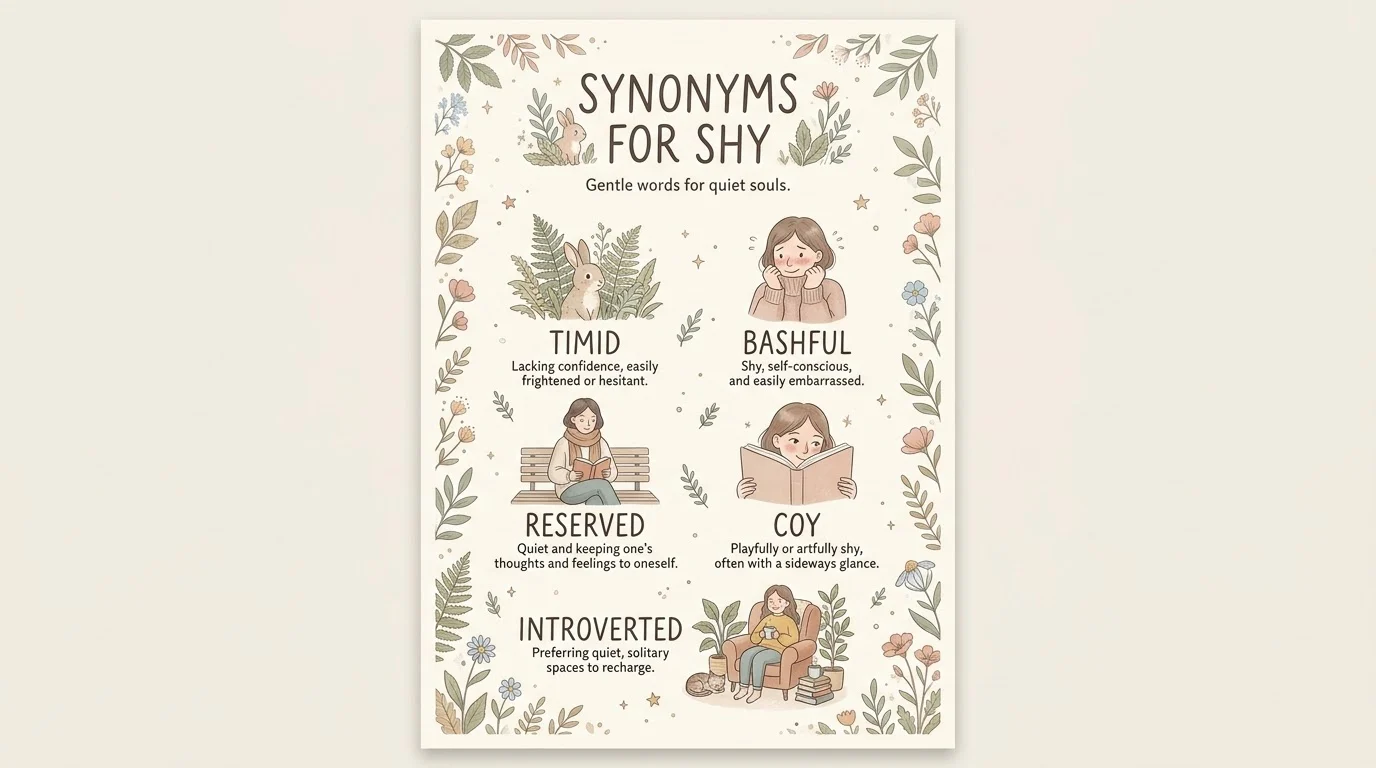
Shy is a small word with a gentle meaning. It can describe a person who feels nervous around others, an animal that hides, or a plant that closes its leaves. For this reason, finding the right synonyms for shy can change the tone of a sentence completely. This guide gives you clear synonyms for shy, with meanings, examples, and advice on when to use each one.
In addition, this guide helps you avoid vague writing. For example, a nervous person calls for timid, while a quiet person calls for reserved, and a modest person calls for bashful. The best choice depends on the context, the audience, and the feeling you want to create.
Quick Answer: What Does Shy Mean
Quick answer: Shy means nervous or uneasy in social situations. Good synonyms for shy include timid, bashful, reserved, quiet, and introverted. Generally, timid also fits nervousness. Socially, reserved also fits quiet behaviour. For modesty, bashful also fits a gentle meaning.
Meaning, Tone, and Context
Simple Definition
Shy describes a person who feels nervous, awkward, or uneasy with others. It can also describe an animal that avoids people, or a plant that reacts to touch. For example, a shy child may hide behind a parent at a party.
Part of Speech
Shy is mainly an adjective, as in a shy smile. It can also act as a verb in phrases such as shy away from. Common forms include shyness, shyer, and shyest. Shyness names the quality. Shyer compares two people.
Tone
Shy sounds gentle, kind, and sympathetic. It can feel warm in a story, and it can feel formal in a report. However, it can also sound negative when it means fear or weakness. In that case, a specific synonym works better.
Formality
Shy works in formal, academic, business, and casual writing. In formal writing, pair it with a clear noun, such as shy behaviour or shy student. In casual writing, a short phrase such as a bit shy or very shy is enough.
Common Use Cases
- People: timid, bashful, and reserved
- Animals: timid, wary, and cautious
- Plants: sensitive, closing, and delicate
- Behaviour: quiet, withdrawn, and modest
- Feeling: nervous, uneasy, and self-conscious
Important Word Forms
Use shy for the general idea. Timid fits nervousness. Reserved fits quiet choice. The word shyness, in addition, covers the trait as a whole. Introverted fits a personality style, not just one moment.
When and How to Use Shy by Context
Academic Context
In academic writing, name the behaviour or the trait. For example, write shy behaviour, social shyness, or shy response. This keeps the claim precise. A reader can then follow the argument without guessing.
Social Context
In conversation, shy is easy and friendly. For example, you can say: He is a bit shy at first. If a friend asks what you mean, add a detail: He takes time to warm up to new people.
Literary Context
In stories and poems, shy can stand for innocence, modesty, or fear. Writers often use it as a theme. For example, a character may stay shy until a kind friend helps her speak. Here, shy means quiet fear, not rudeness.
Creative Context
In creative work, vary the word to avoid repetition. Use timid for fear, reserved for choice, and bashful for modesty. This variety, therefore, keeps the writing fresh and clear.
Casual Context
In casual talk, shy can describe almost any quiet person. For example: The new puppy is shy around guests. The phrase is gentle. It does not mean the puppy is unfriendly.
Another Word for Shy
If you need one simple replacement for shy, timid is the safest general choice. Quiet behaviour also calls for reserved. Modesty also calls for bashful. Fear also calls for nervous. Each choice, however, changes the focus a little, so pick the focus you want.
When Not to Use Shy
Do not use shy when a precise word is available. For example, avoid shy when you mean rude, cold, or unfriendly. Similarly, avoid shy for a person who chooses quiet time, unless you add reserved. In addition, avoid shy as a label for a child you have not described. The reader needs evidence, not only a label.
Words Commonly Confused With Shy
Shy vs Timid
Timid stresses fear and lack of courage. Shy stresses unease in social situations. Timid mice may run from noise. Shy children may avoid new friends.
Shy vs Reserved
Reserved stresses a choice to stay quiet. Shy stresses a feeling of unease. Reserved people may enjoy quiet time. Shy people may want to speak but feel nervous.
Shy vs Introverted
Introverted describes a personality that gains energy alone. Shy describes unease with others. Therefore, do not use introverted for a single nervous moment.
Shy vs Bashful
Bashful stresses modesty and blushing. Shy is the wider group. Bashful smiles show modesty. Shy people may also feel nervous.
Shy vs Quiet
Quiet describes low sound or few words. Shy describes a feeling behind the quiet. Quiet people may feel calm. Shy people may feel nervous.
Best Synonym for Shy by Context
| Context | Best Synonym | Example |
|---|---|---|
| General meaning | Timid | The timid child stayed near her mother. |
| Quiet choice | Reserved | In meetings, he stayed reserved and listened. |
| Modesty | Bashful | Bashful smiles also marked her first day. |
| Animals | Wary | The wary deer kept its distance. |
| Formal writing | Withdrawn | The report describes withdrawn behaviour. |
| Personality | Introverted | Each introverted student needs quiet time. |
| Feeling | Nervous | He felt nervous before the speech. |
| Gentle tone | Modest | Modest and kind, she avoided praise. |
Which Synonym Should You Choose?
Ask three questions. First, is it fear, choice, or modesty? Second, is it a person, an animal, or a moment? Third, is the tone formal or casual? Fear, for example, calls for timid, while choice calls for reserved, and modesty calls for bashful. This short test gives a clear answer in most cases.
10 Key Synonyms for Shy
| Synonym | Meaning | Example |
|---|---|---|
| Timid | Nervous and easily frightened | A timid voice answered the question. |
| Bashful | Modest and easily embarrassed | She gave a bashful smile. |
| Reserved | Quiet and slow to speak | At first, he seemed reserved. |
| Quiet | Making little sound | In class, the quiet girl listened well. |
| Withdrawn | Pulled back from others | Withdrawn after the move, he missed old friends. |
| Introverted | Energised by quiet time | Introverted people often enjoy reading alone. |
| Nervous | Worried and uneasy | Nervous hands held the paper tightly. |
| Modest | Not seeking praise | Please note her modest reply to praise. |
| Wary | Careful about danger | Wary animals kept away from the path. |
| Self-conscious | Aware of being watched | Critics praised his self-conscious acting. |
Synonyms for Shy by Context and Usage Differences
Professional vs Personal
At work, use reserved, withdrawn, and quiet. These words sound precise. Personally, use shy, timid, and bashful. These words, in addition, sound warm and simple.
Formal vs Conversational
Formal writing prefers withdrawn, reserved, and introverted. Conversation prefers shy, timid, and quiet. The meaning stays close, but the register changes.
Academic
Academic writers often name the behaviour: shy behaviour, social shyness, or withdrawn response. In addition, they define the term in the first paragraph. This avoids confusion later in the text.
Professional and Business
Business writing favours reserved, quiet, and modest. These words fit reports, briefs, and notes. For example, a note may describe a reserved speaker, not a shy speaker.
Creative and Literary
Creative writing can use stronger words: bashful, timid, and self-conscious. These words carry feeling. However, use timid only for fear, not for choice.
Slang and Modern
Modern casual speech includes shy for quiet people, and wallflower for a person at a party. For example: She felt like a wallflower at the dance. The phrase is gentle, not rude.
Strongest vs Weaker
Strongest: withdrawn, self-conscious, timid. Middle: shy, reserved, bashful. Weaker: quiet, modest, wary. Choose strength to match your meaning.
Emotional vs Neutral
Emotional: timid, bashful, nervous. Neutral: reserved, quiet, introverted. A news report prefers neutral words. A review can use emotional words.
Antonyms for Shy
| Antonym | Meaning | Example |
|---|---|---|
| Bold | Brave and confident | Bold students asked the first questions. |
| Confident | Sure of oneself | Confident speakers held the room with ease. |
| Outgoing | Friendly and social | Outgoing children made friends at once. |
| Talkative | Talking a lot | Talkative guests filled the hall with noise. |
| Extroverted | Energised by people | Extroverted hosts welcomed every guest. |
| Assertive | Speaking up clearly | Assertive leaders shared their plans openly. |
Comparison: Shy and Its Closest Alternatives
Timid is the closest general match to shy, but it stresses fear more than social unease. Reserved is closer for quiet choice, but it stresses decision, not feeling. Bashful is closer for modesty, but it stresses blushing, not fear. Therefore, use shy for the general idea, and use a specific synonym when the feeling or choice matters most.
Common Phrases and Expressions
1. Shy away from
Avoiding something: She tends to shy away from large crowds.
2. Wallflower
The quiet person at a party: He felt like a wallflower at the dance.
3. Shy smile
Made from modesty: She gave a shy smile when praised.
4. Shy of
Based on lacking: The team was shy of funds for the trip.
5. Shy and retiring
Found in quiet people: He was shy and retiring as a child.
6. Bashful grin
Made from embarrassment: He showed a bashful grin after the joke.
7. Timid heart
Based on fear: A timid heart may avoid new challenges.
8. Quiet as a mouse
Found in silence: The shy child was quiet as a mouse.
9. Come out of your shell
Made for confidence: With support, she came out of her shell.
10. Shy violets
The term for shy people: The class was full of shy violets at first.
Common Mistakes to Avoid
1. Calling quiet people rude
Quiet people may feel shy, not rude. For example, name the feeling when you can: nervous, modest, or reserved.
2. Calling reserved people shy
Reserved people may choose quiet time. Also, use reserved for choice, and shy for unease.
3. Using timid for every shy person
Timid means fearful. However, if the person is only modest, use bashful instead.
4. Mixing shy with introverted without care
Introverted describes personality. Shy describes unease. Also, check which idea you want before you choose.
5. Forgetting the audience
Readers need a clear noun. Reserved helps in a report. Also, shy alone may confuse a new reader.
Frequently Asked Questions
What is a formal synonym for shy?
Reserved and withdrawn are formal alternatives. Also, choose reserved for choice, and withdrawn for behaviour.
What is an informal synonym for shy?
Timid, bashful, and quiet are common informal choices. Also, they sound natural in everyday talk.
What is another word for shy in academic writing?
Withdrawn is usually best, with the behaviour added: shy behaviour or social shyness.
What is the difference between shy and introverted?
Introverted describes energy from quiet time. Shy describes unease with others. Also, many people are one, not both.
What is the opposite of shy?
The opposite depends on context: bold for courage, confident for self-belief, and outgoing for social ease.
What does shy away from mean?
It means to avoid something, such as a large crowd, a hard task, or a new idea.
What are good synonyms for shy in general?
Good synonyms for shy include timid, bashful, reserved, quiet, and introverted. Also, pick the word that matches the feeling and the tone.
Conclusion
Shy is a useful word, but it works best when the feeling, choice, or modesty is clear. Generally, choose timid for fear. In addition, choose reserved for quiet choice. Similarly, choose bashful for modesty, and introverted for personality. To check the core meaning, see Merriam-Webster’s definition of shy. With these synonyms for shy, you can write with more precision, warmth, and confidence.
