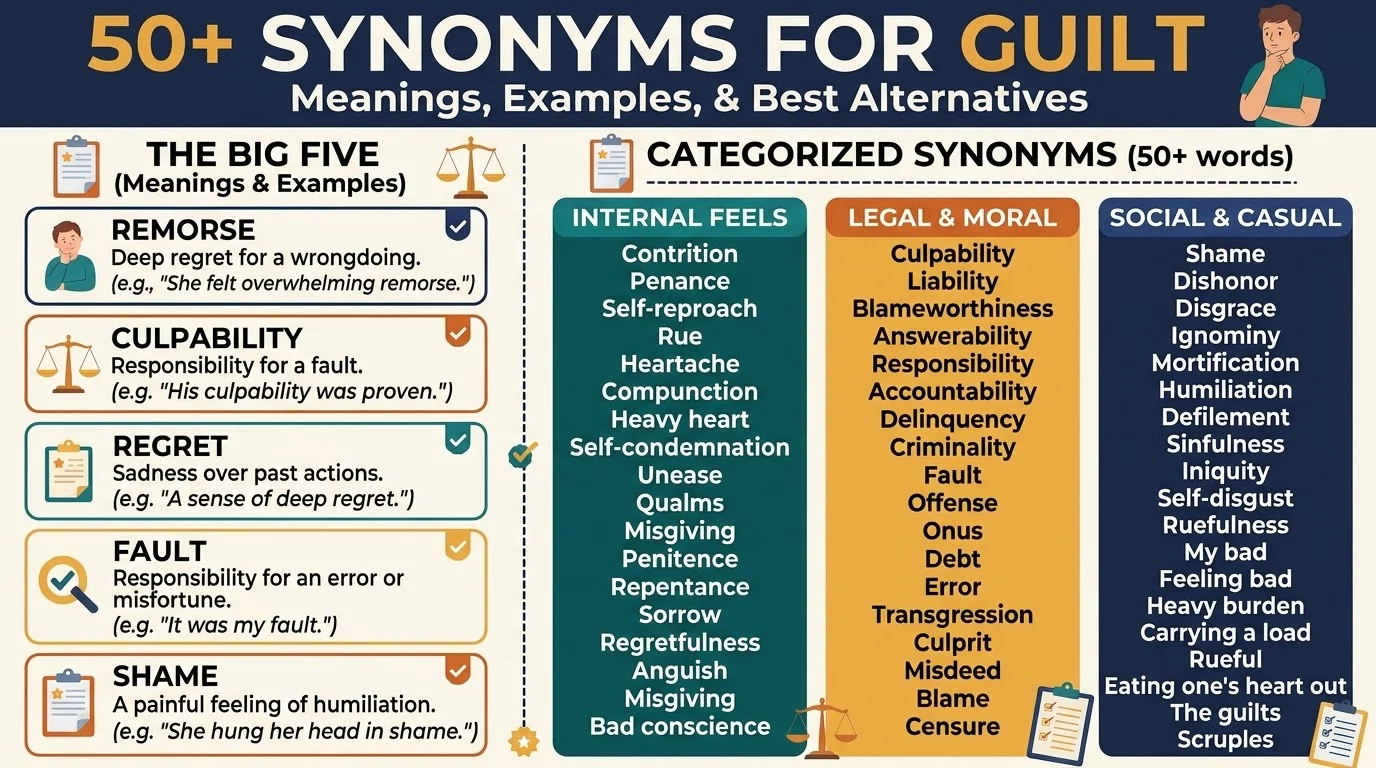
Guilt is a heavy word with a moral meaning. It can describe a feeling after a mistake, a legal finding, or a sense of duty to others. For this reason, finding the right synonyms for guilt can change the tone of a sentence completely. This guide gives you clear synonyms for guilt, with meanings, examples, and advice on when to use each one.
In addition, this guide helps you avoid vague writing. For example, a feeling calls for remorse, while a legal case calls for culpability, and a small regret calls for shame. The best choice depends on the context, the audience, and the feeling you want to create.
Quick Answer: What Does Guilt Mean?
Quick answer: Guilt means feeling bad about a wrong act, and it also means being responsible for it. Good synonyms for guilt include remorse, shame, regret, blame, and culpability. Generally, remorse also fits a feeling. Legally, culpability also fits responsibility. For regret, shame also fits a softer meaning.
Meaning, Tone, and Context
Simple Definition
Guilt is the uneasy feeling that follows a wrong act or a broken promise. It can also describe legal responsibility for a crime. For example, a person may feel guilt after lying to a friend.
Part of Speech
Guilt is mainly a noun, as in a sense of guilt. It can also act as a verb in phrases such as guilt into. Common forms include guilty, guiltless, and guilt-ridden. Guilty describes the person. Guiltless describes innocence.
Tone
Guilt sounds serious, moral, and heavy. It can feel formal in a court report, and it can feel personal in a diary. However, it can also sound harsh when the fault is small. In that case, a specific synonym works better.
Formality
Guilt works in formal, academic, business, and casual writing. In formal writing, pair it with a clear noun, such as guilt feeling or guilt verdict. In casual writing, a short phrase such as a bit of guilt or real guilt is enough.
Common Use Cases
- Feeling: remorse, shame, and regret
- Legal: culpability, blame, and liability
- Moral: conscience, fault, and wrongdoing
- Social: embarrassment, awkwardness, and apology
- Personal: self-blame, sorrow, and contrition
Important Word Forms
Use guilt for the general idea. Remorse fits deep regret. Shame fits public embarrassment. The word culpability, in addition, covers legal blame. Contrition fits sincere sorrow in formal writing.
When and How to Use Guilt by Context
Academic Context
In academic writing, name the type or the field. For example, write moral guilt, legal guilt, or survivor guilt. This keeps the claim precise. A reader can then follow the argument without guessing.
Social Context
In conversation, guilt is easy and honest. For example, you can say: I feel guilty about missing the party. If a friend asks what you mean, add a detail: I promised to help, but I stayed home.
Literary Context
In stories and poems, guilt can stand for conscience, punishment, or redemption. Writers often use it as a theme. For example, a character may carry guilt for years. Here, guilt means inner torment, not a court verdict.
Creative Context
In creative work, vary the word to avoid repetition. Use remorse for deep feeling, shame for embarrassment, and blame for responsibility. This variety, therefore, keeps the writing fresh and clear.
Casual Context
In casual talk, guilt can describe almost any small regret. For example: I feel guilty about eating the last slice. The phrase is light. It does not mean a crime took place.
Another Word for Guilt
If you need one simple replacement for guilt, remorse is the safest general choice. Embarrassment also calls for shame. Responsibility also calls for blame. Sorrow also calls for regret. Each choice, however, changes the focus a little, so pick the focus you want.
When Not to Use Guilt
Do not use guilt when a precise word is available. For example, avoid guilt when you mean sadness, anger, or fear alone. Similarly, avoid guilt for a legal case without proof, unless you add alleged. In addition, avoid guilt as a label for a person you have not described. The reader needs evidence, not only a label.
Words Commonly Confused With Guilt
Guilt vs Remorse
Remorse stresses deep regret and a wish to undo the act. Guilt stresses the feeling of having done wrong. Remorse often leads to apology. Guilt may stay private.
Guilt vs Shame
Shame stresses how others see you. Guilt stresses what you did. Shame can follow public exposure. Guilt can follow a private act.
Guilt vs Regret
Regret stresses wishing an act had not happened. Guilt stresses moral fault. Therefore, do not use regret for a crime, unless the focus is wishing.
Guilt vs Blame
Blame stresses assigning fault to someone. Guilt stresses feeling fault in oneself. Blame can come from others. Guilt comes from within.
Guilt vs Liability
Liability stresses legal duty to pay or answer. Guilt stresses moral or legal fault. Liability fits contracts. Guilt fits conscience and courts.
Best Synonym for Guilt by Context
| Context | Best Synonym | Example |
|---|---|---|
| General feeling | Remorse | He showed remorse after the mistake. |
| Public feeling | Shame | In public, shame also followed the error. |
| Legal case | Culpability | Culpability was proved by the evidence. |
| Small regret | Regret | She felt regret about the harsh words. |
| Formal writing | Contrition | The report notes sincere contrition. |
| Assigning fault | Blame | Each side also shared the blame. |
| Inner feeling | Conscience | His conscience troubled him at night. |
| Gentle tone | Sorrow | Sorrow, not anger, filled her letter. |
Which Synonym Should You Choose?
Ask three questions. First, is it a feeling, a legal case, or a regret? Second, is it private or public? Third, is the tone formal or casual? A feeling, for example, calls for remorse, while a legal case calls for culpability, and a regret calls for shame. This short test gives a clear answer in most cases.
10 Key Synonyms for Guilt
| Synonym | Meaning | Example |
|---|---|---|
| Remorse | Deep regret for a wrong act | A deep remorse followed his apology. |
| Shame | Pain from dishonour | She felt shame after the public error. |
| Regret | Wishing an act had not happened | At first, regret seemed small. |
| Blame | Responsibility for a fault | In court, blame fell on one driver. |
| Culpability | Legal responsibility | Culpability was clear from the records. |
| Contrition | Sincere sorrow | Contrition marked his letter of apology. |
| Conscience | Inner sense of right and wrong | Conscience kept him awake that night. |
| Self-blame | Blaming oneself | Please avoid self-blame for small errors. |
| Wrongdoing | An act against rules | Wrongdoing led to a formal inquiry. |
| Fault | A mistake or flaw | Critics found fault in the plan. |
Synonyms for Guilt by Context and Usage Differences
Professional vs Personal
At work, use culpability, liability, and blame. These words sound precise. Personally, use guilt, remorse, and shame. These words, in addition, sound warm and simple.
Formal vs Conversational
Formal writing prefers culpability, contrition, and liability. Conversation prefers guilt, shame, and regret. The meaning stays close, but the register changes.
Academic
Academic writers often name the type: moral guilt, legal guilt, or survivor guilt. In addition, they define the term in the first paragraph. This avoids confusion later in the text.
Professional and Business
Business writing favours liability, blame, and fault. These words fit reports, briefs, and notes. For example, a note may describe liability, not guilt, for a contract error.
Creative and Literary
Creative writing can use stronger words: remorse, shame, and conscience. These words carry feeling. However, use remorse only for deep regret, not for small errors.
Slang and Modern
Modern casual speech includes guilt trip for pressure, and guilt-free for no regret. For example: He used a guilt trip to get help. The phrase is informal, not legal.
Strongest vs Weaker
Strongest: culpability, remorse, contrition. Middle: guilt, shame, blame. Weaker: regret, sorrow, fault. Choose strength to match your meaning.
Emotional vs Neutral
Emotional: remorse, shame, sorrow. Neutral: culpability, liability, blame. A news report prefers neutral words. A review can use emotional words.
Antonyms for Guilt
| Antonym | Meaning | Example |
|---|---|---|
| Innocence | Freedom from fault | Innocence was proved by the records. |
| Acquittal | A court finding of not guilty | Acquittal ended the long trial. |
| Clear conscience | A mind free of guilt | A clear conscience helped him sleep. |
| Pride | Pleasure in good work | Pride replaced shame after the apology. |
| Forgiveness | Pardoning a fault | Forgiveness eased the guilt in time. |
| Blamelessness | State of no blame | Blamelessness was clear in the report. |
Comparison: Guilt and Its Closest Alternatives
Remorse is the closest general match to guilt, but it stresses deep regret more than fault. Shame is closer for public feeling, but it stresses exposure, not act. Culpability is closer for legal cases, but it stresses proof, not feeling. Therefore, use guilt for the general idea, and use a specific synonym when the feeling or case matters most.
Common Phrases and Expressions
1. Guilt trip
Avoiding pressure: He tried a guilt trip to get help.
2. Guilt-free
The state of no regret: She enjoyed a guilt-free holiday.
3. Pangs of guilt
Made from regret: Pangs of guilt followed the lie.
4. Guilty conscience
Based on inner blame: A guilty conscience kept him awake.
5. Guilty pleasure
Found in small joys: Chocolate is her guilty pleasure.
6. Guilt by association
Made from links: Guilt by association can harm innocent friends.
7. Admit guilt
Based on confession: He decided to admit guilt and apologise.
8. Prove guilt
Found in court: The court must prove guilt with evidence.
9. Sense of guilt
Made for feeling: A sense of guilt grew after the error.
10. Guilty as charged
The verdict phrase: The jury found him guilty as charged.
Common Mistakes to Avoid
1. Calling sadness guilt
Sadness may follow guilt, but it is not guilt alone. For example, name the feeling when you can: regret, sorrow, or shame.
2. Calling regret guilt
Regret may lack moral fault. Also, use guilt only when a wrong act is present.
3. Using guilt for alleged cases
Alleged guilt needs proof. However, if proof is absent, use alleged fault instead.
4. Mixing guilt with shame without care
Shame stresses exposure. Guilt stresses act. Also, check which idea you want before you choose.
5. Forgetting the audience
Readers need a clear noun. Culpability helps in a report. Also, guilt alone may confuse a new reader.
Frequently Asked Questions
What is a formal synonym for guilt?
Culpability and contrition are formal alternatives. Also, choose culpability for law, and contrition for sorrow.
What is an informal synonym for guilt?
Remorse, shame, and regret are common informal choices. Also, they sound natural in everyday talk.
What is another word for guilt in academic writing?
Moral guilt is usually best, with the type added: legal guilt or survivor guilt.
What is the difference between guilt and shame?
Shame stresses exposure to others. Guilt stresses the act itself. Also, many acts cause both feelings.
What is the opposite of guilt?
The opposite depends on context: innocence for fault, acquittal for law, and pride for feeling.
What does guilt trip mean?
It means using another person’s guilt to pressure them into help or agreement.
What are good synonyms for guilt in general?
Good synonyms for guilt include remorse, shame, regret, blame, and culpability. Also, pick the word that matches the feeling and the tone.
Conclusion
Guilt is a useful word, but it works best when the feeling, case, or regret is clear. Generally, choose remorse for deep feeling. In addition, choose shame for exposure. Similarly, choose culpability for legal blame, and regret for small wishes. To check the core meaning, see Merriam-Webster’s definition of guilt. With these synonyms for guilt, you can write with more precision, warmth, and confidence.
