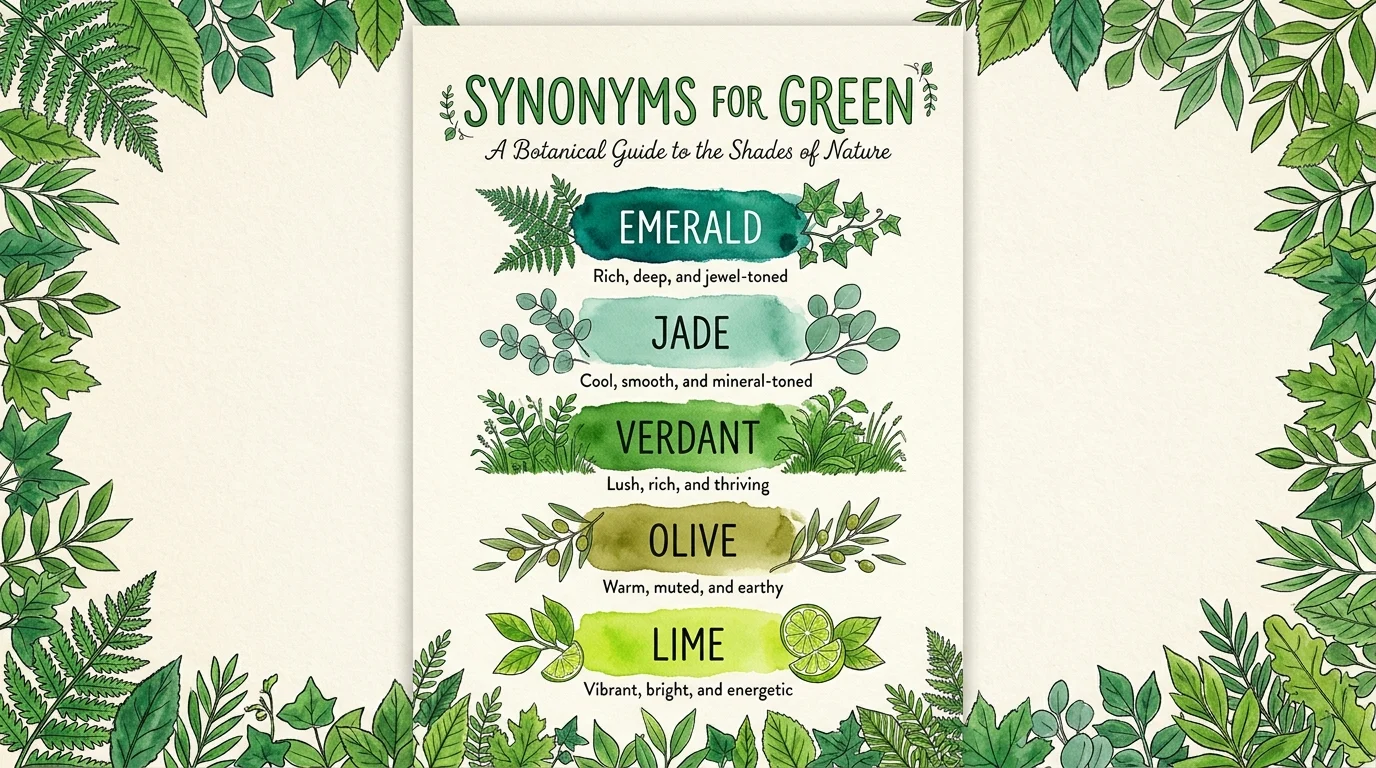
Green is a colour, a feeling, and an idea. It can describe grass, leaves, and fields, and it can also describe envy, inexperience, and care for nature. For this reason, finding the right synonyms for green can change the meaning of a sentence completely. This guide gives you clear synonyms for green, with meanings, examples, and advice on when to use each one.
In addition, this guide helps you avoid vague writing. For example, a colour calls for emerald, while nature calls for leafy, and inexperience calls for new. The best choice depends on the context, the audience, and the feeling you want to create.
Quick Answer: What Does Green Mean?
Quick answer: Green means the colour between blue and yellow, and it also means fresh, natural, or new. Good synonyms for green include emerald, leafy, verdant, fresh, natural, and eco-friendly. Generally, emerald also fits a colour meaning. Visually, leafy or verdant also fits nature. For inexperience, new also fits a simple meaning.
Meaning, Tone, and Context
Simple Definition
Green is the colour of grass, leaves, and many plants. It can also describe something fresh, natural, or not yet ripe. For example, a green apple is unripe, and a green valley is full of plants.
Part of Speech
Green is mainly an adjective, as in green leaves. It can also act as a noun, as in the green of the hills. Common forms include greenness, greener, and greenest. Greenness names the quality. Greener compares two things.
Tone
Green sounds calm, natural, and positive. It can feel fresh in a garden guide, and it can feel formal in an eco report. However, it can also sound negative when it means envy or sickness. In that case, a specific synonym works better.
Formality
Green works in formal, academic, business, and casual writing. In formal writing, pair it with a clear noun, such as green energy or green policy. In casual writing, a short phrase such as bright green or light green is enough.
Common Use Cases
- Colour: emerald, lime, olive, and mint
- Nature: leafy, grassy, and verdant
- Environment: eco-friendly, sustainable, and natural
- Feeling: envious, jealous, and sickly
- Experience: new, fresh, and untried
Important Word Forms
Use green for the general idea. Emerald fits a rich colour. Leafy fits plants and trees. The word greenery, in addition, covers plants as a group. Eco-friendly fits care for nature, not colour.
When and How to Use Green by Context
Academic Context
In academic writing, name the shade or the field. For example, write emerald green, green energy, or green policy. This keeps the claim precise. A reader can then follow the argument without guessing.
Social Context
In conversation, green is easy and friendly. For example, you can say: I love the green hills. If a friend asks what you mean, add a detail: I mean bright grass and dark trees.
Literary Context
In stories and poems, green can stand for youth, hope, or envy. Writers often use it as a theme. For example, a character may feel green with envy. Here, green means jealousy, not colour.
Creative Context
In creative work, vary the word to avoid repetition. Use emerald for colour, leafy for nature, and fresh for newness. This variety, therefore, keeps the writing fresh and clear.
Casual Context
In casual talk, green can describe almost any plant colour. For example: The garden is very green this year. The phrase is praise for growth. It does not mean every leaf has the same shade.
Another Word for Green
If you need one simple replacement for green, emerald is the safest colour choice. Nature also calls for leafy. Feeling also calls for envious. Inexperience also calls for new. Each choice, however, changes the focus a little, so pick the focus you want.
When Not to Use Green
Do not use green when a precise word is available. For example, avoid green when you mean blue, yellow, or brown. Similarly, avoid green for a colour that is clearly teal or olive, unless you add the shade. In addition, avoid green as praise for work you have not described. The reader needs evidence, not only a label.
Words Commonly Confused With Green
Green vs Emerald
Emerald is a rich, deep green shade. Green is the wider colour group. A ring can be emerald. A field can be green.
Green vs Teal
Teal mixes blue and green. Green sits between blue and yellow. A teal wall looks blue in some light. A green wall looks leaf-like.
Green vs Olive
Olive is a dull, yellow-green shade. Green is the wider group. Therefore, do not use olive for bright grass colour.
Green vs Eco-friendly
Eco-friendly describes care for nature. Green can mean the same in slogans, but it also means colour. A product can be eco-friendly without being green in colour.
Green vs Fresh
Fresh means new or recently made. Green can mean fresh in people and plants, but it also means colour. Fresh bread is not green in colour.
Best Synonym for Green by Context
| Context | Best Synonym | Example |
|---|---|---|
| General colour | Emerald | The dress is a rich emerald colour. |
| Nature | Leafy | In summer, the valley looks leafy and full. |
| Environment | Eco-friendly | Eco-friendly packaging also cuts plastic waste. |
| Envy | Envious | She felt envious of her friend’s success. |
| Formal writing | Verdant | The report describes a verdant valley. |
| Light shade | Mint | Each wall is painted a soft mint shade. |
| Inexperience | New | He is new to the job and still learning. |
| Bright shade | Lime | Bright and fresh, the lime shirt stands out. |
Which Synonym Should You Choose?
Ask three questions. First, is it a colour, nature, or a feeling? Second, is it light, dark, or dull? Third, is the tone formal or casual? A colour, for example, calls for emerald or lime, while nature calls for leafy, and envy calls for envious. This short test gives a clear answer in most cases.
10 Key Synonyms for Green
| Synonym | Meaning | Example |
|---|---|---|
| Emerald | A rich deep green | A deep emerald stone sits in the ring. |
| Lime | A bright yellow-green | She wore a lime jacket in the rain. |
| Olive | A dull yellow-green | At dusk, the hills turned olive. |
| Jade | A pale blue-green stone colour | In the shop, a jade vase caught her eye. |
| Mint | A light fresh green | Soft and light, the mint room feels calm. |
| Forest | A dark tree green | Forest trees filled the whole valley. |
| Leafy | Full of leaves | Leafy branches shaded the path. |
| Verdant | Green with plants | Please visit the verdant garden in spring. |
| Grassy | Covered with grass | Grassy fields stretched to the river. |
| Eco-friendly | Kind to nature | Critics praised the eco-friendly plan. |
Synonyms for Green by Context and Usage Differences
Professional vs Personal
At work, use verdant, eco-friendly, and emerald. These words sound precise. Personally, use green, leafy, and fresh. These words, in addition, sound warm and simple.
Formal vs Conversational
Formal writing prefers verdant, eco-friendly, and emerald. Conversation prefers green, leafy, and mint. The meaning stays close, but the register changes.
Academic
Academic writers often name the shade: emerald, olive, or forest. In addition, they define the term in the first paragraph. This avoids confusion later in the text.
Professional and Business
Business writing favours eco-friendly, sustainable, and natural. These words fit reports, briefs, and product notes. For example, a brief may ask for eco-friendly packaging, not green packaging.
Creative and Literary
Creative writing can use stronger words: verdant, emerald, and leafy. These words carry colour and feeling. However, use verdant only for plant-rich scenes.
Slang and Modern
Modern casual speech includes go green for eco choices, and green for new staff. For example: The office decided to go green. The phrase praises eco action, not colour.
Strongest vs Weaker
Strongest: verdant, emerald, eco-friendly. Middle: green, leafy, fresh. Weaker: mint, lime, grassy. Choose strength to match your praise.
Emotional vs Neutral
Emotional: envious, verdant, fresh. Neutral: emerald, leafy, eco-friendly. A news report prefers neutral words. A review can use emotional words.
Antonyms for Green
| Antonym | Meaning | Example |
|---|---|---|
| Red | A different colour | Red and green both appear in the flag. |
| Brown | A dull earth colour | The leaves turned brown in autumn. |
| Withered | Dried and faded | Withered plants replaced the green ones. |
| Experienced | Skilled through practice | Experienced staff guided the new team. |
| Ripe | Ready to eat | Ripe fruit replaced the green fruit. |
| Artificial | Made, not natural | Artificial grass lacks the smell of green grass. |
Comparison: Green and Its Closest Alternatives
Emerald is the closest colour match to green, but it is narrower and richer. Leafy is closer for nature, but it stresses leaves, not colour. Eco-friendly is closer for nature care, but it stresses action, not shade. Therefore, use green for the general idea, and use a specific synonym when the shade or meaning matters most.
Common Phrases and Expressions
1. Green with envy
A feeling of envy: She was green with envy when her friend won.
2. Give the green light
The signal to proceed: The manager gave the green light to the project.
3. Green thumb
Made for gardening skill: He has a green thumb and grows tomatoes easily.
4. Go green
Based on eco-friendly choices: The family decided to go green and cut waste.
5. Green around the gills
Found in illness or shock: He looked green around the gills after the long boat ride.
6. Green-eyed monster
Made from jealousy: Jealousy, also called the green-eyed monster, can spoil friendships.
7. Green belt
Based on land protection: The green belt around the city limits new building.
8. Green energy
Found in clean power: Green energy comes from sun, wind, and water.
9. Green fingers
Made for gardening: She has green fingers and keeps plants alive all year.
10. Green room
The waiting room for performers: Actors waited in the green room before the show.
Common Mistakes to Avoid
1. Using green for every plant colour
Repeating green weakens it. Name the shade when you can: lime, olive, or mint.
2. Calling teal green without care
Teal mixes blue and green. Use teal for a blue-green shade, and green for a leaf shade.
3. Using eco-friendly for colour
Eco-friendly means kind to nature. If the item is only green in colour, use emerald or lime.
4. Mixing green with fresh without care
Fresh means new. Green means colour or nature. Check which idea you want before you choose.
5. Forgetting the audience
Readers need a clear noun. Verdant helps in a report. Green alone may confuse a new reader.
Frequently Asked Questions
What is a formal synonym for green?
Verdant and emerald are formal alternatives. Choose verdant for nature, and emerald for colour.
What is an informal synonym for green?
Leafy, mint, and lime are common informal choices. They sound natural in everyday talk.
What is another word for green in academic writing?
Verdant is usually best, with the shade added: emerald, olive, or forest green.
What is the difference between green and emerald?
Emerald is a rich deep shade. Green is the wider colour group. Many greens are not emerald.
What is the opposite of green?
The opposite depends on context: red for colour, withered for plants, and experienced for people.
What does green with envy mean?
It means feeling jealous of someone else, such as a friend who won a prize.
What are good synonyms for green in general?
Good synonyms for green include emerald, leafy, verdant, mint, lime, and eco-friendly. Pick the word that matches the shade and the tone.
Conclusion
Green is a useful word, but it works best when the shade, nature, or feeling is clear. Generally, choose emerald for a rich colour. In addition, choose leafy or verdant for nature. Similarly, choose eco-friendly for nature care, and new for inexperience. To check the core meaning, see Merriam-Webster’s definition of green. With these synonyms for green, you can write with more precision, warmth, and confidence.
