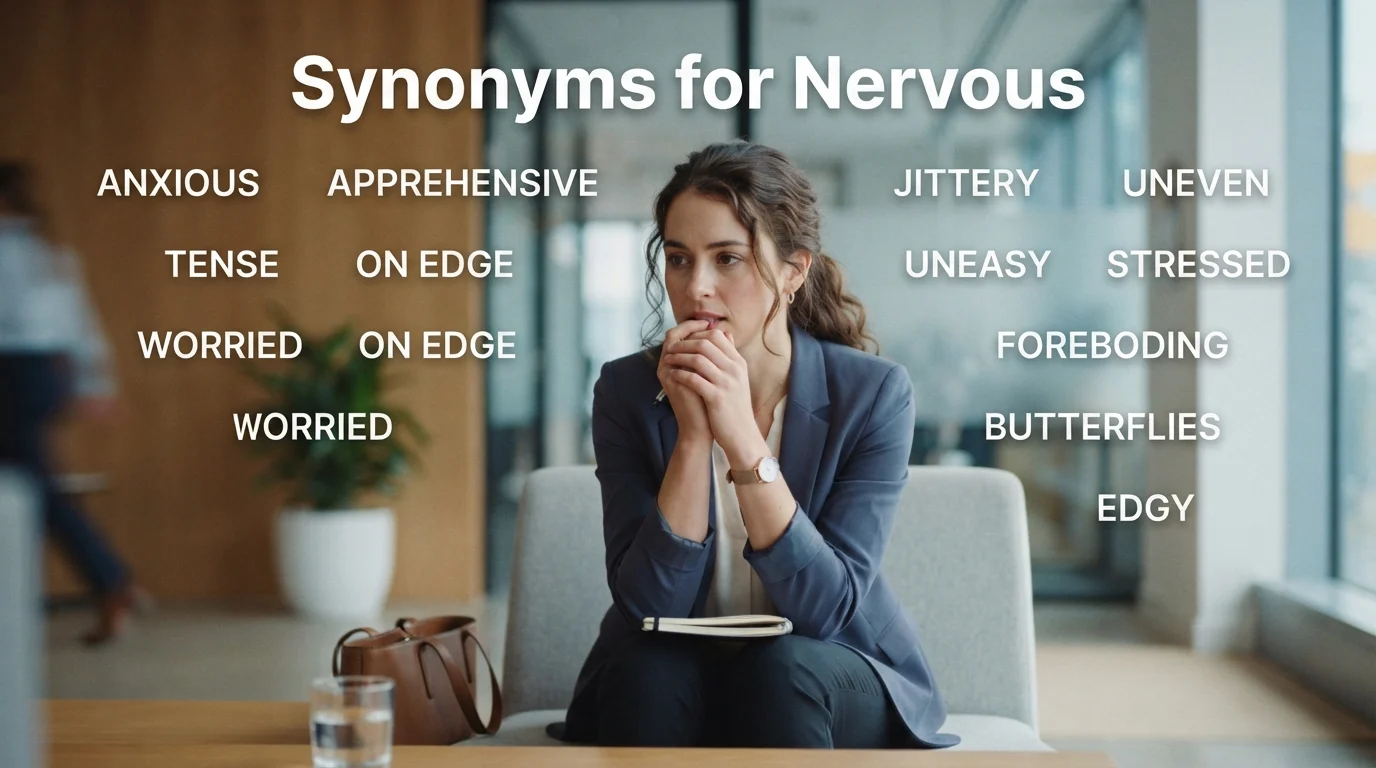
Do you keep using the word “nervous” in essays, emails, creative writing, mental health content, or everyday conversation? While it is one of the most common and useful words in English, repeating it can make your writing feel flat, repetitive, or overly simple.
The good news is that the best alternative depends on what you actually mean. You might be describing mild anxiety, intense fear, anxious anticipation, shyness, restlessness, or physical tension before a big event.
This guide explains synonyms for “nervous” by meaning, tone, context, and usage. You will learn which alternatives work best in academic writing, professional communication, creative expression, mental health content, and casual conversation.
Quick Answer: What Does “Nervous” Mean?
“Nervous” describes a state of anxiety, unease, or apprehension. It can refer to mild worry before an event, intense fear, shyness in social situations, or physical tension. Depending on context, alternatives include anxious, apprehensive, jittery, uneasy, tense, edgy, fidgety, worried, antsy, and on edge.
Meaning, Tone, and Context
Simple Definition
“Nervous” generally refers to:
- Anxiety: feeling worried or uneasy about something
- Apprehension: anticipating something with fear or unease
- Tension: physical or mental strain
- Shyness: feeling uncomfortable in social situations
- Restlessness: inability to relax or stay still
- Fear: being afraid of something specific
Part of Speech
“Nervous” functions primarily as an adjective.
Examples:
- “She was nervous before the interview.”
- “He gets nervous around large crowds.”
Related Forms:
- Nervously (adverb): in a nervous manner
- Nervousness (noun): the state of being nervous
- Nerve (noun): courage; a bundle of fibers
- Nervy (adjective): bold or impudent (British); nervous (American)
Positive, Negative, or Neutral Tone
“Nervous” is generally negative but can be neutral in some contexts.
Negative associations:
- “She was nervous about the exam.”
- “He felt nervous meeting her parents.”
Neutral contexts:
- “A little nervous energy can help performance.”
- “Nervousness before a big event is normal.”
Formality Level
“Nervous” is a standard word that works in both formal and informal English. It is appropriate in academic writing, business communication, creative writing, and casual conversation.
However, more specific alternatives can add precision and variety depending on the context.
Common Use Cases
“Nervous” commonly refers to:
- Performance anxiety: before a test, interview, or presentation
- Social anxiety: meeting new people, large crowds
- Anticipation: waiting for important news or events
- Physical symptoms: trembling, sweating, fidgeting
- General worry: everyday concerns and stress
Important Word Forms
- Nervous (adjective): anxious or uneasy
- Nervously (adverb): in an anxious manner
- Nervousness (noun): the state of being nervous
- Nerve (noun): courage; a fiber in the body
- Nervy (adjective): bold or impudent (British); nervous (American)
- Nervous system (noun): the body’s network of nerves
When and How to Use “Nervous”
Use “nervous” when you want to describe a state of anxiety, unease, or apprehension. Because the word is broad, more specific alternatives can add precision depending on the context.
Professional
“She was nervous before her presentation to the board.”
This works naturally in business communication.
Academic
“Students often feel nervous before exams.”
The term is appropriate in academic contexts.
Personal
“I get nervous when I have to speak in public.”
The word sounds natural in everyday conversation.
Creative
“His nervous hands trembled as he opened the letter.”
The word creates a vivid image of anxiety.
Mental Health
“Nervousness can be a symptom of an anxiety disorder.”
This is appropriate in mental health contexts.
Medical
“The patient reported feeling nervous and on edge.”
This is standard in medical contexts.
Another Word for “Nervous”
There is no single perfect synonym because “nervous” can refer to anxiety, apprehension, tension, shyness, restlessness, or fear.
- Anxiety context: anxious, worried, uneasy, concerned, tense
- Apprehension context: apprehensive, fearful, frightened, scared
- Tension context: tense, edgy, on edge, jittery, wired
- Shyness context: shy, timid, self-conscious, bashful
- Restlessness context: restless, fidgety, antsy, jumpy, agitated
- Fear context: afraid, fearful, terrified, panic-stricken
If you need one broad alternative, “anxious” works in most contexts, while “apprehensive” works for anticipating something with fear. “Jittery” works for physical symptoms.
When Not to Use “Nervous”
“Nervous” can become too vague when you need to specify exactly what kind of nervousness you are describing.
Consider:
“She was nervous.”
This statement does not tell readers whether she was worried, scared, shy, tense, or restless.
A more precise sentence could be:
“She was apprehensive about the upcoming surgery.”
Similarly, avoid using “nervous” when you mean “excited” in a positive context. Use “excited” or “eager” instead.
Words Commonly Confused With “Nervous”
Nervous vs. Anxious
Anxious often implies worry about something specific. Nervous can be more general.
Example:
“She was anxious about the test results.” (specific worry)
“She was nervous before the test.” (general unease)
Nervous vs. Excited
Excited is a positive feeling of enthusiasm. Nervous is negative or neutral.
Example:
“She was excited about the trip.” (positive)
“She was nervous about the flight.” (negative)
Nervous vs. Scared
Scared implies fear of something specific. Nervous can be more general unease.
Example:
“She was scared of the dark.” (fear)
“She was nervous about the dark alley.” (unease)
Nervous vs. Tense
Tense implies physical or mental strain. Nervous can be more emotional.
Example:
“His muscles were tense.” (physical)
“He was nervous about the meeting.” (emotional)
Nervous vs. Shy
Shy means uncomfortable in social situations. Nervous can be broader.
Example:
“She is shy around new people.” (social)
“She is nervous about the interview.” (specific)
Nervous vs. Worried
Worried means thinking about problems or potential problems. Nervous can be more physical.
Example:
“She was worried about her grades.” (thinking)
“She was nervous before the exam.” (physical/emotional)
Best Synonym by Context for “Nervous”
| Context | Best Synonym | Why It Works | Example |
|---|---|---|---|
| Formal writing | Apprehensive, anxious | Precise and professional | She was apprehensive about the changes. |
| Academic writing | Anxious, concerned | Standard academic usage | Students reported feeling anxious before exams. |
| Business/Professional | Uneasy, tense | Professional and clear | He felt uneasy about the merger. |
| Performance anxiety | Jittery, edgy | Physical symptoms | She felt jittery before the performance. |
| Social anxiety | Self-conscious, shy | Social contexts | He felt self-conscious at the party. |
| Anticipation | Apprehensive, on edge | Waiting for something | She was on edge waiting for the news. |
| Physical symptoms | Jittery, fidgety, jumpy | Physical restlessness | He was fidgety during the interview. |
| Casual conversation | Nervous, worried | Natural and informal | I’m so nervous about tomorrow. |
| Creative writing | Tremulous, edgy, unsettled | Adds literary depth | Her tremulous hands betrayed her fear. |
| Mental health | Anxious, agitated | Clinical context | The patient reported feeling agitated. |
| Fear context | Afraid, fearful, scared | Strong fear | She was fearful of the outcome. |
| Extreme nervousness | Panicked, frantic | Severe anxiety | He was panicked before the surgery. |
Which Synonym Should You Choose?
Start by identifying what kind of “nervous” you are describing.
- Anxiety: anxious, worried, uneasy, concerned
- Apprehension: apprehensive, fearful, frightened
- Tension: tense, edgy, on edge, jittery, wired
- Shyness: shy, timid, self-conscious, bashful
- Restlessness: restless, fidgety, antsy, jumpy, agitated
- Fear: afraid, fearful, terrified, panic-stricken
10 Key Synonyms for “Nervous”
The table below includes accurate alternatives with clear meanings and usage contexts.
| Synonym | Simple Meaning | Best Used For | Example Sentence |
|---|---|---|---|
| Anxious | Worried or uneasy | General, clinical | She was anxious about the results. |
| Apprehensive | Anticipating something with fear | Formal, anticipation | He was apprehensive about the meeting. |
| Jittery | Feeling nervous and restless | Physical symptoms | She felt jittery before the exam. |
| Uneasy | Slightly worried or uncomfortable | General, mild | He felt uneasy about the situation. |
| Tense | Mentally or physically strained | Physical, emotional | The atmosphere was tense. |
| Edgy | Irritable and nervous | Informal, general | She was feeling edgy all day. |
| Fidgety | Unable to stay still | Physical restlessness | The children were fidgety during the long wait. |
| Worried | Thinking about problems | General, everyday | He was worried about the deadline. |
| Antsy | Restless and impatient | Informal, casual | She was antsy waiting for the results. |
| On edge | Tense and irritable | Informal, general | He was on edge before the interview. |
Synonym Groups and Usage Differences
Professional vs. Personal Synonyms
Professional writing benefits from specific terms such as apprehensive, uneasy, concerned, and tense.
Personal communication often uses nervous itself or casual alternatives like jittery, antsy, or on edge.
Compare:
“I’m so nervous!” (personal)
“She was apprehensive about the restructuring.” (professional)
Formal vs. Conversational Synonyms
Nervous works in both formal and conversational English.
Formal alternatives: apprehensive, anxious, uneasy, concerned
Conversational alternatives: jittery, antsy, on edge, jumpy
Examples:
“She was apprehensive about the changes.” (formal)
“She was feeling jittery before the test.” (conversational)
Academic Synonyms
Academic writing should distinguish between nervous (general), anxious (worry), apprehensive (anticipation), and tense (strain).
For example:
“The study examined test anxiety among students.”
“Participants reported feeling apprehensive before the procedure.”
Professional and Business Synonyms
Business writing often benefits from phrases such as uneasy, concerned, apprehensive, and tense.
Instead of:
“Employees are nervous about the merger.”
Consider:
“Employees are apprehensive about the proposed merger.”
Creative or Literary Synonyms
Creative writing can use tremulous, edgy, unsettled, quivering, and taut depending on the context.
For example:
“Her tremulous voice betrayed her nervousness.”
“The atmosphere was taut with anticipation.”
Slang or Modern Synonyms
Antsy is a common casual term.
Jittery is casual for physical nervousness.
On edge is casual for tension.
Wired is casual for agitated.
Freaking out is slang for extreme nervousness.
Examples:
“I’m so antsy about the results.” (casual)
“She was freaking out before the speech.” (slang)
Strongest vs. Weaker Synonyms
“Nervous” synonyms vary in intensity:
Milder: uneasy, concerned, worried
Moderate: nervous, anxious, tense
Strong: apprehensive, jittery, edgy
Very Strong: panicked, terrified, frantic
Emotional vs. Neutral Synonyms
“Nervous” is generally emotional and negative.
Emotional alternatives: fearful, panicked, terrified, frantic
Neutral alternatives: concerned, uneasy, tense
Examples:
“She was terrified of the results.” (emotional, strong)
“She was concerned about the results.” (neutral, mild)
Antonyms of “Nervous”
“Nervous” has several antonyms depending on context:
| Antonym | Context | Meaning | Example Sentence |
|---|---|---|---|
| Calm | General | Peaceful and relaxed | She remained calm during the crisis. |
| Relaxed | General | Free from tension | He felt relaxed after the massage. |
| Confident | General | Sure of oneself | She was confident before the interview. |
| Composed | General | Calm and in control | He was composed during the emergency. |
| Serene | General | Peaceful and untroubled | The garden was serene. |
| Unflappable | General | Hard to upset | She was unflappable under pressure. |
| Assured | General | Confident and certain | He was assured in his delivery. |
Comparison: “Nervous” vs. Similar Words
Nervous vs. Anxious
Main difference: Anxious often implies worry about something specific. Nervous can be more general.
Examples:
“She was anxious about the test results.” (specific worry)
“She was nervous before the test.” (general unease)
Nervous vs. Excited
Main difference: Excited is a positive feeling of enthusiasm. Nervous is negative or neutral.
Examples:
“She was excited about the trip.” (positive)
“She was nervous about the flight.” (negative)
Nervous vs. Scared
Main difference: Scared implies fear of something specific. Nervous can be more general unease.
Examples:
“She was scared of the dark.” (fear)
“She was nervous about the dark alley.” (unease)
Nervous vs. Tense
Main difference: Tense implies physical or mental strain. Nervous can be more emotional.
Examples:
“His muscles were tense.” (physical)
“He was nervous about the meeting.” (emotional)
Nervous vs. Shy
Main difference: Shy means uncomfortable in social situations. Nervous can be broader.
Examples:
“She is shy around new people.” (social)
“She is nervous about the interview.” (specific)
Nervous vs. Worried
Main difference: Worried means thinking about problems or potential problems. Nervous can be more physical.
Examples:
“She was worried about her grades.” (thinking)
“She was nervous before the exam.” (physical/emotional)
Common Phrases and Expressions with “Nervous”
1. Nervous wreck
Meaning:
Someone who is extremely nervous.
Example:
“She was a nervous wreck before the wedding.”
2. Nervous energy
Meaning:
Restless energy caused by anxiety.
Example:
“He paced the room with nervous energy.”
3. Get on someone’s nerves
Meaning:
To annoy someone.
Example:
“The constant noise is getting on my nerves.”
4. A bundle of nerves
Meaning:
Someone who is very nervous.
Example:
“She was a bundle of nerves before the presentation.”
5. Nervous laughter
Meaning:
Laughing out of nervousness.
Example:
“He let out a nervous laugh.”
6. Butterflies in my stomach
Meaning:
Feeling nervous.
Example:
“I had butterflies in my stomach before the interview.”
7. On edge
Meaning:
Tense and irritable.
Example:
“She was on edge all day.”
8. Jumpy
Meaning:
Easily startled; nervous.
Example:
“He was jumpy after the accident.”
9. Nerve-racking
Meaning:
Causing nervousness.
Example:
“Waiting for the results was nerve-racking.”
10. Steady one’s nerves
Meaning:
To calm down.
Example:
“She took a deep breath to steady her nerves.”
Common Mistakes to Avoid
1. Using “nervous” when “excited” is more appropriate
Excited is positive. Nervous is negative or neutral.
Incorrect: “I’m nervous about the party!” (if happy)
Correct: “I’m excited about the party!”
2. Confusing “nervous” with “anxious”
Anxious often implies worry about something specific. Nervous can be more general.
Incorrect: “She was nervous about the results.” (if worried)
Correct: “She was anxious about the results.”
3. Using “nervous” in formal writing when “apprehensive” is needed
Formal writing benefits from more precise terms.
Informal: “She was nervous about the changes.”
Formal: “She was apprehensive about the changes.”
4. Overusing “nervous” in writing
Repetition can make content feel dull. Use alternatives such as anxious, apprehensive, jittery, uneasy, and tense.
5. Choosing a synonym that changes the meaning
Do not replace nervous with scared unless you mean fear.
Do not replace nervous with shy unless you mean social discomfort.
FAQs
What is the best synonym for “nervous”?
The best synonym depends on context. Anxious works for worry, apprehensive for anticipation, jittery for physical symptoms, uneasy for mild discomfort, and tense for strain.
What is a formal synonym for “nervous”?
Apprehensive, anxious, uneasy, concerned, and tense are formal synonyms.
What is an informal synonym for “nervous”?
Jittery, antsy, on edge, jumpy, and wired are common informal alternatives.
What is another word for “nervous” in creative writing?
Tremulous, edgy, unsettled, quivering, and taut work well in creative writing.
What is the difference between “nervous” and “anxious”?
Anxious often implies worry about something specific. Nervous can be more general.
What is the opposite of “nervous”?
Depending on context, opposites include calm, relaxed, confident, composed, and serene.
What does “nervous” mean in a medical context?
In medicine, nervous can refer to the nervous system or to symptoms of anxiety such as trembling, sweating, or restlessness.
Conclusion
“Nervous” is a versatile and essential word that can describe anxiety, apprehension, tension, shyness, restlessness, and fear. The best synonym depends on what you actually mean.
Choose anxious for worry, apprehensive for anticipation, jittery for physical symptoms, uneasy for mild discomfort, tense for strain, and scared for fear.
Most importantly, do not replace “nervous” simply to avoid repetition. First identify what kind of nervousness—emotional, physical, social, or anticipatory—you are actually describing. Then choose the alternative that communicates that idea most clearly.
For academic, professional, and formal writing, precision is usually more valuable than vocabulary variety. A specific term such as apprehensive, anxious, uneasy, or tense can tell readers much more than the broad word nervous.
Before publishing a vocabulary guide, verify definitions and usage with trusted dictionaries such as Cambridge, Oxford, Merriam-Webster, Collins, or Britannica. This helps ensure that each alternative accurately matches its intended meaning and context.
The practical takeaway is simple: when “nervous” feels too general, ask yourself what kind of anxiety, fear, or tension you are actually describing. Then use the most precise word available.
Discover More:-
- 50+ Synonyms for Elite: Meanings, Examples, and Best Alternatives
- 50+ Synonyms for Identity: Meanings, Examples, and Best Alternatives

2 thoughts on “50+ Synonyms for Nervous: Meanings, Examples, and Best Alternatives”