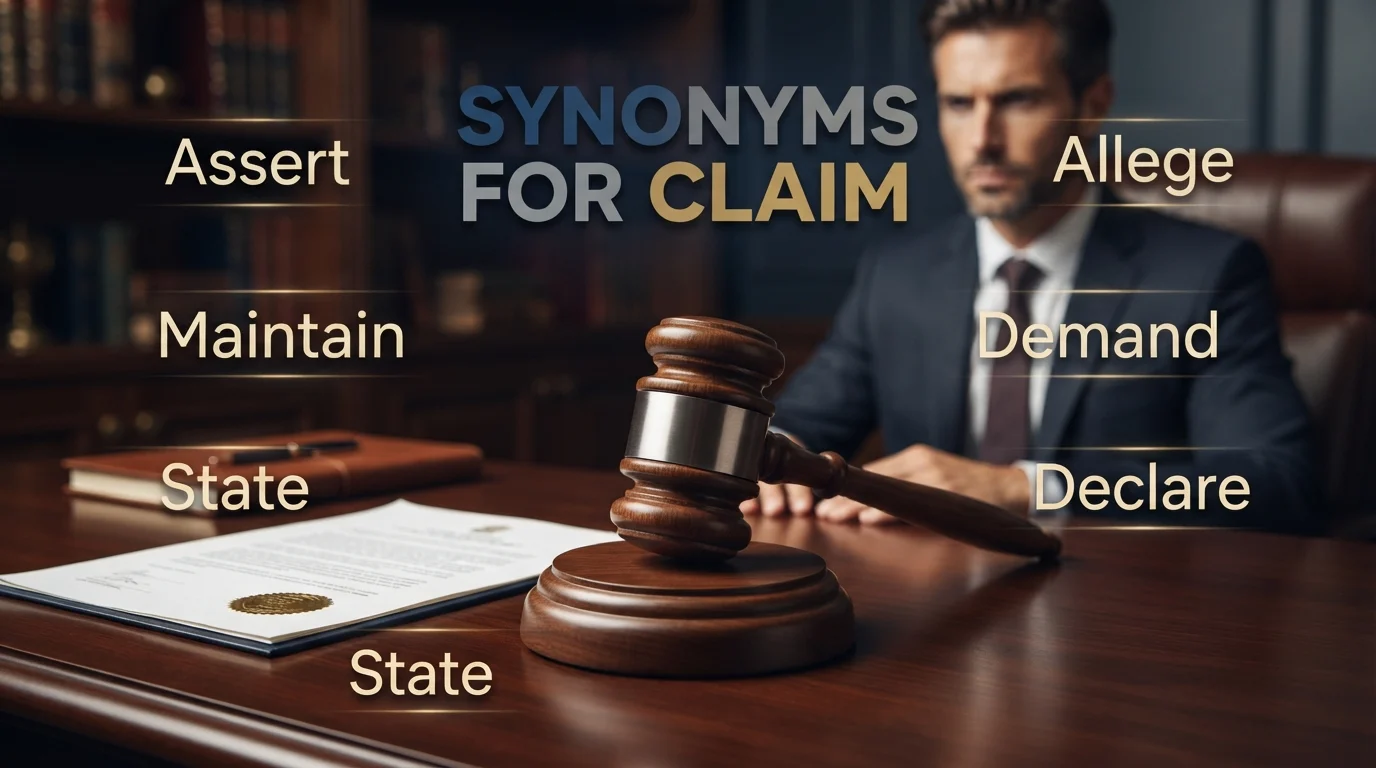
Do you keep using the word “claim” in essays, business reports, legal writing, news articles, insurance forms, or everyday conversation? While it is one of the most useful and versatile words in English, repeating it can make your writing feel flat, repetitive, or overly vague.
The good news is that the best alternative depends on what you actually mean. You might be describing an assertion, a demand for something you are owed, a formal request, a legal right, or a statement that may or may not be true.
This guide explains synonyms for “claim” by meaning, tone, context, and usage. You will learn which alternatives work best in academic writing, professional communication, legal contexts, insurance, news reporting, and casual conversation.
Quick Answer: What Does “Claim” Mean?
“Claim” can mean to state something as true, to demand something as a right, to request something formally, or to take ownership of something. As a noun, it refers to an assertion, a demand, or a formal request. Depending on context, alternatives include assert, allege, maintain, contend, demand, request, state, declare, affirm, assertion, and allegation.
Meaning, Tone, and Context
Simple Definition
“Claim” generally refers to:
- Asserting: stating something as true, often without proof
- Demanding: asking for something as a right
- Requesting: applying for something formally
- Taking ownership: asserting ownership of something
- Legal action: making a formal legal request or demand
- Insurance: requesting payment for a loss
Part of Speech
“Claim” functions primarily as a verb and a noun.
Verb Examples:
- “He claims to know the answer.”
- “She claimed her luggage at the airport.”
Noun Examples:
- “His claim was rejected by the insurance company.”
- “She made a claim for damages.”
Related Forms:
- Claimant (noun): a person making a claim
- Claimed (verb): asserted or demanded
- Claiming (verb): asserting or demanding
- Unclaimed (adjective): not claimed
- Counterclaim (noun/verb): a claim made in response to another claim
Positive, Negative, or Neutral Tone
“Claim” is generally neutral, but it can be negative when it implies an unproven assertion.
Positive or neutral associations:
- “She claimed her prize.” (neutral)
- “He claimed his rightful inheritance.” (neutral)
Negative contexts:
- “He claimed to be innocent, but the evidence suggested otherwise.” (unproven)
- “The company made false claims about its product.” (negative)
Formality Level
“Claim” is a standard word that works in both formal and informal English. It is especially common in legal, academic, business, and news contexts.
However, more specific alternatives can add precision and variety depending on the context.
Common Use Cases
“Claim” commonly refers to:
- Assertions: claiming that something is true
- Legal claims: filing a claim, making a claim
- Insurance claims: submitting a claim for damages
- Ownership: claiming ownership of property
- Rights: claiming a right or entitlement
- Demands: claiming payment or compensation
Important Word Forms
- Claim (verb): to assert, demand, or take ownership
- Claim (noun): an assertion, demand, or request
- Claimant (noun): a person making a claim
- Claimed (verb): asserted or demanded
- Claiming (verb): asserting or demanding
- Counterclaim (noun/verb): a claim made in response
- Unclaimed (adjective): not claimed
When and How to Use “Claim”
Use “claim” when you want to describe asserting something as true, demanding something as a right, or requesting something formally. Because the word is broad, more specific alternatives can add precision depending on the context.
Professional
“The company claims that its new product is more effective.”
This works naturally in business communication.
Academic
“The study claims a causal relationship between the variables.”
The term is appropriate in academic writing, though more precise terms like suggests or demonstrates may be better.
Legal
“The plaintiff claims damages for breach of contract.”
This is standard in legal contexts.
Insurance
“She filed a claim for the damage to her car.”
This is standard in insurance contexts.
Personal
“He claims he didn’t see the sign.”
The word sounds natural in everyday conversation.
News
“The senator claims to have new evidence.”
This is standard in news reporting.
Another Word for “Claim”
There is no single perfect synonym because “claim” can refer to asserting, demanding, requesting, or taking ownership.
- Assertion context: assert, allege, maintain, contend, state, declare, affirm
- Demand context: demand, request, require, ask for, insist on
- Legal context: file a claim, sue, petition, litigate
- Ownership context: take, appropriate, seize, assume ownership
- Insurance context: file a claim, submit a claim, request compensation
- Right context: assert a right, exercise a right, demand a right
If you need one broad alternative, “assert” works for stating something as true, while “demand” works for requesting something as a right. “Allege” works in legal contexts.
When Not to Use “Claim”
“Claim” can become too vague or imply doubt when you need to specify exactly what is being stated or demanded.
Consider:
“He claims it’s true.”
This statement does not tell readers whether he is asserting, alleging, or demanding.
A more precise sentence could be:
“He asserts that the data supports his conclusion.”
Similarly, in academic writing, “claim” can imply that something is unproven. Use “demonstrate”, “show”, or “suggest” when appropriate.
Words Commonly Confused With “Claim”
Claim vs. Assert
Assert means to state something confidently and forcefully. Claim can imply less certainty.
Example:
“She asserted her innocence.” (confident)
“She claimed to be innocent.” (possibly unproven)
Claim vs. Allege
Allege means to claim something is true, often without proof, and is common in legal contexts.
Example:
“The prosecutor alleged that he committed fraud.” (legal)
“He claimed he was innocent.” (general)
Claim vs. Maintain
Maintain means to continue to assert something, often in the face of opposition.
Example:
“She maintained her innocence throughout the trial.” (continued to assert)
“She claimed she was innocent.” (stated)
Claim vs. Demand
Demand means to ask for something forcefully as a right. Claim can mean demanding, but also asserting.
Example:
“She demanded a refund.” (forceful)
“She claimed a refund.” (requested)
Claim vs. State
State means to express something clearly and definitely. Claim can imply uncertainty.
Example:
“He stated the facts.” (clear)
“He claimed the facts supported him.” (possibly unproven)
Claim vs. Declare
Declare means to announce something officially or formally. Claim can be less formal.
Example:
“The government declared a state of emergency.” (official)
“He claimed to have won the lottery.” (unverified)
Best Synonym by Context for “Claim”
| Context | Best Synonym | Why It Works | Example |
|---|---|---|---|
| Formal writing | Assert, maintain | Precise and professional | The report asserts a clear causal link. |
| Academic writing | Allege, contend | Standard academic usage | The study alleges a correlation. |
| Legal writing | Allege, petition, sue | Legally precise | The plaintiff alleges breach of contract. |
| Insurance | File a claim, submit a claim | Industry standard | She filed a claim for the damage. |
| Business/Professional | Assert, state, maintain | Professional and clear | The company maintains that the product is safe. |
| News reporting | Allege, claim | Standard news usage | The senator alleges misconduct. |
| Ownership | Take, assume, appropriate | Emphasizes possession | He took ownership of the property. |
| Rights | Assert, exercise | Emphasizes entitlement | She asserted her right to remain silent. |
| Demand | Demand, insist on, require | Emphasizes demand | He demanded compensation. |
| Casual conversation | Say, insist | Natural and informal | He says he didn’t do it. |
| Creative writing | Profess, purport | Literary and formal | She professed her innocence. |
| Request | Request, apply for | Formal request | He applied for a refund. |
Which Synonym Should You Choose?
Start by identifying what kind of “claim” you are describing.
- Assertion: assert, allege, maintain, contend, state, declare
- Demand: demand, insist on, require, ask for
- Legal: allege, petition, sue, litigate
- Insurance: file a claim, submit a claim, request compensation
- Ownership: take, assume, appropriate, seize
- Rights: assert, exercise, demand
- Request: request, apply for, petition
10 Key Synonyms for “Claim”
The table below includes accurate alternatives with clear meanings and usage contexts.
| Synonym | Simple Meaning | Best Used For | Example Sentence |
|---|---|---|---|
| Assert | State confidently | General, formal | She asserted her innocence. |
| Allege | Claim without proof | Legal, news | The prosecutor alleged fraud. |
| Maintain | Continue to assert | General, formal | He maintained his position. |
| Contend | Argue or assert | Academic, debate | The author contends that the policy failed. |
| Demand | Ask forcefully | General, business | She demanded a refund. |
| Request | Ask for formally | Business, formal | He requested a copy of the report. |
| State | Express clearly | General, formal | He stated the facts. |
| Declare | Announce officially | Formal, legal | The government declared a state of emergency. |
| Affirm | State positively | Formal, legal | She affirmed her commitment. |
| Assertion | A confident statement | General, formal | His assertion was met with skepticism. |
Synonym Groups and Usage Differences
Professional vs. Personal Synonyms
Professional writing benefits from specific terms such as assert, maintain, state, contend, and allege.
Personal communication often uses claim itself or casual alternatives like say, insist, or argue.
Compare:
“He says he’s innocent.” (personal)
“He maintains his innocence.” (professional)
Formal vs. Conversational Synonyms
Claim works in both formal and conversational English.
Formal alternatives: assert, maintain, contend, allege, affirm
Conversational alternatives: say, insist, argue
Examples:
“The study contends that the policy was ineffective.” (formal)
“He says it’s true.” (conversational)
Academic Synonyms
Academic writing should distinguish between claim (general), assert (confident), contend (argue), and allege (without proof).
For example:
“The author contends that the evidence is insufficient.”
“The study alleges a link between the two variables.”
Professional and Business Synonyms
Business writing often benefits from phrases such as assert, maintain, state, report, and contend.
Instead of:
“The company claims the product is safe.”
Consider:
“The company maintains that the product meets all safety standards.”
Creative or Literary Synonyms
Creative writing can use profess, purport, avow, and aver depending on the context.
For example:
“She professed her love for him.”
“He purported to be a doctor.”
Slang or Modern Synonyms
Say is the most common casual alternative.
Insist is casual for maintaining.
Argue is casual for contending.
Go with is slang for claiming.
Examples:
“He says he didn’t do it.” (casual)
“She insists she’s right.” (casual)
Strongest vs. Weaker Synonyms
“Claim” synonyms vary in intensity:
Milder: say, state, mention
Moderate: claim, assert, maintain
Strong: contend, allege, affirm
Very Strong: demand, insist, declare
Emotional vs. Neutral Synonyms
“Claim” is generally neutral.
Emotional alternatives: insist, demand (forceful)
Neutral alternatives: state, assert, maintain
Examples:
“She insisted on her innocence.” (forceful)
“She stated her position.” (neutral)
Antonyms of “Claim”
“Claim” has several antonyms depending on context:
| Antonym | Context | Meaning | Example Sentence |
|---|---|---|---|
| Deny | Assertion | State that something is not true | He denied the allegations. |
| Disclaim | Ownership | Renounce a claim | She disclaimed any responsibility. |
| Relinquish | Ownership | Give up a claim | He relinquished his claim to the property. |
| Surrender | Ownership | Give up | The company surrendered its claim. |
| Forfeit | Rights | Lose a right | He forfeited his claim to the prize. |
| Refute | Assertion | Prove wrong | The evidence refuted the claim. |
| Reject | Demand | Refuse | The insurance company rejected the claim. |
Comparison: “Claim” vs. Similar Words
Claim vs. Assert
Main difference: Assert means to state something confidently and forcefully. Claim can imply less certainty.
Examples:
“She asserted her innocence.” (confident)
“She claimed to be innocent.” (possibly unproven)
Claim vs. Allege
Main difference: Allege means to claim something is true, often without proof, and is common in legal contexts.
Examples:
“The prosecutor alleged that he committed fraud.” (legal)
“He claimed he was innocent.” (general)
Claim vs. Maintain
Main difference: Maintain means to continue to assert something, often in the face of opposition.
Examples:
“She maintained her innocence throughout the trial.” (continued to assert)
“She claimed she was innocent.” (stated)
Claim vs. Demand
Main difference: Demand means to ask for something forcefully as a right. Claim can mean demanding, but also asserting.
Examples:
“She demanded a refund.” (forceful)
“She claimed a refund.” (requested)
Claim vs. State
Main difference: State means to express something clearly and definitely. Claim can imply uncertainty.
Examples:
“He stated the facts.” (clear)
“He claimed the facts supported him.” (possibly unproven)
Claim vs. Declare
Main difference: Declare means to announce something officially or formally. Claim can be less formal.
Examples:
“The government declared a state of emergency.” (official)
“He claimed to have won the lottery.” (unverified)
Common Phrases and Expressions with “Claim”
1. Make a claim
Meaning:
Assert something or request compensation.
Example:
“She made a claim for damages.”
2. File a claim
Meaning:
Submit a formal request, especially for insurance.
Example:
“He filed a claim with his insurance company.”
3. Claim responsibility
Meaning:
Accept responsibility for something.
Example:
“The group claimed responsibility for the attack.”
4. Claim victory
Meaning:
Declare that one has won.
Example:
“The candidate claimed victory early.”
5. Claim innocence
Meaning:
Assert that one is not guilty.
Example:
“He continued to claim innocence.”
6. Claim ownership
Meaning:
Assert that something belongs to you.
Example:
“She claimed ownership of the land.”
7. Claim a prize
Meaning:
Collect a prize.
Example:
“He claimed his prize at the ceremony.”
8. Claim damages
Meaning:
Request compensation for loss.
Example:
“The company claimed damages for breach of contract.”
9. Claim a right
Meaning:
Assert a legal or moral entitlement.
Example:
“She claimed her right to remain silent.”
10. Claim asylum
Meaning:
Apply for protection in another country.
Example:
“The refugees claimed asylum at the border.”
Common Mistakes to Avoid
1. Using “claim” when a more precise term is available
If you mean assert, allege, maintain, or demand, use the more specific word.
Vague: “He claimed it was true.”
Precise: “He asserted that it was true.”
2. Confusing “claim” with “allege”
Allege is used in legal contexts and implies lack of proof. Claim is broader.
Legal: “The prosecutor alleged fraud.”
General: “He claimed he was innocent.”
3. Using “claim” in academic writing when “demonstrate” is needed
In academic writing, claim implies uncertainty. Use demonstrate, show, or suggest when appropriate.
Incorrect: “The study claims a causal relationship.”
Correct: “The study demonstrates a causal relationship.”
4. Overusing “claim” in writing
Repetition can make content feel dull. Use alternatives such as assert, maintain, allege, contend, and state.
5. Choosing a synonym that changes the meaning
Do not replace claim with demand unless you mean forceful request.
Do not replace claim with declare unless you mean official announcement.
FAQs
What is the best synonym for “claim”?
The best synonym depends on context. Assert works for confident statements, allege for legal contexts, maintain for continued assertion, demand for forceful requests, and state for clear statements.
What is a formal synonym for “claim”?
Assert, maintain, contend, allege, and affirm are formal synonyms.
What is an informal synonym for “claim”?
Say, insist, and argue are common informal alternatives.
What is another word for “claim” in legal writing?
Allege, petition, sue, and litigate are common in legal writing.
What is the difference between “claim” and “allege”?
Allege is used in legal contexts and implies lack of proof. Claim is broader.
What is the opposite of “claim”?
Depending on context, opposites include deny, disclaim, relinquish, surrender, and refute.
What does “claim” mean in an insurance context?
In insurance, a claim is a formal request for payment or compensation for a loss covered by a policy.
Conclusion
“Claim” is a versatile and essential word that can describe asserting, demanding, requesting, and taking ownership. The best synonym depends on what you actually mean.
Choose assert for confident statements, allege for legal contexts, maintain for continued assertion, demand for forceful requests, state for clear statements, and file a claim for insurance.
Most importantly, do not replace “claim” simply to avoid repetition. First identify what kind of claim—assertion, demand, legal, or ownership—you are actually describing. Then choose the alternative that communicates that idea most clearly.
For academic, professional, and legal writing, precision is usually more valuable than vocabulary variety. A specific term such as asserts, alleges, maintains, or demands can tell readers much more than the broad word claims.
Before publishing a vocabulary guide, verify definitions and usage with trusted dictionaries such as Cambridge, Oxford, Merriam-Webster, Collins, or Britannica. This helps ensure that each alternative accurately matches its intended meaning and context.
The practical takeaway is simple: when “claim” feels too general or vague, ask yourself what kind of assertion, demand, or request you are actually describing. Then use the most precise word available.
Discover More:-
- 50+ Synonyms for Impactful: Meanings, Examples, and Best Alternatives
- 50+ Synonyms for Ask: Meanings, Examples, and Best Alternatives

2 thoughts on “50+ Synonyms for Claim: Meanings, Examples, and Best Alternatives”