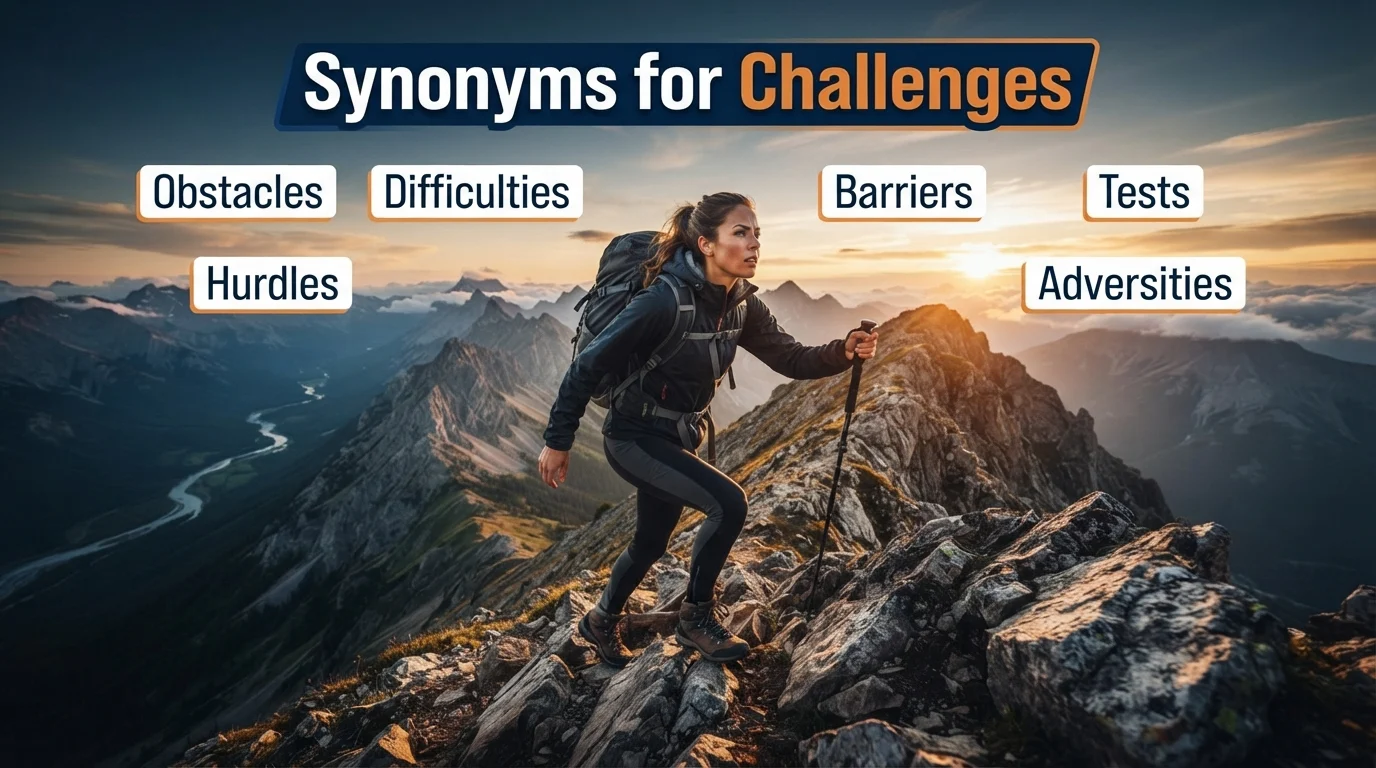
Do you keep using the word “challenges” in essays, business reports, project proposals, motivational content, or everyday conversation? While it is one of the most useful and dynamic words in modern English, repeating it can make your writing feel flat, generic, or overly corporate.
The good news is that the best alternative depends on what you actually mean. You might be describing obstacles, difficulties, hurdles, problems, tests of ability, or opportunities for growth.
This guide explains synonyms for “challenges” by meaning, tone, context, and usage. You will learn which alternatives work best in academic writing, professional communication, project management, creative expression, and casual conversation.
Quick Answer: What Does “Challenges” Mean?
“Challenges” refers to difficult tasks, problems, or situations that test someone’s abilities, resources, or determination. It can also refer to obstacles that must be overcome, or opportunities that require effort and skill. Depending on context, alternatives include obstacles, difficulties, hurdles, problems, barriers, tests, trials, issues, setbacks, and adversities.
Meaning, Tone, and Context
Simple Definition
“Challenges” generally refers to:
- Difficult tasks: things that require effort and skill
- Obstacles: things that block or hinder progress
- Problems: issues that need to be solved
- Tests of ability: situations that assess strength or skill
- Adversities: difficult or unfavorable conditions
- Opportunities: difficult situations that offer growth
Part of Speech
“Challenges” functions primarily as a noun (plural of “challenge”) and as a verb.
Noun Examples:
- “The project faced many challenges.”
- “She overcame significant challenges.”
Verb Examples:
- “He challenges the status quo.”
- “The new policy challenges traditional thinking.”
Related Forms:
- Challenge (noun): a difficult task or problem
- Challenge (verb): to test or question
- Challenging (adjective): difficult but interesting
- Challenged (adjective): tested or questioned
- Challenger (noun): a person who challenges
Positive, Negative, or Neutral Tone
“Challenges” is generally neutral but can be positive or negative depending on context.
Positive associations:
- “The challenge helped her grow.”
- “We embrace challenges as opportunities.”
Negative contexts:
- “The company faces serious financial challenges.”
- “The challenges were overwhelming.”
Formality Level
“Challenges” is a standard word that works in both formal and informal English. It is especially common in business, academic, motivational, and professional contexts.
However, more specific alternatives can add precision and variety depending on the context.
Common Use Cases
“Challenges” commonly refers to:
- Business: economic challenges, market challenges, operational challenges
- Education: academic challenges, learning challenges, classroom challenges
- Personal development: life challenges, emotional challenges, physical challenges
- Project management: technical challenges, logistical challenges, scheduling challenges
- Social issues: societal challenges, environmental challenges, global challenges
- Sports: competitive challenges, physical challenges, mental challenges
Important Word Forms
- Challenge (noun): a difficult task or problem
- Challenge (verb): to test or question
- Challenging (adjective): difficult but interesting
- Challenged (adjective): tested or questioned
- Challenger (noun): a person who challenges
- Unchallenged (adjective): not questioned or tested
When and How to Use “Challenges”
Use “challenges” when you want to describe difficult tasks, problems, or situations that require effort and skill. Because the word is broad, more specific alternatives can add precision depending on the context.
Professional
“The company faces several challenges in the coming quarter.”
This works naturally in business communication.
Academic
“The study examines the challenges of implementing new technology.”
The term is appropriate in academic research.
Personal
“She overcame many challenges to achieve her goals.”
The word sounds natural in everyday conversation.
Project Management
“The team identified key challenges early in the project.”
This is standard in project management.
Motivational
“Challenges are opportunities in disguise.”
This is common in motivational content.
News
“World leaders discussed the challenges of climate change.”
This is standard in news reporting.
Another Word for “Challenges”
There is no single perfect synonym because “challenges” can refer to obstacles, difficulties, problems, tests, or adversities.
- Obstacle context: obstacles, barriers, hurdles, impediments, roadblocks
- Difficulty context: difficulties, problems, complications, issues, troubles
- Test context: tests, trials, tribulations, ordeals, assessments
- Adversity context: adversities, hardships, misfortunes, setbacks
- Opportunity context: opportunities, ventures, undertakings, endeavors
If you need one broad alternative, “obstacles” works for things that block progress, while “difficulties” works for general problems. “Hurdles” works for challenges that must be overcome.
When Not to Use “Challenges”
“Challenges” can become too vague or euphemistic when you need to specify exactly what kind of difficulty you are describing.
Consider:
“We face challenges.”
This statement does not tell readers whether the challenges are financial, technical, personal, or logistical.
A more precise sentence could be:
“We face significant supply chain and staffing challenges.”
Similarly, avoid using “challenges” when you mean “problems” in a direct, negative context. Use “problems”, “issues”, or “crises” instead.
Words Commonly Confused With “Challenges”
Challenges vs. Obstacles
Obstacles are things that block or hinder progress. Challenges are broader and can include tests of ability.
Example:
“The fallen tree was an obstacle on the road.” (physical block)
“Learning a new language is a challenge.” (test of ability)
Challenges vs. Problems
Problems are issues that need to be solved. Challenges can be opportunities for growth.
Example:
“We have a problem with the software.” (issue)
“We face a challenge in implementing the software.” (task)
Challenges vs. Difficulties
Difficulties are hard situations or conditions. Challenges can be positive.
Example:
“She had difficulty understanding the concept.” (hard situation)
“She faced the challenge of learning a new skill.” (positive task)
Challenges vs. Hurdles
Hurdles are obstacles that must be overcome, often in a race or competition. Challenges are broader.
Example:
“The final exam was a hurdle.” (obstacle to pass)
“College is a challenge.” (broad experience)
Challenges vs. Tests
Tests are assessments of ability or knowledge. Challenges can be more general.
Example:
“The exam was a test of her knowledge.” (assessment)
“The project was a challenge.” (general difficulty)
Challenges vs. Adversity
Adversity refers to difficult or unfavorable conditions. Challenges can be chosen or embraced.
Example:
“She faced great adversity.” (difficult conditions)
“She embraced the challenge.” (chosen task)
Best Synonym by Context for “Challenges”
| Context | Best Synonym | Why It Works | Example |
|---|---|---|---|
| Formal writing | Obstacles, impediments | Precise and professional | The project faced significant obstacles. |
| Academic writing | Difficulties, barriers | Standard academic usage | The study examines barriers to implementation. |
| Business/Professional | Issues, obstacles, hurdles | Professional and clear | The company faces several operational hurdles. |
| Project management | Risks, issues, constraints | Project-specific | The team identified key risks early. |
| Personal development | Trials, tribulations, adversities | Personal and emotional | She overcame many trials to succeed. |
| Motivational | Opportunities, tests, trials | Inspirational and positive | Challenges are opportunities for growth. |
| Sports | Tests, hurdles, competitions | Competitive and physical | The final match was a real test. |
| News reporting | Crises, issues, problems | Serious and factual | World leaders discussed global crises. |
| Casual conversation | Problems, hurdles, difficulties | Natural and informal | Life throws hurdles at everyone. |
| Creative writing | Tribulations, ordeals, trials | Literary and dramatic | The hero faced many trials. |
| Strategic planning | Risks, barriers, constraints | Strategic and formal | The strategy addresses key barriers. |
| Social issues | Crises, issues, problems | Social and global | Climate change is a global crisis. |
Which Synonym Should You Choose?
Start by identifying what kind of “challenges” you are describing.
- Obstacles: obstacles, barriers, hurdles, impediments, roadblocks
- Difficulties: difficulties, problems, complications, issues, troubles
- Tests: tests, trials, tribulations, ordeals, assessments
- Adversity: adversities, hardships, misfortunes, setbacks
- Opportunities: opportunities, ventures, undertakings, endeavors
10 Key Synonyms for “Challenges”
The table below includes accurate alternatives with clear meanings and usage contexts.
| Synonym | Simple Meaning | Best Used For | Example Sentence |
|---|---|---|---|
| Obstacles | Things that block progress | General, professional | The team overcame many obstacles. |
| Difficulties | Hard situations or conditions | General, academic | She faced difficulties in her studies. |
| Hurdles | Obstacles to overcome | Project management, sports | The project cleared several hurdles. |
| Problems | Issues that need solving | General, casual | We need to solve these problems. |
| Barriers | Things that prevent progress | Academic, social | Language barriers can be challenging. |
| Tests | Assessments of ability | Sports, academic | The final exam was a real test. |
| Trials | Difficult experiences | Personal, literary | She endured many trials. |
| Setbacks | Delays or reversals | Business, personal | The project suffered several setbacks. |
| Issues | Problems or concerns | Business, professional | The team discussed key issues. |
| Adversities | Difficult conditions | Formal, literary | She overcame great adversities. |
Synonym Groups and Usage Differences
Professional vs. Personal Synonyms
Professional writing benefits from specific terms such as obstacles, barriers, issues, risks, and constraints.
Personal communication often uses challenges itself or casual alternatives like problems, hurdles, or difficulties.
Compare:
“Life is full of hurdles.” (personal)
“The project faces several barriers to completion.” (professional)
Formal vs. Conversational Synonyms
Challenges works in both formal and conversational English.
Formal alternatives: obstacles, impediments, adversities, barriers
Conversational alternatives: problems, hurdles, difficulties
Examples:
“The company faced significant impediments.” (formal)
“We ran into a few problems.” (conversational)
Academic Synonyms
Academic writing should distinguish between challenges (general), barriers (things that prevent progress), difficulties (hard situations), and constraints (limitations).
For example:
“The study examines barriers to technology adoption.”
“The researchers faced methodological constraints.”
Professional and Business Synonyms
Business writing often benefits from phrases such as obstacles, issues, risks, barriers, and constraints.
Instead of:
“We face challenges.”
Consider:
“We face several market barriers and operational constraints.”
Creative or Literary Synonyms
Creative writing can use trials, tribulations, ordeals, adversities, and hardships depending on the context.
For example:
“The hero faced many trials on his journey.”
“She endured countless hardships.”
Slang or Modern Synonyms
Hurdles is a common casual term.
Speed bumps is informal for minor challenges.
Roadblocks is casual for obstacles.
Struggles is casual for difficulties.
Examples:
“Life has its speed bumps.” (casual)
“We hit a few roadblocks.” (casual)
Strongest vs. Weaker Synonyms
“Challenges” synonyms vary in intensity:
Milder: difficulties, issues, hurdles
Moderate: challenges, obstacles, barriers
Strong: adversities, hardships, tribulations
Very Strong: crises, ordeals, catastrophes
Emotional vs. Neutral Synonyms
“Challenges” is generally neutral.
Emotional alternatives: trials, tribulations, hardships, adversities
Neutral alternatives: obstacles, barriers, issues, difficulties
Examples:
“She endured great hardships.” (emotional)
“The project faced several obstacles.” (neutral)
Antonyms of “Challenges”
“Challenges” has several antonyms depending on context:
| Antonym | Context | Meaning | Example Sentence |
|---|---|---|---|
| Ease | General | Lack of difficulty | The task was completed with ease. |
| Simplicity | General | Quality of being simple | The simplicity of the plan was its strength. |
| Success | Outcome | Achievement of a goal | The project was a success. |
| Advantage | General | Favorable condition | The team had a clear advantage. |
| Opportunity | General | Favorable chance | The challenge became an opportunity. |
| Solution | Problem | Answer to a problem | They found a solution quickly. |
| Support | General | Help or assistance | She received support from her team. |
Comparison: “Challenges” vs. Similar Words
Challenges vs. Obstacles
Main difference: Obstacles are things that block or hinder progress. Challenges are broader and can include tests of ability.
Examples:
“The fallen tree was an obstacle on the road.” (physical block)
“Learning a new language is a challenge.” (test of ability)
Challenges vs. Problems
Main difference: Problems are issues that need to be solved. Challenges can be opportunities for growth.
Examples:
“We have a problem with the software.” (issue)
“We face a challenge in implementing the software.” (task)
Challenges vs. Difficulties
Main difference: Difficulties are hard situations or conditions. Challenges can be positive.
Examples:
“She had difficulty understanding the concept.” (hard situation)
“She faced the challenge of learning a new skill.” (positive task)
Challenges vs. Hurdles
Main difference: Hurdles are obstacles that must be overcome, often in a race or competition. Challenges are broader.
Examples:
“The final exam was a hurdle.” (obstacle to pass)
“College is a challenge.” (broad experience)
Challenges vs. Tests
Main difference: Tests are assessments of ability or knowledge. Challenges can be more general.
Examples:
“The exam was a test of her knowledge.” (assessment)
“The project was a challenge.” (general difficulty)
Challenges vs. Adversity
Main difference: Adversity refers to difficult or unfavorable conditions. Challenges can be chosen or embraced.
Examples:
“She faced great adversity.” (difficult conditions)
“She embraced the challenge.” (chosen task)
Common Phrases and Expressions with “Challenges”
1. Face challenges
Meaning:
Confront difficulties.
Example:
“The company faces several challenges this year.”
2. Overcome challenges
Meaning:
Successfully deal with difficulties.
Example:
“She overcame many challenges to reach her goal.”
3. Embrace challenges
Meaning:
Accept difficulties positively.
Example:
“He embraces challenges as opportunities.”
4. Meet challenges
Meaning:
Deal with difficulties successfully.
Example:
“The team met the challenge head-on.”
5. Pose challenges
Meaning:
Present difficulties.
Example:
“The new regulations pose challenges for small businesses.”
6. Rise to the challenge
Meaning:
Successfully deal with a difficult situation.
Example:
“She rose to the challenge and exceeded expectations.”
7. Challenge yourself
Meaning:
Push yourself to do difficult things.
Example:
“Challenge yourself to learn something new every day.”
8. Challenging times
Meaning:
Difficult periods.
Example:
“We are living in challenging times.”
9. Key challenges
Meaning:
Main difficulties.
Example:
“The report identifies key challenges for the industry.”
10. Face up to challenges
Meaning:
Accept and deal with difficulties.
Example:
“We must face up to these challenges.”
Common Mistakes to Avoid
1. Using “challenges” when a more precise term is available
If you mean obstacles, barriers, problems, or crises, use the more specific word.
Vague: “We face challenges.”
Precise: “We face significant supply chain barriers.”
2. Confusing “challenges” with “problems”
Problems are negative issues that need solving. Challenges can be positive opportunities.
Negative: “We have a problem with the software.”
Positive: “We face a challenge in implementing the software.”
3. Using “challenges” in academic writing when “barriers” is needed
In academic writing, barriers often refers to things that prevent progress. Use it precisely.
Vague: “The study examines challenges to adoption.”
Precise: “The study examines barriers to adoption.”
4. Overusing “challenges” in writing
Repetition can make content feel dull. Use alternatives such as obstacles, difficulties, hurdles, barriers, and issues.
5. Choosing a synonym that changes the meaning
Do not replace challenges with crises unless you mean severe emergencies.
Do not replace challenges with opportunities unless you mean positive possibilities.
FAQs
What is the best synonym for “challenges”?
The best synonym depends on context. Obstacles works for things that block progress, difficulties for hard situations, hurdles for obstacles to overcome, barriers for things that prevent progress, and tests for assessments of ability.
What is a formal synonym for “challenges”?
Obstacles, impediments, adversities, barriers, and constraints are formal synonyms.
What is an informal synonym for “challenges”?
Problems, hurdles, roadblocks, and struggles are common informal alternatives.
What is another word for “challenges” in business writing?
Obstacles, issues, risks, barriers, and constraints work well in business writing.
What is the difference between “challenges” and “obstacles”?
Obstacles are things that block or hinder progress. Challenges are broader and can include tests of ability.
What is the opposite of “challenges”?
Depending on context, opposites include ease, simplicity, success, advantage, and opportunity.
What does “challenges” mean in a project management context?
In project management, challenges often refer to risks, issues, constraints, or obstacles that may affect project success.
Conclusion
“Challenges” is a versatile and dynamic word that can describe obstacles, difficulties, problems, tests, adversities, and opportunities. The best synonym depends on what you actually mean.
Choose obstacles for things that block progress, difficulties for hard situations, hurdles for obstacles to overcome, barriers for things that prevent progress, tests for assessments, and adversities for difficult conditions.
Most importantly, do not replace “challenges” simply to avoid repetition. First identify what kind of challenge—obstacle, difficulty, test, or opportunity—you are actually describing. Then choose the alternative that communicates that idea most clearly.
For academic, professional, and formal writing, precision is usually more valuable than vocabulary variety. A specific term such as barriers, constraints, impediments, or risks can tell readers much more than the broad word challenges.
Before publishing a vocabulary guide, verify definitions and usage with trusted dictionaries such as Cambridge, Oxford, Merriam-Webster, Collins, or Britannica. This helps ensure that each alternative accurately matches its intended meaning and context.
The practical takeaway is simple: when “challenges” feels too general or corporate, ask yourself what kind of obstacle, difficulty, or test you are actually describing. Then use the most precise word available.
Discover More:-
- Synonyms for Lost: 50+ Better Words & Alternatives
- 50+ Synonyms for Using: Meanings, Examples, and Best Alternatives
