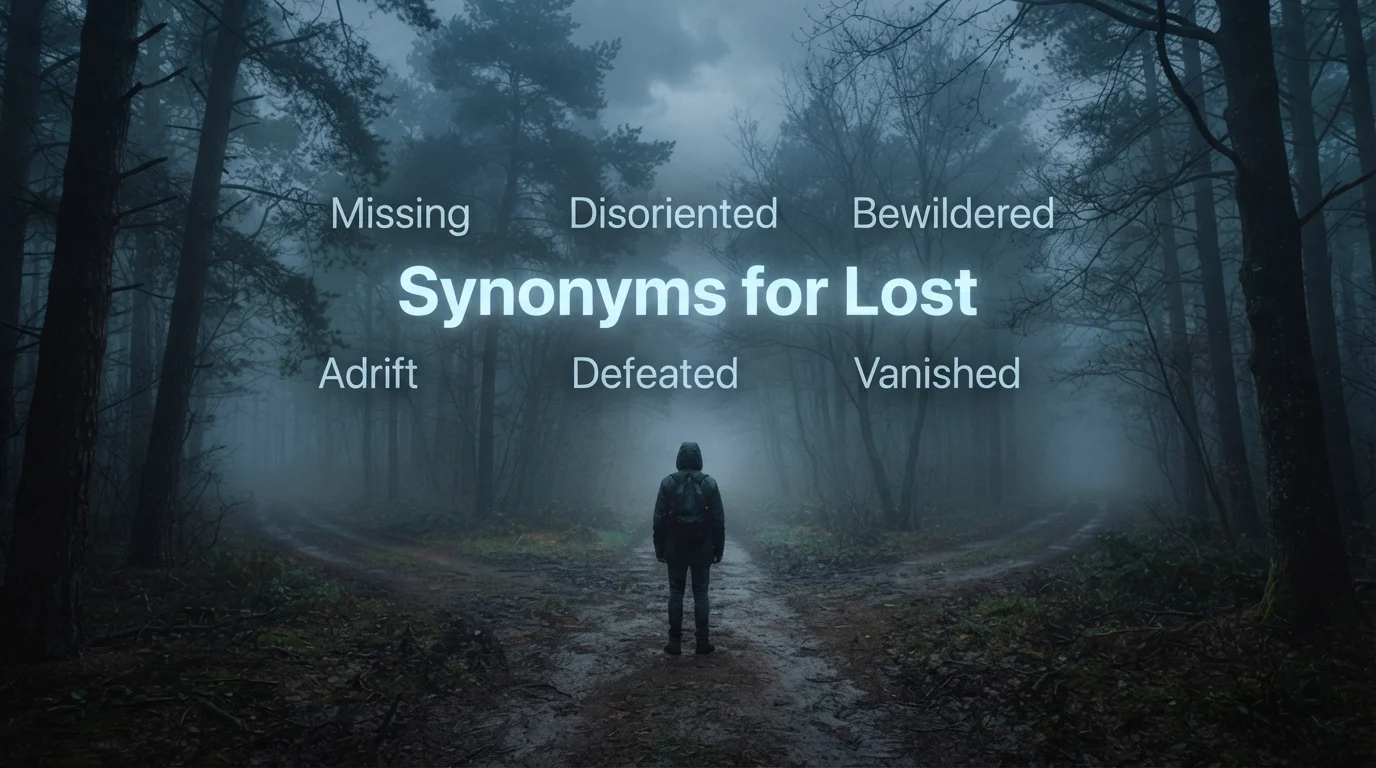
Do you keep using the word “lost” in essays, creative writing, professional reports, academic papers, or everyday conversation? While it is a simple and useful word, repeating it can make your writing feel monotonous or fail to capture the specific type of loss, confusion, or destruction you mean.
The good news is that the best alternative depends on what you actually mean. You might be describing being unable to find your way, missing a possession, feeling confused, being defeated, wasting an opportunity, or describing something that has been destroyed.
This guide explains synonyms for “lost” by meaning, tone, context, and usage. You will learn which alternatives work best in academic writing, professional communication, creative expression, emotional contexts, and casual conversation.
Quick Answer: What Does “Lost” Mean?
“Lost” refers to being unable to find one’s way, missing something that cannot be found, feeling confused or bewildered, being defeated or destroyed, or having wasted an opportunity. Depending on context, alternatives include missing, misplaced, astray, bewildered, disoriented, confused, defeated, ruined, vanished, and forfeited.
Meaning, Tone, and Context
Simple Definition
“Lost” generally refers to:
- Unable to find the way: not knowing where you are or how to get somewhere
- Missing or misplaced: unable to be found
- Confused or bewildered: not understanding what is happening
- Defeated or destroyed: beaten in a contest or ruined
- Wasted or forfeited: an opportunity or chance that has passed
- Emotionally adrift: feeling without purpose or direction
Part of Speech
“Lost” functions as an adjective and as the past tense/past participle of the verb “lose.”
Adjective Examples:
- “We are lost; can you help us find the station?”
- “The lost keys were never found.”
- “She felt lost after moving to a new city.”
Verb Examples:
- “I lost my wallet yesterday.”
- “The team lost the championship game.”
Related Forms:
- Lose (verb): to be deprived of; to fail to win; to misplace
- Loss (noun): the fact of losing something or someone
- Losing (adjective/verb): failing to win; experiencing loss
- Loser (noun): a person who loses; a failure (often derogatory)
- Lostness (noun): the state of being lost
Positive, Negative, or Neutral Tone
“Lost” is generally negative, though in some contexts it can be neutral or even reflective.
Negative associations:
- “He felt lost and alone after the divorce.”
- “The lost opportunity haunted her.”
Neutral or reflective contexts:
- “The explorers were lost in the wilderness but eventually found their way.”
- “We got lost on the hike but enjoyed the adventure.”
Formality Level
“Lost” is a standard word that works in both formal and informal English. However, more specific alternatives like disoriented, bewildered, and forfeited are often preferred in formal and academic writing.
Common Use Cases
“Lost” commonly refers to:
- Navigation: being unable to find one’s way
- Possessions: missing or misplaced items
- Emotions: feeling adrift, confused, or without purpose
- Competition: being defeated in a game or contest
- Opportunities: missed chances or wasted potential
- Destruction: something ruined, destroyed, or beyond recovery
- Death: having died (euphemistic, as in “lost a loved one”)
Important Word Forms
- Lose (verb): to be deprived of; to fail to win
- Lost (adjective/verb): unable to find the way; past tense of lose
- Loss (noun): the experience of losing something
- Losing (adjective/verb): failing to win; experiencing loss
- Loser (noun): one who loses
- Lostness (noun): the quality of being lost
When and How to Use “Lost”
Use “lost” when you want to describe being unable to find your way, missing something, feeling confused, being defeated, or having wasted an opportunity.
Professional
“We lost the contract due to the delay.”
This works naturally in business communication.
Academic
“The study examined how children feel lost during major life transitions.”
The term is appropriate in psychological or sociological contexts.
Personal
“I’m lost; can you show me the way to the station?”
The word sounds natural in everyday conversation.
Creative
“The lost soul wandered through the abandoned city, searching for meaning.”
The term can describe a character’s emotional state.
Emotional
“She felt lost after her best friend moved away.”
The word captures feelings of disorientation and sadness.
Competition
“Our team lost the game by a single point.”
This is standard sports language.
Another Word for “Lost”
There is no single perfect synonym because “lost” can refer to many different situations.
- Navigation context: disoriented, astray, off course, adrift
- Missing possessions: misplaced, missing, vanished, disappeared
- Confusion context: bewildered, confused, perplexed, baffled
- Emotional context: adrift, aimless, rootless, forlorn
- Competition context: defeated, beaten, vanquished, conquered
- Opportunity context: forfeited, wasted, squandered, missed
- Destruction context: ruined, destroyed, demolished, annihilated
- Death context: deceased, departed, passed away (euphemistic)
If you need one broad alternative, “missing” works for possessions, “disoriented” for navigation, “bewildered” for confusion, and “defeated” for competition.
When Not to Use “Lost”
“Lost” can become too vague when you need to specify what kind of loss you are describing.
Consider:
“Everything is lost.”
This statement does not tell readers whether things are missing, destroyed, or beyond recovery.
A more precise sentence could be:
“All our equipment was destroyed in the fire.”
“Several important documents are missing.”
Similarly, avoid using “lost” when you mean “missed” (as in an opportunity) or “forfeited” (as in a right) in formal writing.
Words Commonly Confused With “Lost”
Lost vs. Missing
Missing means unable to be found. Lost is broader and can include being unable to find one’s way.
Example:
“The missing documents were never recovered.” (unable to be found)
“We are lost; we need a map.” (navigation)
Lost vs. Misplaced
Misplaced means temporarily unable to be found, often because it was put in the wrong place.
Example:
“I misplaced my glasses.” (put in wrong place)
“I lost my wallet.” (cannot be found at all)
Lost vs. Disoriented
Disoriented means confused about direction or location. Lost can mean this but is broader.
Example:
“After the accident, he was disoriented.” (confused about location)
“We got lost in the forest.” (unable to find the way)
Lost vs. Bewildered
Bewildered means confused and puzzled. Lost can mean this but also refers to navigation or possessions.
Example:
“She was bewildered by the complex instructions.” (confused)
“He was lost in thought.” (absorbed)
Lost vs. Defeated
Defeated specifically means beaten in a contest or battle. Lost can mean this but is broader.
Example:
“The army was defeated.” (beaten)
“Our team lost the game.” (failed to win)
Lost vs. Ruined
Ruined means destroyed or severely damaged. Lost can mean this but is broader.
Example:
“The crops were ruined by the flood.” (destroyed)
“He lost everything in the fire.” (deprived of)
Best Synonym by Context for “Lost”
| Context | Best Synonym | Why It Works | Example |
|---|---|---|---|
| Formal writing | Disoriented, forfeited | Precise and professional | The hiker became disoriented in the fog. |
| Academic writing | Bewildered, disoriented | Standard academic usage | The participants felt bewildered by the changes. |
| Navigation | Astray, off course, disoriented | Specifically about direction | The ship went astray in the storm. |
| Missing possessions | Misplaced, missing, vanished | About items that cannot be found | The misplaced file was found later. |
| Emotional state | Adrift, aimless, rootless | About feeling without purpose | She felt adrift after graduation. |
| Confusion | Bewildered, perplexed, baffled | About mental confusion | He was bewildered by the sudden change. |
| Competition | Defeated, beaten, vanquished | About losing a contest | The team was defeated in the final. |
| Opportunity | Forfeited, squandered, missed | About wasted chances | The opportunity was squandered. |
| Destruction | Ruined, destroyed, demolished | About things beyond recovery | The ancient city was destroyed. |
| Casual conversation | Lost (itself) | Natural and concise | I lost my keys again. |
| Death (euphemistic) | Departed, passed away | Respectful contexts | We lost a beloved colleague. |
Which Synonym Should You Choose?
Start by identifying what kind of “lost” you are describing.
- Unable to find the way: disoriented, astray, off course, adrift
- Missing possessions: misplaced, missing, vanished, disappeared
- Confused or bewildered: bewildered, perplexed, baffled, puzzled
- Emotionally adrift: adrift, aimless, rootless, forlorn
- Defeated: defeated, beaten, vanquished, conquered
- Wasted opportunity: forfeited, squandered, missed, wasted
- Destroyed: ruined, destroyed, demolished, annihilated
- Death: departed, passed away, deceased
10 Key Synonyms for “Lost”
The table below includes accurate alternatives with clear meanings and usage contexts.
| Synonym | Simple Meaning | Best Used For | Example Sentence |
|---|---|---|---|
| Missing | Unable to be found | Possessions, people | The missing dog was found safe. |
| Misplaced | Put in the wrong place | Everyday items | I misplaced my keys again. |
| Disoriented | Confused about direction | Navigation, medical | The hiker was disoriented in the fog. |
| Astray | Off the right path | Navigation, moral | The letter went astray in the mail. |
| Bewildered | Confused and puzzled | Mental confusion | She was bewildered by the news. |
| Adrift | Floating without direction | Emotional, nautical | He felt adrift after losing his job. |
| Defeated | Beaten in a contest | Sports, competition | The team was defeated in the final. |
| Forfeited | Lost as a penalty | Rights, opportunities | He forfeited his chance to compete. |
| Ruined | Destroyed or spoiled | Property, plans | The rain ruined our picnic. |
| Vanished | Disappeared suddenly | People, objects | The keys seemed to have vanished. |
Synonym Groups and Usage Differences
Professional vs. Personal Synonyms
Professional writing benefits from specific terms such as disoriented, forfeited, squandered, and misplaced.
Personal communication often uses lost itself or casual alternatives like missing, misplaced, or gone.
Compare:
“I lost my keys.” (personal)
“The documents were misplaced during the transition.” (professional)
Formal vs. Conversational Synonyms
Lost works in both formal and conversational English.
Formal alternatives: disoriented, bewildered, forfeited, vanquished
Conversational alternatives: gone, missing, misplaced, mixed up
Examples:
“The expedition became disoriented in the blizzard.” (formal)
“We got lost on the way home.” (conversational)
Academic Synonyms
Academic writing should distinguish between lost (general), disoriented (spatial), bewildered (cognitive), and forfeited (rights/opportunities).
For example:
“The participants reported feeling disoriented after the virtual reality experiment.”
Professional and Business Synonyms
Business writing often benefits from phrases such as forfeited, squandered, missed, and misplaced.
Instead of:
“We lost the opportunity.”
Consider:
“We forfeited the opportunity due to the delay.”
Creative or Literary Synonyms
Creative writing can use adrift, forlorn, rootless, vanished, ruined, and vanquished.
For example:
“The forlorn traveler wandered through the deserted streets.”
“The vanquished king fled into the night.”
Slang or Modern Synonyms
Gone means lost or missing.
MIA (Missing In Action) means lost or absent.
AWOL means absent without leave.
Nowhere to be found means lost.
Examples:
“My phone is gone.” (casual)
“He’s been MIA lately.” (informal)
Strongest vs. Weaker Synonyms
“Lost” synonyms vary in intensity:
Milder: misplaced, missing, gone
Moderate: lost, disoriented, astray
Strong: bewildered, adrift, defeated
Very Strong: vanquished, annihilated, ruined
Emotional vs. Neutral Synonyms
“Lost” is generally emotional or neutral.
Emotional alternatives: forlorn, adrift, rootless, heartbroken
Neutral alternatives: missing, misplaced, disoriented
Examples:
“She felt forlorn after the loss.” (emotional)
“The keys are missing.” (neutral)
Antonyms of “Lost”
“Lost” has several antonyms depending on context:
| Antonym | Context | Meaning | Example Sentence |
|---|---|---|---|
| Found | General | Discovered or located | The lost keys were found. |
| Oriented | Navigation | Knowing one’s direction | She felt oriented after checking the map. |
| Clear | Confusion | Not confused | His mind was clear and focused. |
| Victorious | Competition | Having won | The victorious team celebrated. |
| Retained | Possession | Kept or preserved | The documents were retained. |
| Recovered | Destruction | Restored or regained | The stolen items were recovered. |
| Found | Navigation | Located | We found our way back to the trail. |
| Purposeful | Emotional | Having direction | She felt purposeful after finding a new job. |
Comparison: “Lost” vs. Similar Words
Lost vs. Missing
Main difference: Missing means unable to be found. Lost is broader and can include navigation, confusion, and defeat.
Examples:
“The missing documents were never found.” (unable to be found)
“We are lost; we need a map.” (navigation)
Lost vs. Misplaced
Main difference: Misplaced means temporarily unable to be found, often because it was put in the wrong place.
Examples:
“I misplaced my glasses.” (put in wrong place)
“I lost my wallet.” (cannot be found at all)
Lost vs. Disoriented
Main difference: Disoriented means confused about direction or location. Lost can mean this but is broader.
Examples:
“After the accident, he was disoriented.” (confused about location)
“We got lost in the forest.” (unable to find the way)
Lost vs. Bewildered
Main difference: Bewildered means confused and puzzled. Lost can mean this but also refers to navigation or possessions.
Examples:
“She was bewildered by the complex instructions.” (confused)
“He was lost in thought.” (absorbed)
Lost vs. Defeated
Main difference: Defeated specifically means beaten in a contest or battle. Lost can mean this but is broader.
Examples:
“The army was defeated.” (beaten)
“Our team lost the game.” (failed to win)
Lost vs. Ruined
Main difference: Ruined means destroyed or severely damaged. Lost can mean this but is broader.
Examples:
“The crops were ruined by the flood.” (destroyed)
“He lost everything in the fire.” (deprived of)
Common Phrases and Expressions with “Lost”
1. Get lost
Meaning:
To become unable to find the way; also, a rude way to tell someone to go away.
Example:
“We got lost on the way to the hotel.”
“Get lost! I don’t want to talk to you.”
2. Lost in thought
Meaning:
Deeply absorbed in thinking.
Example:
“She was lost in thought during the meeting.”
3. Lost cause
Meaning:
A hopeless situation or effort.
Example:
“Trying to change his mind is a lost cause.”
4. Lost track of time
Meaning:
To be unaware of how much time has passed.
Example:
“I was reading and lost track of time.”
5. Lost for words
Meaning:
Unable to speak due to shock or emotion.
Example:
“I was lost for words when I heard the news.”
6. Lost in translation
Meaning:
Meaning that cannot be accurately conveyed from one language to another.
Example:
“The humor was lost in translation.”
7. Lost opportunity
Meaning:
A chance that has passed and cannot be recovered.
Example:
“It was a lost opportunity to expand the business.”
8. Lost and found
Meaning:
A place where lost items are kept until claimed.
Example:
“Check the lost and found for your umbrella.”
9. Lost soul
Meaning:
A person who seems without purpose or direction.
Example:
“He wandered the city like a lost soul.”
10. Lost generation
Meaning:
A generation that lacks direction or is disillusioned.
Example:
“The novel captures the spirit of the lost generation.”
Common Mistakes to Avoid
1. Using “lost” when “missing” or “misplaced” is more precise
Missing means unable to be found. Misplaced means put in the wrong place. Lost is broader.
Vague: “The file is lost.”
Precise: “The file is missing.”
Precise: “I misplaced the file.”
2. Confusing “lost” with “defeated” in competition
Defeated specifically means beaten. Lost is broader.
Example:
“Our team lost the game.” (failed to win)
“Our team was defeated by a stronger opponent.” (beaten)
3. Using “lost” in formal writing when “forfeited” is more precise
Forfeited means lost as a penalty. Lost is broader.
Example:
“He forfeited his right to appeal.” (legal)
“He lost his right to appeal.” (general)
4. Overusing “lost” in writing
Repetition can make content feel dull. Use alternatives such as missing, misplaced, disoriented, bewildered, adrift, defeated, and forfeited.
5. Using “lost” when “ruined” or “destroyed” is meant
Ruined means destroyed or severely damaged. Lost can mean deprived of.
Example:
“The crops were ruined.” (destroyed)
“He lost his crops in the flood.” (deprived of)
FAQs
What is the best synonym for “lost”?
The best synonym depends on context. Missing works for possessions, disoriented for navigation, bewildered for confusion, defeated for competition, and forfeited for opportunities.
What is a formal synonym for “lost”?
Disoriented, bewildered, forfeited, vanquished, and squandered are formal synonyms.
What is an informal synonym for “lost”?
Gone, missing, misplaced, and MIA are common informal alternatives.
What is another word for “lost” in creative writing?
Adrift, forlorn, rootless, vanished, ruined, and vanquished work well in creative writing.
What is the difference between “lost” and “missing”?
Missing means unable to be found. Lost is broader and can include navigation, confusion, and defeat.
What is the opposite of “lost”?
Depending on context, opposites include found, oriented, clear, victorious, retained, and recovered.
What does “lost” mean in an emotional context?
Emotionally, “lost” means feeling adrift, without purpose, or without direction, often after a significant change or loss.
Conclusion
“Lost” is a versatile word that can describe navigation, missing possessions, confusion, defeat, wasted opportunities, and emotional disorientation. The best synonym depends on what you actually mean.
Choose missing for possessions, misplaced for items put in the wrong place, disoriented for navigation, bewildered for confusion, adrift for emotional states, defeated for competition, and forfeited for opportunities.
The practical takeaway is simple: when “lost” feels too general, ask yourself what kind of loss, confusion, or defeat you are actually describing. Then use the most precise word available.

2 thoughts on “Synonyms for Lost: 50+ Better Words & Alternatives”