Do you keep using the word “vulnerable” in essays, mental health content, cybersecurity reports, business risk assessments, or everyday conversation? While it is one of the most powerful and meaningful words in modern English, repeating it can make your writing feel flat, repetitive, or overly generic.
The good news is that the best alternative depends on what you actually mean. You might be describing physical exposure to harm, emotional openness, financial risk, cybersecurity weaknesses, or social marginalization.
This guide explains synonyms for “vulnerable” by meaning, tone, context, and usage. You will learn which alternatives work best in academic writing, professional communication, mental health content, cybersecurity, creative expression, and casual conversation.
Quick Answer: What Does “Vulnerable” Mean?
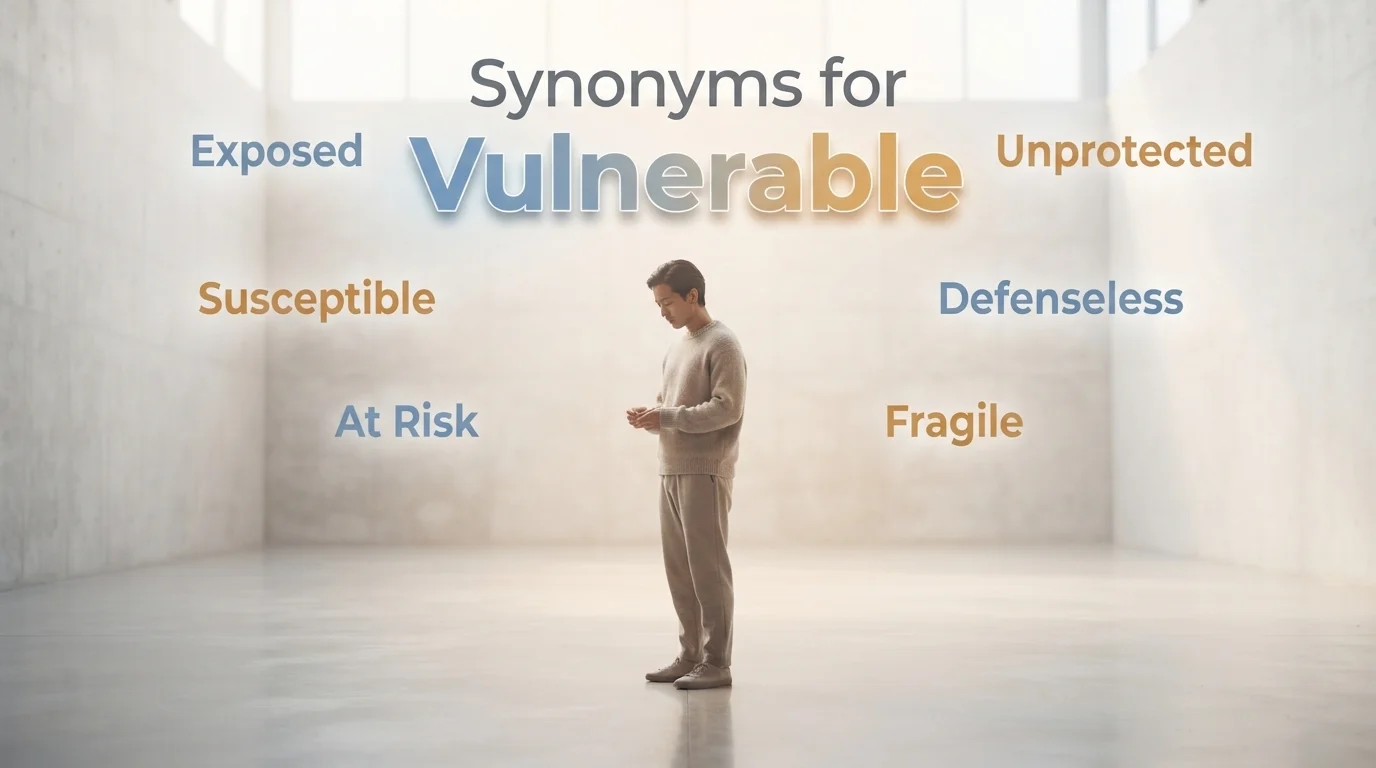
“Vulnerable” describes a state of being exposed to harm, risk, or attack—whether physical, emotional, financial, or digital. It can also mean being open to criticism, easily hurt, or lacking protection. Depending on context, alternatives include exposed, susceptible, at risk, unprotected, defenseless, fragile, weak, open, unsafe, and imperiled.
Meaning, Tone, and Context
Simple Definition
“Vulnerable” generally refers to:
- Physical exposure: open to harm, injury, or attack
- Emotional openness: easily hurt or sensitive
- Financial risk: exposed to loss or instability
- Digital weakness: susceptible to cyberattacks
- Social marginalization: lacking protection or rights
- General susceptibility: likely to be affected by something negative
Part of Speech
“Vulnerable” functions primarily as an adjective.
Examples:
- “The child was vulnerable to illness.”
- “The system is vulnerable to hacking.”
Related Forms:
- Vulnerability (noun): the state of being vulnerable
- Vulnerably (adverb): in a vulnerable manner
- Invulnerable (adjective): not vulnerable
- Vulnerabilities (noun): multiple weaknesses
Positive, Negative, or Neutral Tone
“Vulnerable” is generally negative in contexts involving harm or risk, but it can be positive in emotional contexts where openness and authenticity are valued.
Negative associations:
- “The aged are vulnerable to scams.”
- “The company’s network is vulnerable to attack.”
Positive or neutral contexts:
- “She was vulnerable and honest about her feelings.”
- “Vulnerability is a strength in leadership.”
Formality Level
“Vulnerable” is a standard word that works in both formal and informal English. It is especially common in academic, medical, legal, cybersecurity, and social work contexts.
However, more specific alternatives can add precision and variety depending on the context.
Common Use Cases
“Vulnerable” commonly refers to:
- Healthcare: vulnerable patients, vulnerable populations
- Cybersecurity: vulnerable systems, vulnerable software
- Social work: vulnerable children, vulnerable adults
- Finance: vulnerable economies, vulnerable investments
- Emotional contexts: vulnerable feelings, vulnerable moments
- Environmental: vulnerable ecosystems, vulnerable species
- Legal: vulnerable witnesses, vulnerable defendants
Important Word Forms
- Vulnerable (adjective): exposed to harm or risk
- Vulnerability (noun): the state of being vulnerable
- Vulnerably (adverb): in a vulnerable manner
- Invulnerable (adjective): not vulnerable
- Vulnerabilities (noun): weaknesses or exposures
When and How to Use “Vulnerable”
Use “vulnerable” when you want to describe something or someone that is exposed to harm, risk, or attack. Because the word is broad, more specific alternatives can add precision depending on the context.
Professional
“The system is vulnerable to cyberattacks.”
This works naturally in IT and cybersecurity communication.
Academic
“The study focused on vulnerable populations during the pandemic.”
The term is appropriate in academic research.
Personal
“I felt vulnerable sharing my story.”
The word sounds natural in emotional or therapeutic contexts.
Business
“The company’s supply chain is vulnerable to disruption.”
This is standard in business risk assessments.
Social Work
“Social workers protect vulnerable children and adults.”
This is appropriate in social services contexts.
Creative
“The fortress was vulnerable from the north.”
The word creates a sense of tension and risk in storytelling.
Another Word for “Vulnerable”
There is no single perfect synonym because “vulnerable” can refer to physical exposure, emotional openness, financial risk, digital weakness, or social marginalization.
- Physical exposure: exposed, unprotected, defenseless, unguarded
- Risk/susceptibility: susceptible, at risk, prone, liable
- Emotional openness: open, exposed, raw, defenseless
- Weakness: fragile, weak, delicate, frail
- Digital weakness: unsecured, unprotected, hackable, compromised
- Social marginalization: disadvantaged, marginalized, at-risk
- Environmental: endangered, threatened, fragile
If you need one broad alternative, “exposed” works for most contexts, while “susceptible” works for medical or scientific contexts. “At risk” works for social and financial contexts.
When Not to Use “Vulnerable”
“Vulnerable” can become too vague when you need to specify exactly what kind of vulnerability you are describing.
Consider:
“He is vulnerable.”
This statement does not tell readers whether he is physically, emotionally, financially, or digitally vulnerable.
A more precise sentence could be:
“He is emotionally vulnerable after the breakup.”
Similarly, avoid using “vulnerable” when you mean “weak” in a negative context. Use “weak” or “fragile” instead.
Words Commonly Confused With “Vulnerable”
Vulnerable vs. Weak
Weak means lacking strength. Vulnerable means exposed to harm or risk.
Example:
“He felt weak after the illness.” (lacking strength)
“He felt vulnerable after the breakup.” (emotionally exposed)
Vulnerable vs. Susceptible
Susceptible means likely to be affected by something. Vulnerable means exposed to harm.
Example:
“She is susceptible to colds.” (likely to catch)
“She is vulnerable to infection.” (exposed to harm)
Vulnerable vs. Exposed
Exposed means uncovered or unprotected. Vulnerable is broader and includes risk.
Example:
“The wire was exposed.” (uncovered)
“The system was vulnerable to attack.” (at risk)
Vulnerable vs. Fragile
Fragile means easily broken or damaged. Vulnerable means exposed to harm.
Example:
“The glass is fragile.” (easily broken)
“The child is vulnerable to illness.” (at risk)
Vulnerable vs. Defenseless
Defenseless means unable to defend oneself. Vulnerable can mean exposed to risk.
Example:
“The village was defenseless against attack.” (unable to defend)
“The system was vulnerable to hacking.” (at risk)
Vulnerable vs. At Risk
At risk means in danger of harm or loss. Vulnerable is broader.
Example:
“The species is at risk of extinction.” (in danger)
“The species is vulnerable to habitat loss.” (exposed to risk)
Best Synonym by Context for “Vulnerable”
| Context | Best Synonym | Why It Works | Example |
|---|---|---|---|
| Formal writing | Susceptible, exposed | Precise and professional | The population is susceptible to disease. |
| Academic writing | At-risk, susceptible | Standard academic usage | The study focused on at-risk youth. |
| Cybersecurity | Unsecured, unprotected, compromised | Technical and specific | The network is unsecured and vulnerable. |
| Healthcare | Immunocompromised, at-risk | Medically accurate | Immunocompromised patients are vulnerable. |
| Social work | Marginalized, disadvantaged | Socially accurate | The program supports marginalized communities. |
| Finance | Exposed, at risk | Financial context | The economy is exposed to market shocks. |
| Emotional context | Open, raw, exposed | Emotional and personal | She felt raw and vulnerable after the loss. |
| Environmental | Endangered, threatened, fragile | Ecological context | The ecosystem is fragile and vulnerable. |
| Legal | At-risk, unprotected | Legal context | The witness was vulnerable and needed protection. |
| Creative writing | Defenseless, exposed, unguarded | Literary and dramatic | The city lay defenseless against the invaders. |
| Business risk | Exposed, at risk, susceptible | Business context | The supply chain is exposed to disruption. |
| Casual conversation | Open, exposed, at risk | Natural and informal | I felt really exposed after sharing that. |
Which Synonym Should You Choose?
Start by identifying what kind of “vulnerable” you are describing.
- Physical exposure: exposed, unprotected, defenseless, unguarded
- Risk/susceptibility: susceptible, at risk, prone, liable
- Emotional openness: open, exposed, raw, defenseless
- Weakness: fragile, weak, delicate, frail
- Digital weakness: unsecured, unprotected, hackable, compromised
- Social marginalization: disadvantaged, marginalized, at-risk
- Environmental: endangered, threatened, fragile
10 Key Synonyms for “Vulnerable”
The table below includes accurate alternatives with clear meanings and usage contexts.
| Synonym | Simple Meaning | Best Used For | Example Sentence |
|---|---|---|---|
| Exposed | Uncovered or unprotected | General, cybersecurity | The system is exposed to attacks. |
| Susceptible | Likely to be affected | Medical, scientific | Children are susceptible to infections. |
| At risk | In danger of harm | Social, financial | At-risk youth need support. |
| Unprotected | Lacking protection | Legal, physical | The workers were unprotected from hazards. |
| Defenseless | Unable to defend | Physical, creative | The village was defenseless against attack. |
| Fragile | Easily broken or damaged | Environmental, emotional | The ecosystem is fragile and vulnerable. |
| Weak | Lacking strength | Physical, structural | The bridge was weak and vulnerable. |
| Open | Accessible or exposed | Emotional, physical | She was open and vulnerable with her feelings. |
| Unsafe | Not safe | General | The building was unsafe and vulnerable. |
| Imperiled | In danger | Formal, literary | The species is imperiled by habitat loss. |
Synonym Groups and Usage Differences
Professional vs. Personal Synonyms
Professional writing benefits from specific terms such as susceptible, at risk, exposed, unprotected, and compromised.
Personal communication often uses vulnerable itself or casual alternatives like open, exposed, or raw.
Compare:
“I felt really exposed after sharing that.” (personal)
“The system is susceptible to attack.” (professional)
Formal vs. Conversational Synonyms
Vulnerable works in both formal and conversational English.
Formal alternatives: susceptible, imperiled, exposed, compromised
Conversational alternatives: open, exposed, at risk
Examples:
“The population is susceptible to the disease.” (formal)
“I felt really open and vulnerable.” (conversational)
Academic Synonyms
Academic writing should distinguish between vulnerable (general), susceptible (medical), at-risk (social), and marginalized (social).
For example:
“The study focused on vulnerable populations.”
“Children are susceptible to respiratory infections.”
Professional and Business Synonyms
Business writing often benefits from phrases such as exposed, at risk, susceptible, unprotected, and compromised.
Instead of:
“Our system is vulnerable.”
Consider:
“Our system is exposed to potential cyberattacks and requires immediate patching.”
Creative or Literary Synonyms
Creative writing can use defenseless, exposed, unguarded, imperiled, and frail depending on the context.
For example:
“The city lay defenseless against the coming storm.”
“She felt exposed and unguarded in the unfamiliar room.”
Slang or Modern Synonyms
Exposed is a common casual alternative.
At risk is casual and professional.
Raw is modern for emotionally vulnerable.
Open is casual for emotionally vulnerable.
Examples:
“I felt really exposed after that.” (casual)
“She was raw and open about her struggles.” (modern)
Strongest vs. Weaker Synonyms
“Vulnerable” synonyms vary in intensity:
Milder: open, exposed, unguarded
Moderate: vulnerable, susceptible, at risk
Strong: defenseless, unprotected, compromised
Very Strong: imperiled, endangered, helpless
Emotional vs. Neutral Synonyms
“Vulnerable” is generally emotional or neutral depending on context.
Emotional alternatives: raw, open, exposed, defenseless
Neutral alternatives: susceptible, at risk, unprotected
Examples:
“She felt raw and exposed.” (emotional)
“The population is susceptible to disease.” (neutral)
Antonyms of “Vulnerable”
“Vulnerable” has several antonyms depending on context:
| Antonym | Context | Meaning | Example Sentence |
|---|---|---|---|
| Protected | General | Shielded from harm | The children are protected from danger. |
| Secure | General | Safe from threats | The building is secure. |
| Invulnerable | General | Impossible to harm | The fortress seemed invulnerable. |
| Safe | General | Free from danger | The area is safe for tourists. |
| Sheltered | General | Protected from harm | The refugees were sheltered from the storm. |
| Guarded | General | Watched over | The entrance is guarded. |
| Resilient | Emotional | Able to recover | She is resilient and strong. |
| Strong | Physical | Having strength | He is strong and healthy. |
Comparison: “Vulnerable” vs. Similar Words
Vulnerable vs. Weak
Main difference: Weak means lacking strength. Vulnerable means exposed to harm or risk.
Examples:
“He felt weak after the illness.” (lacking strength)
“He felt vulnerable after the breakup.” (emotionally exposed)
Vulnerable vs. Susceptible
Main difference: Susceptible means likely to be affected by something. Vulnerable means exposed to harm.
Examples:
“She is susceptible to colds.” (likely to catch)
“She is vulnerable to infection.” (exposed to harm)
Vulnerable vs. Exposed
Main difference: Exposed means uncovered or unprotected. Vulnerable is broader and includes risk.
Examples:
“The wire was exposed.” (uncovered)
“The system was vulnerable to attack.” (at risk)
Vulnerable vs. Fragile
Main difference: Fragile means easily broken or damaged. Vulnerable means exposed to harm.
Examples:
“The glass is fragile.” (easily broken)
“The child is vulnerable to illness.” (at risk)
Vulnerable vs. Defenseless
Main difference: Defenseless means unable to defend oneself. Vulnerable can mean exposed to risk.
Examples:
“The village was defenseless against attack.” (unable to defend)
“The system was vulnerable to hacking.” (at risk)
Vulnerable vs. At Risk
Main difference: At risk means in danger of harm or loss. Vulnerable is broader.
Examples:
“The species is at risk of extinction.” (in danger)
“The species is vulnerable to habitat loss.” (exposed to risk)
Common Phrases and Expressions with “Vulnerable”
1. Vulnerable to
Meaning:
Susceptible to harm or attack.
Example:
“The system is vulnerable to hacking.”
2. Vulnerable populations
Meaning:
Groups at higher risk of harm.
Example:
“The program supports vulnerable populations.”
3. Feel vulnerable
Meaning:
Experience emotional exposure.
Example:
“She felt vulnerable sharing her story.”
4. Vulnerable moment
Meaning:
A time of emotional openness.
Example:
“It was a vulnerable moment for both of us.”
5. Vulnerable species
Meaning:
Species at risk of extinction.
Example:
“The panda is a vulnerable species.”
6. Vulnerable adult
Meaning:
An adult at risk of harm or exploitation.
Example:
“Social workers protect vulnerable adults.”
7. Vulnerable child
Meaning:
A child at risk of harm.
Example:
“The program helps vulnerable children.”
8. Vulnerable position
Meaning:
A situation of exposure or risk.
Example:
“He was in a vulnerable position.”
9. Vulnerable point
Meaning:
A weak spot.
Example:
“The castle’s vulnerable point was the north gate.”
10. Vulnerable to criticism
Meaning:
Open to being criticized.
Example:
“The policy is vulnerable to criticism.”
Common Mistakes to Avoid
1. Using “vulnerable” when a more precise term is available
If you mean exposed, susceptible, at risk, or defenseless, use the more specific word.
Vague: “He is vulnerable.”
Precise: “He is emotionally vulnerable after the loss.”
2. Confusing “vulnerable” with “weak”
Weak means lacking strength. Vulnerable means exposed to harm.
Incorrect: “The glass is vulnerable.” (if easily broken)
Correct: “The glass is fragile.”
3. Using “vulnerable” in technical contexts when “unsecured” is needed
Cybersecurity writing often benefits from specific terms like unsecured, unpatched, or compromised.
Vague: “The system is vulnerable.”
Precise: “The system is unpatched and vulnerable to remote exploits.”
4. Overusing “vulnerable” in writing
Repetition can make content feel dull. Use alternatives such as exposed, susceptible, at risk, defenseless, and unprotected.
5. Choosing a synonym that changes the meaning
Do not replace vulnerable with weak unless you mean lacking strength.
Do not replace vulnerable with fragile unless you mean easily broken.
FAQs
What is the best synonym for “vulnerable”?
The best synonym depends on context. Exposed works for general use, susceptible for medical contexts, at risk for social contexts, defenseless for physical danger, and unsecured for cybersecurity.
What is a formal synonym for “vulnerable”?
Susceptible, imperiled, exposed, compromised, and unprotected are formal synonyms.
What is an informal synonym for “vulnerable”?
Open, exposed, raw, and at risk are common informal alternatives.
What is another word for “vulnerable” in creative writing?
Defenseless, exposed, unguarded, imperiled, and frail work well in creative writing.
What is the difference between “vulnerable” and “weak”?
Weak means lacking strength. Vulnerable means exposed to harm or risk.
What is the opposite of “vulnerable”?
Depending on context, opposites include protected, secure, invulnerable, safe, sheltered, guarded, and resilient.
What does “vulnerable” mean in a cybersecurity context?
In cybersecurity, vulnerable means a system, network, or application has weaknesses that could be exploited by attackers.
Conclusion
“Vulnerable” is a powerful and versatile word that can describe physical exposure, emotional openness, financial risk, digital weakness, and social marginalization. The best synonym depends on what you actually mean.
Choose exposed for general use, susceptible for medical contexts, at risk for social contexts, defenseless for physical danger, unsecured for cybersecurity, and raw for emotional contexts.
Most importantly, do not replace “vulnerable” simply to avoid repetition. First identify what kind of vulnerability—physical, emotional, financial, or digital—you are actually describing. Then choose the alternative that communicates that idea most clearly.
For academic, professional, and technical writing, precision is usually more valuable than vocabulary variety. A specific term such as susceptible, compromised, marginalized, or unsecured can tell readers much more than the broad word vulnerable.
Before publishing a vocabulary guide, verify definitions and usage with trusted dictionaries such as Cambridge, Oxford, Merriam-Webster, Collins, or Britannica. This helps ensure that each alternative accurately matches its intended meaning and context.
The practical takeaway is simple: when “vulnerable” feels too general, ask yourself what kind of exposure, risk, or openness you are actually describing. Then use the most precise word available
Discover More:-
- 50+ Synonyms for Energy: Meanings, Examples, and Best Alternatives
- 50+ Synonyms for Led: Meanings, Examples, and Best Alternatives

1 thought on “50+ Synonyms for Vulnerable: Meanings, Examples, and Best Alternatives”