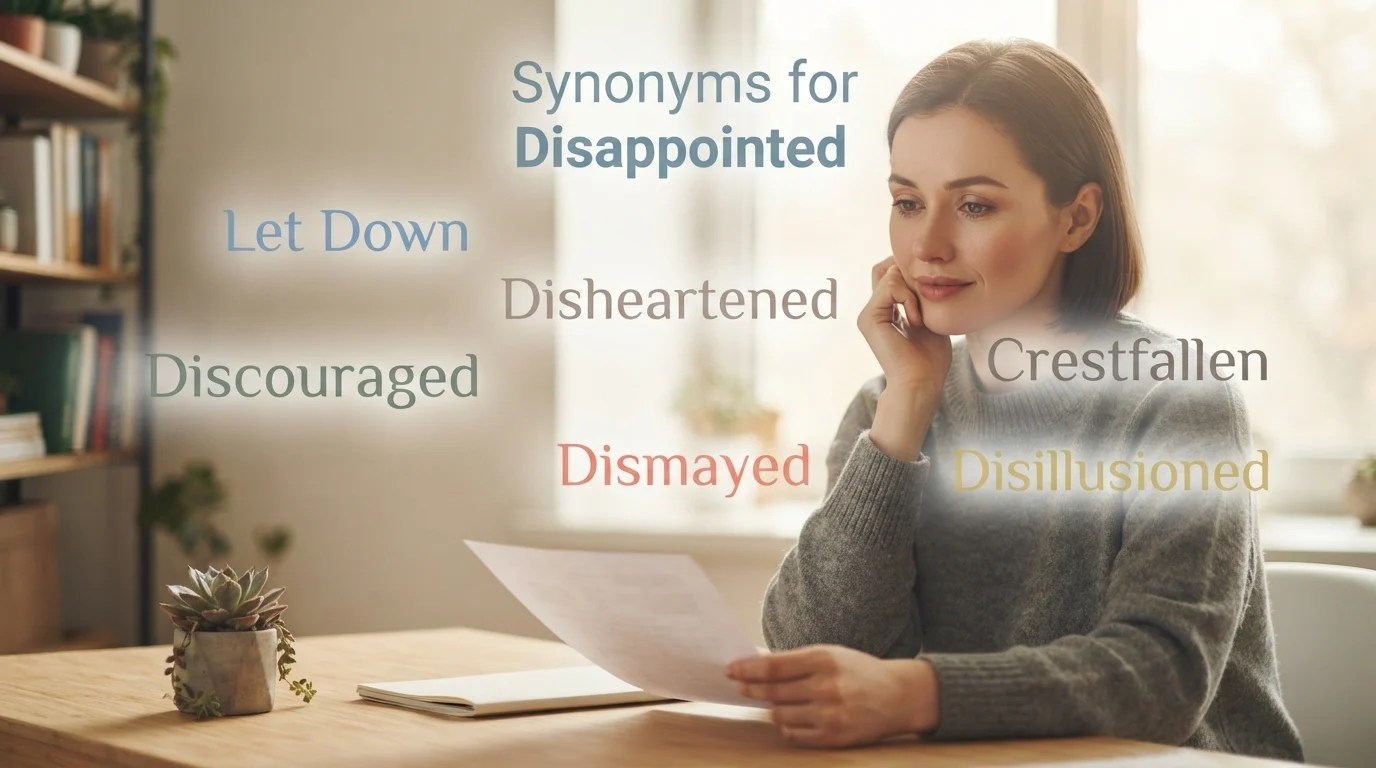
Do you keep using the word “disappointed” in emails, essays, creative writing, customer service messages, or everyday conversation? While it is one of the most common and useful words in English, repeating it can make your writing feel flat, repetitive, or overly emotional.
The good news is that the best alternative depends on what you actually mean. You might be describing mild letdown, deep sorrow, frustration, disillusionment, or a sense of defeat.
This guide explains synonyms for “disappointed” by meaning, tone, context, and usage. You will learn which alternatives work best in academic writing, professional communication, customer service, creative expression, and casual conversation.
Quick Answer: What Does “Disappointed” Mean?
“Disappointed” describes feeling sad, dissatisfied, or let down because something did not meet expectations or hopes. Depending on context, alternatives include let down, disheartened, discouraged, dismayed, crestfallen, disillusioned, discontented, frustrated, displeased, and dispirited.
Meaning, Tone, and Context
Simple Definition
“Disappointed” generally refers to:
- Letdown: sadness because expectations were not met
- Dissatisfaction: unhappiness with an outcome
- Discouragement: loss of confidence or hope
- Dismay: shock and disappointment
- Disillusionment: loss of belief or trust
- Frustration: annoyance at being unable to achieve something
Part of Speech
“Disappointed” functions primarily as an adjective and as the past participle of the verb “disappoint.”
Adjective Examples:
- “She was disappointed with the results.”
- “The fans were disappointed by the loss.”
Verb Examples:
- “The outcome disappointed everyone.”
- “He disappointed his family by dropping out.”
Related Forms:
- Disappoint (verb): to fail to meet expectations
- Disappointing (adjective): causing disappointment
- Disappointment (noun): the feeling of being disappointed
- Disappointingly (adverb): in a disappointing manner
- Disappointed (adjective): feeling let down
Positive, Negative, or Neutral Tone
“Disappointed” is negative. It expresses sadness, dissatisfaction, or letdown.
Negative associations:
- “She was deeply disappointed by the decision.”
- “The results were disappointing.”
Neutral or mild contexts:
- “He was a little disappointed but understood.”
- “I’m disappointed, but I’ll get over it.”
Formality Level
“Disappointed” is a standard word that works in both formal and informal English. It is appropriate in academic writing, business communication, customer service, creative writing, and casual conversation.
However, more specific alternatives can add precision and variety depending on the context.
Common Use Cases
“Disappointed” commonly refers to:
- Customer service: disappointed customers, disappointed clients
- Professional: disappointed with results, disappointed by performance
- Academic: disappointed with grades, disappointed by feedback
- Personal: disappointed in someone, disappointed with life
- Creative: disappointed hopes, disappointed expectations
- Sports: disappointed fans, disappointed players
Important Word Forms
- Disappointed (adjective): feeling let down
- Disappoint (verb): to fail to meet expectations
- Disappointing (adjective): causing disappointment
- Disappointment (noun): the feeling of being disappointed
- Disappointingly (adverb): in a disappointing manner
- Disappointed (adjective): feeling let down
When and How to Use “Disappointed”
Use “disappointed” when you want to describe feeling sad or dissatisfied because something did not meet expectations. Because the word is broad, more specific alternatives can add precision depending on the context.
Professional
“We are disappointed with the quarterly results.”
This works naturally in business communication.
Academic
“Students were disappointed with their exam scores.”
The term is appropriate in academic contexts.
Personal
“I’m disappointed that you didn’t tell me.”
The word sounds natural in everyday conversation.
Customer Service
“We understand you are disappointed, and we apologize.”
This is standard in customer service.
Creative
“She was disappointed to find the house empty.”
The word creates a sense of letdown.
Sports
“The players were disappointed after the loss.”
This is standard in sports reporting.
Another Word for “Disappointed”
There is no single perfect synonym because “disappointed” can refer to mild letdown, deep sorrow, frustration, disillusionment, or defeat.
- Mild letdown: let down, unhappy, displeased, unsatisfied
- Deep disappointment: disheartened, discouraged, crestfallen, dismayed
- Loss of hope: disillusioned, despairing, hopeless
- Frustration: frustrated, thwarted, foiled
- Defeat: defeated, beaten, vanquished
- Emotional sadness: saddened, sorrowful, downcast, dejected
If you need one broad alternative, “let down” works in most contexts, while “disheartened” works for deeper disappointment. “Disillusioned” works for loss of belief.
When Not to Use “Disappointed”
“Disappointed” can become too strong or too weak when you need to specify exactly how someone feels.
Consider:
“She was disappointed.”
This statement does not tell readers whether she was mildly unhappy, deeply hurt, frustrated, or disillusioned.
A more precise sentence could be:
“She was deeply disheartened by the rejection.”
Similarly, avoid using “disappointed” when you mean “annoyed” or “angry” in a simple context. Use “annoyed”, “frustrated”, or “angry” instead.
Words Commonly Confused With “Disappointed”
Disappointed vs. Sad
Sad is a general emotion. Disappointed specifically relates to unmet expectations.
Example:
“She felt sad after the movie.” (general)
“She was disappointed with the ending.” (unmet expectations)
Disappointed vs. Frustrated
Frustrated emphasizes annoyance at being unable to achieve something. Disappointed emphasizes sadness at unmet expectations.
Example:
“He was frustrated by the delays.” (annoyed)
“He was disappointed by the delays.” (sad)
Disappointed vs. Discouraged
Discouraged emphasizes loss of confidence or motivation. Disappointed emphasizes sadness.
Example:
“She felt discouraged after failing the exam.” (lost confidence)
“She was disappointed with her grade.” (sad)
Disappointed vs. Disillusioned
Disillusioned emphasizes loss of belief or trust. Disappointed is broader.
Example:
“He became disillusioned with politics.” (lost belief)
“He was disappointed with the policy.” (sad)
Disappointed vs. Dismayed
Dismayed emphasizes shock and distress. Disappointed emphasizes sadness.
Example:
“She was dismayed by the news.” (shocked)
“She was disappointed by the news.” (sad)
Disappointed vs. Displeased
Displeased emphasizes annoyance or disapproval. Disappointed emphasizes sadness.
Example:
“The teacher was displeased with the behavior.” (annoyed)
“The teacher was disappointed with the results.” (sad)
Best Synonym by Context for “Disappointed”
| Context | Best Synonym | Why It Works | Example |
|---|---|---|---|
| Formal writing | Disheartened, discouraged | Precise and professional | The team was disheartened by the loss. |
| Academic writing | Disheartened, dissatisfied | Standard academic usage | Students were dissatisfied with the feedback. |
| Business/Professional | Displeased, dissatisfied | Professional and clear | The client was displeased with the service. |
| Customer service | Let down, unhappy | Empathetic and polite | We understand you feel let down. |
| Casual conversation | Let down, bummed | Natural and informal | I’m really bummed about the cancellation. |
| Deep disappointment | Crestfallen, devastated | Emphasizes depth | She was crestfallen after the rejection. |
| Loss of hope | Disillusioned, despairing | Emphasizes loss of belief | He became disillusioned with the system. |
| Frustration | Frustrated, thwarted | Emphasizes annoyance | She was frustrated by the lack of progress. |
| Creative writing | Dejected, downcast, sorrowful | Adds literary depth | He walked away with a dejected expression. |
| Sports | Defeated, beaten | Sports context | The players were defeated after the loss. |
| Emotional | Saddened, sorrowful | Emphasizes sadness | She was saddened by the news. |
| Mild | Unhappy, displeased | Mild disappointment | He was unhappy with the outcome. |
Which Synonym Should You Choose?
Start by identifying what kind of “disappointed” you are describing.
- Mild letdown: let down, unhappy, displeased, unsatisfied
- Deep disappointment: disheartened, discouraged, crestfallen, dismayed
- Loss of hope: disillusioned, despairing, hopeless
- Frustration: frustrated, thwarted, foiled
- Defeat: defeated, beaten, vanquished
- Emotional sadness: saddened, sorrowful, downcast, dejected
10 Key Synonyms for “Disappointed”
The table below includes accurate alternatives with clear meanings and usage contexts.
| Synonym | Simple Meaning | Best Used For | Example Sentence |
|---|---|---|---|
| Let down | Feeling failed by someone | General, emotional | I felt really let down by the result. |
| Disheartened | Losing confidence or hope | Deep disappointment | The team was disheartened by the loss. |
| Discouraged | Losing motivation | Academic, professional | She felt discouraged after the rejection. |
| Dismayed | Shocked and distressed | Strong emotional response | He was dismayed by the news. |
| Crestfallen | Sad and defeated | Literary, emotional | She looked crestfallen after the interview. |
| Disillusioned | Losing belief or trust | Loss of faith | He became disillusioned with politics. |
| Discontented | Unhappy and dissatisfied | General, formal | The workers were discontented with the conditions. |
| Frustrated | Annoyed at being unable to succeed | General, emotional | She was frustrated by the delays. |
| Displeased | Annoyed or disapproving | Formal, professional | The client was displeased with the service. |
| Dispirited | Losing enthusiasm | General, formal | The team was dispirited after the defeat. |
Synonym Groups and Usage Differences
Professional vs. Personal Synonyms
Professional writing benefits from specific terms such as displeased, dissatisfied, disheartened, and discouraged.
Personal communication often uses disappointed itself or casual alternatives like let down, bummed, or upset.
Compare:
“I’m really bummed about the news.” (personal)
“The client was displeased with the outcome.” (professional)
Formal vs. Conversational Synonyms
Disappointed works in both formal and conversational English.
Formal alternatives: displeased, dissatisfied, disheartened, dispirited
Conversational alternatives: let down, bummed, upset, down
Examples:
“The committee was displeased with the results.” (formal)
“I’m so bummed about the cancellation.” (conversational)
Academic Synonyms
Academic writing should distinguish between disappointed (general), dissatisfied (unhappy with something), and disheartened (loss of confidence).
For example:
“Students were dissatisfied with the feedback.”
“The team was disheartened by the setback.”
Professional and Business Synonyms
Business writing often benefits from phrases such as displeased, dissatisfied, concerned, and disappointed.
Instead of:
“We are disappointed with the results.”
Consider:
“We are disappointed with the results and will take corrective action.”
Creative or Literary Synonyms
Creative writing can use crestfallen, dejected, downcast, sorrowful, forlorn, and woeful depending on the context.
For example:
“He walked away with a crestfallen expression.”
“A forlorn sadness settled over her.”
Slang or Modern Synonyms
Bummed is a common casual term for disappointed.
Let down is a common casual phrase.
Deflated is casual for disappointed.
Gutted is British slang for extremely disappointed.
Examples:
“I’m really bummed about the cancellation.” (casual)
“She was gutted when she didn’t get the job.” (British slang)
Strongest vs. Weaker Synonyms
“Disappointed” synonyms vary in intensity:
Milder: unhappy, displeased, unsatisfied
Moderate: disappointed, let down, discouraged
Strong: disheartened, dismayed, crestfallen
Very Strong: devastated, gutted, heartbroken
Emotional vs. Neutral Synonyms
“Disappointed” is generally emotional and negative.
Emotional alternatives: crestfallen, devastated, gutted, heartbroken
Neutral alternatives: dissatisfied, displeased, unhappy
Examples:
“She was devastated by the news.” (emotional)
“The client was dissatisfied with the service.” (neutral)
Antonyms of “Disappointed”
“Disappointed” has several antonyms depending on context:
| Antonym | Context | Meaning | Example Sentence |
|---|---|---|---|
| Pleased | General | Feeling happy and satisfied | She was pleased with the results. |
| Satisfied | General | Content with the outcome | He was satisfied with the service. |
| Delighted | General | Very happy | They were delighted with the news. |
| Thrilled | General | Extremely happy | She was thrilled with the gift. |
| Content | General | Peacefully happy | He was content with his progress. |
| Encouraged | Motivation | Given hope and confidence | She felt encouraged by the feedback. |
| Elated | Emotional | Extremely happy | He was elated by the promotion. |
Comparison: “Disappointed” vs. Similar Words
Disappointed vs. Sad
Main difference: Sad is a general emotion. Disappointed specifically relates to unmet expectations.
Examples:
“She felt sad after the movie.” (general)
“She was disappointed with the ending.” (unmet expectations)
Disappointed vs. Frustrated
Main difference: Frustrated emphasizes annoyance at being unable to achieve something. Disappointed emphasizes sadness at unmet expectations.
Examples:
“He was frustrated by the delays.” (annoyed)
“He was disappointed by the delays.” (sad)
Disappointed vs. Discouraged
Main difference: Discouraged emphasizes loss of confidence or motivation. Disappointed emphasizes sadness.
Examples:
“She felt discouraged after failing the exam.” (lost confidence)
“She was disappointed with her grade.” (sad)
Disappointed vs. Disillusioned
Main difference: Disillusioned emphasizes loss of belief or trust. Disappointed is broader.
Examples:
“He became disillusioned with politics.” (lost belief)
“He was disappointed with the policy.” (sad)
Disappointed vs. Dismayed
Main difference: Dismayed emphasizes shock and distress. Disappointed emphasizes sadness.
Examples:
“She was dismayed by the news.” (shocked)
“She was disappointed by the news.” (sad)
Disappointed vs. Displeased
Main difference: Displeased emphasizes annoyance or disapproval. Disappointed emphasizes sadness.
Examples:
“The teacher was displeased with the behavior.” (annoyed)
“The teacher was disappointed with the results.” (sad)
Common Phrases and Expressions with “Disappointed”
1. Disappointed with
Meaning:
Unhappy about something.
Example:
“She was disappointed with the service.
2. Disappointed in
Meaning:
Let down by someone.
Example:
“I’m disappointed in you.”
3. Disappointed by
Meaning:
Let down by an outcome or event.
Example:
“The fans were disappointed by the loss.”
4. Disappointed at
Meaning:
Unhappy about a specific thing.
Example:
“She was disappointed at the lack of progress.”
5. Disappointed to hear
Meaning:
Saddened by news.
Example:
“I’m disappointed to hear about the cancellation.”
6. Disappointed to learn
Meaning:
Saddened by information.
Example:
“We were disappointed to learn of the delay.”
7. Bitterly disappointed
Meaning:
Extremely disappointed.
Example:
“He was bitterly disappointed by the rejection.”
8. Deeply disappointed
Meaning:
Very disappointed.
Example:
“She was deeply disappointed by the decision.”
9. Disappointed hopes
Meaning:
Hopes that were not fulfilled.
Example:
“The disappointed hopes of the fans were evident.”
10. Disappointed expectations
Meaning:
Expectations that were not met.
Example:
“The disappointed expectations led to frustration.”
Common Mistakes to Avoid
1. Using “disappointed” when a more precise term is available
If you mean frustrated, discouraged, disillusioned, or dismayed, use the more specific word.
Vague: “She was disappointed.”
Precise: “She was deeply discouraged by the rejection.”
2. Confusing “disappointed” with “sad”
Sad is a general emotion. Disappointed relates to unmet expectations.
Incorrect: “She was disappointed after her dog died.” (if grief)
Correct: “She was sad after her dog died.”
3. Using “disappointed” in customer service when “sorry” is needed
In customer service, express empathy directly.
Incorrect: “You are disappointed.”
Correct: “We are sorry for the disappointment this has caused.”
4. Overusing “disappointed” in writing
Repetition can make content feel dull. Use alternatives such as let down, disheartened, discouraged, dismayed, and crestfallen.
5. Choosing a synonym that changes the meaning
Do not replace disappointed with angry unless you mean anger.
Do not replace disappointed with disillusioned unless you mean loss of belief.
FAQs
What is the best synonym for “disappointed”?
The best synonym depends on context. Let down works for general use, disheartened for deep disappointment, discouraged for loss of motivation, disillusioned for loss of belief, and crestfallen for literary contexts.
What is a formal synonym for “disappointed”?
Displeased, dissatisfied, disheartened, dispirited, and discontented are formal synonyms.
What is an informal synonym for “disappointed”?
Let down, bummed, upset, down, and gutted are common informal alternatives.
What is another word for “disappointed” in creative writing?
Crestfallen, dejected, downcast, sorrowful, forlorn, and woeful work well in creative writing.
What is the difference between “disappointed” and “sad”?
Sad is a general emotion. Disappointed specifically relates to unmet expectations.
What is the opposite of “disappointed”?
Depending on context, opposites include pleased, satisfied, delighted, thrilled, content, and encouraged.
What does “disappointed” mean in a business context?
In business, disappointed often means dissatisfied with results, service, or performance—and usually implies a need for improvement.
Conclusion
“Disappointed” is a versatile and emotional word that can describe mild letdown, deep sorrow, frustration, disillusionment, and defeat. The best synonym depends on what you actually mean.
Choose let down for general use, disheartened for deep disappointment, discouraged for loss of motivation, disillusioned for loss of belief, frustrated for annoyance, and crestfallen for literary contexts.
Most importantly, do not replace “disappointed” simply to avoid repetition. First identify what kind of disappointment—mild, deep, frustrating, or disillusioning—you are actually describing. Then choose the alternative that communicates that idea most clearly.
For academic, professional, and formal writing, precision is usually more valuable than vocabulary variety. A specific term such as dissatisfied, disheartened, displeased, or discouraged can tell readers much more than the broad word disappointed.
Before publishing a vocabulary guide, verify definitions and usage with trusted dictionaries such as Cambridge, Oxford, Merriam-Webster, Collins, or Britannica. This helps ensure that each alternative accurately matches its intended meaning and context.
The practical takeaway is simple: when “disappointed” feels too general or too strong, ask yourself what kind of letdown, sadness, or frustration you are actually describing. Then use the most precise word available.
Discover More:-
- 50+ Synonyms for Soft: Meanings, Examples, and Best Alternatives
- 50+ Synonyms for Unity: Meanings, Examples, and Best Alternatives

2 thoughts on “50+ Synonyms for Disappointed: Meanings, Examples, and Best Alternatives”