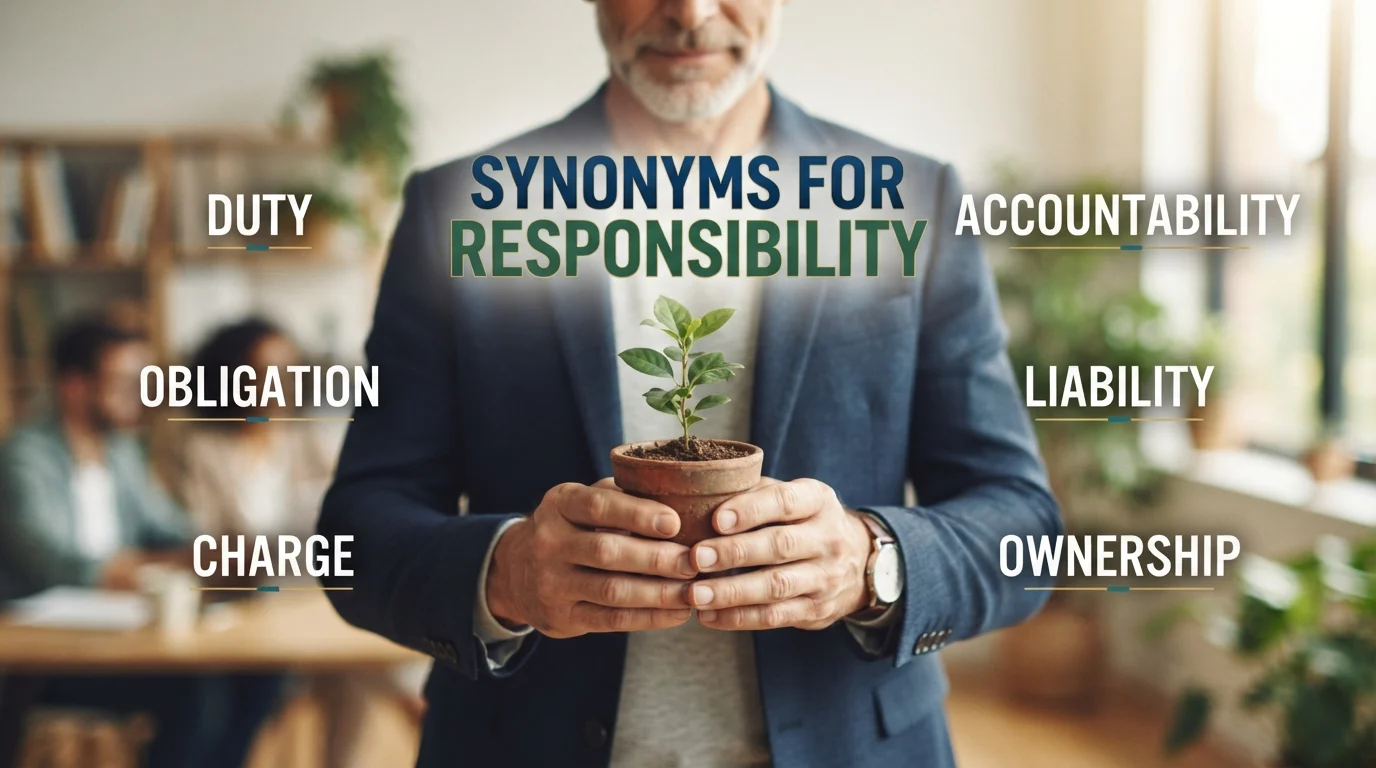
Do you keep using the word “responsibility” in essays, business reports, job descriptions, emails, or everyday conversation? While it is one of the most important and useful nouns in English, repeating it can make your writing feel flat, repetitive, or overly formal.
The good news is that the best alternative depends on what you actually mean. You might be describing a duty, an obligation, accountability, a burden, a task, or the state of being in charge.
This guide explains synonyms for “responsibility” by meaning, tone, context, and usage. You will learn which alternatives work best in academic writing, professional communication, resumes, legal contexts, creative expression, and casual conversation.
Quick Answer: What Does “Responsibility” Mean?
“Responsibility” refers to a duty or task that you are required or expected to do, the state of being accountable for something, or the quality of being reliable and dependable. Depending on context, alternatives include duty, obligation, accountability, liability, burden, task, charge, commitment, ownership, and trustworthiness.
Meaning, Tone, and Context
Simple Definition
“Responsibility” generally refers to:
- Duty: something you are required or expected to do
- Accountability: being answerable for your actions or decisions
- Obligation: a moral or legal requirement
- Burden: a heavy or difficult duty
- Task: a specific job or assignment
- Charge: the state of being in charge of someone or something
- Reliability: the quality of being dependable and trustworthy
Part of Speech
“Responsibility” functions primarily as a noun.
Examples:
- “It is your responsibility to complete the report.”
- “She takes her responsibilities seriously.”
- “The company has a responsibility to its employees.”
Related Forms:
- Responsible (adjective): having a duty or being accountable
- Responsibly (adverb): in a responsible manner
- Irresponsible (adjective): not showing responsibility
- Responsibilities (noun): multiple duties or tasks
Positive, Negative, or Neutral Tone
“Responsibility” is generally neutral but can be positive or negative depending on context.
Positive associations:
- “She showed great responsibility in handling the crisis.”
- “Taking responsibility is a sign of maturity.”
Negative or burdensome contexts:
- “The responsibility weighed heavily on him.”
- “He avoided responsibility for his actions.”
Formality Level
“Responsibility” is a standard word that works in both formal and informal English. It is especially common in academic, professional, legal, and business contexts.
However, more specific alternatives can add precision and variety depending on the context.
Common Use Cases
“Responsibility” commonly refers to:
- Workplace: job responsibilities, managerial responsibility, shared responsibility
- Legal: legal responsibility, liability, accountability
- Moral: moral responsibility, social responsibility, personal responsibility
- Parenting: parental responsibility, family responsibilities
- Finance: financial responsibility, fiscal responsibility
- Leadership: responsibility for a team, responsibility for outcomes
Important Word Forms
- Responsibility (noun): a duty or state of being accountable
- Responsible (adjective): having a duty or being accountable
- Responsibilities (noun): multiple duties
- Irresponsible (adjective): not showing responsibility
- Responsibly (adverb): in a responsible manner
- Responsiveness (noun): the quality of reacting quickly
When and How to Use “Responsibility”
Use “responsibility” when you want to describe a duty, obligation, accountability, or the state of being in charge. Because the word is broad, more specific alternatives can add precision depending on the context.
Professional
“Managing the budget is one of my key responsibilities.”
This works naturally in business communication and job descriptions.
Academic
“Students have a responsibility to cite their sources properly.”
The term is appropriate in academic contexts.
Legal
“The company accepted legal responsibility for the accident.”
This is standard in legal contexts.
Personal
“I take full responsibility for my mistake.”
The word sounds natural in everyday conversation.
Leadership
“She has responsibility for a team of twenty employees.”
This is appropriate in leadership and management contexts.
Social
“We all have a responsibility to protect the environment.”
This is common in social and ethical discussions.
Another Word for “Responsibility”
There is no single perfect synonym because “responsibility” can refer to a duty, obligation, accountability, burden, task, or reliability.
- Duty context: duty, obligation, charge, onus
- Accountability context: accountability, liability, answerability
- Task context: task, assignment, job, role
- Burden context: burden, weight, load, cross
- Moral context: moral duty, ethical obligation
- Reliability context: reliability, dependability, trustworthiness
If you need one broad alternative, “duty” works for moral or official obligations, while “accountability” works for being answerable. “Obligation” works for legal or moral requirements.
When Not to Use “Responsibility”
“Responsibility” can become too vague when you need to specify exactly what kind of responsibility you are describing.
Consider:
“He has a lot of responsibility.”
This statement does not tell readers whether he has many tasks, is accountable for outcomes, has a heavy burden, or is in a leadership position.
A more precise sentence could be:
“He is accountable for the department’s budget and performance.”
Similarly, avoid using “responsibility” when you mean “task” in a simple work context. Use “task”, “assignment”, or “duty” instead.
Words Commonly Confused With “Responsibility”
Responsibility vs. Duty
Duty often implies a moral or legal obligation. Responsibility can be broader.
Example:
“It is your duty to vote.” (moral obligation)
“It is your responsibility to complete the task.” (assignment)
Responsibility vs. Accountability
Accountability emphasizes being answerable for outcomes. Responsibility can mean having a duty.
Example:
“She has accountability for the results.” (answerable)
“She has responsibility for the project.” (in charge)
Responsibility vs. Obligation
Obligation emphasizes a binding requirement, often legal or moral. Responsibility can be broader.
Example:
“You have an obligation to pay taxes.” (binding requirement)
“You have a responsibility to your family.” (broader)
Responsibility vs. Task
Task refers to a specific piece of work. Responsibility is broader.
Example:
“Her task is to update the database.” (specific)
“Her responsibility is to manage the department.” (broader)
Responsibility vs. Burden
Burden emphasizes the weight or difficulty of a duty. Responsibility is neutral.
Example:
“Caring for his parents was a burden.” (heavy)
“Caring for his parents was his responsibility.” (neutral)
Responsibility vs. Liability
Liability refers to legal responsibility. Responsibility is broader.
Example:
“The company accepted liability for the damage.” (legal)
“The company accepted responsibility for the mistake.” (broader)
Best Synonym by Context for “Responsibility”
| Context | Best Synonym | Why It Works | Example |
|---|---|---|---|
| Formal writing | Accountability, obligation | Precise and professional | The manager has accountability for the team’s performance. |
| Academic writing | Duty, obligation | Standard academic usage | Students have a duty to uphold academic integrity. |
| Business/Professional | Accountability, ownership | Professional and clear | She took ownership of the project. |
| Legal writing | Liability, accountability | Legally precise | The company accepted liability for the damage. |
| Resume | Duty, role, ownership | Professional and action-oriented | Key duties include budget management and team leadership. |
| Moral context | Duty, obligation, charge | Moral and ethical | We have a moral duty to help those in need. |
| Leadership | Charge, accountability | Emphasizes being in charge | She is in charge of the marketing department. |
| Burden context | Burden, weight, load | Emphasizes difficulty | The burden of leadership weighed on him. |
| Task context | Task, assignment, job | Specific work | Her assignment was to complete the audit. |
| Casual conversation | Job, duty | Natural and informal | It’s my job to lock up. |
| Reliability context | Dependability, trustworthiness | Emphasizes reliability | His dependability earned him a promotion. |
| Financial context | Fiscal responsibility, stewardship | Financial and formal | The board emphasized fiscal responsibility. |
Which Synonym Should You Choose?
Start by identifying what kind of “responsibility” you are describing.
- Duty: duty, obligation, charge, onus
- Accountability: accountability, liability, answerability
- Task: task, assignment, job, role
- Burden: burden, weight, load, cross
- Moral: moral duty, ethical obligation
- Reliability: reliability, dependability, trustworthiness
10 Key Synonyms for “Responsibility”
The table below includes accurate alternatives with clear meanings and usage contexts.
| Synonym | Simple Meaning | Best Used For | Example Sentence |
|---|---|---|---|
| Duty | A moral or legal obligation | Moral, legal, professional | It is your duty to report the incident. |
| Obligation | A binding requirement | Legal, moral, formal | You have an obligation to pay taxes. |
| Accountability | Being answerable for outcomes | Professional, leadership | She has accountability for the results. |
| Liability | Legal responsibility | Legal, financial | The company accepted liability. |
| Burden | A heavy or difficult duty | Emotional, difficult contexts | The burden of care fell on her. |
| Task | A specific piece of work | Workplace, projects | Her task was to update the database. |
| Charge | The state of being in charge | Leadership, formal | She is in charge of the department. |
| Commitment | A promise or dedication | Personal, professional | He made a commitment to finish the project. |
| Ownership | Taking responsibility for something | Professional, modern | She took ownership of the mistake. |
| Trustworthiness | The quality of being reliable | Personal, professional | His trustworthiness made him a great leader. |
Synonym Groups and Usage Differences
Professional vs. Personal Synonyms
Professional writing benefits from specific terms such as accountability, ownership, duty, obligation, and charge.
Personal communication often uses responsibility itself or casual alternatives like job, duty, or burden.
Compare:
“It’s my job to lock up.” (personal)
“She has accountability for the department.” (professional)
Formal vs. Conversational Synonyms
Responsibility works in both formal and conversational English.
Formal alternatives: accountability, obligation, liability, charge
Conversational alternatives: job, duty, burden
Examples:
“The board has accountability for the budget.” (formal)
“It’s my job to feed the dog.” (conversational)
Academic Synonyms
Academic writing should distinguish between responsibility (general), duty (moral), obligation (binding), and accountability (answerable).
For example:
“Researchers have a duty to report their findings honestly.”
“Students have an obligation to cite their sources.”
Professional and Business Synonyms
Business writing often benefits from phrases such as accountability, ownership, duty, charge, and stewardship.
Instead of:
“Her responsibility is to manage the team.”
Consider:
“She has accountability for managing the team.”
Creative or Literary Synonyms
Creative writing can use burden, charge, cross, yoke, and mantle depending on the context.
For example:
“The burden of command weighed heavily on him.”
“She took up the mantle of leadership.”
Slang or Modern Synonyms
Job is a common casual term for responsibility.
On someone’s plate is casual for responsibilities.
Take ownership is modern professional.
Step up is casual for taking responsibility.
Examples:
“That’s not my job.” (casual)
“She really stepped up.” (casual)
Strongest vs. Weaker Synonyms
“Responsibility” synonyms vary in intensity:
Milder: task, role, duty
Moderate: responsibility, obligation, charge
Strong: accountability, liability, burden
Very Strong: onus, weight, cross
Emotional vs. Neutral Synonyms
“Responsibility” is generally neutral.
Emotional alternatives: burden, weight, cross (negative); commitment, ownership (positive)
Neutral alternatives: duty, obligation, task, charge
Examples:
“The burden of leadership was heavy.” (emotional, negative)
“She has a duty to complete the task.” (neutral)
Antonyms of “Responsibility”
“Responsibility” has several antonyms depending on context:
| Antonym | Context | Meaning | Example Sentence |
|---|---|---|---|
| Irresponsibility | General | Lack of responsibility | His irresponsibility caused problems. |
| Negligence | General | Failure to take care | The accident was due to negligence. |
| Exemption | Obligation | Freedom from duty | He was granted exemption from the task. |
| Absolution | Moral | Release from blame | The court granted absolution. |
| Immunity | Legal | Freedom from liability | The diplomat had legal immunity. |
| Dependency | Personal | Relying on others | His dependency prevented him from acting. |
| Avoidance | General | Avoiding responsibility | Her avoidance of the issue was frustrating. |
Comparison: “Responsibility” vs. Similar Words
Responsibility vs. Duty
Main difference: Duty often implies a moral or legal obligation. Responsibility can be broader.
Examples:
“It is your duty to vote.” (moral obligation)
“It is your responsibility to complete the task.” (assignment)
Responsibility vs. Accountability
Main difference: Accountability emphasizes being answerable for outcomes. Responsibility can mean having a duty.
Examples:
“She has accountability for the results.” (answerable)
“She has responsibility for the project.” (in charge)
Responsibility vs. Obligation
Main difference: Obligation emphasizes a binding requirement, often legal or moral. Responsibility can be broader.
Examples:
“You have an obligation to pay taxes.” (binding requirement)
“You have a responsibility to your family.” (broader)
Responsibility vs. Task
Main difference: Task refers to a specific piece of work. Responsibility is broader.
Examples:
“Her task is to update the database.” (specific)
“Her responsibility is to manage the department.” (broader)
Responsibility vs. Burden
Main difference: Burden emphasizes the weight or difficulty of a duty. Responsibility is neutral.
Examples:
“Caring for his parents was a burden.” (heavy)
“Caring for his parents was his responsibility.” (neutral)
Responsibility vs. Liability
Main difference: Liability refers to legal responsibility. Responsibility is broader.
Examples:
“The company accepted liability for the damage.” (legal)
“The company accepted responsibility for the mistake.” (broader)
Common Phrases and Expressions with “Responsibility”
1. Take responsibility
Meaning:
Accept accountability for something.
Example:
“He took responsibility for the mistake.”
2. Responsibility for
Meaning:
Being in charge of or accountable for something.
Example:
“She has responsibility for the marketing department.”
3. Sense of responsibility
Meaning:
Awareness of one’s duties.
Example:
“He has a strong sense of responsibility.”
4. Shared responsibility
Meaning:
Responsibility divided among people.
Example:
“Protecting the environment is a shared responsibility.”
5. Social responsibility
Meaning:
The duty to act for the benefit of society.
Example:
“The company emphasizes social responsibility.”
6. Personal responsibility
Meaning:
Accountability for one’s own actions.
Example:
“He believes in personal responsibility.”
7. Parental responsibility
Meaning:
Legal duties of parents.
Example:
“Parental responsibility includes providing for a child’s needs.”
8. Duty of care
Meaning:
A legal obligation to avoid causing harm.
Example:
“Doctors have a duty of care to their patients.”
9. On someone’s shoulders
Meaning:
Being someone’s responsibility.
Example:
“The success of the project is on her shoulders.”
10. Pass the buck
Meaning:
Shift responsibility to someone else.
Example:
“Don’t pass the buck—take responsibility.”
Common Mistakes to Avoid
1. Using “responsibility” when a more precise term is available
If you mean duty, accountability, obligation, or liability, use the more specific word.
Vague: “He has a lot of responsibility.”
Precise: “He is accountable for the department’s budget and performance.”
2. Confusing “responsibility” with “accountability”
Accountability emphasizes being answerable for outcomes. Responsibility can mean having a duty.
Incorrect: “She has responsibility for the results.” (if answerable)
Correct: “She has accountability for the results.”
3. Using “responsibility” in legal writing when “liability” is needed
Legal documents require precise language. Use liability, obligation, or duty of care.
Vague: “The company accepted responsibility for the damage.”
Precise: “The company accepted liability for the damage.”
4. Overusing “responsibility” in writing
Repetition can make content feel dull. Use alternatives such as duty, accountability, obligation, charge, and ownership.
5. Choosing a synonym that changes the meaning
Do not replace responsibility with burden unless you mean a heavy duty.
Do not replace responsibility with task unless you mean a specific piece of work.
FAQs
What is the best synonym for “responsibility”?
The best synonym depends on context. Duty works for moral obligations, accountability for being answerable, obligation for binding requirements, liability for legal contexts, and task for specific work.
What is a formal synonym for “responsibility”?
Accountability, obligation, liability, charge, and stewardship are formal synonyms.
What is an informal synonym for “responsibility”?
Job, duty, and burden are common informal alternatives.
What is another word for “responsibility” in a resume?
Duty, role, ownership, accountability, and charge work well in resumes.
What is the difference between “responsibility” and “accountability”?
Accountability emphasizes being answerable for outcomes. Responsibility can mean having a duty.
What is the opposite of “responsibility”?
Depending on context, opposites include irresponsibility, negligence, exemption, absolution, and immunity.
What does “responsibility” mean in a legal context?
In law, responsibility often refers to liability—being legally accountable for something, such as damages or harm.
Conclusion
“Responsibility” is a versatile and important word that can describe duties, obligations, accountability, burdens, tasks, and reliability. The best synonym depends on what you actually mean.
Choose duty for moral obligations, accountability for being answerable, obligation for binding requirements, liability for legal contexts, task for specific work, and burden for heavy duties.
Most importantly, do not replace “responsibility” simply to avoid repetition. First identify what kind of responsibility—duty, accountability, obligation, or task—you are actually describing. Then choose the alternative that communicates that idea most clearly.
For academic, professional, and legal writing, precision is usually more valuable than vocabulary variety. A specific term such as accountability, liability, duty, or charge can tell readers much more than the broad word responsibility.
Before publishing a vocabulary guide, verify definitions and usage with trusted dictionaries such as Cambridge, Oxford, Merriam-Webster, Collins, or Britannica. This helps ensure that each alternative accurately matches its intended meaning and context.
The practical takeaway is simple: when “responsibility” feels too general, ask yourself what kind of duty, accountability, or obligation you are actually describing. Then use the most precise word available.

1 thought on “Synonyms for Responsibility: 50+ Words to Use Instead”