Do you keep using the word “has” in essays, business reports, emails, creative writing, or everyday conversation? While it is one of the most common and essential verbs in English, repeating it can make your writing feel flat, repetitive, or monotonous.
The good news is that the best alternative depends on what you actually mean. “Has” can indicate possession, ownership, characteristics, experiences, relationships, or obligations. Each use has its own set of alternatives.
This guide explains synonyms for “has” by meaning, tone, context, and usage. You will learn which alternatives work best in academic writing, professional communication, creative expression, resumes, and casual conversation.
Quick Answer: What Does “Has” Mean?
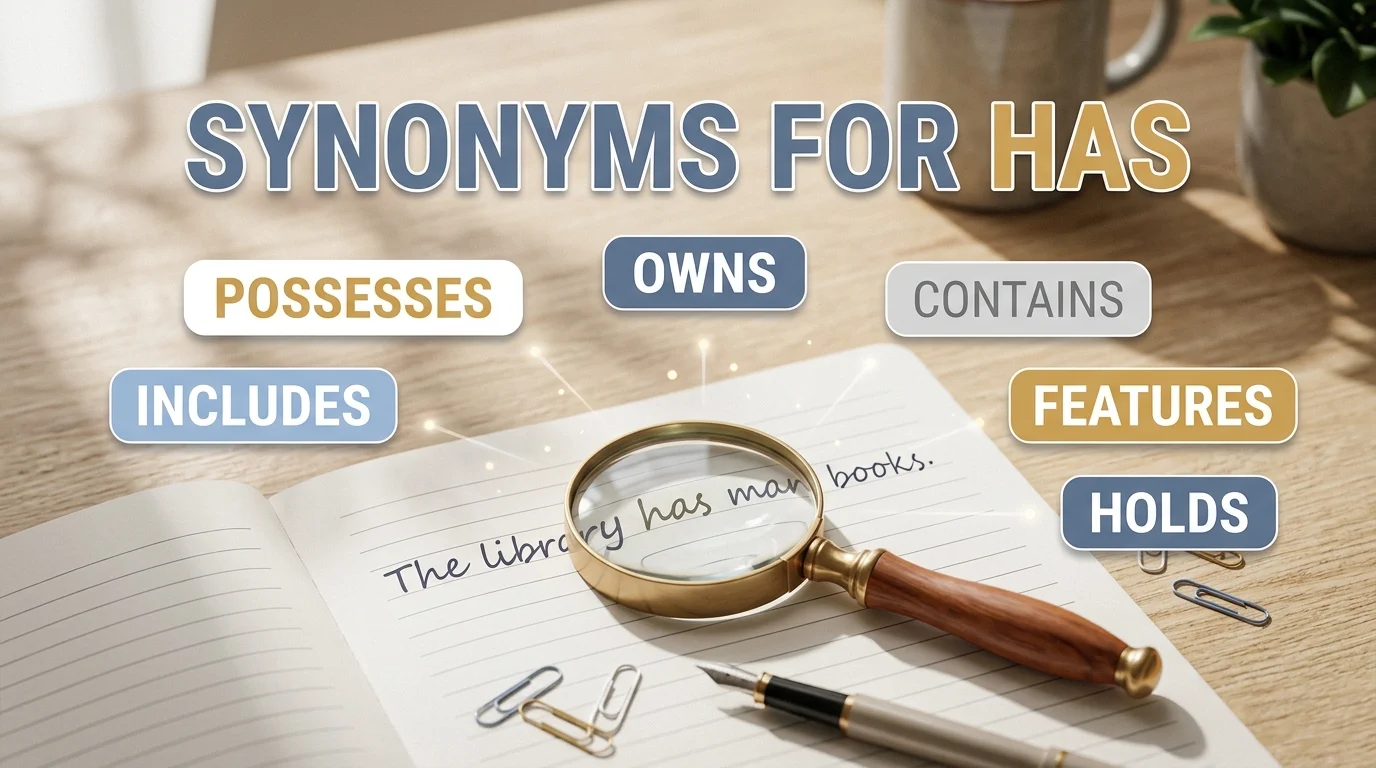
“Has” is the third-person singular present tense of the verb “to have.” It indicates possession, ownership, characteristics, experiences, relationships, or obligations. Depending on context, alternatives include possesses, owns, holds, contains, includes, features, maintains, experiences, enjoys, and boasts.
Meaning, Tone, and Context
Simple Definition
“Has” generally refers to:
- Possession: owning or holding something
- Characteristics: having a quality or feature
- Experiences: undergoing or enjoying something
- Relationships: having a connection with someone
- Obligations: having a duty or responsibility
- Containment: including or comprising something
Part of Speech
“Has” is a verb—specifically the third-person singular present tense of “to have.”
Examples:
- “She has a car.” (possession)
- “He has blue eyes.” (characteristic)
- “The company has 500 employees.” (containment)
- “She has a meeting at 3 PM.” (obligation)
Related Forms:
- Have (verb): base form
- Has (verb): third-person singular present
- Had (verb): past tense and past participle
- Having (verb): present participle
Positive, Negative, or Neutral Tone
“Has” is neutral. Its tone depends entirely on the words around it.
Positive:
- “She has a wonderful sense of humor.”
Negative:
- “He has a terrible temper.”
Neutral:
- “The building has three floors.”
Formality Level
“Has” is a standard verb that works in all levels of English—formal, informal, academic, professional, and casual. However, overuse can make writing feel repetitive or weak.
Stronger, more specific alternatives can make writing more vivid and precise.
Common Use Cases
“Has” commonly appears in:
- Possession: “She has a dog.”
- Characteristics: “He has a kind heart.”
- Containment: “The box has five items.”
- Experiences: “She has a headache.”
- Obligations: “He has a deadline.”
- Relationships: “She has two sisters.”
Important Word Forms
- Has (verb): third-person singular present
- Have (verb): base form
- Had (verb): past tense
- Having (verb): present participle
When and How to Use “Has”
Use “has” when you want to describe possession, characteristics, experiences, relationships, or obligations. Because “has” is so common, stronger alternatives can make writing more precise and engaging.
Professional
“The company has a strong reputation in the industry.”
This works in business communication, though stronger verbs may be better.
Academic
“The study has several limitations.”
This is standard in academic writing.
Personal
“She has a beautiful smile.”
The word sounds natural in everyday conversation.
Creative
“The old house has a mysterious history.”
The word describes characteristics in creative writing.
Resume
“She has five years of experience in marketing.”
This is common in resumes, though stronger verbs are preferred.
Business
“The product has many useful features.”
This is appropriate in product descriptions.
Another Word for “Has”
There is no single perfect synonym because “has” can indicate possession, characteristics, experiences, relationships, or obligations.
- Possession context: possesses, owns, holds, retains
- Characteristics context: features, exhibits, displays, boasts
- Containment context: contains, includes, comprises, encompasses
- Experiences context: experiences, enjoys, suffers, undergoes
- Obligations context: bears, carries, holds, maintains
- Relationships context: maintains, enjoys, shares
If you need one broad alternative, “possesses” works for possession, while “features” works for characteristics and “contains” works for containment.
When Not to Use “Has”
“Has” can become weak or repetitive when a stronger, more specific verb would be more effective.
Consider:
“The company has a new product.”
A stronger version:
“The company launched a new product.”
Similarly, avoid overusing “has” in resumes. Instead of:
“She has experience in marketing.”
Consider:
“She brings five years of marketing experience.”
However, do not eliminate “has” entirely—it is essential for present perfect tense and certain constructions.
Words Commonly Confused With “Has”
Has vs. Have
Has is used with third-person singular subjects (he, she, it). Have is used with I, you, we, they.
Example:
“She has a car.” (singular)
“They have a car.” (plural)
Has vs. Had
Has is present tense. Had is past tense.
Example:
“She has a car.” (present)
“She had a car.” (past)
Has vs. Contains
Contains specifically means to have within. Has is broader.
Example:
“The box contains books.” (within)
“The box has a lid.” (part of)
Has vs. Owns
Owns specifically means to have as property. Has is broader.
Example:
“She owns a house.” (property)
“She has a house.” (broader)
Has vs. Features
Features specifically means to include as a prominent part. Has is broader.
Example:
“The phone features a new camera.” (prominent)
“The phone has a camera.” (general)
Has vs. Possesses
Possesses is more formal and often implies a quality or attribute. Has is broader.
Example:
“She possesses great talent.” (formal)
“She has great talent.” (general)
Best Synonym by Context for “Has”
| Context | Best Synonym | Why It Works | Example |
|---|---|---|---|
| Formal writing | Possesses, features | Precise and professional | The company possesses a strong reputation. |
| Academic writing | Exhibits, demonstrates | Standard academic usage | The study exhibits several limitations. |
| Business/Professional | Features, includes, offers | Professional and clear | The product features a new design. |
| Possession | Owns, holds, possesses | Emphasizes ownership | She owns three properties. |
| Characteristics | Features, displays, boasts | Emphasizes qualities | The car features a sleek design. |
| Containment | Contains, includes, comprises | Emphasizes contents | The box contains five items. |
| Experiences | Experiences, enjoys, suffers | Emphasizes experience | She experiences frequent headaches. |
| Obligations | Bears, carries, holds | Emphasizes duty | He bears responsibility for the project. |
| Relationships | Maintains, enjoys, shares | Emphasizes connection | She maintains close ties with her family. |
| Resume | Brings, offers, possesses | Professional and action-oriented | She brings five years of experience. |
| Casual conversation | Has (itself), got | Natural and informal | She’s got a new car. |
| Product descriptions | Features, includes, boasts | Marketing and sales | The phone boasts a 48MP camera. |
Which Synonym Should You Choose?
Start by identifying what kind of “has” you are using.
- Possession: possesses, owns, holds, retains
- Characteristics: features, exhibits, displays, boasts
- Containment: contains, includes, comprises, encompasses
- Experiences: experiences, enjoys, suffers, undergoes
- Obligations: bears, carries, holds, maintains
- Relationships: maintains, enjoys, shares
10 Key Synonyms for “Has”
The table below includes accurate alternatives with clear meanings and usage contexts.
| Synonym | Simple Meaning | Best Used For | Example Sentence |
|---|---|---|---|
| Possesses | Owns or has as a quality | Formal, qualities | She possesses great talent. |
| Owns | Has as property | Property, ownership | He owns three companies. |
| Holds | Contains or supports | Containment, position | The jar holds two liters. |
| Contains | Has within | Containment | The box contains books. |
| Includes | Has as part of a whole | Composition | The price includes tax. |
| Features | Has as a prominent part | Products, characteristics | The phone features a new camera. |
| Maintains | Keeps or continues to have | Relationships, conditions | She maintains a healthy lifestyle. |
| Experiences | Undergoes or feels | Experiences, emotions | He experiences frequent headaches. |
| Enjoys | Has as a benefit | Positive experiences | She enjoys good health. |
| Boasts | Has as a proud feature | Marketing, pride | The hotel boasts a rooftop pool. |
Synonym Groups and Usage Differences
Professional vs. Personal Synonyms
Professional writing benefits from specific terms such as possesses, features, includes, offers, and brings.
Personal communication often uses has itself or casual alternatives like got.
Compare:
“She’s got a new car.” (personal)
“The company possesses a strong reputation.” (professional)
Formal vs. Conversational Synonyms
Has works in both formal and conversational English.
Formal alternatives: possesses, exhibits, comprises, maintains
Conversational alternatives: got, has
Examples:
“The report exhibits several limitations.” (formal)
“She’s got a new job.” (conversational)
Academic Synonyms
Academic writing should distinguish between has (general), exhibits (shows), demonstrates (proves), and comprises (consists of).
For example:
“The study exhibits several limitations.”
“The sample comprises 200 participants.”
Professional and Business Synonyms
Business writing often benefits from phrases such as features, includes, offers, boasts, and brings.
Instead of:
“The product has many features.”
Consider:
“The product features a sleek design and includes a one-year warranty.”
Creative or Literary Synonyms
Creative writing can use possesses, holds, boasts, exudes, and radiates depending on the context.
For example:
“The old house exudes a sense of history.”
“She radiates confidence.”
Slang or Modern Synonyms
Got is the most common casual alternative.
Has got is casual and emphatic.
Sports is slang for has or wears.
Examples:
“She’s got a new phone.” (casual)
“He’s sporting a new haircut.” (slang)
Strongest vs. Weaker Synonyms
“Has” synonyms vary in strength:
Weaker: has, got
Moderate: possesses, holds, contains
Stronger: features, boasts, exhibits
Emotional vs. Neutral Synonyms
“Has” is neutral. Alternatives can be emotional or emphatic.
Emotional alternatives: boasts, exudes, radiates
Neutral alternatives: has, contains, includes
Examples:
“The hotel boasts a stunning view.” (emphatic, positive)
“The box contains five items.” (neutral)
Antonyms of “Has”
“Has” has several antonyms depending on context:
| Antonym | Context | Meaning | Example Sentence |
|---|---|---|---|
| Lacks | Possession | Does not have | He lacks experience. |
| Doesn’t have | General | Negative possession | She doesn’t have a car. |
| Misses | General | Does not have something needed | The team misses a key player. |
| Needs | General | Requires something | The plant needs water. |
| Wants | General | Desires something | She wants a new phone. |
Comparison: “Has” vs. Similar Words
Has vs. Have
Main difference: Has is used with third-person singular subjects. Have is used with I, you, we, they.
Examples:
“She has a car.” (singular)
“They have a car.” (plural)
Has vs. Had
Main difference: Has is present tense. Had is past tense.
Examples:
“She has a car.” (present)
“She had a car.” (past)
Has vs. Contains
Main difference: Contains specifically means to have within. Has is broader.
Examples:
“The box contains books.” (within)
“The box has a lid.” (part of)
Has vs. Owns
Main difference: Owns specifically means to have as property. Has is broader.
Examples:
“She owns a house.” (property)
“She has a house.” (broader)
Has vs. Features
Main difference: Features specifically means to include as a prominent part. Has is broader.
Examples:
“The phone features a new camera.” (prominent)
“The phone has a camera.” (general)
Has vs. Possesses
Main difference: Possesses is more formal and often implies a quality or attribute. Has is broader.
Examples:
“She possesses great talent.” (formal)
“She has great talent.” (general)
Common Phrases and Expressions with “Has”
1. Has been
Meaning:
Present perfect tense of “to be.”
Example:
“She has been working here for five years.”
2. Has to
Meaning:
Must; is required to.
Example:
“She has to finish the report by Friday.”
3. Has got
Meaning:
Casual for “has” or “must.”
Example:
“She’s got a new car.”
4. Has a point
Meaning:
Is correct about something.
Example:
“He has a point about the budget.”
5. Has a say
Meaning:
Has influence in a decision.
Example:
“Employees have a say in company policy.”
6. Has a hand in
Meaning:
Is involved in.
Example:
“She had a hand in the project’s success.”
7. Has what it takes
Meaning:
Has the necessary qualities.
Example:
“She has what it takes to succeed.”
8. Has it out
Meaning:
To argue until a disagreement is resolved.
Example:
“They had it out after the meeting.”
9. Has a lot going for it
Meaning:
Has many advantages.
Example:
“The proposal has a lot going for it.”
10. Has seen better days
Meaning:
Is in poor condition.
Example:
“The old car has seen better days.”
Common Mistakes to Avoid
1. Overusing “has” in writing
Repetition can make writing feel dull. Use alternatives such as possesses, features, includes, contains, and offers.
Repetitive: “The company has a strong reputation. It has a new product. It has many customers.”
Improved: “The company possesses a strong reputation, features a new product, and serves many customers.”
2. Confusing “has” with “have”
Has is used with third-person singular subjects. Have is used with I, you, we, they.
Incorrect: “They has a car.”
Correct: “They have a car.”
3. Using “has” in resumes when stronger verbs are better
Resumes benefit from action verbs like brings, offers, possesses, and delivers.
Weak: “She has five years of experience.”
Stronger: “She brings five years of experience in marketing.”
4. Using “has” when “features” is more precise
Features emphasizes prominent parts. Has is broader.
Vague: “The phone has a camera.”
Precise: “The phone features a 48MP camera.”
5. Choosing a synonym that changes the meaning
Do not replace has with owns unless you mean property.
Do not replace has with contains unless you mean within.
FAQs
What is the best synonym for “has”?
The best synonym depends on context. Possesses works for formal possession, owns for property, contains for containment, features for characteristics, and includes for composition.
What is a formal synonym for “has”?
Possesses, features, exhibits, comprises, and maintains are formal synonyms.
What is an informal synonym for “has”?
Got and has got are common informal alternatives.
What is another word for “has” in a resume?
Brings, offers, possesses, and delivers work well in resumes.
What is the difference between “has” and “have”?
Has is used with third-person singular subjects. Have is used with I, you, we, they.
What is the opposite of “has”?
Depending on context, opposites include lacks, doesn’t have, misses, and needs.
Can “has” always be replaced?
No. “Has” is essential for present perfect tense and certain constructions. Replace it only when a stronger, more precise verb improves clarity.
Conclusion
“Has” is a fundamental verb that can indicate possession, characteristics, experiences, relationships, or obligations. The best synonym depends on what you actually mean.
Choose possesses for formal possession, owns for property, contains for containment, features for characteristics, includes for composition, and brings for resumes.
Most importantly, do not replace “has” simply to avoid repetition. First identify what kind of meaning—possession, characteristic, containment, or experience—you are actually expressing. Then choose the alternative that communicates that idea most clearly.
For academic, professional, and formal writing, precision is usually more valuable than vocabulary variety. A specific term such as possesses, features, contains, or comprises can tell readers much more than the broad word has.
Before publishing a vocabulary guide, verify definitions and usage with trusted dictionaries such as Cambridge, Oxford, Merriam-Webster, Collins, or Britannica. This helps ensure that each alternative accurately matches its intended meaning and context.
The practical takeaway is simple: when “has” feels weak or repetitive, ask yourself what kind of possession, characteristic, or experience you are actually describing. Then use the most precise word available.
