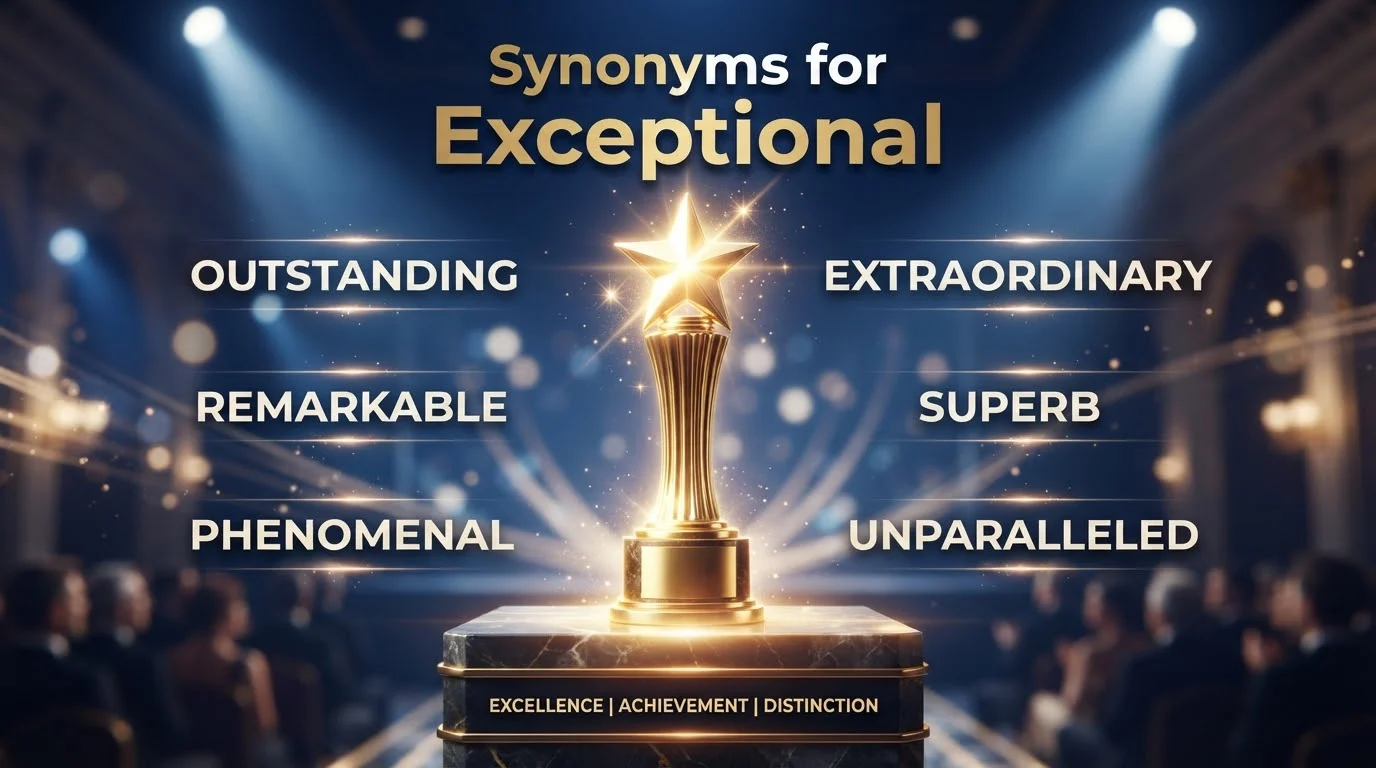
Do you keep using the word “exceptional” in essays, performance reviews, resumes, creative writing, or everyday conversation? While it is one of the most positive and powerful adjectives in English, repeating it can make your writing feel flat, vague, or overly generic.
The good news is that the best alternative depends on what you actually mean. You might be describing something unusually excellent, remarkably rare, extraordinarily talented, or simply far above average.
This guide explains synonyms for “exceptional” by meaning, tone, context, and usage. You will learn which alternatives work best in academic writing, professional communication, resumes, creative expression, and casual conversation.
Quick Answer: What Does “Exceptional” Mean?
“Exceptional” describes something that is unusually excellent, outstanding, or rare—far above the ordinary or expected standard. It can refer to exceptional talent, exceptional quality, exceptional circumstances, or exceptional service. Depending on context, alternatives include outstanding, extraordinary, remarkable, superb, excellent, phenomenal, unique, unparalleled, remarkable, and distinguished.
Meaning, Tone, and Context
Simple Definition
“Exceptional” generally refers to:
- Excellence: far above average or expected
- Rarity: uncommon or unusual
- Outstanding quality: remarkably good
- Special circumstances: unusual situations (e.g., “exceptional circumstances”)
- Exceptional ability: extraordinary talent or skill
Part of Speech
“Exceptional” functions primarily as an adjective.
Examples:
- “She has exceptional talent.”
- “The service was exceptional.”
- “This is an exceptional case.”
Related Forms:
- Exceptionally (adverb): in an exceptional manner
- Exception (noun): a case that does not follow the rule
- Exceptionality (noun): the quality of being exceptional
- Exceptionable (adjective): causing objection (different meaning)
Positive, Negative, or Neutral Tone
“Exceptional” is generally positive, but it can be neutral in contexts like “exceptional circumstances.”
Positive associations:
- “Her performance was exceptional.”
- “The food was exceptional.”
Neutral contexts:
- “The policy allows for exceptional circumstances.”
- “This is an exceptional case that requires special handling.”
Formality Level
“Exceptional” is a standard word that works in both formal and informal English. It is especially common in academic, professional, and performance-review contexts.
However, more specific alternatives can add precision and variety depending on the context.
Common Use Cases
“Exceptional” commonly refers to:
- Performance: exceptional performance, exceptional results
- Quality: exceptional quality, exceptional service, exceptional product
- Talent: exceptional talent, exceptional ability, exceptional skill
- Circumstances: exceptional circumstances, exceptional cases
- Value: exceptional value, exceptional opportunity
- Achievement: exceptional achievement, exceptional contribution
Important Word Forms
- Exceptional (adjective): unusually excellent or rare
- Exceptionally (adverb): in an exceptional manner
- Exception (noun): a case that does not follow the rule
- Exceptionality (noun): the quality of being exceptional
- Exceptionable (adjective): causing objection
When and How to Use “Exceptional”
Use “exceptional” when you want to describe something that is unusually excellent, outstanding, or rare. Because the word is broad, more specific alternatives can add precision depending on the context.
Professional
“Her performance this quarter was exceptional.”
This works naturally in performance reviews and business communication.
Academic
“The study identified exceptional cases that did not follow the trend.”
The term is appropriate in academic research.
Resume
“Delivered exceptional results under tight deadlines.”
This is common in resumes and cover letters.
Personal
“The food at that restaurant was exceptional.”
The word sounds natural in everyday conversation.
Customer Service
“We strive to provide exceptional service to every customer.”
This is standard in customer service contexts.
Creative
“The sunset was exceptional—a masterpiece of color and light.”
The word creates a vivid, positive image.
Another Word for “Exceptional”
There is no single perfect synonym because “exceptional” can refer to excellence, rarity, outstanding quality, special circumstances, or extraordinary ability.
- Excellence context: excellent, outstanding, superb, superior, first-rate
- Rarity context: rare, unusual, uncommon, unique, singular
- Outstanding quality context: remarkable, extraordinary, phenomenal, exceptional
- Special circumstances context: special, unusual, atypical, anomalous
- Extraordinary ability context: gifted, talented, prodigious, brilliant
If you need one broad alternative, “outstanding” works in most contexts, while “extraordinary” works for rarity. “Remarkable” works for striking excellence.
When Not to Use “Exceptional”
“Exceptional” can become too vague when you need to specify exactly what kind of excellence or rarity you are describing.
Consider:
“The results were exceptional.”
This statement does not tell readers whether the results were excellent, rare, unexpected, or outstanding.
A more precise sentence could be:
“The results exceeded all expectations and set a new record.”
Similarly, avoid using “exceptional” when you mean “good” in a simple context. Use “good”, “great”, or “excellent” instead.
Words Commonly Confused With “Exceptional”
Exceptional vs. Excellent
Excellent means very good. Exceptional means far above average or rare.
Example:
“The food was excellent.” (very good)
“The food was exceptional.” (outstanding, rare)
Exceptional vs. Extraordinary
Extraordinary means very unusual or remarkable. Exceptional emphasizes excellence.
Example:
“It was an extraordinary event.” (unusual)
“It was an exceptional performance.” (outstanding)
Exceptional vs. Outstanding
Outstanding means extremely good. Exceptional means unusually excellent or rare.
Example:
“She is an outstanding student.” (very good)
“She is an exceptional student.” (rare, outstanding)
Exceptional vs. Unique
Unique means one of a kind. Exceptional means unusually excellent or rare.
Example:
“Her style is unique.” (one of a kind)
“Her talent is exceptional.” (outstanding)
Exceptional vs. Remarkable
Remarkable means worthy of attention. Exceptional means far above average.
Example:
“The recovery was remarkable.” (noteworthy)
“The recovery was exceptional.” (outstanding)
Exceptional vs. Superior
Superior means higher in quality. Exceptional means unusually excellent.
Example:
“This product is superior.” (higher quality)
“This product is exceptional.” (outstanding)
Best Synonym by Context for “Exceptional”
| Context | Best Synonym | Why It Works | Example |
|---|---|---|---|
| Formal writing | Outstanding, extraordinary | Precise and professional | The results were outstanding. |
| Academic writing | Exceptional, anomalous | Standard academic usage | The study identified exceptional cases. |
| Business/Resume | Outstanding, superior, exceptional | Professional and impactful | Delivered outstanding results. |
| Performance review | Excellent, outstanding, exceptional | Professional and positive | Her performance was exceptional. |
| Customer service | Exceptional, superb, excellent | Professional and polite | We provide exceptional service. |
| Creative writing | Extraordinary, remarkable, phenomenal | Adds literary depth | The sunset was extraordinary. |
| Casual conversation | Amazing, incredible, outstanding | Natural and informal | That was an amazing meal. |
| Rarity | Rare, unique, singular | Emphasizes rarity | It was a rare opportunity. |
| Talent | Gifted, talented, prodigious | Emphasizes ability | She is a gifted musician. |
| Quality | Superb, superior, first-rate | Emphasizes quality | The quality is superb. |
| Circumstances | Special, unusual, atypical | Emphasizes exception | The policy allows for special circumstances. |
| Achievement | Remarkable, extraordinary | Emphasizes achievement | It was a remarkable achievement. |
Which Synonym Should You Choose?
Start by identifying what kind of “exceptional” you are describing.
- Excellence: excellent, outstanding, superb, superior, first-rate
- Rarity: rare, unusual, uncommon, unique, singular
- Outstanding quality: remarkable, extraordinary, phenomenal
- Special circumstances: special, unusual, atypical, anomalous
- Extraordinary ability: gifted, talented, prodigious, brilliant
10 Key Synonyms for “Exceptional”
The table below includes accurate alternatives with clear meanings and usage contexts.
| Synonym | Simple Meaning | Best Used For | Example Sentence |
|---|---|---|---|
| Outstanding | Extremely good | General, professional | Her performance was outstanding. |
| Extraordinary | Very unusual or remarkable | General, creative | It was an extraordinary achievement. |
| Remarkable | Worthy of attention | General, academic | The results were remarkable. |
| Superb | Excellent in quality | Quality, service | The service was superb. |
| Excellent | Very good | General, everyday | The food was excellent. |
| Phenomenal | Remarkable or extraordinary | Emphasis, informal | The response was phenomenal. |
| Unique | One of a kind | Rarity, distinction | Her style is unique. |
| Unparalleled | Having no equal | Formal, emphasis | The quality is unparalleled. |
| Distinguished | Successful and respected | Professional, academic | She had a distinguished career. |
| First-rate | Of the highest quality | Quality, informal | The hotel was first-rate. |
Synonym Groups and Usage Differences
Professional vs. Personal Synonyms
Professional writing benefits from specific terms such as outstanding, exceptional, superior, distinguished, and first-rate.
Personal communication often uses exceptional itself or casual alternatives like amazing, incredible, or outstanding.
Compare:
“That was an amazing meal.” (personal)
“The service was exceptional.” (professional)
Formal vs. Conversational Synonyms
Exceptional works in both formal and conversational English.
Formal alternatives: outstanding, extraordinary, unparalleled, distinguished
Conversational alternatives: amazing, incredible, phenomenal, first-rate
Examples:
“The results were unparalleled.” (formal)
“The results were amazing.” (conversational)
Academic Synonyms
Academic writing should distinguish between exceptional (outstanding), anomalous (unusual), significant (statistically meaningful), and noteworthy (worthy of attention).
For example:
“The study identified several exceptional cases.”
“The findings were noteworthy but not statistically significant.”
Professional and Business Synonyms
Business writing often benefits from phrases such as outstanding, superior, exceptional, distinguished, and first-rate.
Instead of:
“She did an exceptional job.”
Consider:
“She delivered outstanding results that exceeded expectations.”
Creative or Literary Synonyms
Creative writing can use extraordinary, remarkable, phenomenal, singular, and transcendent depending on the context.
For example:
“The sunset was extraordinary—a masterpiece of color and light.”
“Her voice had a singular beauty.”
Slang or Modern Synonyms
Amazing is the most common casual alternative.
Incredible is similar.
Phenomenal is emphatic and modern.
Awesome is casual and positive.
Examples:
“That was an amazing performance.” (casual)
“The response was phenomenal.” (modern)
Strongest vs. Weaker Synonyms
“Exceptional” synonyms vary in intensity:
Milder: good, great, excellent
Moderate: exceptional, outstanding, superb
Strong: extraordinary, phenomenal, unparalleled
Very Strong: transcendent, peerless, incomparable
Emotional vs. Neutral Synonyms
“Exceptional” is generally positive and emotional.
Emotional alternatives: amazing, phenomenal, incredible, extraordinary
Neutral alternatives: outstanding, superior, first-rate
Examples:
“The sunset was absolutely phenomenal.” (emotional)
“The product is superior to competitors.” (neutral)
Antonyms of “Exceptional”
“Exceptional” has several antonyms depending on context:
| Antonym | Context | Meaning | Example Sentence |
|---|---|---|---|
| Ordinary | General | Normal, not special | It was an ordinary day. |
| Average | General | Typical, not outstanding | His performance was average. |
| Mediocre | Quality | Not very good | The food was mediocre. |
| Common | Rarity | Usual, not rare | It’s a common occurrence. |
| Unremarkable | General | Not noteworthy | The results were unremarkable. |
| Typical | General | Usual, expected | It was a typical response. |
| Inferior | Quality | Lower in quality | The product was inferior. |
| Poor | Quality | Low quality | The service was poor. |
Comparison: “Exceptional” vs. Similar Words
Exceptional vs. Excellent
Main difference: Excellent means very good. Exceptional means far above average or rare.
Examples:
“The food was excellent.” (very good)
“The food was exceptional.” (outstanding, rare)
Exceptional vs. Extraordinary
Main difference: Extraordinary means very unusual or remarkable. Exceptional emphasizes excellence.
Examples:
“It was an extraordinary event.” (unusual)
“It was an exceptional performance.” (outstanding)
Exceptional vs. Outstanding
Main difference: Outstanding means extremely good. Exceptional means unusually excellent or rare.
Examples:
“She is an outstanding student.” (very good)
“She is an exceptional student.” (rare, outstanding)
Exceptional vs. Unique
Main difference: Unique means one of a kind. Exceptional means unusually excellent or rare.
Examples:
“Her style is unique.” (one of a kind)
“Her talent is exceptional.” (outstanding)
Exceptional vs. Remarkable
Main difference: Remarkable means worthy of attention. Exceptional means far above average.
Examples:
“The recovery was remarkable.” (noteworthy)
“The recovery was exceptional.” (outstanding)
Exceptional vs. Superior
Main difference: Superior means higher in quality. Exceptional means unusually excellent.
Examples:
“This product is superior.” (higher quality)
“This product is exceptional.” (outstanding)
Common Phrases and Expressions with “Exceptional”
1. Exceptional performance
Meaning:
Outstanding achievement.
Example:
“Her exceptional performance earned her a promotion.”
2. Exceptional quality
Meaning:
Outstanding standard.
Example:
“The product is known for its exceptional quality.”
3. Exceptional talent
Meaning:
Extraordinary ability.
Example:
“She has exceptional talent in music.”
4. Exceptional service
Meaning:
Outstanding customer service.
Example:
“The hotel is known for its exceptional service.”
5. Exceptional circumstances
Meaning:
Unusual or special situations.
Example:
“The policy allows for exceptions in exceptional circumstances.”
6. Exceptional case
Meaning:
An unusual or special instance.
Example:
“This is an exceptional case that requires special handling.”
7. Exceptional value
**Meaning:
Outstanding worth for the price.
Example:
“The restaurant offers exceptional value.”
8. Exceptional results
Meaning:
Outstanding outcomes.
Example:
“The team delivered exceptional results.”
9. Exceptional ability
Meaning:
Extraordinary skill.
Example:
“Her exceptional ability set her apart.”
10. Exceptional achievement
Meaning:
Outstanding accomplishment.
Example:
“Winning the award was an exceptional achievement.”
Common Mistakes to Avoid
1. Using “exceptional” when a more precise term is available
If you mean outstanding, extraordinary, superb, or remarkable, use the more specific word.
Vague: “The results were exceptional.”
Precise: “The results exceeded all expectations and set a new record.”
2. Confusing “exceptional” with “exceptionable”
Exceptional means outstanding. Exceptionable means causing objection.
Incorrect: “Her behavior was exceptional.” (if objectionable)
Correct: “Her behavior was exceptionable.” (objectionable)
3. Using “exceptional” in academic writing when “significant” is needed
In academic writing, significant has a statistical meaning. Use it precisely.
Incorrect: “There was an exceptional difference.” (if statistical)
Correct: “There was a significant difference (p < .05).”
4. Overusing “exceptional” in writing
Repetition can make content feel dull. Use alternatives such as outstanding, extraordinary, remarkable, superb, and phenomenal.
5. Choosing a synonym that changes the meaning
Do not replace exceptional with unique unless you mean one of a kind.
Do not replace exceptional with rare unless you mean uncommon.
FAQs
What is the best synonym for “exceptional”?
The best synonym depends on context. Outstanding works for general excellence, extraordinary for rarity, remarkable for noteworthy, superb for quality, and phenomenal for emphasis.
What is a formal synonym for “exceptional”?
Outstanding, extraordinary, unparalleled, distinguished, and superior are formal synonyms.
What is an informal synonym for “exceptional”?
Amazing, incredible, phenomenal, and awesome are common informal alternatives.
What is another word for “exceptional” in a resume?
Outstanding, superior, exceptional, and distinguished work well in resumes.
What is the difference between “exceptional” and “excellent”?
Excellent means very good. Exceptional means far above average or rare.
What is the opposite of “exceptional”?
Depending on context, opposites include ordinary, average, mediocre, common, unremarkable, and typical.
What does “exceptional” mean in a legal context?
In legal contexts, “exceptional circumstances” refers to unusual situations that may justify special treatment or exceptions to rules.
Conclusion
“Exceptional” is a powerful, positive word that can describe excellence, rarity, outstanding quality, special circumstances, and extraordinary ability. The best synonym depends on what you actually mean.
Choose outstanding for general excellence, extraordinary for rarity, remarkable for noteworthy, superb for quality, phenomenal for emphasis, and unique for one-of-a-kind distinction.
Most importantly, do not replace “exceptional” simply to avoid repetition. First identify what kind of excellence or rarity you are actually describing. Then choose the alternative that communicates that idea most clearly.
For academic, professional, and formal writing, precision is usually more valuable than vocabulary variety. A specific term such as outstanding, extraordinary, unparalleled, or distinguished can tell readers much more than the broad word exceptional.
Before publishing a vocabulary guide, verify definitions and usage with trusted dictionaries such as Cambridge, Oxford, Merriam-Webster, Collins, or Britannica. This helps ensure that each alternative accurately matches its intended meaning and context.
The practical takeaway is simple: when “exceptional” feels too general, ask yourself what kind of excellence or rarity you are actually describing. Then use the most precise word available.
Discover More:-
- 50+ Synonyms for Leadership: Meanings, Examples, and Best Alternatives
- 50+ Synonyms for Insight: Meanings, Examples, and Best Alternatives
