Do you keep using the word “plus” in essays, business reports, math problems, product descriptions, or everyday conversation? While it is one of the most useful and flexible words in English, repeating it can make your writing feel flat, informal, or overly simplistic.
The good news is that the best alternative depends on what you actually mean. You might be adding information, describing an advantage, indicating a positive value, or listing benefits. “Plus” can function as a preposition, conjunction, adjective, and noun—and each use has its own set of alternatives.
This guide explains synonyms for “plus” by meaning, tone, context, and usage. You will learn which alternatives work best in academic writing, professional communication, product marketing, creative expression, and casual conversation.
Quick Answer: What Does “Plus” Mean?
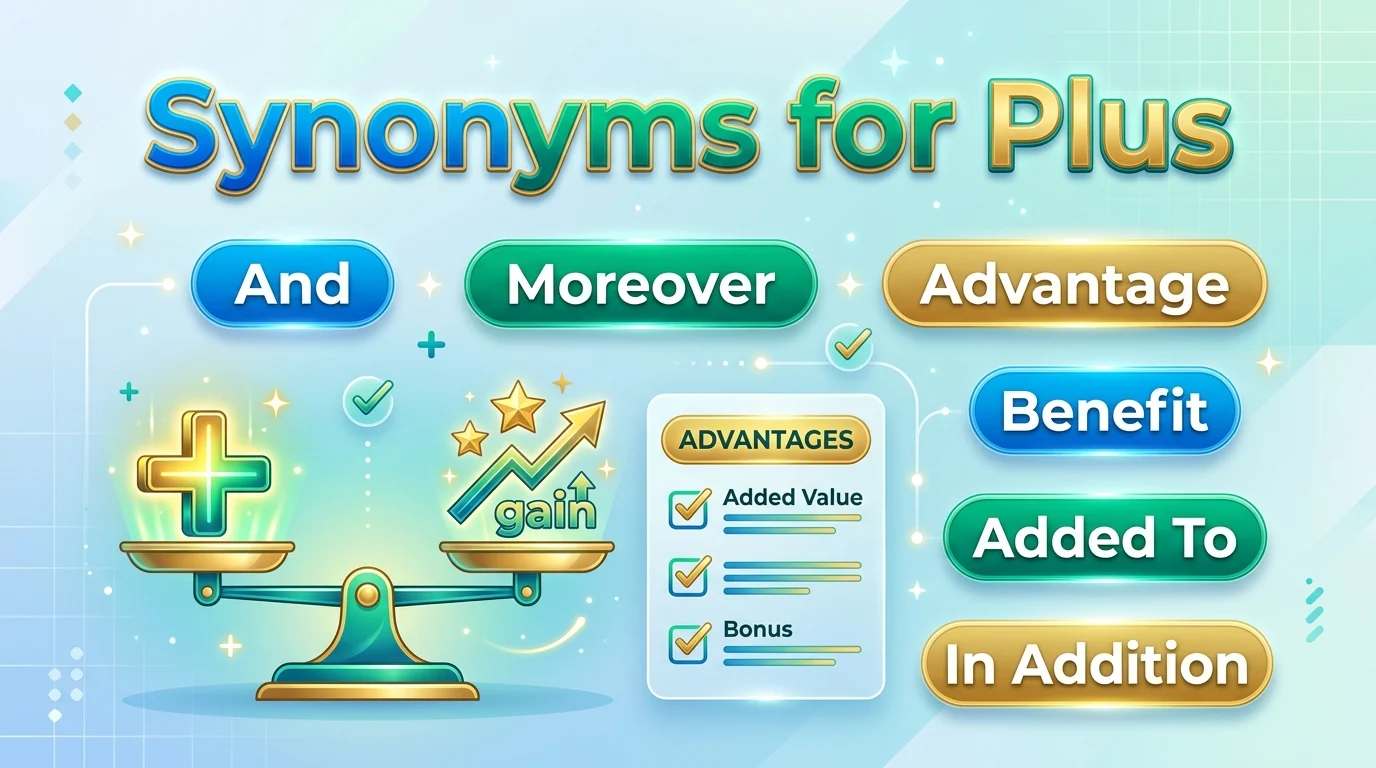
“Plus” is used to add information, indicate an advantage or benefit, show a positive value, or mean “and also.” Depending on context, alternatives include and, added to, in addition to, moreover, furthermore, besides, advantage, benefit, upside, asset, positive, and above zero.
Meaning, Tone, and Context
Simple Definition
“Plus” generally refers to:
- Addition: adding numbers or amounts (two plus three)
- Additional information: adding a point (plus, it’s cheap)
- Advantage: a positive quality (the plus of this job)
- Positive value: above zero (plus five degrees)
- Bonus: something extra (a plus for the team)
Part of Speech
“Plus” functions as a preposition, conjunction, adjective, and noun.
Preposition Examples:
- “Two plus three equals five.”
- “The rent plus utilities comes to $1,500.”
Conjunction Examples:
- “The hotel is beautiful, plus it’s affordable.”
Adjective Examples:
- “On the plus side, we finished early.”
- “Plus five degrees.”
Noun Examples:
- “The plus of this job is the salary.”
- “Experience is a big plus.”
Related Forms:
- Pluses (noun): advantages
- Plussed (adjective): increased (rare)
- Surplus (noun): an amount left over
- Nonplus (verb): to confuse
Positive, Negative, or Neutral Tone
“Plus” is generally neutral but can be positive when describing advantages.
Positive associations:
- “The plus of this job is the flexible hours.”
- “Her experience is a big plus.”
Neutral contexts:
- “Two plus three equals five.”
- “Plus five degrees.”
Formality Level
“Plus” is a standard word that works in both formal and informal English. However, as a conjunction meaning “and also,” it is informal and should be avoided in formal writing.
Formal alternatives: moreover, furthermore, in addition
Informal alternatives: plus, and, besides
Common Use Cases
“Plus” commonly appears in:
- Math: two plus two
- Prices: rent plus utilities
- Advantages: the plus of this plan
- Temperature: plus five degrees
- Casual speech: plus, it’s fun
- Resumes: experience is a plus
Important Word Forms
- Plus (preposition): added to
- Plus (conjunction): and also (informal)
- Plus (adjective): positive; favorable
- Plus (noun): an advantage
- Pluses (noun): multiple advantages
When and How to Use “Plus”
Use “plus” when you want to add information, indicate an advantage, or show a positive value. Because the word is flexible, more specific alternatives can add precision depending on the context.
Professional
“The salary plus benefits makes this an attractive offer.”
This works naturally in business communication.
Academic
“Avoid using “plus” as a conjunction in academic writing. Use moreover or furthermore instead.
Example:
“Moreover, the data supports the hypothesis.”
Personal
“The trip was fun, plus we got to see the ocean.”
The word sounds natural in everyday conversation.
Math
“Two plus two equals four.”
This is standard in mathematical contexts.
Business
“Experience with project management is a plus.”
This is common in job descriptions.
Temperature
“The temperature reached plus ten degrees.”
This is standard in weather reporting.
Another Word for “Plus”
There is no single perfect synonym because “plus” can mean addition, an advantage, positive value, or additional information.
- Addition context: added to, and, together with, in addition to
- Additional information: moreover, furthermore, additionally, besides
- Advantage context: advantage, benefit, upside, asset, perk
- Positive value: positive, above zero, favorable
- Bonus context: bonus, extra, added benefit
If you need one broad alternative, “in addition to” works for addition, while “advantage” works for benefits. “Moreover” works for formal additional information.
When Not to Use “Plus”
“Plus” can become too informal when you need a more formal tone.
Consider:
“The plan is affordable, plus it’s efficient.”
This is fine in casual conversation, but in formal writing:
“The plan is affordable; moreover, it is efficient.”
Similarly, avoid using “plus” when you mean “advantage” in a formal context. Use “advantage”, “benefit”, or “asset” instead.
Words Commonly Confused With “Plus”
Plus vs. And
And is the standard conjunction for addition. Plus is more informal in this use.
Example:
“We need milk and eggs.” (standard)
“We need milk, plus eggs.” (informal, emphatic)
Plus vs. Moreover
Moreover is formal. Plus is informal.
Example:
“Moreover, the results were consistent.” (formal)
“Plus, the results were consistent.” (informal)
Plus vs. Advantage
Advantage is a noun meaning a benefit. Plus can be a noun or conjunction.
Example:
“The advantage of this plan is its cost.” (noun)
“The plus of this plan is its cost.” (noun, informal)
Plus vs. Benefit
Benefit emphasizes a positive effect. Plus can mean an advantage.
Example:
“The health benefits are significant.” (positive effect)
“The plus is the flexible schedule.” (advantage)
Plus vs. Added To
Added to is more explicit for math or totals. Plus is common in both.
Example:
“The tax added to the total was significant.” (explicit)
“Two plus two equals four.” (common)
Plus vs. Positive
Positive describes a value above zero. Plus can mean the same.
Example:
“The temperature is positive five degrees.” (formal)
“The temperature is plus five degrees.” (common)
Best Synonym by Context for “Plus”
| Context | Best Synonym | Why It Works | Example |
|---|---|---|---|
| Formal writing | Moreover, furthermore | Formal and precise | Moreover, the data supports the hypothesis. |
| Academic writing | In addition, additionally | Standard academic usage | In addition, the results were significant. |
| Business/Professional | Together with, along with | Professional and clear | The salary together with benefits is competitive. |
| Math | Added to | Explicit and precise | Two added to three equals five. |
| Advantage context | Benefit, advantage, asset | Emphasizes positive quality | Experience is a big advantage. |
| Casual conversation | And, besides | Natural and informal | The food was great, and it was cheap. |
| Product descriptions | Bonus, extra, added benefit | Marketing and branding | A bonus is the free shipping. |
| Temperature | Positive, above zero | Weather and science | The temperature is above zero. |
| Resume | Asset, advantage, strength | Professional context | Bilingual ability is an asset. |
| Creative writing | Moreover, besides | Adds variety | Besides, the view was stunning. |
| Job descriptions | Advantage, bonus | Hiring context | Project management experience is a bonus. |
| General addition | In addition to, along with | Neutral and clear | Along with the rent, utilities are included. |
Which Synonym Should You Choose?
Start by identifying what function “plus” is serving.
- Addition (math): added to, and
- Additional information: moreover, furthermore, in addition, besides
- Advantage: advantage, benefit, upside, asset, perk
- Positive value: positive, above zero, favorable
- Bonus: bonus, extra, added benefit
10 Key Synonyms for “Plus”
The table below includes accurate alternatives with clear meanings and usage contexts.
| Synonym | Simple Meaning | Best Used For | Example Sentence |
|---|---|---|---|
| And | In addition to | General, informal | We need milk and eggs. |
| Added to | Combined with | Math, totals | Two added to three equals five. |
| In addition to | As well as | Formal, general | In addition to the rent, utilities are extra. |
| Moreover | Furthermore | Formal writing | Moreover, the results were consistent. |
| Furthermore | In addition | Formal writing | Furthermore, the data supports the theory. |
| Besides | In addition; also | Casual, general | Besides, it’s affordable. |
| Advantage | A benefit | Business, personal | The advantage of this plan is its cost. |
| Benefit | A positive effect | General, professional | The benefits include health insurance. |
| Upside | A positive aspect | Casual, business | The upside is the flexible schedule. |
| Asset | A valuable quality | Professional, resume | Experience is a valuable asset. |
Synonym Groups and Usage Differences
Professional vs. Personal Synonyms
Professional writing benefits from specific terms such as moreover, furthermore, in addition, advantage, and asset.
Personal communication often uses plus itself or casual alternatives like and, besides, or upside.
Compare:
“The food was great, plus it was cheap.” (personal)
“The plan is affordable; moreover, it is efficient.” (professional)
Formal vs. Conversational Synonyms
Plus as a conjunction is informal.
Formal alternatives: moreover, furthermore, in addition
Conversational alternatives: and, besides, plus
Examples:
“Moreover, the data supports the hypothesis.” (formal)
“Besides, it’s fun.” (conversational)
Academic Synonyms
Academic writing should avoid plus as a conjunction. Use moreover, furthermore, in addition, or additionally.
For example:
“Moreover, the findings are consistent with previous research.”
“In addition, the sample size was adequate.”
Professional and Business Synonyms
Business writing often benefits from phrases such as advantage, benefit, asset, along with, and together with.
Instead of:
“Experience is a plus.”
Consider:
“Experience is a valuable asset for this role.”
Creative or Literary Synonyms
Creative writing can use besides, moreover, furthermore, and beyond that depending on the context.
For example:
“Beyond that, the view was stunning.”
“Besides, the night was still young.”
Slang or Modern Synonyms
Plus itself is common in casual speech.
And is the most common casual alternative.
On top of that is casual for “in addition.”
To boot is slang for “as an additional benefit.”
Examples:
“On top of that, it’s free.” (casual)
“The food was great and cheap to boot.” (slang)
Strongest vs. Weaker Synonyms
“Plus” synonyms vary in formality:
Milder: and, besides
Moderate: in addition to, along with
Strong: moreover, furthermore
Very Strong: beyond that, on top of that
Emotional vs. Neutral Synonyms
“Plus” is generally neutral.
Emotional alternatives: on top of that, to boot (emphatic)
Neutral alternatives: moreover, in addition, along with
Examples:
“On top of that, it’s free!” (emphatic)
“Moreover, the data supports the theory.” (neutral)
Antonyms of “Plus”
“Plus” has several antonyms depending on context:
| Antonym | Context | Meaning | Example Sentence |
|---|---|---|---|
| Minus | Math | Subtracted from | Five minus two equals three. |
| Without | Addition | Not including | The price without tax is lower. |
| Except | Addition | Excluding | The package includes everything except shipping. |
| Negative | Value | Below zero | The temperature was negative five degrees. |
| Disadvantage | Advantage | A negative quality | The disadvantage is the cost. |
| Drawback | Advantage | A negative aspect | The drawback is the location. |
Comparison: “Plus” vs. Similar Words
Plus vs. And
Main difference: And is the standard conjunction for addition. Plus is more informal in this use.
Examples:
“We need milk and eggs.” (standard)
“We need milk, plus eggs.” (informal, emphatic)
Plus vs. Moreover
Main difference: Moreover is formal. Plus is informal.
Examples:
“Moreover, the results were consistent.” (formal)
“Plus, the results were consistent.” (informal)
Plus vs. Advantage
Main difference: Advantage is a noun meaning a benefit. Plus can be a noun or conjunction.
Examples:
“The advantage of this plan is its cost.” (noun)
“The plus of this plan is its cost.” (noun, informal)
Plus vs. Benefit
Main difference: Benefit emphasizes a positive effect. Plus can mean an advantage.
Examples:
“The health benefits are significant.” (positive effect)
“The plus is the flexible schedule.” (advantage)
Plus vs. Added To
Main difference: Added to is more explicit for math or totals. Plus is common in both.
Examples:
“The tax added to the total was significant.” (explicit)
“Two plus two equals four.” (common)
Plus vs. Positive
Main difference: Positive describes a value above zero. Plus can mean the same.
Examples:
“The temperature is positive five degrees.” (formal)
“The temperature is plus five degrees.” (common)
Common Phrases and Expressions with “Plus”
1. Plus point
Meaning:
An advantage.
Example:
“A major plus point is the location.”
2. On the plus side
Meaning:
Considering the advantages.
Example:
“On the plus side, we finished early.”
3. A big plus
Meaning:
A significant advantage.
Example:
“Experience is a big plus.”
4. Plus one
Meaning:
An additional person; a guest.
Example:
“Can I bring a plus one?”
5. Plus or minus
Meaning:
Approximately; with a small margin of error.
Example:
“The estimate is 100 plus or minus 10.”
6. Plus sign
Meaning:
The symbol “+”.
Example:
“Add a plus sign between the numbers.”
7. Added plus
Meaning:
An additional advantage.
Example:
“The free parking is an added plus.”
8. Plus factor
Meaning:
An additional positive element.
Example:
“Her fluency in Spanish was a plus factor.”
9. Plus benefits
Meaning:
Additional advantages or perks.
Example:
“The salary plus benefits is competitive.”
10. Plus tax
Meaning:
Before tax is added.
Example:
“The price is $50 plus tax.”
Common Mistakes to Avoid
1. Using “plus” as a conjunction in formal writing
In formal writing, use moreover, furthermore, or in addition instead of “plus.”
Informal: “The plan is affordable, plus it’s efficient.”
Formal: “The plan is affordable; moreover, it is efficient.”
2. Confusing “plus” with “advantage”
Advantage is a noun. Plus can be a noun or conjunction.
Incorrect: “The plus of this job is the salary.” (acceptable but informal)
Correct: “The advantage of this job is the salary.” (formal)
3. Using “plus” in academic writing
Academic writing benefits from precise terms like moreover, furthermore, and in addition.
Vague: “Plus, the data supports the theory.”
Precise: “Moreover, the data supports the theory.”
4. Overusing “plus” in writing
Repetition can make content feel dull. Use alternatives such as and, besides, moreover, in addition, and advantage.
5. Choosing a synonym that changes the meaning
Do not replace plus with positive unless you mean above zero.
Do not replace plus with benefit unless you mean a positive effect.
FAQs
What is the best synonym for “plus”?
The best synonym depends on context. And works for general addition, moreover for formal writing, advantage for benefits, and positive for values above zero.
What is a formal synonym for “plus”?
Moreover, furthermore, in addition, and additionally are formal synonyms.
What is an informal synonym for “plus”?
And, besides, and on top of that are common informal alternatives.
What is another word for “plus” in math?
Added to is the most precise alternative. And also works in simple addition.
What is the difference between “plus” and “moreover”?
Moreover is formal. Plus is informal when used as a conjunction.
What is the opposite of “plus”?
Depending on context, opposites include minus, without, except, negative, and disadvantage.
What does “plus” mean in a resume?
In a resume, “plus” often refers to an advantage or asset—something that makes a candidate more attractive.
Conclusion
“Plus” is a versatile and useful word that can describe addition, an advantage, a positive value, or additional information. The best synonym depends on what you actually mean.
Choose and for general addition, in addition to for formal contexts, moreover for formal writing, advantage for benefits, positive for values above zero, and asset for professional contexts.
