Do you keep using the word “occupied” in essays, business reports, travel writing, news articles, or everyday conversation? While it is a useful and versatile adjective, repeating it can make your writing feel flat, vague, or overly formal.
The good news is that the best alternative depends on what you actually mean. You might be describing a person who is busy, a seat or facility that is in use, a house where someone lives, or a territory under military control.
This guide explains synonyms for “occupied” by meaning, tone, context, and usage. You will learn which alternatives work best in academic writing, professional communication, travel and hospitality, news reporting, and casual conversation.
Quick Answer: What Does “Occupied” Mean?
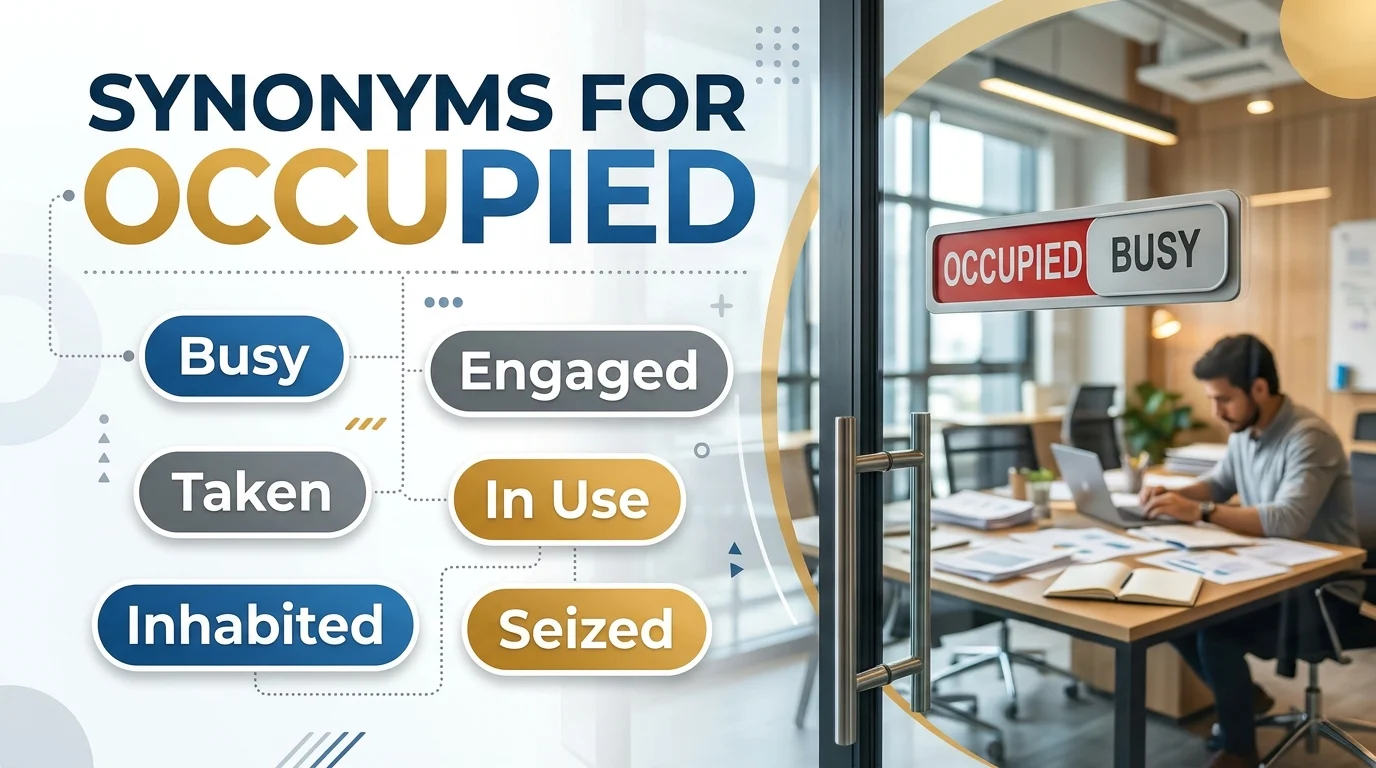
“Occupied” describes someone who is busy or engaged in an activity, something that is in use or taken, a place where someone lives, or a territory controlled by military force. Depending on context, alternatives include busy, engaged, taken, in use, inhabited, tenanted, seized, controlled, absorbed, and preoccupied.
Meaning, Tone, and Context
Simple Definition
“Occupied” generally refers to:
- Busy: engaged in an activity; having no free time
- In use: being used by someone (a seat, bathroom, phone line)
- Inhabited: lived in by people (a house, building, region)
- Seized: taken control of by military force (territory, country)
- Mentally engaged: absorbed or preoccupied with something
Part of Speech
“Occupied” functions primarily as an adjective and as the past tense of the verb “occupy.”
Adjective Examples:
- “The seat is occupied.”
- “She is occupied with work.”
Verb Examples:
- “The army occupied the city.”
- “He occupied himself with reading.”
Related Forms:
- Occupy (verb): to fill, use, or take control of
- Occupation (noun): a job; the act of occupying
- Occupant (noun): a person who occupies a place
- Occupancy (noun): the state of being occupied
- Preoccupied (adjective): absorbed in thought
Positive, Negative, or Neutral Tone
“Occupied” is generally neutral, but its tone shifts with context.
Neutral contexts:
- “The seat is occupied.” (in use)
- “She is occupied with work.” (busy)
Negative contexts:
- “The occupied territories remain a source of conflict.” (military)
- “He felt occupied by unwanted thoughts.” (preoccupied)
Positive or practical contexts:
- “The apartment is fully occupied.” (inhabited)
Formality Level
“Occupied” is a standard word that works in both formal and informal English. It is appropriate in academic papers, business reports, news articles, travel writing, and casual conversation.
However, more specific alternatives can add precision and variety depending on the context.
Common Use Cases
“Occupied” commonly refers to:
- Seats and facilities: occupied seat, occupied restroom, occupied phone line
- People: occupied with work, occupied with tasks
- Housing: occupied apartment, occupied building
- Military: occupied territory, occupied zone
- Mental state: occupied with worry, preoccupied with thoughts
Important Word Forms
- Occupied (adjective): busy, in use, inhabited, seized
- Occupy (verb): to fill or take control of
- Occupation (noun): a job; the act of occupying
- Occupant (noun): a person who occupies a place
- Occupancy (noun): the state of being occupied
- Preoccupied (adjective): absorbed in thought
When and How to Use “Occupied”
Use “occupied” when you want to describe something in use, someone who is busy, a place that is inhabited, or a territory under control. Because the word is broad, more specific alternatives can add precision depending on the context.
Professional
“All meeting rooms are currently occupied.”
This works naturally in business communication.
Academic
“The study examines the living conditions in occupied territories.”
The term is appropriate in academic and political writing.
Personal
“I’m occupied with work right now—can I call you later?”
The word sounds natural in everyday conversation.
Travel and Hospitality
“The hotel is fully occupied during the holiday season.”
This is standard in hospitality contexts.
News
“The occupied region has seen months of unrest.”
This is appropriate in news reporting.
Mental State
“She was occupied with thoughts of the upcoming exam.”
The word describes mental engagement.
Another Word for “Occupied”
There is no single perfect because “occupied” can refer to being busy, in use, inhabited, or seized.
- Busy context: busy, engaged, tied up, absorbed, preoccupied
- In use context: taken, in use, engaged (UK), reserved
- Inhabited context: inhabited, tenanted, lived-in, peopled
- Seized context: seized, controlled, taken over, conquered
- Mental state context: absorbed, engrossed, immersed, preoccupied
If you need one broad alternative, “busy” works for people, “taken” works for seats, “inhabited” works for houses, and “seized” works for military contexts.
When Not to Use “Occupied”
“Occupied” can become too vague when you need to specify exactly what kind of occupation you are describing.
Consider:
“The room is occupied.”
This statement does not tell readers whether someone is living there, using it temporarily, or holding it by force.
A more precise sentence could be:
“The conference room is in use until 3 PM.”
Similarly, avoid using “occupied” when you mean “busy” in a casual context. Use “busy” or “tied up” instead.
Words Commonly Confused With “Occupied”
Occupied vs. Busy
Busy is the general, everyday word for having a lot to do. Occupied is slightly more formal and can also mean “in use.”
Example:
“I’m busy today.” (general)
“I’m occupied with a task.” (formal)
Occupied vs. Engaged
Engaged can mean busy or involved in an activity. It is often used for phone lines in British English.
Example:
“She is engaged in a meeting.” (involved)
“The line is engaged.” (British: in use)
Occupied vs. Preoccupied
Preoccupied specifically means absorbed in thought, often to the point of not noticing things.
Example:
“She is occupied with work.” (busy)
“She is preoccupied with worry.” (absorbed in thought)
Occupied vs. Inhabited
Inhabited specifically means lived in by people or animals. Occupied is broader.
Example:
“The island is inhabited.” (lived in)
“The apartment is occupied.” (in use)
Occupied vs. Seized
Seized specifically means taken by force. Occupied can be broader but often implies military control.
Example:
“The troops seized the city.” (took by force)
“The troops occupied the city.” (took control)
Occupied vs. Taken
Taken is the casual word for a seat or spot in use. Occupied is more formal.
Example:
“Sorry, this seat is taken.” (casual)
“Sorry, this seat is occupied.” (formal)
Best Synonym by Context for “Occupied”
| Context | Best Synonym | Why It Works | Example |
|---|---|---|---|
| Formal writing | Engaged, in use | Precise and professional | The facilities are currently in use. |
| Academic writing | Inhabited, tenanted | Standard academic usage | The region is sparsely inhabited. |
| Business/Professional | In use, reserved, engaged | Professional and clear | The conference room is reserved until noon. |
| People (busy) | Busy, engaged, tied up | General and natural | She is busy with a client. |
| Mental state | Absorbed, engrossed, preoccupied | Emotional and reflective | He was absorbed in his book. |
| Seats and facilities | Taken, in use, engaged | Everyday and clear | The seats are all taken. |
| Housing | Inhabited, tenanted, lived-in | Housing and real estate | The building is fully tenanted. |
| Military context | Seized, controlled, taken over | News and political writing | The seized territory remains disputed. |
| Travel and hospitality | Fully booked, full, in use | Hospitality and travel | The hotel is fully booked this weekend. |
| Casual conversation | Busy, tied up, taken | Natural and informal | I’m tied up right now. |
| Creative writing | Engrossed, immersed, absorbed | Literary and expressive | She was immersed in her thoughts. |
| Phone lines | Engaged, busy | British/American usage | The line is engaged. |
Which Synonym Should You Choose?
Start by identifying what kind of occupied you are describing.
- Busy: busy, engaged, tied up, absorbed, preoccupied
- In use: taken, in use, engaged (UK), reserved
- Inhabited: inhabited, tenanted, lived-in, peopled
- Seized: seized, controlled, taken over, conquered
- Mental state: absorbed, engrossed, immersed, preoccupied
10 Key Synonyms for “Occupied”
The table below includes accurate alternatives with clear meanings and usage contexts.
| Synonym | Simple Meaning | Best Used For | Example Sentence |
|---|---|---|---|
| Busy | Having a lot to do | People, general | She is busy with work. |
| Engaged | Involved in an activity | People, phone lines | He is engaged in a meeting. |
| Taken | In use by someone | Seats, spots | Sorry, this seat is taken. |
| In use | Currently being used | Facilities, equipment | The restroom is in use. |
| Inhabited | Lived in by people | Housing, regions | The island is sparsely inhabited. |
| Tenanted | Occupied by a tenant | Real estate | The building is fully tenanted. |
| Seized | Taken by force | Military, legal | The troops seized the city. |
| Controlled | Under authority or power | Military, political | The region is controlled by rebels. |
| Absorbed | Deeply engaged mentally | Mental state | She was absorbed in her book. |
| Preoccupied | Distracted by thoughts | Mental state | He was preoccupied with worry. |
Synonym Groups and Usage Differences
Professional vs. Personal Synonyms
Professional writing benefits from specific terms such as in use, engaged, reserved, tenanted, and controlled.
Personal communication often uses busy, tied up, or taken.
Compare:
“I’m tied up right now.” (personal)
“The facility is currently in use.” (professional)
Formal vs. Conversational Synonyms
Occupied works in both formal and conversational English.
Formal alternatives: engaged, in use, inhabited, tenanted
Conversational alternatives: busy, taken, tied up
Examples:
“The premises are fully tenanted.” (formal)
“Sorry, this seat is taken.” (conversational)
Academic Synonyms
Academic writing should distinguish between occupied (general), inhabited (lived in), tenanted (rented), and annexed (military/political).
For example:
“The region is sparsely inhabited.”
“The territory was annexed by the neighboring state.”
Professional and Business Synonyms
Business writing often benefits from phrases such as in use, reserved, fully booked, and tenanted.
Instead of:
“The rooms are occupied.”
Consider:
“All meeting rooms are currently in use.”
Creative or Literary Synonyms
Creative writing can use absorbed, engrossed, immersed, lost in, and preoccupied depending on the context.
For example:
“She was completely absorbed in her thoughts.”
“He sat engrossed in the old photograph.”
Slang or Modern Synonyms
Tied up is common in casual speech.
Taken is casual for seats.
Booked is casual for a busy schedule.
Swamped is slang for very busy.
Examples:
“I’m swamped this week.” (slang)
“Sorry, that seat’s taken.” (casual)
Strongest vs. Weaker Synonyms
“Occupied” synonyms vary in intensity:
Milder: busy, in use, taken
Moderate: occupied, engaged, inhabited
Strong: absorbed, engrossed, preoccupied
Very Strong: seized, controlled, conquered
Emotional vs. Neutral Synonyms
“Occupied” is generally neutral.
Emotional alternatives: absorbed, engrossed, immersed (positive); preoccupied (negative)
Neutral alternatives: in use, taken, inhabited
Examples:
“She was immersed in her painting.” (emotional, positive)
“The seat is taken.” (neutral)
Antonyms of “Occupied”
“Occupied” has several antonyms depending on context:
| Antonym | Context | Meaning | Example Sentence |
|---|---|---|---|
| Free | General | Not in use | Is this seat free? |
| Vacant | Facilities | Empty, available | The apartment is vacant. |
| Available | General | Ready for use | The room is available. |
| Unoccupied | General | Not occupied | The house has been unoccupied for years. |
| Idle | People | Not busy | The machines are idle. |
| Empty | Places | Containing nothing | The room was empty. |
| Liberated | Military | Freed from control | The liberated territories celebrated. |
Comparison: “Occupied” vs. Similar Words
Occupied vs. Busy
Main difference: Busy is the general, everyday word for having a lot to do. Occupied is slightly more formal and can also mean “in use.”
Examples:
“I’m busy today.” (general)
“I’m occupied with a task.” (formal)
Occupied vs. Engaged
Main difference: Engaged can mean busy or involved in an activity. It is often used for phone lines in British English.
Examples:
“She is engaged in a meeting.” (involved)
“The line is engaged.” (British: in use)
Occupied vs. Preoccupied
Main difference: Preoccupied specifically means absorbed in thought, often to the point of not noticing things.
Examples:
“She is occupied with work.” (busy)
“She is preoccupied with worry.” (absorbed in thought)
Occupied vs. Inhabited
Main difference: Inhabited specifically means lived in by people or animals. Occupied is broader.
Examples:
“The island is inhabited.” (lived in)
“The apartment is occupied.” (in use)
Occupied vs. Seized
Main difference: Seized specifically means taken by force. Occupied can be broader but often implies military control.
Examples:
“The troops seized the city.” (took by force)
“The troops occupied the city.” (took control)
Occupied vs. Taken
Main difference: Taken is the casual word for a seat or spot in use. Occupied is more formal.
Examples:
“Sorry, this seat is taken.” (casual)
“Sorry, this seat is occupied.” (formal)
Common Phrases and Expressions with “Occupied”
1. Fully occupied
Meaning:
Completely in use or busy.
Example:
“The hotel is fully occupied this weekend.”
2. Occupied with
Meaning:
Busy doing something.
Example:
“She is occupied with paperwork.”
3. Occupy oneself
Meaning:
Keep oneself busy.
Example:
“He occupied himself with reading while waiting.”
4. Occupied territory
Meaning:
Land controlled by a foreign military force.
Example:
“The occupied territory remains a source of tension.”
5. Keep someone occupied
Meaning:
Give someone something to do.
Example:
“The games kept the children occupied.”
6. Occupied seat
Meaning:
A seat that is in use.
Example:
“All the occupied seats had bags on them.”
7. Occupied mind
Meaning:
A mind that is busy or distracted.
Example:
“An occupied mind has no room for worry.”
8. Occupied phone line
Meaning:
A phone line that is in use.
Example:
“I couldn’t get through—the line was occupied.”
9. Occupied building
Meaning:
A building that is in use or lived in.
Example:
“The occupied building was evacuated safely.”
10. Occupied zone
Meaning:
An area under military control.
Example:
“Aid workers were denied access to the occupied zone.”
Common Mistakes to Avoid
1. Using “occupied” when a more precise term is available
If you mean busy, taken, inhabited, or seized, use the more specific word.
Vague: “The room is occupied.”
Precise: “The conference room is in use until 3 PM.”
2. Confusing “occupied” with “preoccupied”
Preoccupied specifically means absorbed in thought. Occupied can mean busy or in use.
Incorrect: “She was occupied with worry.” (if distracted)
Correct: “She was preoccupied with worry.”
3. Using “occupied” in casual conversation
Casual conversation benefits from simpler terms like busy or taken.
Formal: “The seat is occupied.”
Casual: “The seat’s taken.”
4. Overusing “occupied” in writing
Repetition can make content feel dull. Use alternatives such as busy, engaged, taken, inhabited, and seized.
5. Choosing a synonym that changes the meaning
Do not replace occupied with seized unless you mean taken by force.
Do not replace occupied with inhabited unless you mean lived in.
FAQs
What is the best synonym for “occupied”?
The best synonym depends on context. Busy works for people, taken for seats, inhabited for houses, seized for military contexts, and absorbed for mental states.
What is a formal synonym for “occupied”?
Engaged, in use, inhabited, tenanted, and controlled are formal synonyms.
What is an informal synonym for “occupied”?
Busy, taken, tied up, and swamped are common informal alternatives.
What is another word for “occupied” in academic writing?
Inhabited, tenanted, annexed, and controlled work well in academic writing.
What is the difference between “occupied” and “busy”?
Busy is the general, everyday word. Occupied is slightly more formal and can also mean “in use.”
What is the opposite of “occupied”?
Depending on context, opposites include free, vacant, available, unoccupied, idle, and empty.
What does “occupied” mean in a military context?
In a military context, occupied means a territory or region that is controlled by a foreign military force.
Conclusion
“Occupied” is a versatile word that can describe someone who is busy, something in use, a place that is inhabited, or a territory under control. The best synonym depends on what you actually mean.
Choose busy for people, taken for seats, in use for facilities, inhabited for houses, seized for military contexts, and absorbed for mental states.
