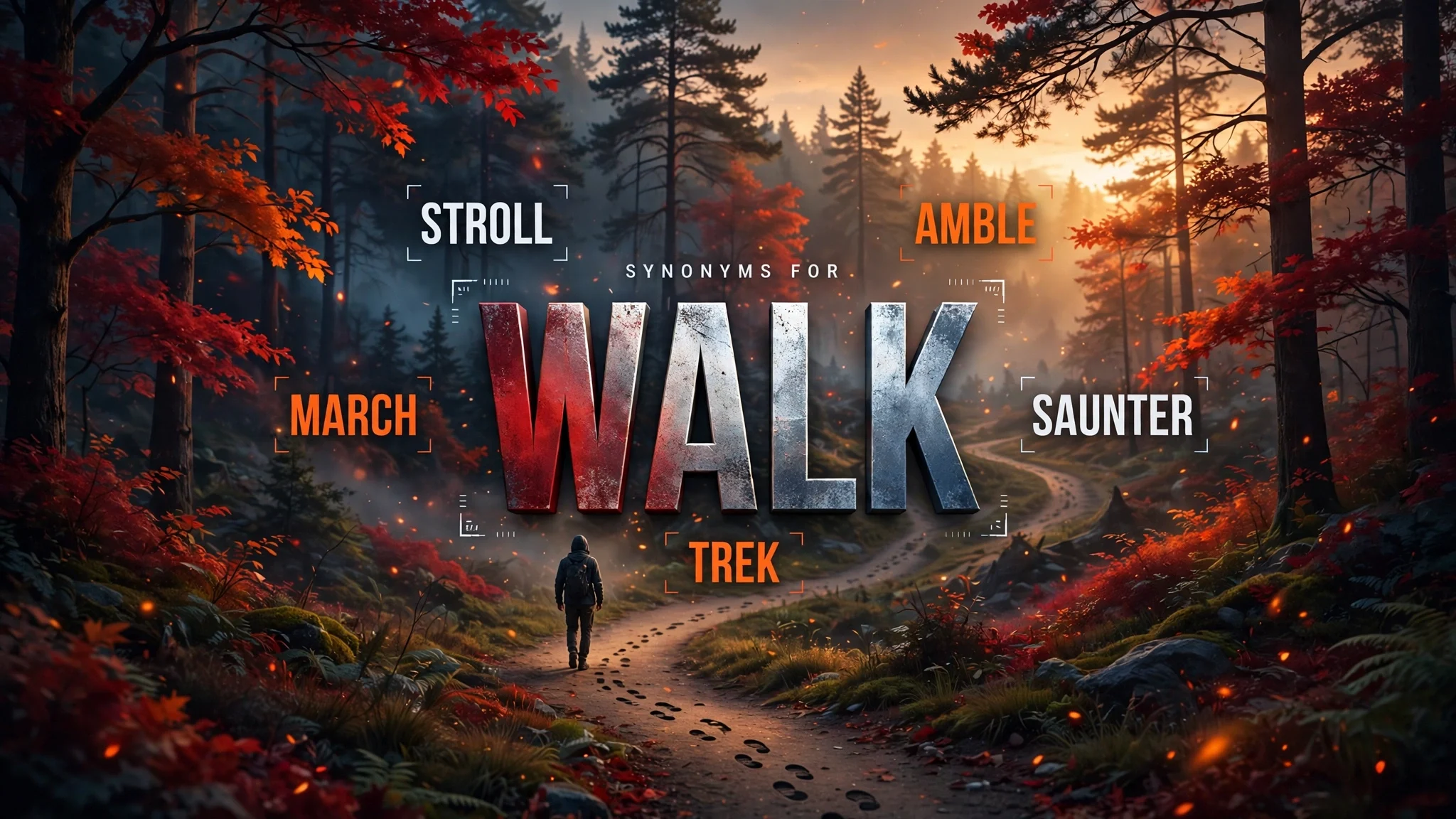
“Walk” is one of the most ordinary words in English, and that is exactly why it can feel flat. We walk to work, walk the dog, walk around a city, and walk away from a difficult conversation, yet each of those journeys has a different pace, mood, and purpose. Using the same verb every time can hide all of that.
The right alternative depends on how someone moves and why. A slow, relaxed walk is not the same as a brisk march to catch a train, and a thoughtful ramble through the countryside is not the same as a determined stride into a meeting.
This guide explains synonyms for “walk” by meaning, tone, context, and usage. You will learn which words suit formal writing, which sound natural in conversation, and which ones to reserve for fiction, travel writing, or everyday speech.
Quick Answer: What Does “Walk” Mean?
To “walk” is to move along on foot at a steady pace, putting one foot in front of the other. As a noun, a walk is a journey made on foot. Useful alternatives include stroll, amble, wander, march, hike, saunter, trek, stride, ramble, and promenade.
Meaning, Tone, and Context
Simple Definition
“Walk” generally refers to:
- Moving on foot at a normal pace: “We walk to school most mornings.”
- Going for pleasure or exercise: “Let us walk along the river after lunch.”
- Moving in a particular manner: “She walked proudly across the stage.”
- Leaving or moving away: “He walked out before the meeting ended.”
- A journey or route on foot: “It is a pleasant walk to the village.”
Part of Speech
“Walk” works as both a verb and a noun. As a verb it describes the action; as a noun it names the journey, route, or way of moving.
Examples:
- “They walk through the park every evening.” (verb)
- “The walk took about an hour.” (noun)
- “She has a confident walk.” (noun, manner of moving)
Related Forms:
- Walked (verb, past): moved on foot
- Walking (verb, present participle; noun): the activity of moving on foot
- Walker (noun): a person who walks, often for exercise or as a hobby
- Walkway (noun): a path or passage for walking
Positive, Negative, or Neutral Tone
“Walk” is generally neutral, but the way someone walks adds feeling. A stroll sounds pleasant, a trudge sounds weary, and a march sounds determined.
Positive or pleasant associations:
- “We strolled through the old town in the sunshine.”
- “She ambled happily along the beach.”
Negative or difficult contexts:
- “They trudged home in the rain.”
- “He shuffled wearily to the door.”
Formality Level
“Walk” is suitable for every level of English, from casual chat to formal reports. More specific verbs, however, are often better in writing: “stroll” for leisure, “march” for purpose, “hike” for a long countryside route, and “proceed on foot” in very formal or official contexts.
Common Use Cases
“Walk” commonly appears in:
- Daily life: walk to work, walk the dog, walk to the shops
- Health and exercise: walk every day, walk for fitness, walk briskly
- Travel: walk around a city, walk a trail, walk to a viewpoint
- Social life: walk with friends, walk and talk, walk home together
- Work and ceremony: walk into a meeting, walk the floor, walk down the aisle
- Nature: walk in the woods, walk along the coast, walk through fields
Important Word Forms
- Walk (verb and noun): move on foot, or a journey on foot
- Walks (verb, third person; noun, plural): regular routes or journeys
- Walking (noun): the activity, often for health or pleasure
- Walker (noun): someone who walks regularly
When and How to Use “Walk”
Use “walk” when the simple fact of moving on foot matters more than the manner. When pace, mood, or setting matters, choose a more precise verb instead.
Academic
“Participants walked the same route each morning.” This is clear and neutral in academic writing, though the study may need to specify pace or distance.
Social
“Shall we walk to the café after class?” This is natural, friendly, and everyday.
Literary
“She walked slowly through the empty house, listening for sounds from the past.” Here the verb carries mood as well as movement.
Creative
“He wandered the night streets, unsure where he was heading.” Creative writing often prefers “wander”, “stroll”, or “drift” to “walk”.
Casual
“I am just going to walk to the corner shop.” This is a typical, relaxed use in everyday speech.
Another Word for “Walk”
There is no single perfect synonym because “walk” can describe pace, purpose, mood, or setting.
- Slow and relaxed: stroll, amble, saunter, meander, wander
- Brisk and purposeful: stride, march, pace, hurry on foot, power-walk
- Long or outdoor routes: hike, trek, ramble, tramp, traverse on foot
- Formal or public movement: promenade, parade, process, proceed on foot
If you need one broad alternative, “stroll” works for leisure, while “stride” works for confident, purposeful movement. For related movement words, see 50+ Synonyms for Motion.
When Not to Use “Walk”
“Walk” can feel too vague when the manner of movement is the interesting part. Consider: “She walked through the market.” A clearer version could be: “She wandered through the market, stopping at every stall.”
Similarly, avoid “walk” for movement that is really running, climbing, or travelling by another means. Use “run”, “climb”, “cycle”, or “travel” when those are accurate, rather than stretching “walk” to cover them.
Words Commonly Confused With “Walk”
Walk vs. Stroll
A stroll is a slow, relaxed walk, usually for pleasure. “Walk” is the general term. Example: “We walked to the station.” / “We strolled along the beach at sunset.”
Walk vs. Wander
To wander is to walk without a fixed route or destination. Example: “He wandered the old streets for hours.” / “She walked directly to the office.”
Walk vs. March
To march is to walk with a firm, regular, purposeful step, often in a group. Example: “The soldiers marched through the town.” / “The children walked home from school.”
Walk vs. Hike
To hike is to walk a long distance, usually in the countryside or on trails, often as recreation. Example: “We hiked to the summit.” / “We walked to the bus stop.”
Walk vs. Stride
To stride is to walk with long, confident steps. Example: “She strode into the room.” / “She walked slowly to the door.”
Walk vs. Ramble
To ramble is to walk for pleasure in the countryside, often without hurrying. Example: “They rambled across the hills.” / “They walked to the village shop.”
Best Synonym by Context for “Walk”
| Context | Best Synonym | Why It Works | Example |
|---|---|---|---|
| Leisurely outing | Stroll | Relaxed and pleasant | We strolled through the gardens. |
| Countryside route | Hike, ramble | Long and outdoors | They hiked across the moors. |
| Confident arrival | Stride | Long, purposeful steps | She strode into the office. |
| Academic writing | Walk, proceed on foot | Neutral and precise | Participants walked the route daily. |
| Business writing | Walk, tour on foot | Clear and professional | He walked the site with the client. |
| Casual conversation | Stroll, wander | Natural and informal | Let us wander around town. |
| Creative writing | Wander, meander | Atmospheric | She meandered along the lane. |
| Formal occasion | Promenade, process | Dignified | Guests promenaded in the gardens. |
Which Synonym Should You Choose?
Start by identifying pace, purpose, and setting.
- Slow and relaxed: stroll, amble, saunter
- Without a fixed route: wander, meander, roam on foot
- Purposeful and brisk: stride, march, power-walk
- Long outdoors: hike, trek, ramble
10 Key Synonyms for “Walk”
| Synonym | Simple Meaning | Best Used For | Example Sentence |
|---|---|---|---|
| Stroll | Slow, relaxed walk | Leisure | We strolled around the lake. |
| Amble | Easy, unhurried walk | Casual, literary | He ambled down the lane. |
| Wander | Walk without a set route | Travel, creative | They wandered through the city. |
| March | Firm, regular walk | Purpose, groups | The band marched down the street. |
| Hike | Long walk outdoors | Countryside, fitness | We hiked up the hill. |
| Saunter | Confident, relaxed walk | Social, literary | She sauntered into the café. |
| Trek | Long, difficult journey on foot | Travel, adventure | They trekked to the village. |
| Stride | Long, confident steps | Formal, purposeful | He strode across the hall. |
| Ramble | Pleasant countryside walk | Leisure, nature | We rambled over the fields. |
| Promenade | Leisurely public walk | Formal, social | Couples promenaded by the sea. |
Synonym Groups and Usage Differences
Professional vs. Personal Synonyms
Professional writing benefits from “walk”, “proceed on foot”, and “tour on foot”. Personal communication often uses “stroll”, “wander”, or “pop round on foot”. Compare: “We strolled to the café.” (personal) / “The inspector walked the site.” (professional)
Formal vs. Conversational Synonyms
Formal alternatives: promenade, process, proceed on foot. Conversational alternatives: stroll, wander, amble, mooch about.
Academic Synonyms
Academic writing should keep “walk” for the general action and add pace, distance, or route when those matter. For example: “Participants walked 2 kilometres at a self-selected pace.”
Professional and Business Synonyms
In business writing, “walk” is usually clearest. Instead of: “We strolled around the site.” Consider: “We walked the site with the client and noted access points.”
Creative or Literary Synonyms
Creative writing can use “wander”, “meander”, “drift”, and “saunter”. For example: “She drifted through the market as the light faded.”
Slang or Modern Synonyms
“Mooch”, “stomp”, and “power-walk” are modern and casual. Examples: “We mooched around town.” / “She power-walks every morning.” Use them sparingly in formal work.
Strongest vs. Weaker Synonyms
Slower and gentler: amble, saunter, meander. Moderate: walk, stroll, wander. Stronger and faster: stride, march, power-walk. Longest and hardest: hike, trek, tramp.
Emotional vs. Neutral Synonyms
Emotional alternatives: trudge, stagger, storm off. Neutral alternatives: walk, stroll, proceed on foot. Examples: “He trudged home, exhausted.” (emotional) / “He walked home.” (neutral)
Antonyms of “Walk”
| Antonym | Context | Meaning | Example Sentence |
|---|---|---|---|
| Run | Movement | Move faster on foot | She ran to catch the bus. |
| Drive | Travel | Travel by vehicle | We drove to the coast. |
| Sit | Posture | Rest seated | He sat by the window. |
| Stand still | Movement | Not move | She stood still in the crowd. |
| Stay | General | Remain in place | We stayed at home. |
| Ride | Travel | Travel on or in something | They rode their bikes home. |
Comparison: “Walk” vs. Similar Words
Walk vs. Stroll
Main difference: A stroll is slow and for pleasure; “walk” is general. Examples: “We walked to work.” / “We strolled in the park.”
Walk vs. Wander
Main difference: Wander has no fixed route; walk can be direct. Examples: “She wandered the streets.” / “She walked to the station.”
Walk vs. March
Main difference: March is firm and regular; walk is ordinary. Examples: “They marched in formation.” / “They walked to school.”
Walk vs. Hike
Main difference: Hike is long and outdoors; walk can be short and anywhere. Examples: “We hiked the trail.” / “We walked to the shop.”
Walk vs. Stride
Main difference: Stride is long and confident; walk is neutral. Examples: “He strode ahead.” / “He walked behind.”
Walk vs. Ramble
Main difference: Ramble is a pleasure walk in the countryside; walk is general. Examples: “They rambled in the hills.” / “They walked home.”
Common Phrases and Expressions with “Walk”
1. Walk the dog
Meaning: Take a dog out for exercise. Example: “I walk the dog before breakfast.”
2. Walk on air
Meaning: Feel extremely happy. Example: “She has been walking on air since the good news.”
3. Walk away from
Meaning: Leave a situation, often deliberately. Example: “He walked away from the argument.”
4. Walk in someone else’s shoes
Meaning: Understand another person’s experience. Example: “Try to walk in her shoes before judging.”
5. Walk a fine line
Meaning: Balance carefully between two difficult options. Example: “Managers walk a fine line between firmness and fairness.”
6. Walk the talk
Meaning: Act in line with what you say. Example: “Good leaders walk the talk.”
7. Walk down memory lane
Meaning: Remember the past, often fondly. Example: “We walked down memory lane over old photographs.”
8. Walk on eggshells
Meaning: Be very careful not to upset someone. Example: “Staff felt they were walking on eggshells.”
9. Walk hand in hand
Meaning: Walk together, often as a couple, or work closely together. Example: “They walked hand in hand along the pier.”
10. Walk it off
Meaning: Recover from a minor upset or injury by walking. Example: “After the fall, he walked it off.” For more on movement words, see 50+ Synonyms for Motion.
Common Mistakes to Avoid
1. Using “walk” when pace matters
If the walk was slow, brisk, or weary, say so. Vague: “She walked home.” Clearer: “She trudged home in the rain.”
2. Confusing “walk” with “wander”
Wander suggests no fixed route. Incorrect for a direct journey: “She wandered to work.” Correct: “She walked to work.”
3. Using “hike” for a short city walk
Hike suggests a long outdoor route. For a short city journey, “walk” or “stroll” is more accurate.
4. Overusing “walk” in fiction
Repeated “he walked, she walked” can flatten a scene. Vary pace and manner: “strode”, “drifted”, “hurried”, “ambled”.
5. Choosing a synonym that changes the setting
Do not replace “walk” with “hike” unless the route is long and outdoors, or with “march” unless the step is firm and purposeful.
FAQs
What is the best synonym for “walk”?
The best synonym depends on context. “Stroll” is best for leisure, “stride” for confidence, “hike” for long outdoor routes, and “wander” for an unfixed route.
What is a formal synonym for “walk”?
“Promenade”, “process”, and “proceed on foot” are formal alternatives.
What is an informal synonym for “walk”?
“Stroll”, “wander”, and “mooch about” are common informal alternatives.
What is another word for “walk” in academic writing?
“Walk” itself is usually best in academic writing, with pace and distance specified, or “proceed on foot” in very formal contexts.
What is the difference between “walk” and “stroll”?
A stroll is slow and relaxed, usually for pleasure. “Walk” is the general term for moving on foot.
What is the opposite of “walk”?
The opposite depends on context: “run” for speed, “drive” or “ride” for travel, and “stay” or “stand still” for not moving.
What does “walk the dog” mean?
It means to take a dog out for exercise and fresh air, usually on a lead.
Conclusion
“Walk” is a useful, neutral word, but it works best when pace and purpose are not the point. Choose “stroll” for leisure, “wander” for an unfixed route, “stride” for confidence, “march” for purpose, and “hike” for a long outdoor journey. For a fuller sense of how dictionaries define the word, see Merriam-Webster’s definition of “walk”. You can also compare related words in 50+ Synonyms for Dystopian for a model of how tone changes meaning, though the words themselves are very different.
