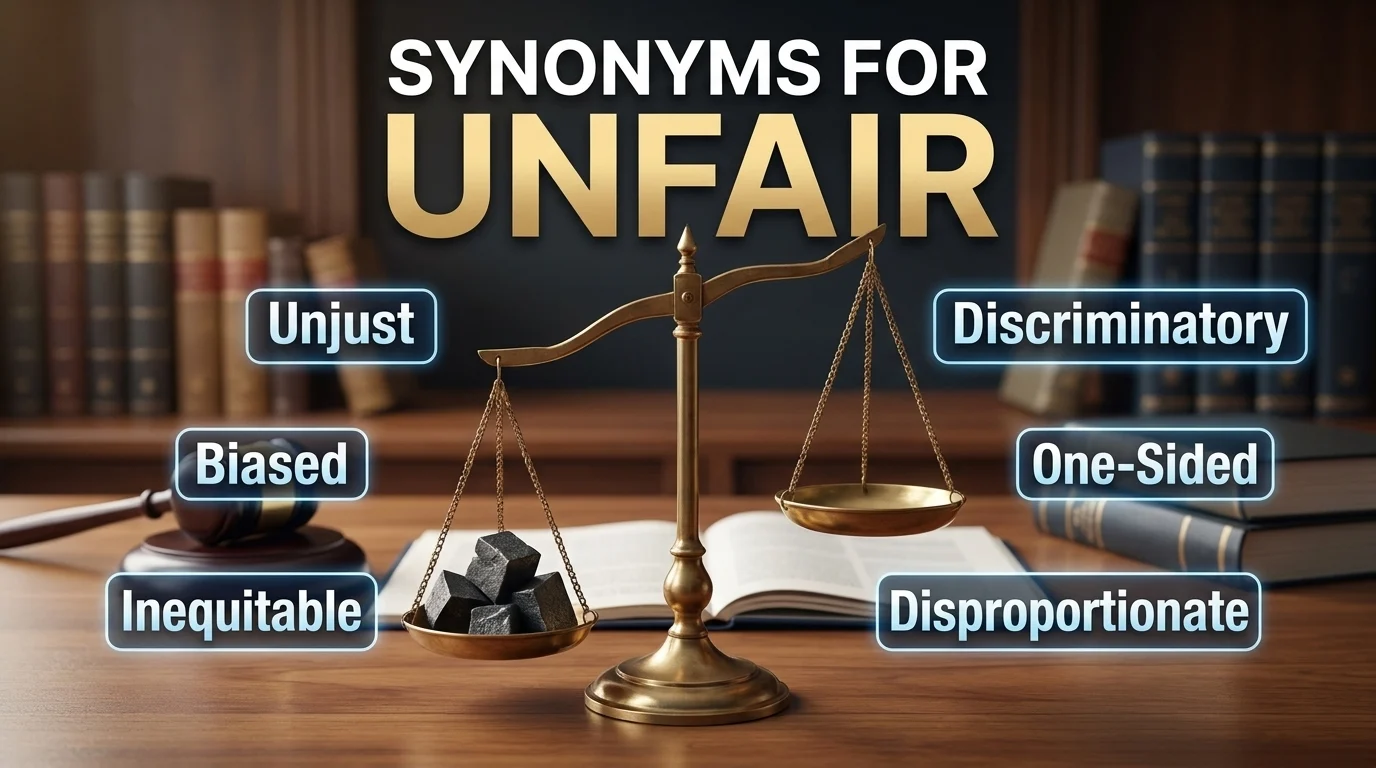
Do you keep using the word “unfair” in essays, business reports, conversations, or creative writing? While it is a clear and common word, repeating it can make your writing feel repetitive or lack nuance.
The good news is that the best alternative depends on what you actually mean. You might be describing a biased decision, an unjust law, a dishonest action, a one-sided situation, or something that is simply not reasonable.
This guide explains synonyms for “unfair” by meaning, tone, context, and usage. You will learn which alternatives work best in academic writing, professional communication, legal contexts, casual conversation, and creative expression.
Quick Answer: What Does “Unfair” Mean?
“Unfair” describes something that is not just, equitable, or impartial. It refers to situations, treatments, or judgments that violate principles of justice or fairness, often due to favoritism, deception, or a lack of impartiality. Depending on context, alternatives include unjust, biased, inequitable, one-sided, discriminatory, prejudiced, dishonest, and unreasonable.
Meaning, Tone, and Context
Simple Definition
“Unfair” generally refers to:
- Lack of justice: situations that violate what is morally right or legally proper
- Bias or favoritism: showing preference for one side without good reason
- Deception or dishonesty: using dishonest methods to gain advantage
- Disproportionate treatment: applying rules or standards unevenly
- Unreasonable harshness: punishment or treatment that is excessive
Part of Speech
“Unfair” is primarily an adjective.
Example:
“The company’s hiring practices were considered unfair.”
Related Forms:
- Unfairly (adverb): in an unfair manner
- Unfairness (noun): the quality of being unfair
Positive, Negative, or Neutral Tone
Unfair is strongly negative.
It expresses clear disapproval of a situation, action, or treatment. The strength of the word makes it effective but can also feel somewhat general or informal in some professional contexts.
Examples:
- “The referee’s decision was unfair.” (negative, situational)
- “It’s unfair that some children have fewer opportunities.” (negative, moral)
Formality Level
“Unfair” is standard English that works in both formal and informal settings. More formal alternatives like inequitable, unjust, or discriminatory are often preferred in academic, legal, and professional writing.
Common Use Cases
Unfair commonly describes:
- Biased decisions: favoring one person or group over another
- Unjust laws or policies: rules that treat people unequally
- Dishonest practices: cheating, fraud, or deception
- Excessive punishment: penalties that are too harsh
- Discrimination: treating people differently based on race, gender, age, etc.
- Arbitrary actions: decisions based on whim rather than reason
Important Word Forms
- Unfair (adjective): not just or equitable
- Unfairly (adverb): in a manner that is not just
- Unfairness (noun): the state or quality of being unfair
- Fair (antonym): just and impartial
When and How to Use “Unfair”
Use “unfair” when describing situations, treatments, or judgments that violate principles of justice, equality, or reason.
Because the word is broad and direct, it is useful when you want to express clear disapproval. However, more specific alternatives can add precision and impact.
Professional
“The disciplinary action seemed unfair given the employee’s otherwise excellent record.”
This works in professional communication, though more formal alternatives may be preferred.
Academic
“Researchers identified systemic unfairness in the distribution of educational resources.”
The term is appropriate in academic contexts when discussing social or institutional inequality.
Personal
“I feel it’s unfair that she got the promotion when I work harder.”
The word sounds natural in everyday conversation.
Legal
“The defendant argued that the trial was unfair due to biased jury selection.”
Here, unfair describes a violation of legal standards.
Creative
“The tyrant’s unfair decrees left the people powerless and hungry.”
The word creates a sense of injustice in storytelling.
Another Word for “Unfair”
There is no single perfect synonym because “unfair” can describe bias, injustice, dishonesty, unreasonableness, or inequality.
- Bias or favoritism: biased, partial, partisan, one-sided, preferential, slanted
- Injustice: unjust, inequitable, iniquitous, wrongful
- Discrimination: discriminatory, prejudiced, ableist, racist, sexist
- Deception: dishonest, fraudulent, underhand, crooked, deceitful
- Excessive harshness: arbitrary, draconian, oppressive, harsh
- Unreasonable: unreasonable, unwarranted, unjustifiable
- Disproportionate: disproportionate, unequal, lopsided, imbalanced
If you need one broad alternative, “unjust” is the closest direct synonym and works in most contexts.
When Not to Use “Unfair”
“Unfair” can become too vague when you need to specify the type of injustice or the reason for it.
Consider:
“The policy is unfair.”
This statement does not tell readers whether the policy is biased, discriminatory, unreasonable, or simply unpopular.
A more precise sentence could be:
“The policy is discriminatory against minority applicants.”
Similarly, avoid using “unfair” when you need to describe illegal actions. Use “illegal” or “unlawful” instead.
Words Commonly Confused With “Unfair”
Unfair vs. Unjust
Unjust emphasizes a violation of what is morally or legally right. Unfair is broader and can include situations that are simply not reasonable.
Example:
“The unjust law was finally repealed.” (moral/legal wrong)
“The grading system seemed unfair.” (could be simply unreasonable)
Unfair vs. Biased
Biased specifically means showing favoritism or prejudice for or against one person or group. Unfair is broader.
Example:
“The biased report favored the developer.” (specific favoritism)
“The situation was unfair.” (general disapproval)
Unfair vs. Discriminatory
Discriminatory specifically refers to treating people unequally based on group membership (race, gender, age, etc.). Unfair is broader.
Example:
“The company’s discriminatory hiring practices excluded women.”
“The teacher’s unfair treatment affected all students.”
Unfair vs. One-sided
One-sided emphasizes favoring only one side in a dispute or comparison. Unfair is broader.
Example:
“The referee’s one-sided calls made the game unwinnable.”
“The one-sided contract favored the landlord.”
Unfair vs. Inequitable
Inequitable is a formal term meaning not fair or equal, often used in legal or academic contexts.
Example:
“The current health care system is inequitable.” (formal)
“The situation is unfair.” (general)
Best Synonym by Context for “Unfair”
Which Synonym Should You Choose?
Start by identifying what kind of “unfairness” you are describing.
- Bias or favoritism: biased, partial, partisan, preferential, slanted
- Injustice: unjust, inequitable, iniquitous, wrongful
- Discrimination: discriminatory, prejudiced, ableist, racist, sexist, ageist, classist
- Dishonesty: dishonest, fraudulent, underhand, crooked, deceitful, unscrupulous
- Excessive harshness: draconian, oppressive, harsh, arbitrary, despotic
- Unreasonable: unreasonable, unwarranted, unjustifiable, uncalled-for
- Disproportionate: disproportionate, unequal, lopsided, imbalanced
- Negative behavior: vile, base, shameful, discreditable
10 Key Synonyms for “Unfair”
The table below includes accurate alternatives with clear meanings and usage contexts.
Synonym Groups and Usage Differences
Professional vs. Personal Synonyms
Professional writing benefits from specific terms such as inequitable, discriminatory, unjust, and unreasonable.
Personal communication often uses unfair, one-sided, or biased.
Compare:
“It’s unfair that I have to work late.” (personal)
“The arrangement is inequitable for junior employees.” (professional)
Formal vs. Conversational Synonyms
Unfair works in both formal and conversational English, though stronger or more precise alternatives exist.
Formal alternatives: inequitable, unjust, discriminatory, disproportionate
Conversational alternatives: one-sided, biased, lopsided
Examples:
“The government’s inequitable policies affect rural communities.” (formal)
“The whole thing is just one-sided.” (conversational)
Legal Synonyms
Legal writing often distinguishes between:
- Unlawful: against the law
- Unjust: against principles of justice
- Discriminatory: treating people unequally based on protected characteristics
Professional and Business Synonyms
Business writing often benefits from phrases such as:
- Unreasonable: for demands or expectations
- Dishonest: for business practices
- Unethical: for behavior that violates professional standards
Instead of:
“The contract was unfair.”
Consider:
“The contract contained disproportionate obligations.”
Creative or Literary Synonyms
Creative writing can use:
- Iniquitous: for moral wrongs
- Oppressive: for harsh, controlling systems
- Despotic: for tyrannical leaders
- Base: for morally low actions
For example:
“The iniquitous regime crushed all dissent with despotic cruelty.”
Slang or Modern Synonyms
Rigged is common slang for something unfairly arranged.
Stacked can describe a situation unfairly favoring one side.
BS (vulgar) is used for outrageous unfairness.
Examples:
“The game was rigged from the start.” (slang)
“The deck was stacked against her.” (idiom)
Strongest vs. Weaker Synonyms
Unfair words vary in intensity:
Milder: unfair, unreasonable, one-sided
Moderate: biased, partial, unequal
Strong: unjust, inequitable, discriminatory
Very Strong: iniquitous, draconian, oppressive, fraudulent
Emotional vs. Neutral Synonyms
Unfair is an emotional word expressing disapproval.
Emotional alternatives: outrageous, shameful, disgraceful, cruel
Neutral alternatives: inequitable, disproportionate, unreasonable
Examples:
“The treatment was unfair.” (emotional)
“The treatment was inequitable.” (neutral, factual)
Antonyms of “Unfair”
Unfair has several clear antonyms depending on context:
| Antonym | Meaning | Example Sentence |
|---|---|---|
| Fair | Free from favoritism or bias | The fair judge listened to both sides. |
| Just | Morally right and proper | The just ruling restored people’s faith. |
| Equitable | Fair and equal for all | The equitable distribution satisfied everyone. |
| Impartial | Not favoring any side | The impartial mediator resolved the dispute. |
| Unbiased | Without prejudice | The unbiased report presented the facts. |
| Reasonable | Fair and sensible | The reasonable request was granted. |
Comparison: “Unfair” vs. Similar Words
Unfair vs. Unjust
Main difference: Unfair is broader and can include unreasonableness. Unjust emphasizes a violation of moral or legal principles.
Examples:
“The unfair grading system frustrated students.” (could be just arbitrary)
“The unjust law violated human rights.” (moral/legal wrong)
Unfair vs. Biased
Main difference: Biased specifically means showing favoritism or prejudice. Unfair is broader.
Examples:
“The biased referee favored the home team.” (specific favoritism)
“The whole situation was unfair.” (general disapproval)
Unfair vs. Discriminatory
Main difference: Discriminatory specifically means treating people unequally based on group characteristics. Unfair is broader.
Examples:
“The discriminatory policy excluded women.”
“The unfair policy affected everyone.”
Unfair vs. Inequitable
Main difference: Inequitable is a formal synonym for unfair, often used in academic or legal writing.
Examples:
“The situation was unfair.” (general)
“The distribution was inequitable.” (formal)
Unfair vs. One-sided
Main difference: One-sided emphasizes favoring only one side. Unfair is broader.
Examples:
“The one-sided debate gave no chance for rebuttal.”
“The unfair rules applied to everyone.”
Common Phrases and Expressions with “Unfair”
1. Unfair advantage
Meaning:
An advantage that is not deserved or is gained through dishonest means.
Example:
“The company gained an unfair advantage through price-fixing.”
2. Play unfair
Meaning:
To act in a dishonest or unjust way.
Example:
“He decided to play unfair during the game, which made everyone upset.”
3. Life isn’t fair
Meaning:
A phrase acknowledging that things don’t always happen as they should.
Example:
“Her mother reminded her that life isn’t fair sometimes.”
4. Unfair dismissal
Meaning:
Being fired from a job for reasons that are not legally or morally justified.
Example:
“He sued the company for unfair dismissal.”
Common Mistakes to Avoid
1. Using “unfair” when a precise term is available
If you mean biased, discriminatory, dishonest, unreasonable, or inequitable, use the more specific word.
Vague: “The policy was unfair.”
Precise: “The policy was discriminatory against older workers.”
2. Confusing unfair with illegal
Not everything that is unfair is illegal, and not everything illegal is necessarily unfair.
Example:
“Breaking the contract was unfair.” (could be legal but unjust)
“The unfair rule was not against the law.” (unfair but legal)
3. Using “unfair” in formal contexts when “inequitable” or “unjust” is better
Academic and professional writing often benefit from more formal alternatives.
Informal: “The unfair distribution of resources…”
Formal: “The inequitable distribution of resources…”
4. Overusing “unfair” in writing
Repetition can make content feel lazy. Instead, identify whether you mean biased, unjust, discriminatory, unreasonable, or one-sided.
5. Choosing a synonym that changes the meaning
Do not replace unfair with discriminatory unless you specifically mean group-based inequality.
FAQs
What is the best synonym for “unfair”?
The best synonym depends on context. Unjust is the closest direct synonym. Biased works for favoritism, discriminatory for group-based inequality, inequitable for formal contexts, and one-sided for imbalances.
What is a formal synonym for “unfair”?
Inequitable, unjust, discriminatory, and disproportionate are formal synonyms. These work well in academic papers, legal documents, and professional reports.
What is an informal synonym for “unfair”?
One-sided, biased, and unfair itself are used in casual contexts. Rigged is common slang.
What is another word for “unfair” in legal contexts?
Unlawful, unjust, discriminatory, and inequitable are commonly used in legal writing.
What is the difference between “unfair” and “unjust”?
Unfair is broader and can include unreasonableness. Unjust emphasizes a violation of moral or legal principles.
What is the opposite of “unfair”?
The opposites include fair, just, equitable, impartial, and unbiased.
What does “unfair” mean in a moral context?
Morally, unfairness refers to actions or situations that violate principles of justice, equality, or ethical treatment.
Conclusion
“Unfair” is a versatile word that can describe bias, injustice, dishonesty, unreasonableness, and inequality. The best synonym depends on what you actually mean.
Choose unjust for moral wrongs, biased for favoritism, discriminatory for group-based inequality, inequitable for formal contexts, one-sided for imbalances, and draconian for excessive harshness.
Most importantly, do not replace “unfair” simply to avoid repetition. First identify what kind of unfairness—bias, injustice, dishonesty, or unreasonableness—you are actually describing. Then choose the alternative that communicates that idea most clearly.
For academic, professional, and formal writing, precision is usually more valuable than vocabulary variety. A specific term such as discriminatory, inequitable, or unjust can tell readers much more than the broad word “unfair.”
Before publishing a vocabulary guide, verify definitions and usage with trusted dictionaries such as Cambridge, Oxford, Merriam-Webster, Collins, or Britannica. This helps ensure that each alternative accurately matches its intended meaning and context.
The practical takeaway is simple: when “unfair” feels too general, ask yourself whether you are describing bias, injustice, dishonesty, or unreasonableness. Then use the most precise word available.
Discover More:-
- 50+ Synonyms for Problems: Meanings, Examples, and Best Alternatives
- 50+ Synonyms for You: Meanings, Examples, and Best Alternatives
