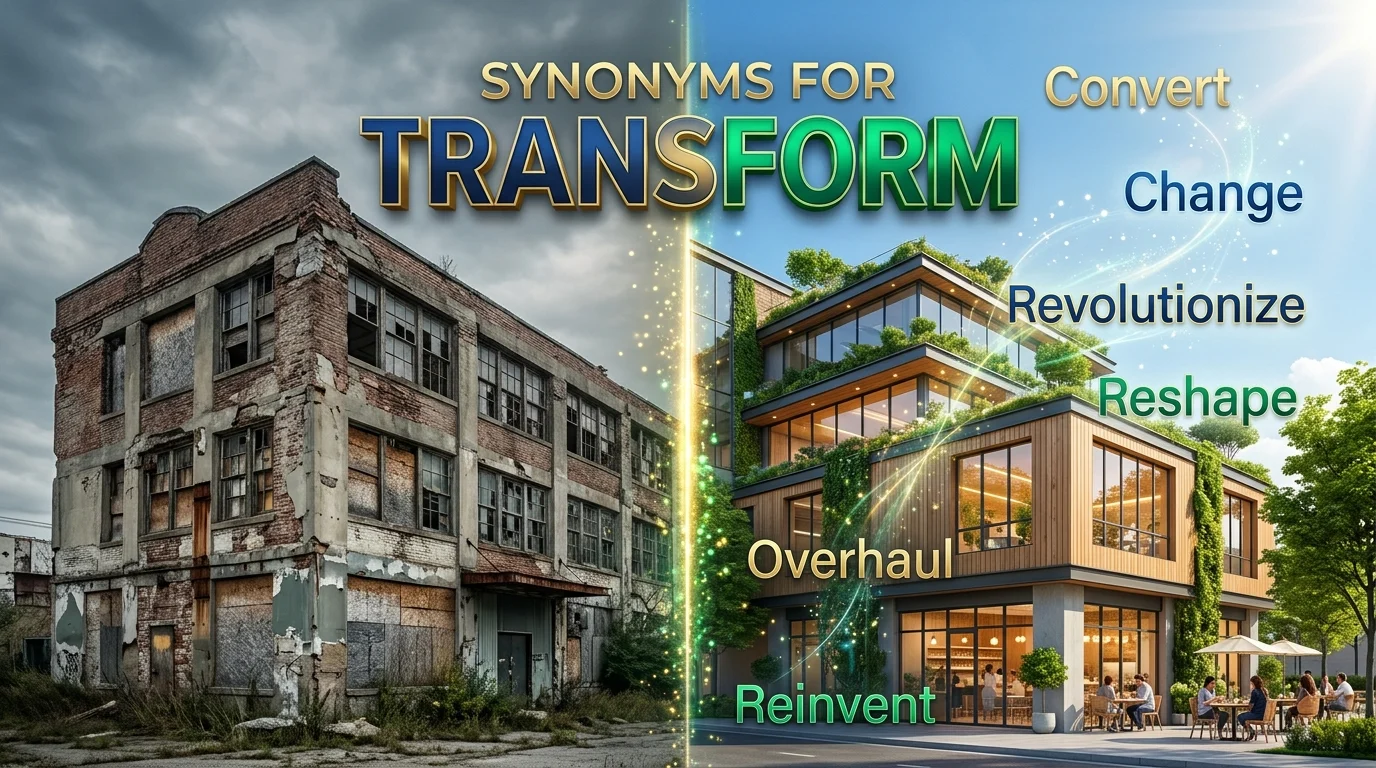
Do you keep using the word “transform” in essays, business reports, academic papers, creative writing, or everyday conversation? While it is one of the most powerful and expressive verbs in English, repeating it can make your writing feel flat, repetitive, or overly dramatic.
The good news is that the best alternative depends on what you actually mean. You might be describing a complete change, a gradual improvement, a physical conversion, a personal reinvention, or a digital upgrade.
This guide explains synonyms for “transform” by meaning, tone, context, and usage. You will learn which alternatives work best in academic writing, professional communication, creative expression, technical documentation, and casual conversation.
Quick Answer: What Does “Transform” Mean?
“Transform” means to change something completely in form, appearance, nature, or character. It can refer to physical conversion, dramatic change, gradual evolution, or personal reinvention. Depending on context, alternatives include convert, change, alter, revolutionize, remodel, reshape, metamorphose, overhaul, modernize, and reinvent.
Meaning, Tone, and Context
Simple Definition
“Transform” generally refers to:
- Complete change: changing something entirely
- Physical conversion: changing form or appearance
- Dramatic improvement: making something much better
- Personal reinvention: changing one’s life or identity
- Digital or technological upgrade: modernizing systems
Part of Speech
“Transform” functions primarily as a verb and occasionally as a noun (in mathematics or linguistics).
Verb Examples:
- “The company transformed its business model.”
- “The caterpillar transforms into a butterfly.”
- “Technology has transformed the way we communicate.”
Noun Examples:
- “The Fourier transform is a mathematical operation.” (technical)
- “The transform was complete.” (rare)
Related Forms:
- Transformation (noun): the act of transforming
- Transformative (adjective): causing transformation
- Transformer (noun): a device or person that transforms
- Transformed (verb/adjective): changed completely
Positive, Negative, or Neutral Tone
“Transform” is generally positive or neutral. It suggests significant, often beneficial change.
Positive associations:
- “The program transformed her life.”
- “The renovation transformed the old house.”
Neutral or technical contexts:
- “The data was transformed into a graph.”
- “The caterpillar transformed into a butterfly.”
Negative contexts:
- “The war transformed the city into ruins.”
- “The scandal transformed his reputation.”
Formality Level
“Transform” is a standard word that works in both formal and informal English. It is appropriate in academic papers, business reports, creative writing, technical documentation, and casual conversation.
However, more specific alternatives can add precision and variety depending on the context.
Common Use Cases
“Transform” commonly refers to:
- Business: transforming a company, transforming strategy, digital transformation
- Technology: transforming data, transforming systems, AI transformation
- Personal development: transforming one’s life, transforming habits
- Nature: transforming landscapes, transforming ecosystems
- Creative: transforming ideas, transforming stories
- Science: transforming energy, transforming matter
Important Word Forms
- Transform (verb): to change completely
- Transformation (noun): the act of transforming
- Transformative (adjective): causing transformation
- Transformer (noun): a device or person that transforms
- Transformed (verb/adjective): changed completely
When and How to Use “Transform”
Use “transform” when you want to describe a complete or significant change in form, appearance, nature, or character. Because the word is strong, more specific alternatives can add precision depending on the context.
Professional
“The new strategy transformed the company’s performance.”
This works naturally in business communication.
Academic
“The study examines how technology transforms education.”
The term is appropriate in academic writing.
Personal
“Travel transformed my perspective on life.”
The word sounds natural in everyday conversation.
Creative
“The abandoned warehouse was transformed into a beautiful art gallery.”
The word creates a vivid image of change.
Technical
“The algorithm transforms raw data into meaningful insights.”
This is standard in technical contexts.
Science
“Energy is transformed from one form to another.”
This is appropriate in scientific writing.
Another Word for “Transform”
There is no single perfect synonym because “transform” can refer to complete change, conversion, improvement, reinvention, or modernization.
- Complete change context: change, alter, convert, transmute
- Physical conversion context: convert, remodel, remake, rebuild
- Dramatic improvement context: revolutionize, overhaul, modernize, upgrade
- Personal reinvention context: reinvent, remake, reshape, redefine
- Gradual change context: evolve, develop, progress, mature
If you need one broad alternative, “convert” works for physical or technical change, while “revolutionize” works for dramatic improvement. “Reshape” works for changing form or structure.
When Not to Use “Transform”
“Transform” can become too strong or vague when you need to specify exactly what kind of change you are describing.
Consider:
“The company transformed.”
This statement does not tell readers whether the company changed its strategy, its structure, its culture, or its products.
A more precise sentence could be:
“The company transformed its business model by shifting to e-commerce.”
Similarly, avoid using “transform” when you mean “improve” in a mild context. Use “improve”, “enhance”, or “upgrade” instead.
Words Commonly Confused With “Transform”
Transform vs. Change
Change is general. Transform implies a complete or dramatic change.
Example:
“She changed her hairstyle.” (general)
“The renovation transformed the house.” (complete)
Transform vs. Convert
Convert often implies changing from one form or use to another. Transform is broader.
Example:
“They converted the barn into a house.” (change of use)
“The renovation transformed the house.” (complete change)
Transform vs. Alter
Alter often implies a partial change. Transform implies a complete change.
Example:
“She altered the dress.” (partial)
“The designer transformed the dress.” (complete)
Transform vs. Revolutionize
Revolutionize implies a radical, groundbreaking change. Transform is broader.
Example:
“The internet revolutionized communication.” (radical)
“Technology transformed communication.” (broader)
Transform vs. Evolve
Evolve implies gradual development. Transform implies a more sudden or complete change.
Example:
“The species evolved over millions of years.” (gradual)
“The landscape was transformed by the earthquake.” (sudden)
Transform vs. Remodel
Remodel often refers to physical renovation. Transform is broader.
Example:
“They remodeled the kitchen.” (physical)
“The renovation transformed the entire house.” (broader)
Best Synonym by Context for “Transform”
| Context | Best Synonym | Why It Works | Example |
|---|---|---|---|
| Formal writing | Convert, alter | Precise and professional | The data was converted into a graph. |
| Academic writing | Transform, reshape | Standard academic usage | Technology reshapes education. |
| Business/Professional | Overhaul, modernize, revolutionize | Professional and clear | The company overhauled its strategy. |
| Creative writing | Metamorphose, remake, reshape | Adds literary depth | The garden metamorphosed into a wonderland. |
| Technical writing | Convert, process | Technical and precise | The algorithm processes raw data. |
| Personal development | Reinvent, remake, reshape | Personal growth | She reinvented herself after the move. |
| Physical renovation | Remodel, remake, rebuild | Physical change | They remodeled the old barn. |
| Scientific context | Convert, transmute | Scientific and precise | Energy is converted from one form to another. |
| Casual conversation | Change, turn into | Natural and informal | The room turned into a nursery. |
| Dramatic change | Revolutionize, overhaul | Emphasizes impact | The invention revolutionized the industry. |
| Gradual change | Evolve, develop | Emphasizes process | The company evolved over time. |
| Digital context | Digitize, modernize, upgrade | Technology and innovation | The company digitized its records. |
Which Synonym Should You Choose?
Start by identifying what kind of transformation you are describing.
- Complete change: change, alter, convert, transmute
- Physical conversion: convert, remodel, remake, rebuild
- Dramatic improvement: revolutionize, overhaul, modernize, upgrade
- Personal reinvention: reinvent, remake, reshape, redefine
- Gradual change: evolve, develop, progress, mature
10 Key Synonyms for “Transform”
The table below includes accurate alternatives with clear meanings and usage contexts.
| Synonym | Simple Meaning | Best Used For | Example Sentence |
|---|---|---|---|
| Convert | Change form or use | Technical, physical | They converted the barn into a house. |
| Change | Make different | General, everyday | She changed her hairstyle. |
| Alter | Change partially | Clothing, plans | She altered the dress. |
| Revolutionize | Change radically | Innovation, technology | The internet revolutionized communication. |
| Remodel | Renovate physically | Buildings, homes | They remodeled the kitchen. |
| Reshape | Change form or structure | Business, society | The policy reshaped the economy. |
| Metamorphose | Change completely | Creative, literary | The garden metamorphosed into a wonderland. |
| Overhaul | Change thoroughly | Systems, processes | The company overhauled its strategy. |
| Modernize | Update to modern standards | Technology, systems | The factory was modernized. |
| Reinvent | Change completely | Personal, business | She reinvented herself after the move. |
Synonym Groups and Usage Differences
Professional vs. Personal Synonyms
Professional writing benefits from specific terms such as overhaul, modernize, reshape, revolutionize, and convert.
Personal communication often uses transform itself or casual alternatives like change, turn into, or reinvent.
Compare:
“The room turned into a nursery.” (personal)
“The company overhauled its strategy.” (professional)
Formal vs. Conversational Synonyms
Transform works in both formal and conversational English.
Formal alternatives: convert, reshape, revolutionize, overhaul, modernize
Conversational alternatives: change, turn into
Examples:
“The data was converted into a graph.” (formal)
“The room turned into a nursery.” (conversational)
Academic Synonyms
Academic writing should distinguish between transform (general), reshape (change structure), convert (change form), and modernize (update).
For example:
“Technology has reshaped education.”
“The data was converted into a usable format.”
Professional and Business Synonyms
Business writing often benefits from phrases such as overhaul, modernize, reshape, revolutionize, and digitize.
Instead of:
“The company transformed its operations.”
Consider:
“The company overhauled its operations to improve efficiency.”
Creative or Literary Synonyms
Creative writing can use metamorphose, remake, transfigure, transmute, and morph depending on the context.
For example:
“The garden metamorphosed into a wonderland.”
“The experience transfigured his outlook on life.”
Slang or Modern Synonyms
Morph is casual for transform.
Turn into is common in casual speech.
Glow up is modern slang for a positive transformation.
Level up is slang for improving or transforming.
Examples:
“The room morphed into a nursery.” (casual)
“She had a major glow-up.” (modern slang)
Strongest vs. Weaker Synonyms
“Transform” synonyms vary in intensity:
Milder: change, alter, adjust
Moderate: transform, convert, reshape
Strong: overhaul, modernize, remake
Very Strong: revolutionize, metamorphose, transfigure
Emotional vs. Neutral Synonyms
“Transform” is generally neutral or positive.
Emotional alternatives: metamorphose, transfigure (dramatic); revolutionize (exciting)
Neutral alternatives: convert, change, alter
Examples:
“The experience transfigured his life.” (emotional, positive)
“The data was converted into a graph.” (neutral)
Antonyms of “Transform”
“Transform” has several antonyms depending on context:
| Antonym | Context | Meaning | Example Sentence |
|---|---|---|---|
| Preserve | Change | Keep the same | The museum preserves historical artifacts. |
| Maintain | Change | Keep in current state | The company maintained its strategy. |
| Restore | Change | Return to original state | The building was restored to its original condition. |
| Conserve | Change | Protect from change | The organization conserves natural resources. |
| Stabilize | Change | Prevent change | The medicine stabilized his condition. |
| Retain | Change | Keep | The company retained its original name. |
| Keep | Change | Continue as is | She kept her old habits. |
Comparison: “Transform” vs. Similar Words
Transform vs. Change
Main difference: Change is general. Transform implies a complete or dramatic change.
Examples:
“She changed her hairstyle.” (general)
“The renovation transformed the house.” (complete)
Transform vs. Convert
Main difference: Convert often implies changing from one form or use to another. Transform is broader.
Examples:
“They converted the barn into a house.” (change of use)
“The renovation transformed the house.” (complete change)
Transform vs. Alter
Main difference: Alter often implies a partial change. Transform implies a complete change.
Examples:
“She altered the dress.” (partial)
“The designer transformed the dress.” (complete)
Transform vs. Revolutionize
Main difference: Revolutionize implies a radical, groundbreaking change. Transform is broader.
Examples:
“The internet revolutionized communication.” (radical)
“Technology transformed communication.” (broader)
Transform vs. Evolve
Main difference: Evolve implies gradual development. Transform implies a more sudden or complete change.
Examples:
“The species evolved over millions of years.” (gradual)
“The landscape was transformed by the earthquake.” (sudden)
Transform vs. Remodel
Main difference: Remodel often refers to physical renovation. Transform is broader.
Examples:
“They remodeled the kitchen.” (physical)
“The renovation transformed the entire house.” (broader)
Common Phrases and Expressions with “Transform”
1. Transform into
Meaning:
Change into something else.
Example:
“The caterpillar transforms into a butterfly.”
2. Transform the way
Meaning:
Change how something is done.
Example:
“Technology has transformed the way we work.”
3. Transform your life
Meaning:
Change your life completely.
Example:
“The program promises to transform your life.”
4. Digital transformation
Meaning:
The process of using digital technology to change how organizations operate.
Example:
“The company invested in digital transformation.”
5. Transformative experience
Meaning:
An experience that changes you significantly.
Example:
“The trip was a transformative experience.”
6. Transform a space
Meaning:
Change the appearance or function of a place.
Example:
“The renovation transformed the space.”
7. Transform data
Meaning:
Convert data into a different format or use.
Example:
“The software transforms data into visual charts.”
8. Transform the industry
Meaning:
Change how an industry operates.
Example:
“New technology is transforming the industry.”
9. Transform education
Meaning:
Change how education is delivered.
Example:
“Online learning has transformed education.”
10. Transform a business
Meaning:
Change how a business operates.
Example:
“The new CEO transformed the business.”
Common Mistakes to Avoid
1. Using “transform” when a more precise term is available
If you mean improve, convert, remodel, or overhaul, use the more specific word.
Vague: “The company transformed.”
Precise: “The company overhauled its operations.”
2. Confusing “transform” with “change”
Change is general. Transform implies a complete or dramatic change.
Incorrect: “She transformed her hairstyle.” (if minor change)
Correct: “She changed her hairstyle.”
3. Using “transform” in academic writing when “reshape” is needed
Academic writing benefits from precise terms like reshape, convert, and restructure.
Vague: “Technology transformed education.”
Precise: “Technology has reshaped education.”
4. Overusing “transform” in writing
Repetition can make content feel dull. Use alternatives such as convert, reshape, overhaul, modernize, and reinvent.
5. Choosing a synonym that changes the meaning
Do not replace transform with change unless you mean a general change.
Do not replace transform with convert unless you mean changing form or use.
FAQs
What is the best synonym for “transform”?
The best synonym depends on context. Convert works for form or use, reshape for structure, revolutionize for radical change, overhaul for thorough change, and reinvent for personal change.
What is a formal synonym for “transform”?
Convert, reshape, revolutionize, overhaul, and modernize are formal synonyms.
What is an informal synonym for “transform”?
Change, turn into, morph, and glow up are common informal alternatives.
What is another word for “transform” in creative writing?
Metamorphose, remake, transfigure, transmute, and morph work well in creative writing.
What is the difference between “transform” and “change”?
Change is general. Transform implies a complete or dramatic change.
What is the opposite of “transform”?
Depending on context, opposites include preserve, maintain, restore, conserve, and stabilize.
What does “transform” mean in a business context?
In business, transform often refers to a major change in strategy, operations, culture, or technology, such as digital transformation.
Conclusion
“Transform” is a powerful and versatile word that can describe complete change, physical conversion, dramatic improvement, personal reinvention, or gradual evolution. The best synonym depends on what you actually mean.
Choose convert for form or use, change for general change, alter for partial change, revolutionize for radical change, reshape for structure, overhaul for thorough change, and reinvent for personal change.

1 thought on “Synonyms for Transform: Better Words to Use Instead”