Do you keep using the word “sustainable” in essays, business reports, environmental content, marketing copy, or everyday conversation? While it is one of the most important and widely used words in modern English, repeating it can make your writing feel flat, buzzword-heavy, or overly generic.
The good news is that the best alternative depends on what you actually mean. You might be describing something environmentally friendly, economically viable, long-lasting, renewable, self-sufficient, or capable of being maintained over time.
This guide explains synonyms for “sustainable” by meaning, tone, context, and usage. You will learn which alternatives work best in academic writing, professional communication, environmental content, business strategy, and casual conversation.
Quick Answer: What Does “Sustainable” Mean?
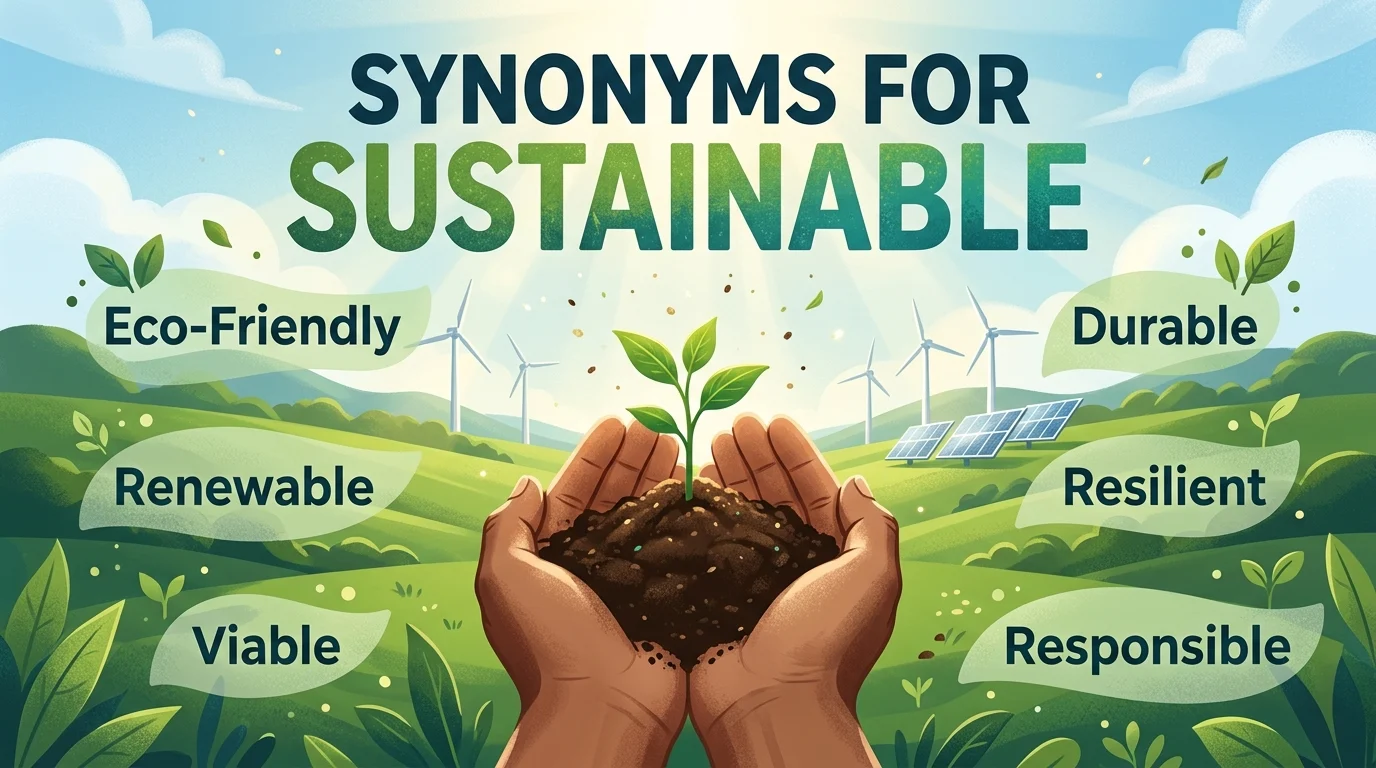
“Sustainable” describes something that can be maintained over time without depleting resources, causing harm, or collapsing. It can refer to environmentally friendly practices, economically viable systems, renewable resources, or long-lasting solutions. Depending on context, alternatives include eco-friendly, renewable, viable, durable, long-lasting, green, responsible, resilient, self-sufficient, and maintainable.
Meaning, Tone, and Context
Simple Definition
“Sustainable” generally refers to:
- Environmental sustainability: not harming the environment or depleting natural resources
- Economic sustainability: financially viable over the long term
- Social sustainability: supporting community well-being and equity
- Renewable: able to be replenished naturally
- Durable: able to last for a long time
- Self-sufficient: able to maintain itself without external support
- Maintainable: able to be continued at the same level
Part of Speech
“Sustainable” functions primarily as an adjective.
Examples:
- “We need sustainable solutions to climate change.”
- “The company adopted sustainable practices.”
- “This is a sustainable business model.”
Related Forms:
- Sustainability (noun): the ability to be maintained over time
- Sustainably (adverb): in a sustainable manner
- Sustain (verb): to maintain or support over time
- Unsustainable (adjective): not able to be maintained
- Sustained (adjective): continuing for an extended period
Positive, Negative, or Neutral Tone
“Sustainable” is generally positive. It suggests responsibility, longevity, and care for the future.
Positive associations:
- “The farm uses sustainable methods.”
- “Sustainable development benefits everyone.”
Neutral or technical contexts:
- “The study examined sustainable yield in fisheries.”
- “The report assesses sustainable growth rates.”
Formality Level
“Sustainable” is a standard word that works in both formal and informal English. It is especially common in academic, environmental, business, and policy contexts.
However, more specific alternatives can add precision and variety depending on the context.
Common Use Cases
“Sustainable” commonly refers to:
- Environment: sustainable agriculture, sustainable energy, sustainable materials
- Business: sustainable growth, sustainable business model, sustainable practices
- Development: sustainable development, sustainable communities
- Economics: sustainable economy, sustainable debt, sustainable growth
- Lifestyle: sustainable living, sustainable fashion, sustainable diet
- Resources: sustainable resources, sustainable forestry, sustainable fishing
Important Word Forms
- Sustainable (adjective): able to be maintained over time
- Sustainability (noun): the ability to be maintained
- Sustainably (adverb): in a sustainable manner
- Sustain (verb): to maintain or support
- Unsustainable (adjective): not able to be maintained
- Sustained (adjective): continuing for an extended period
When and How to Use “Sustainable”
Use “sustainable” when you want to describe something that can be maintained over time without causing harm or depletion. Because the word is broad, more specific alternatives can add precision depending on the context.
Professional
“We are committed to sustainable business practices.”
This works naturally in business and corporate communication.
Academic
“The study examines sustainable agriculture in developing countries.”
The term is appropriate in academic research.
Environmental
“Sustainable energy sources are essential to reduce carbon emissions.”
This is standard in environmental contexts.
Personal
“I’m trying to make more sustainable choices in my daily life.”
The word sounds natural in everyday conversation.
Policy
“The government introduced sustainable development goals.”
This is appropriate in policy contexts.
Business
“The company’s sustainable growth strategy impressed investors.”
This is common in business contexts.
Another Word for “Sustainable”
There is no single perfect synonym because “sustainable” can refer to environmental friendliness, economic viability, durability, renewability, or self-sufficiency.
- Environmental context: eco-friendly, green, environmentally friendly, low-impact, responsible
- Economic context: viable, profitable, feasible, sound, stable
- Durability context: durable, long-lasting, enduring, resilient, robust
- Renewable context: renewable, replenishable, regenerative, recyclable
- Self-sufficiency context: self-sufficient, self-sustaining, independent, autonomous
- Maintainability context: maintainable, scalable, repeatable, continuous
If you need one broad alternative, “eco-friendly” works for environmental contexts, “viable” works for economic contexts, and “durable” works for longevity.
When Not to Use “Sustainable”
“Sustainable” can become too vague or buzzword-heavy when you need to specify exactly what kind of sustainability you are describing.
Consider:
“We need a sustainable solution.”
This statement does not tell readers whether the solution is environmentally friendly, financially viable, durable, or self-sufficient.
A more precise sentence could be:
“We need a financially viable solution that reduces environmental impact.”
Similarly, avoid using “sustainable” when you mean “long-lasting” in a simple durability context. Use “durable”, “long-lasting”, or “enduring” instead.
Words Commonly Confused With “Sustainable”
Sustainable vs. Eco-Friendly
Eco-friendly specifically means not harmful to the environment. Sustainable can be broader.
Example:
“The packaging is eco-friendly.” (environment)
“The business model is sustainable.” (broader)
Sustainable vs. Renewable
Renewable means able to be replenished naturally. Sustainable can include renewable but is broader.
Example:
“Solar power is renewable.” (replenished)
“Solar power is sustainable.” (broader)
Sustainable vs. Viable
Viable means capable of working successfully. Sustainable means able to be maintained over time.
Example:
“The plan is viable.” (workable)
“The plan is sustainable.” (maintainable)
Sustainable vs. Durable
Durable means able to withstand wear or damage. Sustainable means able to be maintained.
Example:
“The material is durable.” (long-lasting)
“The material is sustainable.” (maintainable, eco-friendly)
Sustainable vs. Green
Green often means environmentally friendly. Sustainable can be broader.
Example:
“Green energy is growing.” (environmental)
“Sustainable energy is essential.” (broader)
Sustainable vs. Self-Sufficient
Self-sufficient means able to provide for oneself. Sustainable means able to be maintained.
Example:
“The farm is self-sufficient.” (independent)
“The farm is sustainable.” (maintainable)
Best Synonym by Context for “Sustainable”
| Context | Best Synonym | Why It Works | Example |
|---|---|---|---|
| Formal writing | Viable, maintainable | Precise and professional | The committee proposed a viable long-term plan. |
| Academic writing | Renewable, regenerative | Standard academic usage | The study examines renewable energy sources. |
| Environmental | Eco-friendly, green, low-impact | Environmental context | The company uses eco-friendly packaging. |
| Business/Professional | Viable, scalable, resilient | Professional and clear | The business model is scalable and resilient. |
| Economics | Sound, stable, viable | Economic context | The policy promotes sound economic growth. |
| Durability | Durable, long-lasting, enduring | Longevity context | The material is durable and long-lasting. |
| Resources | Renewable, replenishable | Resource context | The forest is managed as a renewable resource. |
| Self-sufficiency | Self-sufficient, self-sustaining | Independence context | The community is self-sufficient in food. |
| Lifestyle | Responsible, conscious, ethical | Lifestyle context | She makes responsible consumer choices. |
| Casual conversation | Green, eco-friendly | Natural and informal | I try to buy green products. |
| Policy | Sustainable, equitable | Policy context | The policy promotes equitable development. |
| Fashion | Ethical, conscious | Fashion context | The brand uses ethical manufacturing. |
Which Synonym Should You Choose?
Start by identifying what kind of “sustainable” you are describing.
- Environmental: eco-friendly, green, low-impact, environmentally responsible
- Economic: viable, feasible, sound, stable, profitable
- Durability: durable, long-lasting, enduring, resilient
- Renewable: renewable, replenishable, regenerative
- Self-sufficiency: self-sufficient, self-sustaining, independent
- Maintainability: maintainable, scalable, repeatable
10 Key Synonyms for “Sustainable”
The table below includes accurate alternatives with clear meanings and usage contexts.
| Synonym | Simple Meaning | Best Used For | Example Sentence |
|---|---|---|---|
| Eco-friendly | Not harmful to the environment | Environmental contexts | The company uses eco-friendly packaging. |
| Renewable | Able to be replenished naturally | Energy, resources | Solar power is a renewable energy source. |
| Viable | Capable of working successfully | Business, economics | The plan is financially viable. |
| Durable | Able to last a long time | Products, materials | The material is durable and long-lasting. |
| Green | Environmentally friendly | Environmental, lifestyle | Green energy is growing rapidly. |
| Responsible | Ethical and conscious | Lifestyle, business | She makes responsible consumer choices. |
| Resilient | Able to recover and endure | Business, communities | The economy is resilient and adaptable. |
| Self-sufficient | Able to provide for oneself | Communities, systems | The farm is self-sufficient in food. |
| Regenerative | Able to renew or restore | Agriculture, ecology | Regenerative farming improves soil health. |
| Maintainable | Able to be continued | Systems, processes | The process is maintainable at scale. |
Synonym Groups and Usage Differences
Professional vs. Personal Synonyms
Professional writing benefits from specific terms such as viable, resilient, scalable, responsible, and maintainable.
Personal communication often uses sustainable itself or casual alternatives like green, eco-friendly, or ethical.
Compare:
“I try to buy green products.” (personal)
“The company adopted responsible sourcing practices.” (professional)
Formal vs. Conversational Synonyms
Sustainable works in both formal and conversational English.
Formal alternatives: viable, maintainable, regenerative, resilient
Conversational alternatives: green, eco-friendly, ethical
Examples:
“The study examines regenerative agriculture.” (formal)
“I try to be eco-friendly.” (conversational)
Academic Synonyms
Academic writing should distinguish between sustainable (general), renewable (resources), viable (economic), and resilient (systems).
For example:
“The study examines renewable energy adoption.”
“The research focuses on resilient agricultural systems.”
Professional and Business Synonyms
Business writing often benefits from phrases such as viable, scalable, resilient, responsible, and long-term.
Instead of:
“We need a sustainable business model.”
Consider:
“We need a viable, scalable business model that delivers long-term value.”
Creative or Literary Synonyms
Creative writing can use enduring, regenerative, harmonious, balanced, and thriving depending on the context.
For example:
“The village lived in harmonious balance with nature.”
“The land was regenerative, yielding abundance year after year.”
Slang or Modern Synonyms
Green is the most common casual alternative.
Eco is short for ecological.
Clean is casual for environmentally friendly.
Ethical is modern for responsible sourcing.
Examples:
“I’m trying to go green.” (casual)
“She only buys ethical fashion.” (modern)
Strongest vs. Weaker Synonyms
“Sustainable” synonyms vary in intensity:
Milder: responsible, conscious, ethical
Moderate: sustainable, viable, durable
Strong: resilient, regenerative, self-sufficient
Very Strong: regenerative, restorative, net-positive
Emotional vs. Neutral Synonyms
“Sustainable” is generally positive but can be neutral in technical contexts.
Emotional alternatives: harmonious, thriving, responsible (positive)
Neutral alternatives: viable, maintainable, renewable
Examples:
“The community is thriving and harmonious.” (emotional, positive)
“The system is maintainable.” (neutral)
Antonyms of “Sustainable”
“Sustainable” has several antonyms depending on context:
| Antonym | Context | Meaning | Example Sentence |
|---|---|---|---|
| Unsustainable | General | Not able to be maintained | The current pace is unsustainable. |
| Harmful | Environmental | Causing damage | The practice is harmful to the environment. |
| Depleting | Resources | Using up resources | The method is resource-depleting. |
| Short-lived | Durability | Lasting only a short time | The solution was short-lived. |
| Viable | Economics | (Opposite: unviable) Not workable | The plan was financially unviable. |
| Wasteful | Resources | Using more than necessary | The process is wasteful. |
| Destructive | Environmental | Causing damage | The practice is environmentally destructive. |
Comparison: “Sustainable” vs. Similar Words
Sustainable vs. Eco-Friendly
Main difference: Eco-friendly specifically means not harmful to the environment. Sustainable can be broader.
Examples:
“The packaging is eco-friendly.” (environment)
“The business model is sustainable.” (broader)
Sustainable vs. Renewable
Main difference: Renewable means able to be replenished naturally. Sustainable can include renewable but is broader.
Examples:
“Solar power is renewable.” (replenished)
“Solar power is sustainable.” (broader)
Sustainable vs. Viable
Main difference: Viable means capable of working successfully. Sustainable means able to be maintained over time.
Examples:
“The plan is viable.” (workable)
“The plan is sustainable.” (maintainable)
Sustainable vs. Durable
Main difference: Durable means able to withstand wear or damage. Sustainable means able to be maintained.
Examples:
“The material is durable.” (long-lasting)
“The material is sustainable.” (maintainable, eco-friendly)
Sustainable vs. Green
Main difference: Green often means environmentally friendly. Sustainable can be broader.
Examples:
“Green energy is growing.” (environmental)
“Sustainable energy is essential.” (broader)
Sustainable vs. Self-Sufficient
Main difference: Self-sufficient means able to provide for oneself. Sustainable means able to be maintained.
Examples:
“The farm is self-sufficient.” (independent)
“The farm is sustainable.” (maintainable)
Common Phrases and Expressions with “Sustainable”
1. Sustainable development
Meaning:
Development that meets present needs without compromising the future.
Example:
“The UN promotes sustainable development goals.”
2. Sustainable growth
Meaning:
Economic growth that can be maintained long-term.
Example:
“The company focuses on sustainable growth.”
3. Sustainable practices
Meaning:
Methods that are environmentally and socially responsible.
Example:
“The farm uses sustainable practices.”
4. Sustainable energy
Meaning:
Energy from renewable sources.
Example:
“Sustainable energy is key to reducing emissions.”
5. Sustainable living
Meaning:
A lifestyle that reduces environmental impact.
Example:
“She practices sustainable living.”
6. Sustainable business model
Meaning:
A business model that is viable long-term.
Example:
“The startup has a sustainable business model.”
7. Sustainable agriculture
Meaning:
Farming methods that are environmentally sound and viable.
Example:
“Sustainable agriculture preserves soil health.”
8. Sustainable fashion
Meaning:
Clothing produced ethically and environmentally responsibly.
Example:
“The brand is known for sustainable fashion.”
9. Sustainable resources
Meaning:
Resources that can be used without depletion.
Example:
“The forest is managed as a sustainable resource.”
10. Sustainable future
Meaning:
A future that can be maintained without harming the planet.
Example:
“We must work toward a sustainable future.”
Common Mistakes to Avoid
1. Using “sustainable” when a more precise term is available
If you mean eco-friendly, viable, durable, or renewable, use the more specific word.
Vague: “We need a sustainable solution.”
Precise: “We need a financially viable solution that reduces environmental impact.”
2. Confusing “sustainable” with “eco-friendly”
Eco-friendly specifically refers to the environment. Sustainable can be broader.
Incorrect: “The business model is eco-friendly.” (if financial)
Correct: “The business model is sustainable.”
3. Using “sustainable” in business writing when “viable” is needed
Business writing benefits from precise terms like viable, scalable, and resilient.
Vague: “We need a sustainable plan.”
Precise: “We need a financially viable and scalable plan.”
4. Overusing “sustainable” in writing
Repetition can make content feel dull or buzzword-heavy. Use alternatives such as viable, durable, renewable, resilient, and responsible.
5. Choosing a synonym that changes the meaning
Do not replace sustainable with green unless you mean environmentally friendly.
Do not replace sustainable with durable unless you mean long-lasting.
FAQs
What is the best synonym for “sustainable”?
The best synonym depends on context. Eco-friendly works for environmental contexts, viable for economics, durable for longevity, renewable for resources, and resilient for systems.
What is a formal synonym for “sustainable”?
Viable, maintainable, regenerative, resilient, and stewardship are formal synonyms.
What is an informal synonym for “sustainable”?
Green, eco-friendly, clean, and ethical are common informal alternatives.
What is another word for “sustainable” in business writing?
Viable, scalable, resilient, profitable, and long-term work well in business writing.
What is the difference between “sustainable” and “eco-friendly”?
Eco-friendly specifically means not harmful to the environment. Sustainable can be broader and include economic and social dimensions.
What is the opposite of “sustainable”?
Depending on context, opposites include unsustainable, harmful, depleting, short-lived, and wasteful.
What does “sustainable” mean in an environmental context?
In environmental contexts, sustainable means using resources in a way that does not deplete them or cause long-term harm to ecosystems.
Conclusion
“Sustainable” is a versatile and important word that can describe environmental friendliness, economic viability, durability, renewability, and self-sufficiency. The best synonym depends on what you actually mean.
Choose eco-friendly for environmental contexts, viable for economics, durable for longevity, renewable for resources, resilient for systems, and responsible for ethical contexts.
Most importantly, do not replace “sustainable” simply to avoid repetition. First identify what kind of sustainability—environmental, economic, social, or structural—you are actually describing. Then choose the alternative that communicates that idea most clearly.
For academic, professional, and policy writing, precision is usually more valuable than vocabulary variety. A specific term such as viable, regenerative, resilient, or renewable can tell readers much more than the broad word sustainable.
Before publishing a vocabulary guide, verify definitions and usage with trusted dictionaries such as Cambridge, Oxford, Merriam-Webster, Collins, or Britannica. This helps ensure that each alternative accurately matches its intended meaning and context.
The practical takeaway is simple: when “sustainable” feels too general or buzzword-heavy, ask yourself what kind of sustainability—environmental, economic, or social—you are actually describing. Then use the most precise word available.
