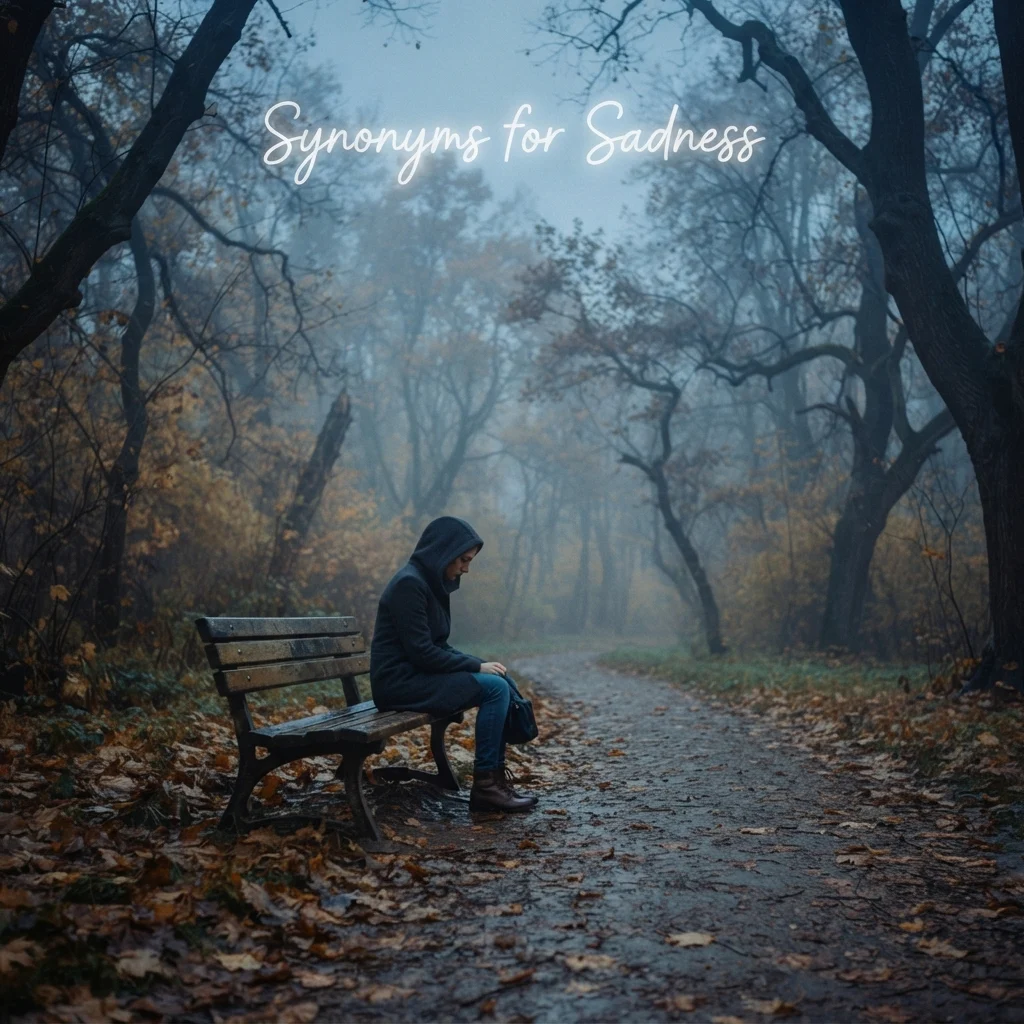
Do you keep using the word “sadness” in essays, creative writing, journaling, professional communication, or everyday conversations? Although it is one of the most fundamental human emotions, repeating it can make your writing feel vague or emotionally flat.
The good news is that the best alternative depends on what you actually mean. You might be referring to mild unhappiness, deep grief, lingering melancholy, disappointment, despair, or emotional pain from loss.
This guide explains synonyms for sadness by meaning, tone, context, and usage. You will learn which alternatives work best in creative writing, academic contexts, professional communication, casual conversation, and emotional expression.
Quick Answer: What Does “Sadness” Mean?
Sadness refers to an emotional state of unhappiness, sorrow, or grief. Depending on context, alternatives include sorrow, grief, melancholy, despair, unhappiness, misery, anguish, dejection, gloom, and heartache .
Meaning, Tone, and Context
Simple Definition
Sadness is the most general word for the feeling of being unhappy. It works in everyday speech and writing for any level of unhappiness, from mild to deep . It can describe:
- A temporary feeling of disappointment
- Prolonged unhappiness from life circumstances
- Deep sorrow from loss or bereavement
- A quiet, reflective emotional state
Part of Speech
Sadness is primarily a noun.
Example:
“Her sadness was evident in her eyes.”
The adjective form is sad.
The adverb form is sadly.
Positive, Negative, or Neutral Tone
Sadness is inherently negative in emotional tone, but it is a natural and valid human emotion. It is often used with empathy and compassion.
Examples:
“His sadness was understandable after the loss.” (empathetic)
“She was consumed by sadness.” (neutral description)
Formality Level
Sadness is a standard, widely accepted word in both formal and informal English. It works in academic writing, creative literature, psychological contexts, news articles, and everyday conversation. However, specific words like grief, anguish, or melancholy can add precision.
Common Use Cases
Sadness commonly refers to:
- Emotional response to loss or bereavement
- Feelings of disappointment or letdown
- Longing, loneliness, or homesickness
- Empathy for others’ suffering
- Existential or philosophical contemplation
- Mental health contexts (mild to moderate depression)
Important Word Forms
- Sadness (noun): the state of being sad
- Sad (adjective): feeling or showing unhappiness
- Sadly (adverb): in a sad manner
- Sadder (comparative): more sad
- Saddest (superlative): most sad
- Sadden (verb): to make someone sad
When and How to Use “Sadness”
Use sadness when discussing unhappiness generally, without needing to specify the cause, intensity, or particular quality of the emotion.
Because the word is broad, it is especially useful when discussing sadness as a general emotional state rather than a specific type of sorrow.
Professional
“The employee’s sadness was understandable following the company’s announcement.”
This works naturally in workplace communication with empathy.
Academic
“The study examines the relationship between sadness and creative expression.”
The broad term is appropriate when discussing the emotion generally.
Personal
“I couldn’t hide my sadness when she moved away.”
The word sounds natural in everyday conversation.
Creative Writing
“A deep sadness settled over the valley as autumn turned to winter.”
The broad term works well when establishing a general mood.
Psychological Context
“Chronic sadness can be a symptom of underlying depression.”
This concise wording is suitable for professional or educational content.
Another Word for “Sadness”
There is no single perfect synonym because sadness can vary in intensity, duration, and cause.
- Deep loss context: grief, bereavement, mourning
- Severe emotional pain: anguish, agony, heartbreak
- Hopeless context: despair, despondency, dejection
- Mild/reflective context: melancholy, gloom, blues
- General unhappiness: sorrow, unhappiness, misery
- Disappointment context: regret, letdown, chagrin
- Creative/literary context: woe, lament, dolor
- Loneliness context: forlornness, loneliness, desolation
When Not to Use “Sadness”
Sadness can become too vague when the reader needs to understand the specific nature or intensity of the emotion.
Consider:
“She felt sadness after the news.”
This statement does not tell readers whether she felt mild disappointment, deep grief, or despair.
A more precise sentence could be:
“She was consumed by grief after the news of her father’s passing.”
Similarly, avoid using sadness when you mean a specific emotional experience. If you mean grief, say grief. If you mean melancholy, say melancholy.
Words Commonly Confused With “Sadness”
Sadness vs. Grief
Grief is the most intense of the group — it typically refers to the deep pain felt after a loved one dies or after a devastating loss. Sadness is a broader, more general term .
Example:
“She felt sadness when her friend moved away.”
“She felt grief when her mother passed away.”
Sadness vs. Sorrow
Sorrow is stronger and more formal than sadness. It is often used for serious, long-lasting unhappiness caused by loss or regret .
Example:
“The sadness of the rainy day matched her mood.” (milder)
“She expressed deep sorrow for her actions.” (more formal, stronger)
Sadness vs. Melancholy
Melancholy is a literary term for a quiet, thoughtful, long-lasting sadness without an obvious cause . It’s more reflective and sometimes even beautiful.
Example:
“She gazed out at the rain with a sense of melancholy.”
Sadness vs. Unhappiness
Unhappiness is a broad word that overlaps with sadness but also covers feelings of dissatisfaction or discontent with life or circumstances .
Example:
“Her sadness was temporary.”
“His unhappiness with his job was obvious.”
Best Synonym by Context for “Sadness”
| Context | Best Synonym | Why It Works | Example |
|---|---|---|---|
| Deep loss | Grief | Indicates profound pain from loss | She was overwhelmed by grief. |
| Severe pain | Anguish | Suggests intense emotional suffering | He cried out in anguish. |
| Hopelessness | Despair | Conveys complete loss of hope | They fell into despair. |
| Reflective mood | Melancholy | Literary, thoughtful sadness | A melancholy settled over him. |
| General unhappiness | Sorrow | More formal and serious | The nation mourned with sorrow. |
| Disappointment | Regret | Focuses on missed opportunities | She felt deep regret. |
| Creative/literary | Woe | Old-fashioned, expressive | He told a tale of woe. |
| Casual conversation | Blues | Informal, mild sadness | I’ve got the blues today. |
| Loneliness | Forlornness | Suggests abandonment | The forlornness of the empty house. |
| Mild/low mood | Gloom | Suggests darkness and low spirits | Gloom settled over the office. |
Which Synonym Should You Choose?
Start by identifying what kind of sadness you are describing.
- Loss of a loved one: grief, bereavement, mourning
- Severe emotional pain: anguish, agony, heartbreak, torment
- Complete hopelessness: despair, despondency, dejection
- Gentle, lingering sadness: melancholy, wistfulness, pensiveness
- General unhappiness: sorrow, unhappiness, misery
- Disappointment: regret, chagrin, letdown
- Loneliness: forlornness, loneliness, desolation
- Dark, heavy sadness: gloom, bleakness, depression
Real Life Examples of “Sadness” in Sentences
School
“The students expressed sadness at their teacher’s retirement.”
A more specific version:
“The students felt a deep sense of loss when their teacher retired.”
Workplace
“She couldn’t hide her sadness about the project’s cancellation.”
A more precise version:
“She was dejected after the project she led was cancelled.”
Creative Writing
“His poetry is filled with sadness and longing.”
For more literary precision:
“His poetry is filled with melancholy and yearning.”
Conversation
“I’m feeling a lot of sadness today.”
In more specific conversation:
“I’ve been feeling really down lately.”
Social Media
“Sometimes you just have to sit with your sadness.”
This empathetic statement works well for mental health awareness posts.
Resume (Contextual)
“I used my experience with grief to support families in crisis.”
A stronger version:
“I provided bereavement counseling to grieving families.”
Storytelling
“The sadness in her eyes told me everything.”
For atmospheric storytelling:
“The sorrow in her eyes was deep and ancient.”
10 Key Synonyms for “Sadness”
The table below includes key alternatives with distinct meanings and usage contexts.
Synonym Groups and Usage Differences
Professional vs. Personal Synonyms
Professional writing benefits from specific terms such as grief, bereavement, emotional distress, and psychological suffering.
Personal communication often uses sadness, down, blue, or heartache.
Compare:
“The employee is experiencing significant sadness.”
“The employee is exhibiting signs of grief-related distress.”
Formal vs. Conversational Synonyms
Sadness itself works in both formal and conversational English.
However, sorrow and anguish are more formal, while blues, down, and bummed out are conversational.
Examples:
“The nation mourned with deep sorrow.” (formal)
“I’ve had the blues all week.” (conversational)
Academic Synonyms
Academic writing should distinguish between sadness (general emotion), depression (clinical condition), grief (specific response to loss), bereavement (state of loss), and melancholy (historical/literary concept) .
Creative or Literary Synonyms
Creative writing can use woe, lament, dolor, lamentation, desolation, and sorrowfulness to add depth and texture .
Science fiction or fantasy writers might describe existential despair, cosmic sorrow, or eternal gloom.
For example:
“The ancient forest held an ageless melancholy, a sorrow that predated memory.”
Slang or Modern Synonyms
Blues and down are common in casual American English.
Bummed is informal for mildly sad.
In a funk suggests a temporary sad or depressed state.
Examples:
“I’m feeling down today.”
“She’s been in a funk all week.”
Intensity Scale
Understanding the intensity of different sadness synonyms helps with precision:
| Intensity | Synonyms |
|---|---|
| Mild | Down, blue, glum, low, dejected |
| Moderate | Sadness, unhappiness, sorrow, gloom |
| Severe | Grief, anguish, despair, heartbreak, misery |
| Profound | Desolation, agony, torment, bereavement |
Antonyms of “Sadness”
Sadness has several clear opposites representing positive emotional states:
| Antonym | Meaning | Example Sentence |
|---|---|---|
| Happiness | State of well-being and joy | She radiated happiness. |
| Joy | Intense, exuberant happiness | The children were filled with joy. |
| Contentment | Satisfied, peaceful happiness | He found contentment in simple pleasures. |
| Elation | Excited joy | She was elated at the news. |
| Cheerfulness | Bright, happy disposition | Her cheerfulness brightened the room. |
| Bliss | Perfect, profound happiness | They lived in wedded bliss. |
| Euphoria | Extreme, overwhelming happiness | He felt euphoria after winning. |
Common Phrases and Expressions with “Sadness”
1. Deep sadness
Meaning:
Profound, intense sadness.
Example:
“She felt deep sadness at the news.”
2. Overwhelming sadness
Meaning:
Sadness so strong it feels uncontrollable.
Example:
“He was overcome by overwhelming sadness.”
3. Wave of sadness
Meaning:
A sudden, intense feeling of sadness.
Example:
“A wave of sadness washed over her.”
4. Heavy heart
Meaning:
A feeling of sorrow or burden.
Example:
“With a heavy heart, she said goodbye.”
5. Sadness of heart
Meaning:
Emotional, heartfelt sorrow.
Example:
“The sadness of heart was too much to bear.”
6. Sadness and despair
Meaning:
A combination of unhappiness and hopelessness.
Example:
“The refugees faced sadness and despair.”
Common Mistakes to Avoid
1. Using “sadness” when a precise term is available
If you mean grief, melancholy, despair, or anguish, use the specific word.
Specific vocabulary makes writing more precise and impactful.
2. Confusing sadness with depression
Sadness is a normal emotion. Depression is a clinical mental health condition characterized by persistent low mood, loss of interest, and other symptoms. Using sadness for clinical depression can minimize serious mental health issues.
3. Confusing sadness with grief
Sadness is general. Grief specifically refers to deep sorrow after loss, especially death .
Incorrect: “His grief about the rain was obvious.”
Correct: “His sadness about the rain was obvious.”
4. Using “melancholy” inappropriately
Melancholy suggests a thoughtful, gentle, often aesthetic sadness . It’s less appropriate for describing acute pain or despair.
5. Overusing “sadness” in creative writing
Repetition can make writing feel flat.
Repetitive: “The sadness was palpable. Her sadness filled the room.”
Improved: “The melancholy was palpable. Her sorrow filled the room.”
6. Choosing a synonym that changes the meaning
Do not replace sadness with despair if you only mean mild disappointment. Always check whether the replacement communicates the same intensity and type of emotion.
FAQs
What is the best synonym for “sadness”?
The best synonym depends on context. Sorrow works for formal, serious sadness. Grief is best for loss. Melancholy is perfect for reflective, gentle sadness. Despair is ideal for hopelessness.
What is a formal synonym for “sadness”?
Sorrow, anguish, and bereavement are formal synonyms. Grief is also formal and appropriate in professional contexts .
What is an informal synonym for “sadness”?
Blues, down, glum, and bummed are common informal alternatives .
What is another word for “sadness” in creative writing?
Melancholy, woe, lament, dolor, desolation, and sorrowfulness work well in creative writing .
What is the difference between “sadness” and “grief”?
Sadness is general unhappiness. Grief is specifically deep sorrow after a loss, especially the death of a loved one .
What is the difference between “sadness” and “melancholy”?
Sadness is a general emotional state. Melancholy is a literary term for a gentle, thoughtful, long-lasting sadness without a clear cause .
What is the opposite of “sadness”?
Opposites include happiness, joy, contentment, and cheerfulness.
Conclusion
Sadness is a universal human emotion with many shades and intensities. The best synonym depends on what you actually mean.
Choose grief for deep loss, sorrow for serious unhappiness, melancholy for reflective sadness, despair for hopelessness, anguish for severe pain, unhappiness for general dissatisfaction, and blues for casual conversation.
Most importantly, do not replace sadness simply to avoid repetition. First identify the specific type, cause, and intensity of the emotion, then choose the alternative that communicates that most clearly.
For academic, professional, and creative writing, precision adds depth and emotional impact. A specific term such as grief, melancholy, or anguish can tell readers much more than the broad word sadness.
Before publishing a vocabulary guide, verify definitions and usage with trusted dictionaries such as Cambridge, Oxford, Merriam-Webster, Collins, or Britannica. This helps ensure that each alternative accurately matches its intended meaning and context.
The practical takeaway is simple: when sadness feels too general, ask yourself what type of emotional experience you are actually describing — loss, disappointment, reflection, despair, or mild unhappiness. Then use the most precise word available.

1 thought on “50+ Synonyms for Sadness: Meanings, Examples, and Best Alternatives”