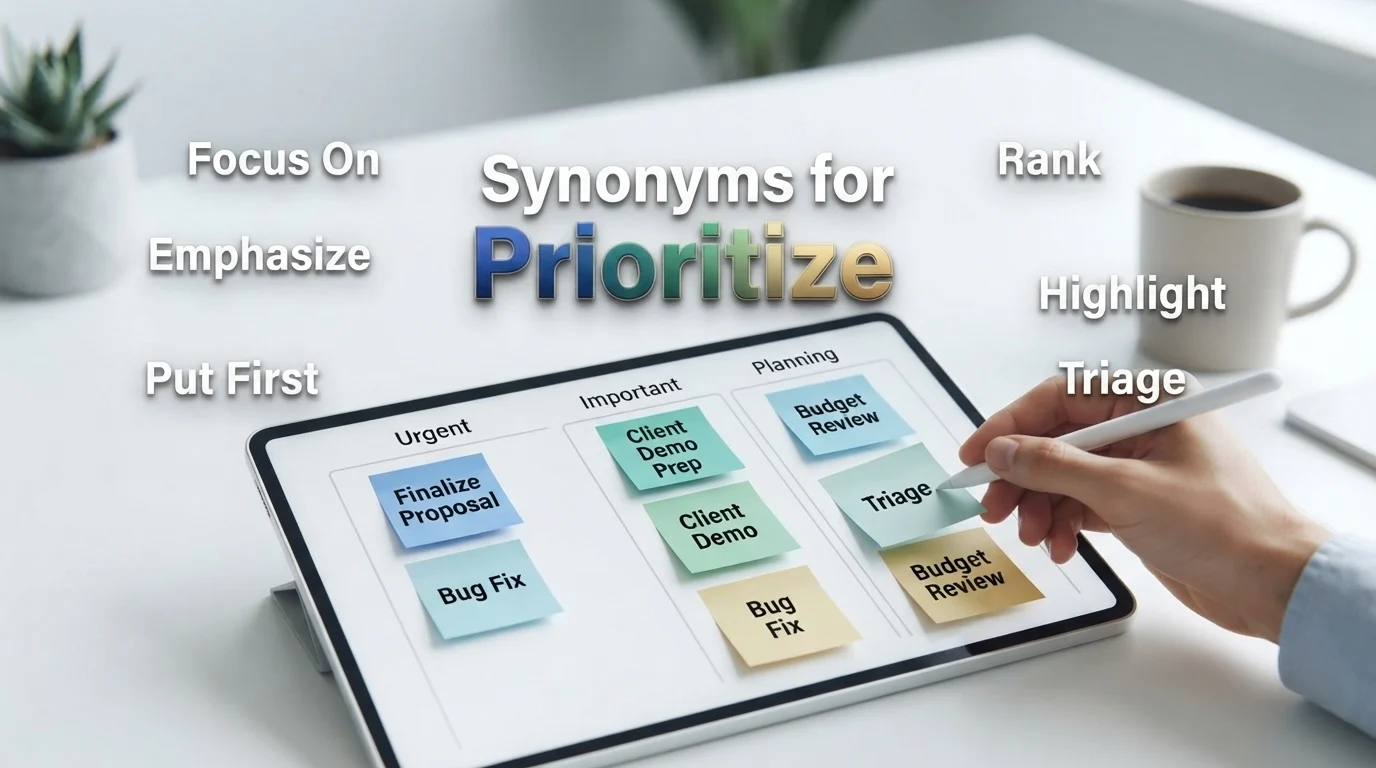
Do you keep using the word “prioritize” in emails, business reports, project plans, resumes, or everyday conversation? While it is one of the most useful and professional words in modern English, repeating it can make your writing feel flat, robotic, or overly corporate.
The good news is that the best alternative depends on what you actually mean. You might be describing ranking tasks, focusing on what matters most, emphasizing a key issue, putting something first, or organizing your time and resources.
This guide explains synonyms for “prioritize” by meaning, tone, context, and usage. You will learn which alternatives work best in academic writing, professional communication, project management, resumes, creative expression, and casual conversation.
Quick Answer: What Does “Prioritize” Mean?
“Prioritize” means to arrange or deal with things in order of importance, to treat something as more important than other things, or to focus attention and resources on what matters most. Depending on context, alternatives include rank, emphasize, focus on, put first, highlight, stress, favor, foreground, make a priority, and give precedence to.
Meaning, Tone, and Context
Simple Definition
“Prioritize” generally refers to:
- Ranking: arranging tasks or items in order of importance
- Focusing: directing attention and energy to what matters most
- Emphasizing: treating something as especially important
- Putting first: giving something precedence over other things
- Allocating resources: directing time, money, or effort to key areas
- Organizing: structuring work or plans by importance
Part of Speech
“Prioritize” functions primarily as a verb.
Examples:
- “We need to prioritize our tasks before the deadline.”
- “The company prioritizes customer satisfaction.”
Related Forms:
- Priority (noun): something treated as more important
- Prioritization (noun): the act of prioritizing
- Prioritized (verb): treated as a priority
- Prioritizing (verb): the act of prioritizing
- Priorities (noun): multiple important things
Positive, Negative, or Neutral Tone
“Prioritize” is generally neutral or positive. It suggests good judgment, organization, and focus.
Positive associations:
- “She prioritizes her family above work.”
- “The team prioritized safety throughout the project.”
Neutral or professional contexts:
- “We need to prioritize these tasks by Friday.”
- “The report prioritizes long-term goals.”
Formality Level
“Prioritize” is a standard word that works in both formal and informal English. It is especially common in business, project management, academic, and professional contexts.
However, more specific alternatives can add precision and variety depending on the context.
Common Use Cases
“Prioritize” commonly refers to:
- Task management: prioritizing tasks, to-do lists, deadlines
- Business strategy: prioritizing goals, initiatives, investments
- Time management: prioritizing time, commitments, activities
- Customer service: prioritizing customer needs, urgent requests
- Personal life: prioritizing family, health, well-being
- Project management: prioritizing features, deliverables, risks
Important Word Forms
- Prioritize (verb): to arrange by importance
- Priority (noun): something treated as more important
- Priorities (noun): multiple important things
- Prioritization (noun): the act of prioritizing
- Prioritized (adjective/verb): treated as a priority
- Prioritizing (verb): the act of prioritizing
When and How to Use “Prioritize”
Use “prioritize” when you want to describe arranging things by importance or focusing on what matters most. Because the word is broad, more specific alternatives can add precision depending on the context.
Professional
“We need to prioritize the most urgent client requests.”
This works naturally in business communication.
Academic
“Students should prioritize their assignments based on deadlines.”
The term is appropriate in academic contexts.
Business
“The company prioritizes innovation and customer satisfaction.”
This is standard in business communication.
Personal
“I’m trying to prioritize my health this year.”
The word sounds natural in everyday conversation.
Project Management
“The team prioritized the critical features for the first release.”
This is standard in project management.
Customer Service
“We prioritize customer safety above all else.”
This is appropriate in customer service contexts.
Another Word for “Prioritize”
There is no single perfect synonym because “prioritize” can refer to ranking, focusing, emphasizing, putting first, or allocating resources.
- Ranking context: rank, order, sequence, arrange, organize
- Focusing context: focus on, concentrate on, zero in on, center on
- Emphasizing context: emphasize, stress, highlight, underline, accent
- Putting first context: put first, give precedence to, favor, foreground
- Allocating resources: allocate resources to, direct resources to, invest in
- Organizing context: organize, structure, streamline, triage
If you need one broad alternative, “focus on” works in most contexts, while “emphasize” works for importance. “Put first” works for precedence.
When Not to Use “Prioritize”
“Prioritize” can become too vague or corporate when you need to specify exactly what you are prioritizing and why.
Consider:
“We need to prioritize.”
This statement does not tell readers what should be prioritized, why, or in what order.
A more precise sentence could be:
“We need to prioritize the safety features before the cosmetic updates.”
Similarly, avoid using “prioritize” when you mean “choose” or “decide” in a simple context. Use “choose”, “select”, or “decide” instead.
Words Commonly Confused With “Prioritize”
Prioritize vs. Emphasize
Emphasize means to give special importance or attention to something. Prioritize means to rank or treat as more important than others.
Example:
“She emphasized the need for caution.” (gave importance)
“She prioritized safety over speed.” (ranked higher)
Prioritize vs. Focus On
Focus on means to concentrate attention on something. Prioritize means to rank by importance.
Example:
“Let’s focus on this task.” (concentrate)
“Let’s prioritize this task.” (rank higher)
Prioritize vs. Rank
Rank means to arrange in order. Prioritize means to treat as more important.
Example:
“Rank the candidates by experience.” (arrange)
“Prioritize the most qualified candidates.” (treat as more important)
Prioritize vs. Choose
Choose means to select from options. Prioritize means to rank or favor.
Example:
“Choose one option.” (select)
“Prioritize the most important option.” (rank)
Prioritize vs. Prefer
Prefer means to like one thing more than another. Prioritize means to treat as more important.
Example:
“I prefer tea over coffee.” (like more)
“I prioritize health over convenience.” (treat as more important)
Prioritize vs. Triage
Triage means to assign degrees of urgency, often in medical or emergency contexts. Prioritize is broader.
Example:
“The nurse triaged the patients.” (medical urgency)
“The manager prioritized the tasks.” (general importance)
Best Synonym by Context for “Prioritize”
| Context | Best Synonym | Why It Works | Example |
|---|---|---|---|
| Formal writing | Give precedence to, rank | Precise and professional | The committee gave precedence to safety concerns. |
| Academic writing | Emphasize, foreground | Standard academic usage | The study emphasizes long-term outcomes. |
| Business/Professional | Focus on, emphasize, put first | Professional and clear | The company focuses on customer retention. |
| Project management | Rank, sequence, triage | Project-specific | The team ranked features by impact. |
| Time management | Allocate time to, focus on | Personal productivity | She allocated more time to high-impact tasks. |
| Customer service | Put first, prioritize | Professional and polite | We put customer safety first. |
| Casual conversation | Put first, focus on | Natural and informal | I’m focusing on my health right now. |
| Creative writing | Foreground, highlight | Literary and expressive | The novel foregrounds social justice themes. |
| Strategic planning | Emphasize, favor | Strategic and formal | The strategy favors long-term growth. |
| Personal life | Make time for, put first | Personal and reflective | I’m making time for family. |
| Resource allocation | Allocate to, direct to | Financial/operational | The budget allocates more to R&D. |
| Emergency context | Triage, rank | Medical/emergency | The paramedics triaged the victims. |
Which Synonym Should You Choose?
Start by identifying what kind of “prioritize” you are describing.
- Ranking: rank, order, sequence, arrange
- Focusing: focus on, concentrate on, zero in on
- Emphasizing: emphasize, stress, highlight, underline
- Putting first: put first, give precedence to, favor, foreground
- Allocating resources: allocate to, direct to, invest in
- Organizing: organize, structure, streamline, triage
10 Key Synonyms for “Prioritize”
The table below includes accurate alternatives with clear meanings and usage contexts.
| Synonym | Simple Meaning | Best Used For | Example Sentence |
|---|---|---|---|
| Focus on | Concentrate attention on | General, professional | Let’s focus on the most urgent tasks. |
| Emphasize | Give special importance to | Academic, professional | The report emphasizes cost reduction. |
| Rank | Arrange in order of importance | Project management | We ranked the tasks by urgency. |
| Put first | Treat as most important | General, personal | She always puts family first. |
| Highlight | Draw attention to | Professional, creative | The presentation highlights key findings. |
| Stress | Give emphasis to | Academic, professional | He stressed the need for caution. |
| Favor | Prefer or give advantage to | Strategic, formal | The policy favors long-term growth. |
| Foreground | Make most prominent | Creative, academic | The novel foregrounds women’s voices. |
| Give precedence to | Treat as more important | Formal, legal | The court gave precedence to safety. |
| Triage | Assign urgency levels | Medical, emergency | The nurse triaged the patients. |
Synonym Groups and Usage Differences
Professional vs. Personal Synonyms
Professional writing benefits from specific terms such as focus on, emphasize, rank, give precedence to, and allocate resources to.
Personal communication often uses prioritize itself or casual alternatives like put first, focus on, or make time for.
Compare:
“I’m putting my health first.” (personal)
“The company prioritizes customer retention.” (professional)
Formal vs. Conversational Synonyms
Prioritize works in both formal and conversational English.
Formal alternatives: give precedence to, rank, emphasize, foreground
Conversational alternatives: put first, focus on, make time for
Examples:
“The committee gave precedence to safety concerns.” (formal)
“I’m focusing on my family right now.” (conversational)
Academic Synonyms
Academic writing should distinguish between prioritize (general), emphasize (give importance), foreground (make prominent), and rank (order by importance).
For example:
“The study emphasizes the role of early intervention.”
“The analysis foregrounds economic factors.”
Professional and Business Synonyms
Business writing often benefits from phrases such as focus on, emphasize, rank, allocate resources to, and give precedence to.
Instead of:
“We need to prioritize customer service.”
Consider:
“We are focusing our resources on improving customer service.”
Creative or Literary Synonyms
Creative writing can use foreground, highlight, spotlight, accent, and underscore depending on the context.
For example:
“The novel foregrounds the experiences of marginalized communities.”
“The director spotlighted the protagonist’s internal struggle.”
Slang or Modern Synonyms
Put first is a common casual phrase.
Make time for is casual for prioritizing.
Focus on is casual and professional.
Zero in on is modern slang for focusing.
Examples:
“I’m putting my goals first this year.” (casual)
“Let’s zero in on the main issue.” (modern)
Strongest vs. Weaker Synonyms
“Prioritize” synonyms vary in intensity:
Milder: focus on, favor, prefer
Moderate: prioritize, emphasize, rank
Strong: put first, give precedence to, foreground
Very Strong: demand priority, take precedence over
Emotional vs. Neutral Synonyms
“Prioritize” is generally neutral or professional.
Emotional alternatives: put first, make time for (personal, emotional)
Neutral alternatives: rank, emphasize, focus on
Examples:
“She always puts her children first.” (emotional, positive)
“The team ranked the tasks by urgency.” (neutral)
Antonyms of “Prioritize”
“Prioritize” has several antonyms depending on context:
| Antonym | Context | Meaning | Example Sentence |
|---|---|---|---|
| Neglect | General | Fail to care for | He neglected his responsibilities. |
| Ignore | General | Pay no attention to | She ignored the warning signs. |
| Deprioritize | General | Treat as less important | The feature was deprioritized. |
| Postpone | Time | Delay to a later time | The meeting was postponed. |
| Delay | Time | Make late or slow | The project was delayed. |
| Sideline | General | Remove from priority | The issue was sidelined. |
| Overlook | General | Fail to notice | The error was overlooked. |
Comparison: “Prioritize” vs. Similar Words
Prioritize vs. Emphasize
Main difference: Emphasize means to give special importance or attention to something. Prioritize means to rank or treat as more important than others.
Examples:
“She emphasized the need for caution.” (gave importance)
“She prioritized safety over speed.” (ranked higher)
Prioritize vs. Focus On
Main difference: Focus on means to concentrate attention on something. Prioritize means to rank by importance.
Examples:
“Let’s focus on this task.” (concentrate)
“Let’s prioritize this task.” (rank higher)
Prioritize vs. Rank
Main difference: Rank means to arrange in order. Prioritize means to treat as more important.
Examples:
“Rank the candidates by experience.” (arrange)
“Prioritize the most qualified candidates.” (treat as more important)
Prioritize vs. Choose
Main difference: Choose means to select from options. Prioritize means to rank or favor.
Examples:
“Choose one option.” (select)
“Prioritize the most important option.” (rank)
Prioritize vs. Prefer
Main difference: Prefer means to like one thing more than another. Prioritize means to treat as more important.
Examples:
“I prefer tea over coffee.” (like more)
“I prioritize health over convenience.” (treat as more important)
Prioritize vs. Triage
Main difference: Triage means to assign degrees of urgency, often in medical or emergency contexts. Prioritize is broader.
Examples:
“The nurse triaged the patients.” (medical urgency)
“The manager prioritized the tasks.” (general importance)
Common Phrases and Expressions with “Prioritize”
1. Prioritize tasks
Meaning:
Arrange tasks by importance.
Example:
“She prioritized tasks based on deadlines.”
2. Prioritize health
Meaning:
Make health a priority.
Example:
“He decided to prioritize his health this year.”
3. Prioritize customer needs
Meaning:
Put customer needs first.
Example:
“The company prioritizes customer needs above all else.”
4. Prioritize spending
Meaning:
Decide what to spend money on first.
Example:
“The government prioritized spending on education.”
5. Prioritize safety
Meaning:
Make safety the most important concern.
Example:
“The airline prioritizes safety above everything.”
6. Prioritize time
Meaning:
Manage time by importance.
Example:
“She learned to prioritize her time effectively.”
7. Prioritize goals
Meaning:
Rank goals by importance.
Example:
“The team prioritized goals for the quarter.”
8. Prioritize work
Meaning:
Organize work by importance.
Example:
“He prioritized work over social activities.”
9. Prioritize family
Meaning:
Put family first.
Example:
“She always prioritizes family.”
10. Prioritize effectively
Meaning:
Rank things well.
Example:
“Managers must prioritize effectively to succeed.”
Common Mistakes to Avoid
1. Using “prioritize” when a more precise term is available
If you mean focus on, emphasize, rank, or put first, use the more specific word.
Vague: “We need to prioritize.”
Precise: “We need to rank these tasks by urgency.”
2. Confusing “prioritize” with “emphasize”
Emphasize means to give importance. Prioritize means to rank by importance.
Incorrect: “She prioritized the need for caution.”
Correct: “She emphasized the need for caution.”
3. Using “prioritize” when “choose” is more appropriate
Choose means to select. Prioritize means to rank.
Incorrect: “Prioritize one option from the list.”
Correct: “Choose one option from the list.”
4. Overusing “prioritize” in writing
Repetition can make content feel dull. Use alternatives such as focus on, emphasize, rank, put first, and highlight.
5. Choosing a synonym that changes the meaning
Do not replace prioritize with prefer unless you mean liking one thing more.
Do not replace prioritize with triage unless you mean assigning urgency levels.
FAQs
What is the best synonym for “prioritize”?
The best synonym depends on context. Focus on works for general use, emphasize for importance, rank for ordering, put first for precedence, and triage for emergency contexts.
What is a formal synonym for “prioritize”?
Give precedence to, rank, emphasize, foreground, and allocate resources to are formal synonyms.
What is an informal synonym for “prioritize”?
Put first, focus on, make time for, and zero in on are common informal alternatives.
What is another word for “prioritize” in a resume?
Streamlined, focused on, emphasized, ranked, and allocated resources to work well in resumes.
What is the difference between “prioritize” and “emphasize”?
Emphasize means to give special importance or attention to something. Prioritize means to rank or treat as more important than others.
What is the opposite of “prioritize”?
Depending on context, opposites include neglect, ignore, deprioritize, postpone, and sideline.
What does “prioritize” mean in a business context?
In business, prioritize means to decide which tasks, projects, or goals are most important and should receive attention and resources first.
Conclusion
“Prioritize” is a versatile and professional word that can describe ranking, focusing, emphasizing, putting first, and allocating resources. The best synonym depends on what you actually mean.
Choose focus on for general use, emphasize for importance, rank for ordering, put first for precedence, give precedence to for formal contexts, and triage for emergency situations.
Most importantly, do not replace “prioritize” simply to avoid repetition. First identify what kind of prioritization—ranking, focusing, emphasizing, or allocating—you are actually describing. Then choose the alternative that communicates that idea most clearly.
For academic, professional, and formal writing, precision is usually more valuable than vocabulary variety. A specific term such as emphasized, ranked, focused on, or allocated resources to can tell readers much more than the broad word prioritized.
Before publishing a vocabulary guide, verify definitions and usage with trusted dictionaries such as Cambridge, Oxford, Merriam-Webster, Collins, or Britannica. This helps ensure that each alternative accurately matches its intended meaning and context.
The practical takeaway is simple: when “prioritize” feels too general or corporate, ask yourself what kind of ranking, focusing, or emphasizing you are actually describing. Then use the most precise word available.
Discover More:-
- 50+ Synonyms for Major: Meanings, Examples, and Best Alternatives
- 50+ Synonyms for Eat: Meanings, Examples, and Best Alternatives

1 thought on “50+ Synonyms for Prioritize: Meanings, Examples, and Best Alternatives”