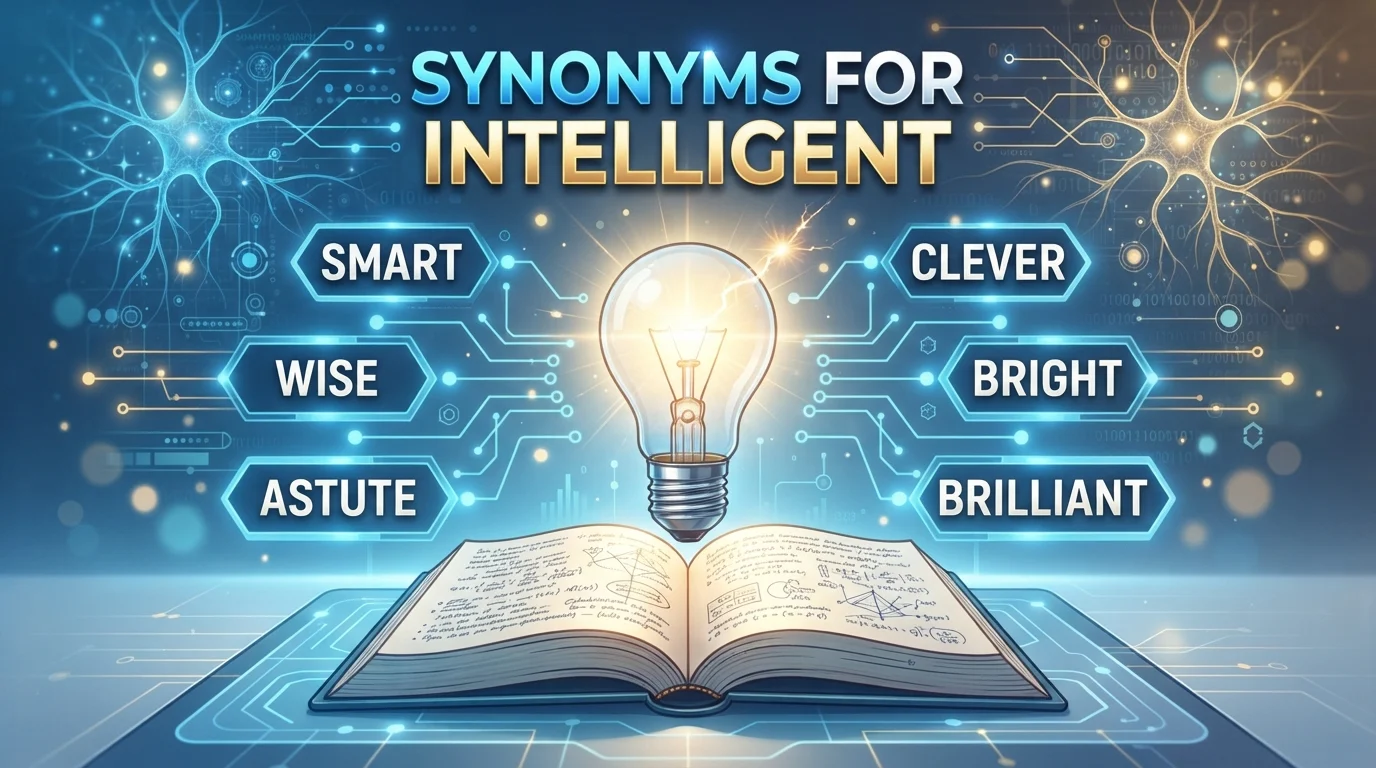
Do you keep using the word “intelligent” in essays, professional reports, academic papers, creative writing, or everyday conversation? While it is a valuable and widely used word, repeating it can make your writing feel monotonous or lack the nuance needed to describe different types of mental ability.
The good news is that the best alternative depends on what you actually mean. You might be describing quick thinking, deep knowledge, creative problem-solving, sharp wit, practical wisdom, or academic brilliance.
This guide explains synonyms for “intelligent” by meaning, tone, context, and usage. You will learn which alternatives work best in academic writing, professional communication, creative expression, scientific content, and casual conversation.
Quick Answer: What Does “Intelligent” Mean?
“Intelligent” refers to having the ability to learn, understand, reason, and apply knowledge effectively. It can describe quick mental processing, deep understanding, creative thinking, or practical problem-solving. Depending on context, alternatives include smart, clever, bright, brilliant, wise, astute, sharp, gifted, knowledgeable, and perceptive.
Meaning, Tone, and Context
Simple Definition
“Intelligent” generally refers to:
- Mental capacity: the ability to learn, understand, and reason
- Quick thinking: processing information rapidly and effectively
- Deep understanding: grasping complex concepts
- Creative problem-solving: finding innovative solutions
- Practical wisdom: applying knowledge to real-world situations
- Academic ability: excelling in learning and scholarship
Part of Speech
“Intelligent” is primarily an adjective.
Examples:
- “She is an intelligent student who grasps concepts quickly.”
- “The intelligent design of the system impressed everyone.”
Related Forms:
- Intelligence (noun): the ability to learn and understand
- Intelligently (adverb): in an intelligent manner
- Intelligentsia (noun): the intellectual elite of a society
- Unintelligent (adjective): lacking intelligence
- Artificial intelligence (noun): machine-based intelligence
Positive, Negative, or Neutral Tone
“Intelligent” is generally positive.
Positive associations:
- “She is an intelligent and capable leader.”
- “His intelligent analysis saved the company.”
Neutral or technical contexts:
- “The intelligent system adapts to user behavior.”
- “Intelligence testing measures cognitive abilities.”
Formality Level
“Intelligent” is a standard word that works in both formal and informal English. However, more specific alternatives like astute, perceptive, erudite, and sagacious are often preferred in formal and academic writing.
Common Use Cases
“Intelligent” commonly describes:
- Academic ability: students, scholars, researchers
- Professional competence: leaders, professionals, experts
- Creative thinking: artists, innovators, problem-solvers
- Practical wisdom: advisors, mentors, decision-makers
- Quick wit: conversationalists, comedians, debaters
- Technical systems: AI, smart devices, adaptive software
Important Word Forms
- Intelligent (adjective): having intelligence
- Intelligence (noun): the capacity for learning and understanding
- Intelligently (adverb): in a smart manner
- Intelligible (adjective): able to be understood (different meaning)
- Unintelligent (adjective): lacking intelligence
- Intellect (noun): the faculty of reasoning
- Intellectual (adjective/noun): relating to intellect; a person who values thinking
When and How to Use “Intelligent”
Use “intelligent” when you want to describe someone or something that demonstrates mental capacity, quick understanding, or effective problem-solving.
Professional
“She is an intelligent manager who quickly identifies solutions.”
This works naturally in professional communication.
Academic
“The study examined intelligent behavior in early childhood development.”
The term is appropriate in academic contexts.
Personal
“He is one of the most intelligent people I know.”
The word sounds natural in everyday conversation.
Business
“The company invested in intelligent automation systems.”
Here, “intelligent” describes technology that adapts and learns.
Creative
“The intelligent detective solved the case through careful observation.”
The term can describe a clever, perceptive character.
Scientific
“Artificial intelligence is transforming multiple industries.”
This is standard scientific and technical language.
Another Word for “Intelligent”
There is no single perfect synonym because “intelligent” can refer to different types of mental ability.
- Quick thinking: sharp, quick-witted, clever, astute, alert
- Deep knowledge: knowledgeable, erudite, scholarly, learned
- Creative ability: brilliant, inventive, innovative, gifted
- Practical wisdom: wise, sage, discerning, perceptive
- Academic excellence: bright, scholarly, intellectual, academic
- Social intelligence: perceptive, insightful, intuitive, empathetic
- Technical intelligence: skilled, proficient, expert, adept
If you need one broad alternative, “smart” works in most casual contexts, “clever” for quick thinking, “bright” for academic ability, and “brilliant” for exceptional intelligence.
When Not to Use “Intelligent”
“Intelligent” can become too broad or vague when you need to specify what kind of intelligence you are describing.
Consider:
“He is intelligent.”
This statement does not tell readers whether he is academically gifted, practically wise, creatively brilliant, or socially perceptive.
A more precise sentence could be:
“He is academically gifted, particularly in mathematics.”
“She is creatively brilliant, with a talent for innovative design.”
Similarly, avoid using “intelligent” when you mean “knowledgeable” (having information) or “wise” (having good judgment).
Words Commonly Confused With “Intelligent”
Intelligent vs. Smart
Smart is the informal equivalent of intelligent. It is more casual but equally common.
Example:
“She is smart.” (casual)
“She is intelligent.” (formal)
Intelligent vs. Clever
Clever emphasizes quick thinking and ingenuity, sometimes with a hint of cunning. Intelligent is broader.
Example:
“She found a clever solution to the problem.” (ingenious)
“He is an intelligent student.” (general ability)
Intelligent vs. Wise
Wise emphasizes good judgment and life experience. Intelligent emphasizes mental capacity.
Example:
“She is wise beyond her years.” (judgment)
“He is intelligent and learns quickly.” (mental ability)
Intelligent vs. Knowledgeable
Knowledgeable means having information about a subject. Intelligent means having the capacity to learn and reason.
Example:
“She is knowledgeable about history.” (information)
“He is intelligent and can analyze complex issues.” (capacity)
Intelligent vs. Brilliant
Brilliant means exceptionally intelligent or talented. It is a stronger word.
Example:
“She is a brilliant scientist.” (exceptional)
“He is intelligent and hardworking.” (general)
Intelligent vs. Gifted
Gifted means having exceptional natural ability or talent. Intelligent is broader.
Example:
“She is gifted in music.” (natural talent)
“He is intelligent and does well in all subjects.” (general ability)
Best Synonym by Context for “Intelligent”
| Context | Best Synonym | Why It Works | Example |
|---|---|---|---|
| Formal writing | Astute, perceptive, sagacious | Precise and professional | The astute analyst predicted the market shift. |
| Academic writing | Scholarly, intellectual, erudite | Standard academic usage | The scholarly article demonstrated intellectual rigor. |
| Quick thinking | Sharp, quick-witted, clever | Emphasizes mental speed | She gave a sharp response during the debate. |
| Exceptional ability | Brilliant, gifted, genius | Emphasizes high intelligence | He is a brilliant mathematician. |
| Practical wisdom | Wise, sage, discerning | Emphasizes judgment | The wise advisor offered practical guidance. |
| Social intelligence | Perceptive, insightful, intuitive | Emphasizes understanding people | She is perceptive and reads people well. |
| Professional skill | Adept, proficient, expert | Emphasizes competence | He is adept at solving complex problems. |
| Academic ability | Bright, scholarly, academic | Emphasizes learning | She is a bright student with a promising future. |
| Creative intelligence | Inventive, innovative, imaginative | Emphasizes creativity | The inventive engineer designed a new system. |
| Casual conversation | Smart, brainy, sharp | Natural and informal | He’s really smart and picks things up quickly. |
| Technical systems | Adaptive, smart, AI-driven | Describes technology | The smart home system learns your preferences. |
| Business context | Strategic, savvy, astute | Emphasizes business acumen | She is a savvy entrepreneur. |
Which Synonym Should You Choose?
Start by identifying what kind of intelligence you are describing.
- Quick thinking: sharp, clever, quick-witted, alert, astute
- Deep knowledge: knowledgeable, erudite, scholarly, learned
- Exceptional ability: brilliant, gifted, genius, prodigious
- Practical wisdom: wise, sage, discerning, perceptive
- Academic excellence: bright, scholarly, intellectual, academic
- Social intelligence: perceptive, insightful, intuitive, empathetic
- Creative ability: inventive, innovative, imaginative, resourceful
- Professional competence: adept, proficient, savvy, expert
10 Key Synonyms for “Intelligent”
The table below includes accurate alternatives with clear meanings and usage contexts.
| Synonym | Simple Meaning | Best Used For | Example Sentence |
|---|---|---|---|
| Smart | Quick to learn or understand | Casual, general contexts | She is smart and picks up new skills quickly. |
| Clever | Quick-thinking and ingenious | Problem-solving, wit | He found a clever solution to the puzzle. |
| Bright | Intelligent and promising | Academic contexts, students | She is a bright student with a bright future. |
| Brilliant | Exceptionally intelligent | High achievement, admiration | He is a brilliant scientist. |
| Wise | Having good judgment | Life experience, advice | The wise elder shared valuable insights. |
| Astute | Sharp and perceptive | Business, analysis | She made an astute observation about the market. |
| Sharp | Quick-witted and alert | Conversation, debate | He has a sharp mind and quick wit. |
| Gifted | Having exceptional talent | Natural ability, arts, academics | She is gifted in mathematics. |
| Knowledgeable | Well-informed | Specific subjects | He is knowledgeable about ancient history. |
| Perceptive | Insightful and observant | Social, emotional contexts | She is perceptive and understands people well. |
Synonym Groups and Usage Differences
Professional vs. Personal Synonyms
Professional writing benefits from specific terms such as astute, strategic, savvy, perceptive, and analytical.
Personal communication often uses smart, clever, bright, or brainy.
Compare:
“He is smart.” (personal)
“He is an astute strategic thinker.” (professional)
Formal vs. Conversational Synonyms
Intelligent works in both formal and conversational English.
Formal alternatives: astute, sagacious, erudite, perceptive
Conversational alternatives: smart, brainy, sharp, quick
Examples:
“The sagacious leader anticipated the crisis.” (formal)
“She’s really sharp and picks things up fast.” (conversational)
Academic Synonyms
Academic writing should distinguish between intelligent (general), scholarly (academic study), intellectual (thinking ability), and erudite (deep reading).
For example:
“The intellectual rigor of the study was impressive.”
“The erudite professor published extensively.”
Professional and Business Synonyms
Business writing often benefits from phrases such as strategic, astute, savvy, analytical, and perceptive.
Instead of:
“He is intelligent.”
Consider:
“He is an astute strategic thinker with strong analytical skills.”
Creative or Literary Synonyms
Creative writing can use brilliant, ingenious, inventive, perceptive, discerning, and sagacious.
For example:
“The ingenious detective pieced together the clues.”
“The sagacious old woman offered timeless wisdom.”
Slang or Modern Synonyms
Brainy means academically intelligent.
Sharp means quick-witted.
Street-smart means practically intelligent.
Nerdy can mean academically intelligent (sometimes negative).
Genius is slang for extremely intelligent.
Examples:
“She’s really brainy.” (academic)
“He’s street-smart and knows how to survive.” (practical)
“That was a genius move.” (slang, brilliant)
Strongest vs. Weaker Synonyms
“Intelligent” synonyms vary in intensity:
Milder: smart, bright, capable
Moderate: intelligent, clever, sharp
Strong: brilliant, gifted, astute
Very Strong: genius, prodigious, sagacious
Emotional vs. Neutral Synonyms
“Intelligent” is generally positive and neutral.
Positive alternatives: brilliant, gifted, wise
Neutral alternatives: smart, capable, knowledgeable
Examples:
“She is a brilliant mind.” (strong positive)
“She is a capable employee.” (neutral positive)
Antonyms of “Intelligent”
“Intelligent” has several antonyms depending on context:
| Antonym | Context | Meaning | Example Sentence |
|---|---|---|---|
| Unintelligent | General | Lacking intelligence | The unintelligent decision cost them. |
| Foolish | General | Lacking intelligence (strong) | That was a foolish mistake. |
| Foolish | Judgment | Lacking good sense | It was foolish to ignore the warning. |
| Ignorant | Knowledge | Lacking knowledge | He was ignorant of the facts. |
| Slow | Learning | Learning at a slower pace | The student was slow to understand. |
| Dull | General | Lacking sharpness | The dull conversation bored everyone. |
| Simple-minded | General | Lacking complexity | The simple-minded approach failed. |
| Naive | Experience | Lacking experience or judgment | His naive assumption was incorrect. |
Comparison: “Intelligent” vs. Similar Words
Intelligent vs. Smart
Main difference: Smart is the informal equivalent of intelligent. Both mean having mental ability, but smart is more casual.
Examples:
“She is smart.” (casual)
“She is intelligent.” (formal)
Intelligent vs. Clever
Main difference: Clever emphasizes quick thinking and ingenuity, sometimes with a hint of cunning. Intelligent is broader.
Examples:
“She found a clever solution.” (ingenious)
“He is an intelligent student.” (general)
Intelligent vs. Wise
Main difference: Wise emphasizes good judgment and life experience. Intelligent emphasizes mental capacity.
Examples:
“She is wise beyond her years.” (judgment)
“He is intelligent and learns quickly.” (capacity)
Intelligent vs. Brilliant
Main difference: Brilliant means exceptionally intelligent or talented. It is a stronger word.
Examples:
“She is a brilliant scientist.” (exceptional)
“He is intelligent and hardworking.” (general)
Intelligent vs. Gifted
Main difference: Gifted means having exceptional natural ability. Intelligent is broader.
Examples:
“She is gifted in music.” (natural talent)
“He is intelligent and does well in all subjects.” (general)
Common Phrases and Expressions with “Intelligent”
1. Highly intelligent
Meaning:
Extremely intelligent.
Example:
“She is a highly intelligent individual.”
2. Emotionally intelligent
Meaning:
Having the ability to understand and manage emotions.
Example:
“Emotionally intelligent leaders are more effective.”
3. Artificially intelligent
Meaning:
Describing machines or systems that simulate human intelligence.
Example:
“The artificially intelligent system learns from user behavior.”
4. Intelligent design
Meaning:
A theory that life was created by an intelligent cause (often used in creationism debates).
Example:
“The concept of intelligent design is controversial.”
5. Intelligent conversation
Meaning:
A discussion involving thoughtful, knowledgeable exchange.
Example:
“I enjoy having intelligent conversations about politics.”
6. Intelligent life
Meaning:
Life forms capable of reasoning and thought, often used in astronomy.
Example:
“Scientists search for signs of intelligent life in the universe.”
7. Intelligent decision
Meaning:
A well-reasoned, sensible choice.
Example:
“Investing in education is an intelligent decision.”
Common Mistakes to Avoid
1. Using “intelligent” when “knowledgeable” or “wise” is more precise
Knowledgeable means having information. Wise means having good judgment. Intelligent means having mental capacity.
Vague: “He is intelligent.”
Precise: “He is knowledgeable about history.”
Precise: “He is wise beyond his years.”
2. Confusing “intelligent” with “intellectual”
Intelligent means having mental ability. Intellectual means valuing or engaging in deep thinking.
Example:
“She is intelligent.” (ability)
“She is an intellectual.” (person who values thinking)
3. Using “intelligent” in casual contexts when “smart” is more natural
In casual conversation, smart, sharp, or brainy are more natural.
Formal: “He is an intelligent individual.”
Casual: “He’s really smart.”
4. Overusing “intelligent” in writing
Repetition can make content feel dull. Use alternatives such as smart, clever, bright, brilliant, astute, sharp, wise, and perceptive.
5. Using “intelligent” when “gifted” or “talented” is meant
Gifted means having exceptional natural ability. Intelligent is broader.
Example:
“She is gifted in music.” (natural talent)
“She is intelligent and does well in all subjects.” (general ability)
FAQs
What is the best synonym for “intelligent”?
The best synonym depends on context. Smart works for casual contexts, clever for quick thinking, bright for academic ability, brilliant for exceptional intelligence, astute for business, and wise for judgment.
What is a formal synonym for “intelligent”?
Astute, perceptive, sagacious, erudite, and scholarly are formal synonyms.
What is an informal synonym for “intelligent”?
Smart, brainy, sharp, quick, and bright are common informal alternatives.
What is another word for “intelligent” in academic writing?
Scholarly, intellectual, erudite, academic, and analytical work well in academic writing.
What is the difference between “intelligent” and “smart”?
Smart is the informal equivalent of intelligent. Both mean having mental ability, but smart is more casual.
What is the opposite of “intelligent”?
Depending on context, opposites include unintelligent, foolish, ignorant, slow, dull, and naive.
What does “intelligent” mean in a technical context?
In technical contexts, “intelligent” describes systems that can learn, adapt, or make decisions, such as artificial intelligence or smart devices.
Conclusion
“Intelligent” is a versatile word that can describe quick thinking, deep knowledge, creative ability, practical wisdom, and academic excellence. The best synonym depends on what you actually mean.
Choose smart for casual contexts, clever for quick thinking, bright for academic ability, brilliant for exceptional intelligence, astute for business, wise for judgment, perceptive for social intelligence, and gifted for natural talent.
Most importantly, do not replace “intelligent” simply to avoid repetition. First identify what kind of intelligence—academic, practical, creative, social, or emotional—you are actually describing. Then choose the alternative that communicates that idea most clearly.
For academic, professional, and formal writing, precision is usually more valuable than vocabulary variety. A specific term such as astute, perceptive, or erudite can tell readers much more than the broad word intelligent.
Before publishing a vocabulary guide, verify definitions and usage with trusted dictionaries such as Cambridge, Oxford, Merriam-Webster, Collins, or Britannica. This helps ensure that each alternative accurately matches its intended meaning and context.
The practical takeaway is simple: when “intelligent” feels too general, ask yourself what kind of mental ability or expertise you are actually describing. Then use the most precise word available.
