Do you keep using the word “goals” in essays, business reports, personal development content, presentations, or everyday conversation? While it is a common and useful word, repeating it can make your writing feel monotonous or lack the nuance needed to describe different types of objectives, targets, and aspirations.
The good news is that the best alternative depends on what you actually mean. You might be referring to specific targets, long-term aspirations, strategic objectives, personal ambitions, or measurable outcomes.
This guide explains synonyms for “goals” by meaning, tone, context, and usage. You will learn which alternatives work best in academic writing, professional communication, personal development, creative expression, and casual conversation.
Quick Answer: What Does “Goals” Mean?
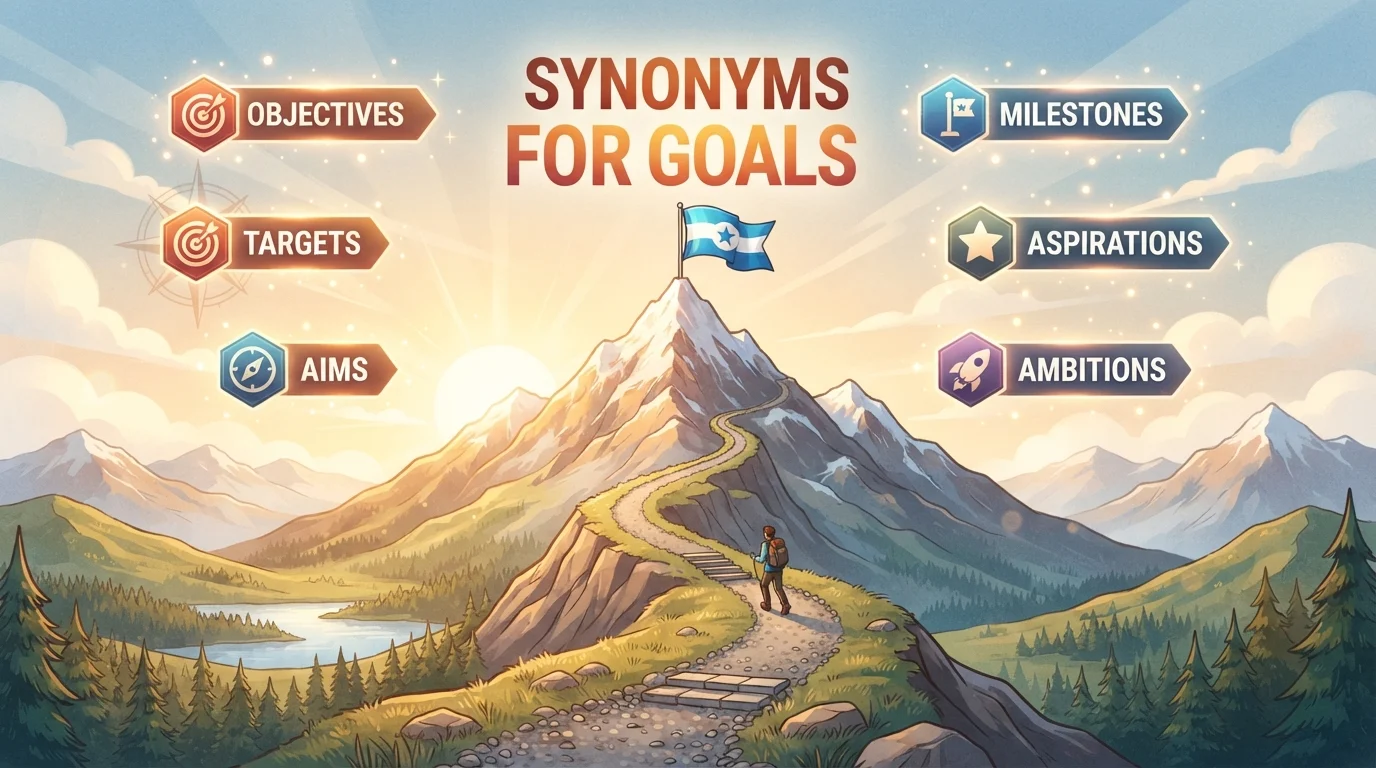
“Goals” refers to the objectives, targets, or outcomes that a person or organization aims to achieve. They can be specific and measurable, broad and aspirational, short-term or long-term, personal or professional. Depending on context, alternatives include objectives, targets, aims, ambitions, aspirations, intentions, purposes, milestones, benchmarks, and destinations.
Meaning, Tone, and Context
Simple Definition
“Goals” generally refers to:
- Objectives: specific results to be achieved
- Targets: measurable outcomes with deadlines
- Aims: general intentions or purposes
- Ambitions: long-term aspirations or desires
- Aspirations: hopes or ambitions for the future
- Intentions: planned actions or outcomes
- Milestones: significant points in progress
- Benchmarks: standards for measurement
Part of Speech
“Goals” is primarily a noun (plural of “goal”).
Noun Examples:
- “She set clear goals for the year.”
- “The company achieved its quarterly goals.”
- “His goal is to run a marathon.”
Related Forms:
- Goal (noun): a single objective or target
- Goalless (adjective): without goals (also used in sports)
- Goalkeeper (noun): a sports position
- Goal-oriented (adjective): focused on achieving goals
Positive, Negative, or Neutral Tone
“Goals” is generally positive or neutral.
Positive associations:
- “Setting goals helps you achieve success.”
- “She accomplished all her goals this year.”
Neutral contexts:
- “The team discussed its goals for the quarter.”
- “What are your goals for this project?”
Formality Level
“Goals” works in both formal and informal English. However, more formal alternatives like objectives, targets, and benchmarks are often preferred in academic and professional writing.
Common Use Cases
“Goals” commonly refers to:
- Personal development: life goals, fitness goals, career goals
- Business: strategic goals, quarterly goals, sales targets
- Academic: learning goals, educational objectives
- Sports: scoring goals, season goals
- Project management: project goals, milestones, deliverables
- Finance: financial goals, savings targets, revenue targets
Important Word Forms
- Goal (noun): a single objective
- Goals (noun): multiple objectives
- Goal-setting (noun): the process of establishing goals
- Goal-oriented (adjective): focused on achieving goals
- Goalless (adjective): without goals; also, a sports match with no goals
When and How to Use “Goals”
Use “goals” when you want to describe objectives, targets, or outcomes that someone aims to achieve. Because the word is broad, more specific alternatives can add precision.
Professional
“Our goals for this quarter include increasing revenue and improving customer satisfaction.”
This works naturally in business communication.
Academic
“The learning goals for this course are clearly outlined in the syllabus.”
The term is appropriate in academic contexts.
Personal
“My goal is to read fifty books this year.”
The word sounds natural in everyday conversation.
Business
“The company set ambitious goals for market expansion.”
Here, “goals” describes strategic objectives.
Sports
“He scored three goals in the match.”
The term has a specific meaning in sports.
Project Management
“We need to define clear goals before starting the project.”
This is standard project management language.
Another Word for “Goals”
There is no single perfect synonym because “goals” can refer to many different types of objectives and aspirations.
- Specific measurable outcomes: targets, objectives, benchmarks, metrics
- Long-term aspirations: ambitions, aspirations, dreams, visions
- General intentions: aims, intentions, purposes, intents
- Progress markers: milestones, checkpoints, deliverables
- Personal development: resolutions, aspirations, ambitions
- Business context: objectives, targets, key results, OKRs
- Sports context: scores, points, tallies
If you need one broad alternative, “objectives” works for professional contexts, “targets” for measurable outcomes, and “aspirations” for long-term dreams.
When Not to Use “Goals”
“Goals” can become too vague when you need to be specific about what kind of objective you are describing.
Consider:
“We have many goals.”
This statement does not tell readers whether the goals are specific targets, long-term aspirations, or general aims.
A more precise sentence could be:
“We have three measurable targets for this quarter.”
Similarly, avoid using “goals” when you mean “resolutions” in a personal context. Use “resolutions” for New Year’s commitments.
Words Commonly Confused With “Goals”
Goals vs. Objectives
Objectives are specific, measurable steps that support broader goals. Goals are broader outcomes.
Example:
“Her goal is to become fluent in Spanish.” (broad outcome)
“Her objective is to complete Level B2 by December.” (specific, measurable)
Goals vs. Targets
Targets are specific, quantifiable goals with deadlines. Goals can be broader.
Example:
“Our goal is to improve customer satisfaction.” (broad)
“Our target is to increase satisfaction scores by 15% this quarter.” (specific)
Goals vs. Aims
Aims are general intentions or purposes. Goals are often more specific.
Example:
“The aim of the project is to improve literacy.” (general purpose)
“The goal is to increase reading scores by 20%.” (specific outcome)
Goals vs. Ambitions
Ambitions are long-term aspirations or desires, often involving achievement or success. Goals can be short-term.
Example:
“Her ambition is to become CEO.” (long-term)
“Her goal is to complete the management training program.” (short-term)
Goals vs. Aspirations
Aspirations are hopes or ambitions for the future, often idealistic. Goals are more concrete.
Example:
“His aspiration is to make a difference in the world.” (idealistic)
“His goal is to volunteer 100 hours this year.” (concrete)
Goals vs. Resolutions
Resolutions are firm decisions to do or not do something, often associated with New Year’s.
Example:
“My New Year’s resolution is to exercise more.” (commitment)
“My goal is to run a 5K by June.” (specific outcome)
Best Synonym by Context for “Goals”
| Context | Best Synonym | Why It Works | Example |
|---|---|---|---|
| Professional writing | Objectives, targets | Precise and professional | Our objectives for Q3 are clearly defined. |
| Academic writing | Learning objectives, outcomes | Standard academic usage | The learning objectives are listed in the syllabus. |
| Business context | Targets, key results, OKRs | Business terminology | We set ambitious targets for revenue growth. |
| Personal development | Aspirations, ambitions | Emphasizes personal growth | Her aspirations include traveling the world. |
| Sports context | Scores, points | Sport-specific terminology | He scored two goals in the second half. |
| Project management | Milestones, deliverables | Project management terminology | The project milestones are due monthly. |
| Strategic planning | Aims, objectives, vision | Strategic terminology | The company’s strategic aims include global expansion. |
| Casual conversation | Goals (itself), dreams | Natural and informal | What are your goals for the summer? |
| Financial context | Targets, benchmarks | Financial terminology | We met our savings targets for the year. |
| Motivational content | Dreams, aspirations, ambitions | Inspirational | Dream big and set ambitious goals. |
| Long-term planning | Vision, mission, aspirations | Visionary terminology | The vision is to become a market leader. |
Which Synonym Should You Choose?
Start by identifying what kind of “goals” you are describing.
- Specific, measurable: targets, objectives, benchmarks, metrics, OKRs
- Long-term aspirations: ambitions, aspirations, dreams, visions
- General intentions: aims, intentions, purposes
- Progress markers: milestones, checkpoints, deliverables
- Personal development: resolutions, aspirations, ambitions
- Business context: objectives, targets, key results
- Sports context: scores, points, tallies
10 Key Synonyms for “Goals”
The table below includes accurate alternatives with clear meanings and usage contexts.
| Synonym | Simple Meaning | Best Used For | Example Sentence |
|---|---|---|---|
| Objectives | Specific, measurable outcomes | Business, academic, professional | Our objectives for this quarter are clear. |
| Targets | Quantifiable goals with deadlines | Business, finance, sales | We exceeded our sales targets this month. |
| Aims | General intentions or purposes | Academic, formal writing | The aim of the study was to identify trends. |
| Ambitions | Long-term aspirations | Personal development | Her ambition is to lead a Fortune 500 company. |
| Aspirations | Hopes for the future | Motivational, personal | His aspirations include writing a novel. |
| Intentions | Planned actions or outcomes | General, formal | Her intentions were good, but the results were poor. |
| Milestones | Significant progress markers | Project management | We celebrated reaching key milestones. |
| Benchmarks | Standards for measurement | Business, performance | The team set new benchmarks for success. |
| Purposes | Reasons or intentions | Formal, academic | The purpose of the initiative is to reduce waste. |
| Destinations | End points or outcomes | Metaphorical, motivational | Success is a journey, not a destination. |
Synonym Groups and Usage Differences
Professional vs. Personal Synonyms
Professional writing benefits from specific terms such as objectives, targets, key results, and OKRs.
Personal communication often uses goals itself or casual alternatives like dreams, ambitions, or aspirations.
Compare:
“My goal is to get fit.” (personal)
“Our objective is to improve operational efficiency by 20%.” (professional)
Formal vs. Conversational Synonyms
Goals works in both formal and conversational English.
Formal alternatives: objectives, targets, benchmarks, purposes
Conversational alternatives: goals, dreams, aims
Examples:
“The department’s objectives are aligned with corporate strategy.” (formal)
“What are your goals for this year?” (conversational)
Academic Synonyms
Academic writing should distinguish between learning goals, learning objectives, learning outcomes, and competencies.
For example:
“The course learning objectives are mapped to program outcomes.”
Professional and Business Synonyms
Business writing often benefits from phrases such as strategic objectives, key performance indicators (KPIs), OKRs (Objectives and Key Results), and targets.
Instead of:
“Our goals are to grow revenue.”
Consider:
“Our strategic objectives include increasing revenue by 25%.”
Creative or Literary Synonyms
Creative writing can use dreams, aspirations, visions, quests, and destinations.
For example:
“Her dream was to see the world.”
“He embarked on a quest for knowledge.”
Slang or Modern Synonyms
Goals is used in modern slang to express admiration or aspiration (e.g., “relationship goals”).
Dreams is a common informal term for aspirations.
Bucket list refers to a list of things to do before you die.
Life goals is a common modern phrase.
Examples:
“They’re relationship goals.” (slang, admiring)
“My dream is to travel the world.” (informal)
Strongest vs. Weaker Synonyms
“Goals” synonyms vary in intensity and specificity:
Broad: aims, intentions, purposes
Moderate: goals, objectives, targets
Strong: ambitions, aspirations, dreams
Very Specific: OKRs, KPIs, benchmarks
Emotional vs. Neutral Synonyms
“Goals” is generally neutral or positive.
Emotional alternatives: dreams, aspirations, ambitions, visions
Neutral alternatives: objectives, targets, aims
Examples:
“Her dream is to make a difference.” (emotional, positive)
“The project objectives are clearly defined.” (neutral)
Antonyms of “Goals”
“Goals” does not have exact antonyms, but depending on context, the following words represent opposites:
| Antonym | Context | Meaning | Example Sentence |
|---|---|---|---|
| Aimlessness | General | Lack of direction or purpose | He drifted through life in aimlessness. |
| Purposelessness | Purpose | Having no purpose | The project suffered from purposelessness. |
| Drifting | Direction | Moving without a goal | She felt like she was drifting. |
| Idleness | Action | Inactivity or laziness | Idleness prevents progress. |
| Apathy | Motivation | Lack of interest or motivation | Apathy can derail your goals. |
Comparison: “Goals” vs. Similar Words
Goals vs. Objectives
Main difference: Goals are broad outcomes. Objectives are specific, measurable steps.
Examples:
“My goal is to be healthy.” (broad)
“My objective is to exercise three times a week.” (specific)
Goals vs. Targets
Main difference: Targets are specific, quantifiable goals with deadlines.
Examples:
“Our goal is to increase brand awareness.” (broad)
“Our target is to increase social media followers by 20%.” (specific)
Goals vs. Aims
Main difference: Aims are general intentions or purposes. Goals are more specific.
Examples:
“The aim of the project is to improve literacy.” (general purpose)
“The goal is to increase reading scores by 20%.” (specific outcome)
Goals vs. Ambitions
Main difference: Ambitions are long-term aspirations. Goals can be short-term.
Examples:
“Her ambition is to become CEO.” (long-term)
“Her goal is to complete this project by Friday.” (short-term)
Goals vs. Aspirations
Main difference: Aspirations are hopes for the future, often idealistic. Goals are more concrete.
Examples:
“His aspiration is to make a difference.” (idealistic)
“His goal is to volunteer 100 hours this year.” (concrete)
Goals vs. Resolutions
Main difference: Resolutions are firm decisions to do or not do something.
Examples:
“My New Year’s resolution is to exercise more.” (commitment)
“My goal is to run a 5K by June.” (specific outcome)
Common Phrases and Expressions with “Goals”
1. Set goals
Meaning:
To establish objectives to achieve.
Example:
“She set clear goals for her career.”
2. Achieve goals
Meaning:
To accomplish objectives.
Example:
“He achieved all his goals this year.”
3. Reach goals
Meaning:
To attain objectives.
Example:
“The team reached its goals ahead of schedule.”
4. Goal-oriented
Meaning:
Focused on achieving objectives.
Example:
“She is a highly goal-oriented individual.”
5. Short-term goals
Meaning:
Objectives to be achieved in the near future.
Example:
“Short-term goals help you build momentum.”
6. Long-term goals
Meaning:
Objectives to be achieved over a longer period.
Example:
“Long-term goals provide direction.”
7. Stretch goals
Meaning:
Ambitious objectives that push you beyond your comfort zone.
Example:
“Setting stretch goals can drive innovation.”
8. SMART goals
Meaning:
Specific, Measurable, Achievable, Relevant, Time-bound objectives.
Example:
“Use SMART goals to make your objectives actionable.”
9. Personal goals
Meaning:
Objectives related to personal development.
Example:
“Her personal goals include learning a new language.”
10. Career goals
Meaning:
Objectives related to professional advancement.
Example:
“His career goals include becoming a manager.”
11. Financial goals
Meaning:
Objectives related to money and savings.
Example:
“Their financial goals include buying a house.”
12. Life goals
Meaning:
Broad objectives for one’s life.
Example:
“Her life goals include traveling and helping others.”
Common Mistakes to Avoid
1. Using “goals” when “objectives” or “targets” is more precise
If you mean specific, measurable outcomes, use objectives or targets.
Vague: “Our goals are to improve.”
Precise: “Our objectives are to increase efficiency by 15%.”
2. Confusing “goals” with “resolutions”
Resolutions are commitments, often for the New Year. Goals are outcomes.
Different: “My New Year’s resolution is to save money.”
Different: “My goal is to save $5,000 by December.”
3. Using “goals” when “aims” or “purposes” is more appropriate
Aims and purposes are general intentions. Goals are specific outcomes.
General: “The aim of the project is to help the community.”
Specific: “The goal is to serve 1,000 meals.”
4. Overusing “goals” in writing
Repetition can make content feel dull. Use alternatives such as objectives, targets, aims, ambitions, aspirations, and milestones.
5. Using “goals” in sports when “scores” or “points” is more appropriate
In sports, “goals” refers to scoring. In other contexts, use different terms.
Sports: “He scored three goals.”
Business: “We achieved our targets.”
FAQs
What is the best synonym for “goals”?
The best synonym depends on context. Objectives works for professional settings, targets for measurable outcomes, aims for general intentions, ambitions for long-term aspirations, and milestones for progress markers.
What is a formal synonym for “goals”?
Objectives, targets, benchmarks, aims, and purposes are formal synonyms.
What is an informal synonym for “goals”?
Dreams, ambitions, and aspirations are common informal alternatives. “Goals” itself is also used informally.
What is another word for “goals” in business?
Objectives, targets, key results, OKRs, and KPIs are common in business contexts.
What is the difference between “goals” and “objectives”?
Goals are broad outcomes. Objectives are specific, measurable steps that support goals.
What is the opposite of “goals”?
Depending on context, opposites include aimlessness, purposelessness, drifting, idleness, and apathy.
What does “goals” mean in modern slang?
In modern slang, “goals” is used to express admiration or aspiration, as in “relationship goals” or “friendship goals.”
Conclusion
“Goals” is a versatile word that can describe objectives, targets, aspirations, and ambitions. The best synonym depends on what you actually mean.
Choose objectives for professional contexts, targets for measurable outcomes, aims for general intentions, ambitions for long-term aspirations, milestones for progress markers, and aspirations for hopes and dreams.
Most importantly, do not replace “goals” simply to avoid repetition. First identify what kind of objective—specific, aspirational, strategic, or personal—you are actually describing. Then choose the alternative that communicates that idea most clearly.
For academic, professional, and formal writing, precision is usually more valuable than vocabulary variety. A specific term such as objectives, targets, or OKRs can tell readers much more than the broad word goals.
Before publishing a vocabulary guide, verify definitions and usage with trusted dictionaries such as Cambridge, Oxford, Merriam-Webster, Collins, or Britannica. This helps ensure that each alternative accurately matches its intended meaning and context.
The practical takeaway is simple: when “goals” feels too general, ask yourself what kind of objective, target, or aspiration you are actually describing. Then use the most precise word available.
