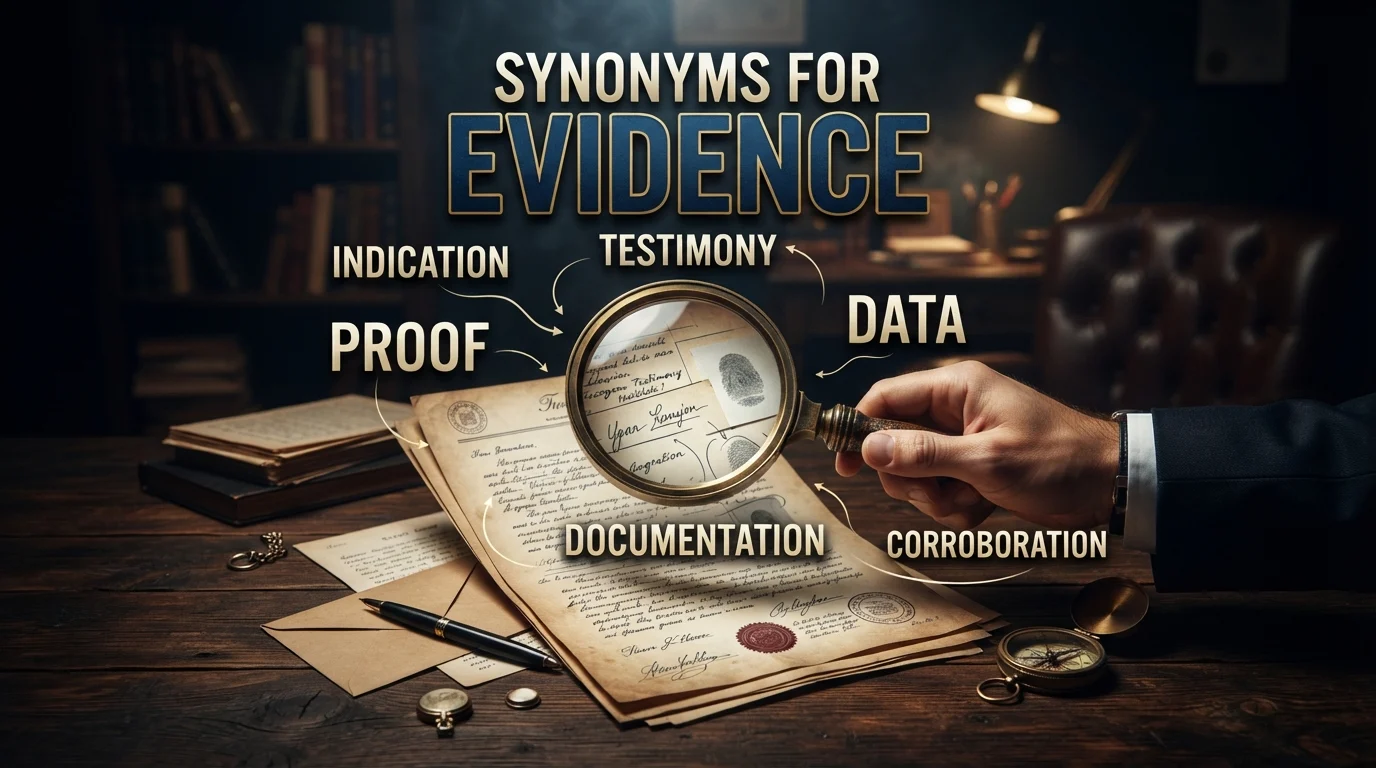
Do you keep using the word “evidence” in essays, research papers, legal documents, business reports, or everyday conversation? While it is one of the most important and authoritative words in English, repeating it can make your writing feel flat, repetitive, or overly formal.
The good news is that the best alternative depends on what you actually mean. You might be describing proof, data, testimony, documentation, signs, or clues that support a claim.
This guide explains synonyms for “evidence” by meaning, tone, context, and usage. You will learn which alternatives work best in academic writing, legal contexts, professional communication, journalism, and casual conversation.
Quick Answer: What Does “Evidence” Mean?
“Evidence” refers to information, facts, or objects that support a belief, claim, or conclusion. It can be direct or circumstantial, physical or testimonial, scientific or anecdotal. Depending on context, alternatives include proof, data, testimony, documentation, indication, sign, confirmation, corroboration, grounds, and substantiation.
Meaning, Tone, and Context
Simple Definition
“Evidence” generally refers to:
- Proof: something that establishes the truth of a claim
- Data: facts, statistics, or information used for analysis
- Testimony: statements given by witnesses
- Documentation: written or recorded material that supports a claim
- Indication: a sign or signal that suggests something
- Corroboration: additional evidence that supports existing evidence
- Grounds: a basis or justification for a belief or action
Part of Speech
“Evidence” functions primarily as a noun and occasionally as a verb.
Noun Examples:
- “There is strong evidence to support the theory.”
- “The evidence was presented in court.”
Verb Examples:
- “The results evidence a clear pattern.” (less common, formal)
- “His actions evidence a lack of concern.” (formal)
Related Forms:
- Evident (adjective): clear or obvious
- Evidently (adverb): clearly or obviously
- Evidentiary (adjective): relating to evidence
- Evidence-based (adjective): based on evidence
Positive, Negative, or Neutral Tone
“Evidence” is generally neutral. It is a factual term used to describe support for a claim, regardless of whether that claim is positive or negative.
Positive associations:
- “The evidence supports the effectiveness of the treatment.”
- “There is strong evidence of progress.”
Negative contexts:
- “The evidence points to his involvement in the crime.”
- “There is no evidence to support the allegation.”
Formality Level
“Evidence” is a standard word that works in both formal and informal English. It is especially common in academic, legal, scientific, and professional contexts.
However, more specific alternatives can add precision and variety depending on the context.
Common Use Cases
“Evidence” commonly refers to:
- Academic writing: evidence for a theory, evidence-based practice
- Legal contexts: evidence in court, admissible evidence, circumstantial evidence
- Scientific research: empirical evidence, experimental evidence, data
- Business communication: evidence of growth, evidence of impact
- Journalism: evidence of wrongdoing, evidence of corruption
- Everyday conversation: evidence of change, evidence of improvement
Important Word Forms
- Evidence (noun): information that supports a claim
- Evidence (verb): to demonstrate or support (formal)
- Evident (adjective): clear or obvious
- Evidently (adverb): clearly or obviously
- Evidentiary (adjective): relating to evidence
- Evidence-based (adjective): based on evidence
When and How to Use “Evidence”
Use “evidence” when you want to describe information, facts, or objects that support a belief, claim, or conclusion. Because the word is broad, more specific alternatives can add precision depending on the context.
Professional
“The report provides evidence of a strong return on investment.”
This works naturally in business communication.
Academic
“The study found evidence to support the hypothesis.”
The term is appropriate in academic research.
Legal
“The prosecution presented compelling evidence against the defendant.”
This is standard in legal contexts.
Scientific
“Experimental evidence supports the theory of relativity.”
This is appropriate in scientific writing.
Personal
“There is no evidence that he was involved.”
The word sounds natural in everyday conversation.
Journalistic
“Investigators found evidence of fraud.”
This is standard in news reporting.
Another Word for “Evidence”
There is no single perfect synonym because “evidence” can refer to proof, data, testimony, documentation, signs, or grounds.
- Proof context: proof, confirmation, verification, substantiation, validation
- Data context: data, facts, statistics, information, findings
- Testimony context: testimony, statement, deposition, affidavit, declaration
- Documentation context: documentation, records, files, papers, archives
- Indication context: indication, sign, signal, clue, hint, symptom
- Corroboration context: corroboration, support, backing, reinforcement
- Grounds context: grounds, basis, foundation, justification, reason
If you need one broad alternative, “proof” works for conclusive evidence, while “data” works for scientific evidence. “Testimony” works for witness statements.
When Not to Use “Evidence”
“Evidence” can become too vague when you need to specify exactly what kind of evidence you are describing.
Consider:
“There is evidence.”
This statement does not tell readers whether the evidence is strong or weak, direct or circumstantial, physical or testimonial.
A more precise sentence could be:
“There is compelling forensic evidence linking the suspect to the crime scene.”
Similarly, avoid using “evidence” when you mean “proof” in a context that requires conclusive certainty. Use “proof” or “conclusive evidence” instead.
Words Commonly Confused With “Evidence”
Evidence vs. Proof
Proof is conclusive evidence that establishes a fact beyond doubt. Evidence can be circumstantial or partial.
Example:
“The evidence suggests he was involved.” (suggests)
“The proof confirmed his guilt.” (conclusive)
Evidence vs. Data
Data refers to facts and statistics collected for analysis. Evidence can be broader.
Example:
“The data shows a clear trend.” (statistics)
“The evidence supports the conclusion.” (broader)
Evidence vs. Testimony
Testimony is a formal statement given by a witness. Evidence can be broader.
Example:
“Her testimony was crucial to the case.” (witness statement)
“The evidence was overwhelming.” (broader)
Evidence vs. Indication
Indication is a sign or signal that suggests something. Evidence is stronger.
Example:
“There are indications of improvement.” (signs)
“There is evidence of improvement.” (stronger)
Evidence vs. Clue
Clue is a piece of evidence that helps solve a problem or mystery. Evidence is broader.
Example:
“The detective found a clue at the scene.” (piece)
“The evidence pointed to the suspect.” (broader)
Evidence vs. Grounds
Grounds refers to a basis or justification for a belief or action. Evidence is broader.
Example:
“There are grounds for suspicion.” (basis)
“There is evidence of wrongdoing.” (broader)
Best Synonym by Context for “Evidence”
| Context | Best Synonym | Why It Works | Example |
|---|---|---|---|
| Formal writing | Proof, substantiation | Precise and professional | The report offers substantiation for the claims. |
| Academic writing | Data, findings | Standard academic usage | The findings support the hypothesis. |
| Legal writing | Testimony, proof, grounds | Legally precise | The testimony was admissible in court. |
| Scientific writing | Empirical evidence, data | Scientifically accurate | Empirical evidence supports the theory. |
| Business communication | Data, indicators, proof | Professional and clear | The data indicates strong growth. |
| Journalism | Proof, documentation, records | News reporting | The documentation revealed widespread fraud. |
| Casual conversation | Proof, sign, clue | Natural and informal | There’s no proof he did it. |
| Indication context | Sign, indication, symptom | Suggests something | There are signs of improvement. |
| Corroboration context | Corroboration, support, backing | Reinforces existing evidence | The witness provided corroboration. |
| Creative writing | Clue, trace, vestige | Adds literary depth | The detective found a trace of evidence. |
| Historical writing | Records, documentation, artifacts | Historical context | The records provide evidence of daily life. |
| Legal/formal | Evidentiary material | Legal terminology | The evidentiary material was submitted. |
Which Synonym Should You Choose?
Start by identifying what kind of “evidence” you are describing.
- Proof: proof, confirmation, verification, substantiation, validation
- Data: data, facts, statistics, information, findings
- Testimony: testimony, statement, deposition, affidavit, declaration
- Documentation: documentation, records, files, papers, archives
- Indication: indication, sign, signal, clue, hint, symptom
- Corroboration: corroboration, support, backing, reinforcement
- Grounds: grounds, basis, foundation, justification, reason
10 Key Synonyms for “Evidence”
The table below includes accurate alternatives with clear meanings and usage contexts.
| Synonym | Simple Meaning | Best Used For | Example Sentence |
|---|---|---|---|
| Proof | Conclusive evidence | General, legal | The proof of his innocence was clear. |
| Data | Facts and statistics | Scientific, academic | The data supports the conclusion. |
| Testimony | Witness statement | Legal, formal | Her testimony was crucial to the case. |
| Documentation | Written records | Business, legal | The documentation was submitted to the court. |
| Indication | A sign or signal | General, medical | There are indications of recovery. |
| Sign | A visible indication | General | The signs point to improvement. |
| Confirmation | Verification of a fact | General, formal | The results provide confirmation of the theory. |
| Corroboration | Supporting evidence | Legal, formal | The witness provided corroboration. |
| Grounds | Basis for belief | Legal, formal | There are grounds for suspicion. |
| Substantiation | Proof or validation | Formal, academic | The report offers substantiation for the claims. |
Synonym Groups and Usage Differences
Professional vs. Personal Synonyms
Professional writing benefits from specific terms such as data, documentation, substantiation, corroboration, and grounds.
Personal communication often uses evidence itself or casual alternatives like proof, sign, or clue.
Compare:
“There’s no proof he did it.” (personal)
“The documentation provides substantiation for the claim.” (professional)
Formal vs. Conversational Synonyms
Evidence works in both formal and conversational English.
Formal alternatives: substantiation, corroboration, documentation, grounds, evidentiary material
Conversational alternatives: proof, sign, clue, indication
Examples:
“The substantiation for the claim is compelling.” (formal)
“There’s no proof he was there.” (conversational)
Academic Synonyms
Academic writing should distinguish between evidence (general), data (quantitative), findings (research results), and proof (conclusive).
For example:
“The findings support the hypothesis.”
“The data provides evidence of a correlation.”
Professional and Business Synonyms
Business writing often benefits from phrases such as data, indicators, proof, documentation, and substantiation.
Instead of:
“There is evidence of growth.”
Consider:
“The data indicates a 15% increase in revenue.”
Creative or Literary Synonyms
Creative writing can use clue, trace, vestige, sign, mark, and token depending on the context.
For example:
“The detective found a trace of evidence at the scene.”
“There was no vestige of the life she once knew.”
Slang or Modern Synonyms
Proof is a common casual term.
Sign is casual for indication.
Clue is casual for evidence in a mystery.
Receipts is modern slang for evidence or proof.
Examples:
“Do you have proof?” (casual)
“She posted the receipts online.” (modern slang)
Strongest vs. Weaker Synonyms
“Evidence” synonyms vary in strength:
Weaker: indication, sign, hint, clue
Moderate: evidence, data, documentation
Strong: proof, corroboration, substantiation
Very Strong: conclusive evidence, irrefutable proof, incontrovertible evidence
Emotional vs. Neutral Synonyms
“Evidence” is generally neutral.
Emotional alternatives: proof, revelation (dramatic)
Neutral alternatives: data, documentation, indication
Examples:
“The revelation shocked the courtroom.” (emotional)
“The data supports the conclusion.” (neutral)
Antonyms of “Evidence”
“Evidence” has several antonyms depending on context:
| Antonym | Context | Meaning | Example Sentence |
|---|---|---|---|
| Disproof | General | Evidence that something is false | The disproof undermined the theory. |
| Refutation | General | Proof that a claim is wrong | The refutation was convincing. |
| Contradiction | General | A statement that contradicts | The contradiction weakened the case. |
| Denial | General | Refusal to admit truth | His denial was unconvincing. |
| Speculation | General | Guesswork without evidence | The theory is pure speculation. |
| Assumption | General | Something taken for granted | The argument rests on an assumption. |
| Conjecture | General | Opinion without evidence | The claim is mere conjecture. |
Comparison: “Evidence” vs. Similar Words
Evidence vs. Proof
Main difference: Proof is conclusive evidence that establishes a fact beyond doubt. Evidence can be circumstantial or partial.
Examples:
“The evidence suggests he was involved.” (suggests)
“The proof confirmed his guilt.” (conclusive)
Evidence vs. Data
Main difference: Data refers to facts and statistics collected for analysis. Evidence can be broader.
Examples:
“The data shows a clear trend.” (statistics)
“The evidence supports the conclusion.” (broader)
Evidence vs. Testimony
Main difference: Testimony is a formal statement given by a witness. Evidence can be broader.
Examples:
“Her testimony was crucial to the case.” (witness statement)
“The evidence was overwhelming.” (broader)
Evidence vs. Indication
Main difference: Indication is a sign or signal that suggests something. Evidence is stronger.
Examples:
“There are indications of improvement.” (signs)
“There is evidence of improvement.” (stronger)
Evidence vs. Clue
Main difference: Clue is a piece of evidence that helps solve a problem or mystery. Evidence is broader.
Examples:
“The detective found a clue at the scene.” (piece)
“The evidence pointed to the suspect.” (broader)
Evidence vs. Grounds
Main difference: Grounds refers to a basis or justification for a belief or action. Evidence is broader.
Examples:
“There are grounds for suspicion.” (basis)
“There is evidence of wrongdoing.” (broader)
Common Phrases and Expressions with “Evidence”
1. Evidence-based
Meaning:
Based on evidence.
Example:
“The practice is evidence-based.”
2. Circumstantial evidence
Meaning:
Evidence that indirectly suggests a fact.
Example:
“The case relied on circumstantial evidence.”
3. Direct evidence
Meaning:
Evidence that directly proves a fact.
Example:
“The witness provided direct evidence.”
4. Empirical evidence
Meaning:
Evidence based on observation or experiment.
Example:
“The theory is supported by empirical evidence.”
5. Hard evidence
Meaning:
Strong, tangible evidence.
Example:
“The police need hard evidence to make an arrest.”
6. Anecdotal evidence
Meaning:
Evidence based on personal accounts.
Example:
“Anecdotal evidence suggests the treatment works.”
7. Overwhelming evidence
Meaning:
Very strong evidence.
Example:
“There is overwhelming evidence of climate change.”
8. Evidence of
Meaning:
A sign or proof of something.
Example:
“There is evidence of improvement.”
9. Give evidence
Meaning:
To testify in court.
Example:
“She gave evidence at the trial.”
10. Destroy evidence
Meaning:
To get rid of proof.
Example:
“He was accused of destroying evidence.”
Common Mistakes to Avoid
1. Using “evidence” when a more precise term is available
If you mean proof, data, testimony, or documentation, use the more specific word.
Vague: “There is evidence.”
Precise: “There is compelling forensic evidence.”
2. Confusing “evidence” with “proof”
Proof is conclusive. Evidence can be partial or circumstantial.
Incorrect: “The evidence proved his guilt.” (if not conclusive)
Correct: “The evidence suggested his guilt.”
3. Using “evidence” in legal writing when “testimony” is needed
In legal contexts, use testimony for witness statements and evidence for physical or documentary material.
Incorrect: “The evidence gave a statement.”
Correct: “The witness gave testimony.”
4. Overusing “evidence” in writing
Repetition can make content feel dull. Use alternatives such as proof, data, testimony, documentation, indication, and corroboration.
5. Choosing a synonym that changes the meaning
Do not replace evidence with proof unless you mean conclusive evidence.
Do not replace evidence with data unless you mean facts and statistics.
FAQs
What is the best synonym for “evidence”?
The best synonym depends on context. Proof works for conclusive evidence, data for scientific evidence, testimony for legal witness statements, documentation for written records, and indication for signs.
What is a formal synonym for “evidence”?
Substantiation, corroboration, documentation, grounds, and evidentiary material are formal synonyms.
What is an informal synonym for “evidence”?
Proof, sign, clue, and receipts (modern slang) are common informal alternatives.
What is another word for “evidence” in academic writing?
Data, findings, empirical evidence, and documentation work well in academic writing.
What is the difference between “evidence” and “proof”?
Proof is conclusive evidence that establishes a fact beyond doubt. Evidence can be circumstantial or partial.
What is the opposite of “evidence”?
Depending on context, opposites include disproof, refutation, contradiction, speculation, and conjecture.
What does “evidence” mean in a legal context?
In law, evidence refers to information, testimony, or objects presented to prove or disprove a fact in a legal proceeding.
Conclusion
“Evidence” is a versatile and essential word that can describe proof, data, testimony, documentation, indications, corroboration, and grounds. The best synonym depends on what you actually mean.
Choose proof for conclusive evidence, data for scientific evidence, testimony for legal witness statements, documentation for written records, indication for signs, and corroboration for supporting evidence.
Most importantly, do not replace “evidence” simply to avoid repetition. First identify what kind of evidence—proof, data, testimony, or indication—you are actually describing. Then choose the alternative that communicates that idea most clearly.
For academic, legal, and professional writing, precision is usually more valuable than vocabulary variety. A specific term such as empirical evidence, testimony, documentation, or substantiation can tell readers much more than the broad word evidence.
Before publishing a vocabulary guide, verify definitions and usage with trusted dictionaries such as Cambridge, Oxford, Merriam-Webster, Collins, or Britannica. This helps ensure that each alternative accurately matches its intended meaning and context.
The practical takeaway is simple: when “evidence” feels too general, ask yourself what kind of proof, data, or indication you are actually describing. Then use the most precise word available
Discover More:-
- 50+ Synonyms for Present: Meanings, Examples, and Best Alternatives
- 50+ Synonyms for True: Meanings, Examples, and Best Alternatives
