Do you keep using the word “comfort” in essays, blog posts, creative writing, customer service messages, or everyday conversation? While it is one of the warmest and most reassuring words in English, repeating it can make your writing feel flat, repetitive, or overly generic.
The good news is that the best alternative depends on what you actually mean. You might be describing physical ease, emotional reassurance, consolation after a loss, a state of well-being, or something that brings relief.
This guide explains synonyms for “comfort” by meaning, tone, context, and usage. You will learn which alternatives work best in academic writing, professional communication, customer service, creative expression, and casual conversation.
Quick Answer: What Does “Comfort” Mean?
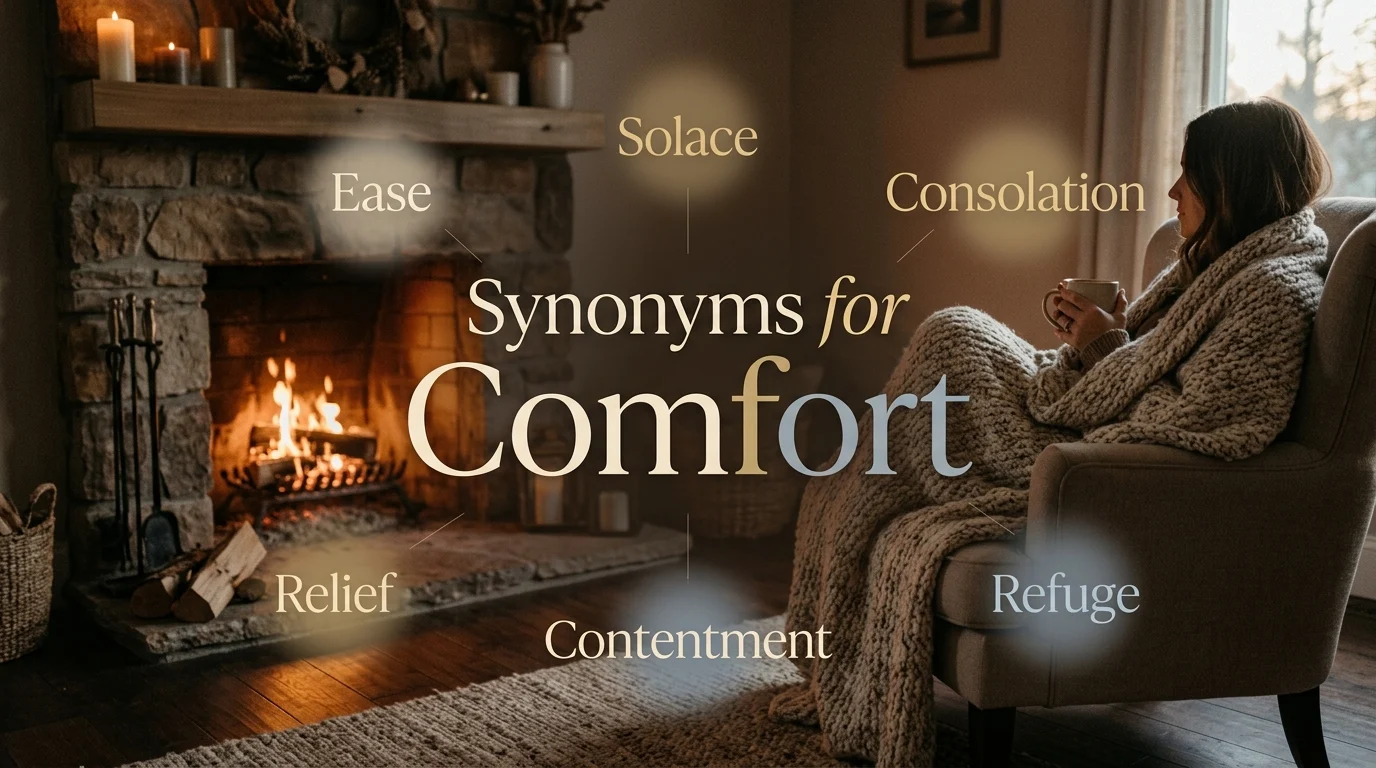
“Comfort” refers to a state of physical ease and freedom from pain, a feeling of emotional reassurance and consolation, or something that provides relief and contentment. Depending on context, alternatives include ease, solace, consolation, reassurance, relief, contentment, well-being, soothing, ** serenity**, and refuge.
Meaning, Tone, and Context
Simple Definition
“Comfort” generally refers to:
- Physical ease: freedom from pain, stress, or discomfort
- Emotional reassurance: solace and consolation in times of distress
- Relief: easing of pain, worry, or difficulty
- Contentment: a state of peaceful satisfaction
- Something that comforts: a person, object, or activity that brings relief
Part of Speech
“Comfort” functions primarily as a noun and a verb.
Noun Examples:
- “The soft chair provided great comfort.”
- “She found comfort in her friends.”
Verb Examples:
- “He comforted the crying child.”
- “The words comforted her.”
Related Forms:
- Comfortable (adjective): providing comfort
- Comfortably (adverb): in a comfortable manner
- Comforter (noun): a person or thing that comforts
- Comforting (adjective): providing comfort
- Discomfort (noun): lack of comfort
Positive, Negative, or Neutral Tone
“Comfort” is generally positive. It suggests relief, ease, and reassurance.
Positive associations:
- “The warm blanket brought her comfort.”
- “His words provided great comfort.”
Neutral contexts:
- “The hotel offers modern comforts.”
- “She lives in comfort.”
Formality Level
“Comfort” is a standard word that works in both formal and informal English. It is appropriate in academic papers, business communication, creative writing, customer service, and casual conversation.
However, more specific alternatives can add precision and variety depending on the context.
Common Use Cases
“Comfort” commonly refers to:
- Physical comfort: comfortable furniture, comfortable clothing, temperature
- Emotional comfort: comfort after a loss, comfort in times of stress
- Customer service: comfort and convenience, comfort of guests
- Healthcare: patient comfort, comfort care
- Hospitality: modern comforts, home comforts
- Creative writing: comfort in nature, comfort in memories
Important Word Forms
- Comfort (noun): a state of ease or relief
- Comfort (verb): to soothe or reassure
- Comfortable (adjective): providing comfort
- Comforting (adjective): providing comfort
- Comforter (noun): a person or thing that comforts
- Discomfort (noun): lack of comfort
When and How to Use “Comfort”
Use “comfort” when you want to describe physical ease, emotional reassurance, or something that brings relief. Because the word is broad, more specific alternatives can add precision depending on the context.
Professional (Customer Service)
“We prioritize the comfort and satisfaction of our guests.”
This works naturally in hospitality and customer service.
Academic
“The study examined the role of comfort in patient recovery.”
The term is appropriate in healthcare research.
Personal
“She found comfort in her family’s support.”
The word sounds natural in everyday conversation.
Creative
“The old cottage offered warmth and comfort on a cold night.”
The word creates a cozy, reassuring image.
Healthcare
“The nurse ensured the patient’s comfort throughout the night.”
This is standard in medical contexts.
Business
“The hotel offers all the modern comforts of home.”
This is appropriate in hospitality marketing.
Another Word for “Comfort”
There is no single perfect synonym because “comfort” can refer to physical ease, emotional reassurance, relief, or contentment.
- Physical ease context: ease, coziness, snugness, relaxation
- Emotional reassurance context: solace, consolation, reassurance, support
- Relief context: relief, respite, reprieve, alleviation
- Contentment context: contentment, satisfaction, well-being, peace
- Something that comforts: refuge, haven, sanctuary, balm
If you need one broad alternative, “ease” works for physical comfort, while “solace” works for emotional comfort. “Consolation” works for comfort after a loss.
When Not to Use “Comfort”
“Comfort” can become too vague when you need to specify exactly what kind of comfort you are describing.
Consider:
“She found comfort.”
This statement does not tell readers whether she found physical ease, emotional solace, relief from pain, or a sense of peace.
A more precise sentence could be:
“She found solace in her friends after the loss.”
Similarly, avoid using “comfort” when you mean “luxury” in a hospitality context. Use “luxury”, “amenities”, or “conveniences” instead.
Words Commonly Confused With “Comfort”
Comfort vs. Solace
Solace specifically means comfort in times of grief or distress. Comfort is broader.
Example:
“She found solace in music after her loss.” (grief)
“The soft bed provided comfort.” (physical)
Comfort vs. Consolation
Consolation means comfort given to someone who is disappointed or sad. Comfort is broader.
Example:
“Her kind words were a consolation.” (disappointment)
“The warm fire provided comfort.” (physical)
Comfort vs. Relief
Relief emphasizes the easing of pain or worry. Comfort can be more ongoing.
Example:
“The medicine brought relief.” (easing pain)
“The armchair provided comfort.” (ongoing ease)
Comfort vs. Contentment
Contentment emphasizes peaceful satisfaction. Comfort can be physical or emotional.
Example:
“He felt contentment with his simple life.” (satisfaction)
“The hotel provided comfort and convenience.” (ease)
Comfort vs. Luxury
Luxury emphasizes expensive, high-quality comfort. Comfort can be simple.
Example:
“The resort offers pure luxury.” (expensive)
“The cabin offers simple comfort.” (simple)
Comfort vs. Ease
Ease emphasizes freedom from difficulty. Comfort can include physical and emotional aspects.
Example:
“She solved the problem with ease.” (no difficulty)
“She relaxed in comfort.” (physical/emotional)
Best Synonym by Context for “Comfort”
| Context | Best Synonym | Why It Works | Example |
|---|---|---|---|
| Formal writing | Solace, consolation | Precise and professional | The community offered solace to the victims. |
| Academic writing | Well-being, relief | Standard academic usage | The study examined patient well-being. |
| Business/Professional | Convenience, amenities | Professional and clear | The hotel offers modern conveniences. |
| Customer service | Satisfaction, ease | Professional and polite | We prioritize guest satisfaction. |
| Creative writing | Solace, refuge, warmth | Adds literary depth | The cottage offered refuge from the storm. |
| Emotional support | Solace, consolation, reassurance | Emotional contexts | Her words brought him solace. |
| Physical ease | Ease, coziness, relaxation | Physical contexts | The chair provided perfect ease. |
| Healthcare | Relief, well-being, ease | Medical contexts | The nurse ensured the patient’s ease. |
| Hospitality | Amenities, luxury, convenience | Hospitality contexts | The resort offers every luxury. |
| Casual conversation | Comfort (itself), coziness | Natural and informal | I just want to relax in comfort. |
| Grief context | Solace, consolation | Grief and loss | She found solace in her faith. |
| Stress relief | Relief, respite, reprieve | Stressful contexts | The vacation offered a much-needed respite. |
Which Synonym Should You Choose?
Start by identifying what kind of comfort you are describing.
- Physical ease: ease, coziness, snugness, relaxation
- Emotional reassurance: solace, consolation, reassurance, support
- Relief: relief, respite, reprieve, alleviation
- Contentment: contentment, satisfaction, well-being, peace
- Something that comforts: refuge, haven, sanctuary, balm
10 Key Synonyms for “Comfort”
The table below includes accurate alternatives with clear meanings and usage contexts.
| Synonym | Simple Meaning | Best Used For | Example Sentence |
|---|---|---|---|
| Ease | Freedom from difficulty or pain | Physical, general | The chair provided perfect ease. |
| Solace | Comfort in grief or distress | Emotional, grief | She found solace in music. |
| Consolation | Comfort after disappointment | Emotional, loss | Her kind words were a consolation. |
| Reassurance | Comfort that removes doubt or fear | Emotional, anxiety | His reassurance calmed her nerves. |
| Relief | Easing of pain or worry | Physical, emotional | The medicine brought relief. |
| Contentment | Peaceful satisfaction | Emotional, reflective | He felt contentment with his life. |
| Well-being | State of health and happiness | Academic, professional | The program promotes employee well-being. |
| Soothing | Calming or comforting | Emotional, physical | The soothing music helped her relax. |
| Serenity | Calm and peaceful state | Emotional, spiritual | The garden offered serenity. |
| Refuge | A place of safety and comfort | Physical, emotional | The cabin was a refuge from the storm. |
Synonym Groups and Usage Differences
Professional vs. Personal Synonyms
Professional writing benefits from specific terms such as well-being, satisfaction, convenience, and amenities.
Personal communication often uses comfort itself or warm alternatives like solace, coziness, and peace.
Compare:
“I just want to relax in comfort.” (personal)
“We prioritize guest satisfaction and well-being.” (professional)
Formal vs. Conversational Synonyms
Comfort works in both formal and conversational English.
Formal alternatives: solace, consolation, well-being, respite
Conversational alternatives: comfort, coziness, peace
Examples:
“The community offered solace to the victims.” (formal)
“I just want some peace and quiet.” (conversational)
Academic Synonyms
Academic writing should distinguish between comfort (general), well-being (health and happiness), relief (easing of symptoms), and quality of life (overall satisfaction).
For example:
“The study examined the relationship between comfort and patient recovery.”
“Quality of life improved significantly after treatment.”
Professional and Business Synonyms
Business writing often benefits from phrases such as convenience, amenities, satisfaction, well-being, and ease.
Instead of:
“We provide comfort to our guests.”
Consider:
“We provide modern amenities and ensure guest satisfaction.”
Creative or Literary Synonyms
Creative writing can use solace, refuge, haven, sanctuary, warmth, balm, and respite depending on the context.
For example:
“The cottage was a haven of warmth and comfort.”
“She found solace in the quiet of the forest.”
Slang or Modern Synonyms
Cozy is a common casual term.
Chill is casual for relaxed comfort.
Comfy is slang for comfortable.
Peace is casual for emotional comfort.
Examples:
“This place is so cozy.” (casual)
“I’m just chilling at home.” (casual)
Strongest vs. Weaker Synonyms
“Comfort” synonyms vary in intensity:
Milder: ease, convenience, coziness
Moderate: comfort, contentment, reassurance
Strong: solace, consolation, relief
Very Strong: refuge, sanctuary, balm
Emotional vs. Neutral Synonyms
“Comfort” is generally emotional and positive.
Emotional alternatives: solace, consolation, reassurance, warmth
Neutral alternatives: ease, convenience, amenities
Examples:
“Her words brought him solace.” (emotional)
“The hotel offers modern conveniences.” (neutral)
Antonyms of “Comfort”
“Comfort” has several antonyms depending on context:
| Antonym | Context | Meaning | Example Sentence |
|---|---|---|---|
| Discomfort | Physical | Lack of comfort | The hard chair caused discomfort. |
| Distress | Emotional | Extreme worry or sadness | The news caused her great distress. |
| Agony | Physical/emotional | Extreme pain | He was in agony after the accident. |
| Misery | Emotional | Great suffering | The refugees lived in misery. |
| Discontent | Emotional | Lack of satisfaction | He felt discontent with his job. |
| Hardship | General | Difficult conditions | The family endured great hardship. |
| Suffering | Physical/emotional | Experience of pain | The patients endured great suffering. |
Comparison: “Comfort” vs. Similar Words
Comfort vs. Solace
Main difference: Solace specifically means comfort in times of grief or distress. Comfort is broader.
Examples:
“She found solace in music after her loss.” (grief)
“The soft bed provided comfort.” (physical)
Comfort vs. Consolation
Main difference: Consolation means comfort given to someone who is disappointed or sad. Comfort is broader.
Examples:
“Her kind words were a consolation.” (disappointment)
“The warm fire provided comfort.” (physical)
Comfort vs. Relief
Main difference: Relief emphasizes the easing of pain or worry. Comfort can be more ongoing.
Examples:
“The medicine brought relief.” (easing pain)
“The armchair provided comfort.” (ongoing ease)
Comfort vs. Contentment
Main difference: Contentment emphasizes peaceful satisfaction. Comfort can be physical or emotional.
Examples:
“He felt contentment with his simple life.” (satisfaction)
“The hotel provided comfort and convenience.” (ease)
Comfort vs. Luxury
Main difference: Luxury emphasizes expensive, high-quality comfort. Comfort can be simple.
Examples:
“The resort offers pure luxury.” (expensive)
“The cabin offers simple comfort.” (simple)
Comfort vs. Ease
Main difference: Ease emphasizes freedom from difficulty. Comfort can include physical and emotional aspects.
Examples:
“She solved the problem with ease.” (no difficulty)
“She relaxed in comfort.” (physical/emotional)
Common Phrases and Expressions with “Comfort”
1. Find comfort in
Meaning:
To gain emotional relief from something.
Example:
“She found comfort in her faith.”
2. Comfort zone
Meaning:
A situation where one feels safe and at ease.
Example:
“Step out of your comfort zone.”
3. Comfort food
Meaning:
Food that provides emotional comfort.
Example:
“Mac and cheese is my favorite comfort food.”
4. Comfort blanket
Meaning:
Something that provides a feeling of security.
Example:
“The old blanket was her comfort blanket.”
5. Too close for comfort
Meaning:
Uncomfortably near or similar.
Example:
“The accident was too close for comfort.”
6. Cold comfort
Meaning:
Small or inadequate consolation.
Example:
“The apology was cold comfort after the damage.”
7. Comfort in numbers
Meaning:
Feeling safer when part of a group.
Example:
“There is comfort in numbers.”
8. Creature comforts
Meaning:
Physical things that make life comfortable.
Example:
“The hotel offers all the creature comforts.”
9. Comfort eating
Meaning:
Eating to cope with emotions.
Example:
“He turned to comfort eating after the breakup.”
10. Words of comfort
Meaning:
Soothing words.
Example:
“She offered words of comfort to the grieving family.”
Common Mistakes to Avoid
1. Using “comfort” when a more precise term is available
If you mean solace, consolation, relief, or contentment, use the more specific word.
Vague: “She found comfort.”
Precise: “She found solace in her friends after the loss.”
2. Confusing “comfort” with “luxury”
Luxury emphasizes expensive quality. Comfort can be simple.
Incorrect: “The cabin was pure comfort.” (if luxurious)
Correct: “The cabin was pure luxury.”
3. Using “comfort” in academic writing when “well-being” is needed
Academic writing benefits from precise terms like well-being, quality of life, and relief.
Vague: “The study examined comfort.”
Precise: “The study examined patient well-being and quality of life.”
4. Overusing “comfort” in writing
Repetition can make content feel dull. Use alternatives such as solace, ease, relief, contentment, and well-being.
5. Choosing a synonym that changes the meaning
Do not replace comfort with luxury unless you mean expensive quality.
Do not replace comfort with relief unless you mean the easing of pain.
FAQs
What is the best synonym for “comfort”?
The best synonym depends on context. Ease works for physical comfort, solace for emotional comfort, consolation for grief, relief for easing pain, and contentment for peaceful satisfaction.
What is a formal synonym for “comfort”?
Solace, consolation, well-being, respite, and alleviation are formal synonyms.
What is an informal synonym for “comfort”?
Cozy, comfy, peace, and chill are common informal alternatives.
What is another word for “comfort” in creative writing?
Solace, refuge, haven, sanctuary, warmth, balm, and respite work well in creative writing.
What is the difference between “comfort” and “solace”?
Solace specifically means comfort in times of grief or distress. Comfort is broader.
What is the opposite of “comfort”?
Depending on context, opposites include discomfort, distress, agony, misery, discontent, and hardship.
What does “comfort” mean in a healthcare context?
In healthcare, comfort often refers to patient well-being, pain relief, and quality of life.
Conclusion
“Comfort” is a warm and versatile word that can describe physical ease, emotional reassurance, relief from pain, and a state of contentment. The best synonym depends on what you actually mean.
Choose ease for physical comfort, solace for emotional comfort, consolation for grief, relief for easing pain, contentment for peaceful satisfaction, and refuge for a place of safety.
Most importantly, do not replace “comfort” simply to avoid repetition. First identify what kind of comfort—physical, emotional, or relief—you are actually describing. Then choose the alternative that communicates that idea most clearly.
For academic, professional, and formal writing, precision is usually more valuable than vocabulary variety. A specific term such as solace, well-being, relief, or respite can tell readers much more than the broad word comfort.
Before publishing a vocabulary guide, verify definitions and usage with trusted dictionaries such as Cambridge, Oxford, Merriam-Webster, Collins, or Britannica. This helps ensure that each alternative accurately matches its intended meaning and context.
The practical takeaway is simple: when “comfort” feels too general, ask yourself what kind of comfort—physical, emotional, or relief—you are actually describing. Then use the most precise word available.
