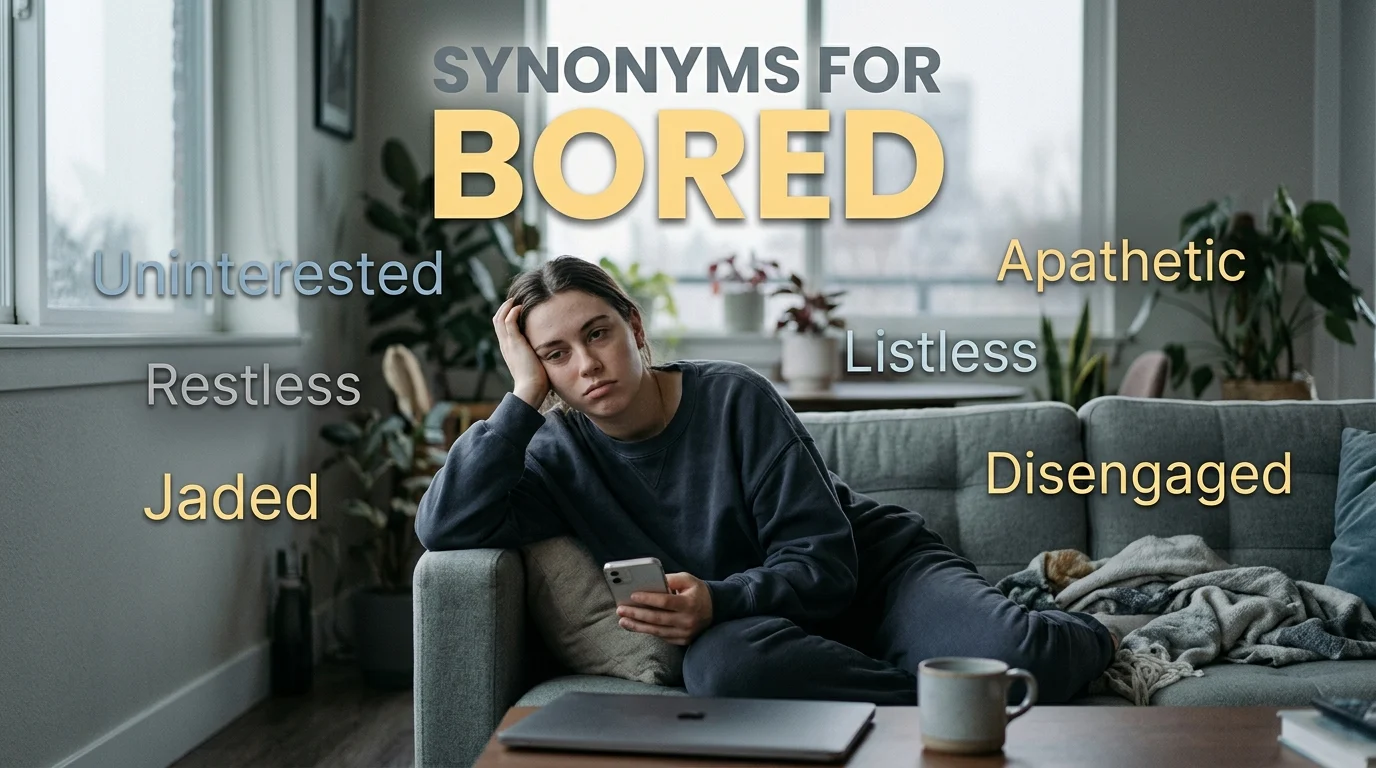
Do you keep using the word “bored” in essays, blog posts, creative writing, social media captions, or everyday conversation? While it is one of the most common and relatable words in English, repeating it can make your writing feel flat, repetitive, or overly simple.
The good news is that the best alternative depends on what you actually mean. You might be describing mild restlessness, complete lack of interest, frustration with inactivity, emotional emptiness, or a situation that simply fails to engage you.
This guide explains synonyms for “bored” by meaning, tone, context, and usage. You will learn which alternatives work best in academic writing, professional communication, creative expression, social media, and casual conversation.
Quick Answer: What Does “Bored” Mean?
“Bored” describes a feeling of restlessness, dissatisfaction, or lack of interest caused by a lack of stimulation, activity, or engagement. Depending on context, alternatives include uninterested, restless, weary, jaded, apathetic, indifferent, listless, ennui-filled, fed up, and disengaged.
Meaning, Tone, and Context
Simple Definition
“Bored” generally refers to:
- Lack of interest: finding something dull or unengaging
- Restlessness: feeling antsy due to inactivity
- Weary familiarity: tired of something repetitive
- Emotional emptiness: feeling flat or uninspired
- Disengagement: mentally checking out from a situation
Part of Speech
“Bored” functions primarily as an adjective and as the past participle of the verb “bore.”
Adjective Examples:
- “I was bored during the lecture.”
- “The children looked bored.”
Verb Examples:
- “The speech bored everyone.”
- “His constant complaints bored her.”
Related Forms:
- Bore (verb): to make someone feel bored
- Boring (adjective): causing boredom
- Boredom (noun): the state of being bored
- Boringly (adverb): in a boring manner
- Bored stiff/bored to tears (idioms): extremely bored
Positive, Negative, or Neutral Tone
“Bored” is generally negative or neutral. It expresses dissatisfaction with a lack of stimulation.
Negative associations:
- “I was so bored I almost fell asleep.”
- “He felt bored and unmotivated.”
Neutral contexts:
- “The students seemed bored during the long lecture.”
- “She was bored with the same routine.”
Formality Level
“Bored” is a standard word that works in both formal and informal English. It is appropriate in creative writing, casual conversation, and some professional contexts.
However, more specific or formal alternatives can add precision and variety depending on the context.
Common Use Cases
“Bored” commonly refers to:
- Everyday situations: bored at home, bored on a rainy day
- Work and school: bored in class, bored at work, bored with routine tasks
- Social contexts: bored at a party, bored with small talk
- Relationships: bored with a partner, bored with the same routine
- Creative writing: bored characters, bored expressions
- Social media: expressing boredom in captions or posts
Important Word Forms
- Bored (adjective): feeling boredom
- Bore (verb): to cause boredom
- Boring (adjective): causing boredom
- Boredom (noun): the state of being bored
- Boringly (adverb): in a boring manner
- Bored stiff (idiom): extremely bored
- Bored to tears (idiom): extremely bored
When and How to Use “Bored”
Use “bored” when you want to describe a feeling of restlessness or lack of interest. Because the word is broad, more specific alternatives can add precision depending on the context.
Professional
“The team seemed bored during the long presentation.”
This works in business communication, though more formal alternatives may be preferred.
Academic
“Students who are bored in class are less likely to engage with the material.”
The term is appropriate in educational research.
Personal
“I’m so bored—there’s nothing to do.”
The word sounds natural in everyday conversation.
Creative
“The character stared out the window, bored and restless.”
The word creates a relatable emotional state.
Social Media
“Bored at home. Send memes.”
This is common in casual social media posts.
Parenting
“The children were bored on the rainy day.”
This is standard in parenting contexts.
Another Word for “Bored”
There is no single perfect synonym because “bored” can refer to lack of interest, restlessness, weariness, or emotional emptiness.
- Lack of interest context: uninterested, indifferent, apathetic, disengaged
- Restlessness context: restless, antsy, fidgety, edgy
- Weariness context: weary, jaded, tired of, fed up
- Emotional emptiness context: listless, flat, uninspired, blasé
- Extreme boredom context: bored stiff, bored to tears, bored to death
If you need one broad alternative, “uninterested” works for lack of interest, while “restless” works for physical boredom. “Jaded” works for weariness from repetition.
When Not to Use “Bored”
“Bored” can become too vague or casual when you need to specify exactly what kind of boredom you are describing.
Consider:
“She was bored.”
This statement does not tell readers whether she was uninterested, restless, weary, or emotionally flat.
A more precise sentence could be:
“She was restless and fidgety, unable to sit still.”
Similarly, avoid using “bored” in formal writing when disengaged, apathetic, or uninspired would be more appropriate.
Words Commonly Confused With “Bored”
Bored vs. Boring
Bored describes how a person feels. Boring describes something that causes boredom.
Example:
“I was bored.” (feeling)
“The movie was boring.” (causing boredom)
Bored vs. Uninterested
Uninterested means having no interest. Bored implies a lack of stimulation.
Example:
“She was uninterested in the topic.” (no interest)
“She was bored during the lecture.” (lack of stimulation)
Bored vs. Apathetic
Apathetic means showing no emotion or concern. Bored is about lack of stimulation.
Example:
“He was apathetic about the election.” (no concern)
“He was bored at the party.” (no stimulation)
Bored vs. Restless
Restless means unable to stay still or calm. Bored can cause restlessness but is broader.
Example:
“The children were restless after sitting all day.” (unable to stay still)
“The children were bored on the rainy day.” (lack of stimulation)
Bored vs. Jaded
Jaded means tired or worn out from too much of something. Bored is about lack of stimulation.
Example:
“She was jaded after years in the industry.” (worn out)
“She was bored with the routine.” (lack of stimulation)
Bored vs. Fed Up
Fed up means annoyed or frustrated with a situation. Bored is about lack of interest.
Example:
“I’m fed up with his excuses.” (frustrated)
“I’m bored with this game.” (uninterested)
Best Synonym by Context for “Bored”
| Context | Best Synonym | Why It Works | Example |
|---|---|---|---|
| Formal writing | Disengaged, apathetic | Precise and professional | The students appeared disengaged during the lecture. |
| Academic writing | Unengaged, unmotivated | Standard academic usage | Unengaged students perform worse academically. |
| Business/Professional | Disengaged, uninspired | Professional and clear | The team seemed disengaged during the meeting. |
| Creative writing | Restless, listless, weary | Adds literary depth | He felt restless and listless on the long afternoon. |
| Casual conversation | Bored (itself), over it | Natural and informal | I’m so over this game. |
| Extreme boredom | Bored stiff, bored to tears | Emphatic and expressive | I was bored stiff during the speech. |
| Lack of interest | Uninterested, indifferent | Emphasizes no interest | She was indifferent to the conversation. |
| Restlessness | Antsy, fidgety, restless | Physical boredom | The kids were antsy after the long car ride. |
| Weariness | Jaded, weary, fed up | Repetition or overexposure | He was jaded after years of the same routine. |
| Emotional emptiness | Listless, flat, uninspired | Emotional boredom | She felt listless and uninspired. |
| Social media | Bored, dying of boredom | Casual and expressive | Dying of boredom over here. |
| Parenting | Restless, fussy | Children’s boredom | The kids were fussy on the rainy day. |
Which Synonym Should You Choose?
Start by identifying what kind of boredom you are describing.
- Lack of interest: uninterested, indifferent, apathetic, disengaged
- Restlessness: restless, antsy, fidgety, edgy
- Weariness: weary, jaded, tired of, fed up
- Emotional emptiness: listless, flat, uninspired, blasé
- Extreme boredom: bored stiff, bored to tears, bored to death
10 Key Synonyms for “Bored”
The table below includes accurate alternatives with clear meanings and usage contexts.
| Synonym | Simple Meaning | Best Used For | Example Sentence |
|---|---|---|---|
| Uninterested | Having no interest | General, formal | She was uninterested in the topic. |
| Restless | Unable to stay still | Physical boredom | The children were restless after sitting all day. |
| Jaded | Tired from too much of something | Weariness, repetition | He was jaded after years in the industry. |
| Apathetic | Showing no emotion or concern | Formal, emotional | The students were apathetic about the project. |
| Indifferent | Having no particular interest | General, formal | He was indifferent to the outcome. |
| Listless | Lacking energy or enthusiasm | Emotional, creative | She felt listless and uninspired. |
| Disengaged | Mentally checked out | Professional, academic | The audience seemed disengaged. |
| Weary | Tired or bored of something | Repetition, emotional | She was weary of the same routine. |
| Fed up | Annoyed or frustrated | Casual, emotional | I’m fed up with this game. |
| Antsy | Restless and impatient | Casual, physical | The kids were antsy on the long drive. |
Synonym Groups and Usage Differences
Professional vs. Personal Synonyms
Professional writing benefits from specific terms such as disengaged, apathetic, uninspired, and unmotivated.
Personal communication often uses bored itself or casual alternatives like over it, antsy, or fed up.
Compare:
“I’m so bored.” (personal)
“The team appeared disengaged during the meeting.” (professional)
Formal vs. Conversational Synonyms
Bored works in both formal and conversational English.
Formal alternatives: disengaged, apathetic, indifferent, listless
Conversational alternatives: antsy, fed up, over it, bored stiff
Examples:
“The students appeared disengaged.” (formal)
“I’m so over this.” (conversational)
Academic Synonyms
Academic writing should distinguish between boredom (emotional state), disengagement (behavioral), and amotivation (psychological).
For example:
“Research shows that boredom in the classroom leads to disengagement.”
“Amotivation is linked to poor academic outcomes.”
Professional and Business Synonyms
Business writing often benefits from phrases such as disengaged, uninspired, unmotivated, and lacking engagement.
Instead of:
“The team was bored.”
Consider:
“The team appeared disengaged and uninspired during the meeting.”
Creative or Literary Synonyms
Creative writing can use restless, listless, weary, jaded, ennui-filled, and world-weary depending on the context.
For example:
“He felt a deep ennui settle over him.”
“She was world-weary and tired of the same routine.”
Slang or Modern Synonyms
Over it is modern slang for bored or done with something.
Dying of boredom is a common exaggeration.
Bored out of my mind is casual and emphatic.
Meh is slang for indifferent or bored.
Examples:
“I’m so over it.” (modern)
“I’m dying of boredom.” (casual)
Strongest vs. Weaker Synonyms
“Bored” synonyms vary in intensity:
Milder: uninterested, indifferent, blasé
Moderate: bored, restless, weary
Strong: jaded, listless, disengaged
Very Strong: bored stiff, bored to tears, bored to death
Emotional vs. Neutral Synonyms
“Bored” is generally emotional but can be neutral.
Emotional alternatives: listless, jaded, fed up, weary
Neutral alternatives: uninterested, indifferent, disengaged
Examples:
“She felt utterly listless.” (emotional)
“He was uninterested in the topic.” (neutral)
Antonyms of “Bored”
“Bored” has several antonyms depending on context:
| Antonym | Context | Meaning | Example Sentence |
|---|---|---|---|
| Interested | General | Having curiosity or attention | She was interested in the topic. |
| Engaged | General | Involved and attentive | The students were engaged in the lesson. |
| Entertained | General | Amused or interested | The audience was entertained by the show. |
| Enthusiastic | Emotion | Showing excitement | He was enthusiastic about the project. |
| Fascinated | Emotion | Extremely interested | She was fascinated by the discovery. |
| Curious | Emotion | Eager to learn | The children were curious about everything. |
| Stimulated | Mental | Mentally engaged | The discussion stimulated his mind. |
Comparison: “Bored” vs. Similar Words
Bored vs. Boring
Main difference: Bored describes how a person feels. Boring describes something that causes boredom.
Examples:
“I was bored.” (feeling)
“The movie was boring.” (causing boredom)
Bored vs. Uninterested
Main difference: Uninterested means having no interest. Bored implies a lack of stimulation.
Examples:
“She was uninterested in the topic.” (no interest)
“She was bored during the lecture.” (lack of stimulation)
Bored vs. Apathetic
Main difference: Apathetic means showing no emotion or concern. Bored is about lack of stimulation.
Examples:
“He was apathetic about the election.” (no concern)
“He was bored at the party.” (no stimulation)
Bored vs. Restless
Main difference: Restless means unable to stay still or calm. Bored can cause restlessness but is broader.
Examples:
“The children were restless after sitting all day.” (unable to stay still)
“The children were bored on the rainy day.” (lack of stimulation)
Bored vs. Jaded
Main difference: Jaded means tired or worn out from too much of something. Bored is about lack of stimulation.
Examples:
“She was jaded after years in the industry.” (worn out)
“She was bored with the routine.” (lack of stimulation)
Bored vs. Fed Up
Main difference: Fed up means annoyed or frustrated with a situation. Bored is about lack of interest.
Examples:
“I’m fed up with his excuses.” (frustrated)
“I’m bored with this game.” (uninterested)
Common Phrases and Expressions with “Bored”
1. Bored stiff
Meaning:
Extremely bored.
Example:
“I was bored stiff during the speech.”
2. Bored to tears
Meaning:
Extremely bored.
Example:
“She was bored to tears by the lecture.”
3. Bored to death
Meaning:
Extremely bored.
Example:
“I’m bored to death—let’s do something.”
4. Bored out of my mind
Meaning:
Extremely bored.
Example:
“I was bored out of my mind at home.”
5. Bored with
Meaning:
Tired of something.
Example:
“I’m bored with the same routine.”
6. Bored by
Meaning:
Made to feel bored by something.
Example:
“He was bored by the long presentation.”
7. Dying of boredom
Meaning:
Extremely bored.
Example:
“I’m dying of boredom.”
8. Bored silly
Meaning:
Extremely bored.
Example:
“The kids were bored silly on the rainy day.”
9. Boredom strikes
Meaning:
Boredom sets in.
Example:
“Boredom strikes when there’s nothing to do.”
10. Fight boredom
Meaning:
Try to overcome boredom.
Example:
“She read a book to fight boredom.”
Common Mistakes to Avoid
1. Confusing “bored” with “boring”
Bored describes how a person feels. Boring describes something that causes boredom.
Incorrect: “I am boring.” (unless you mean you are a boring person)
Correct: “I am bored.”
Correct: “The movie is boring.”
2. Using “bored” when a more precise term is available
If you mean disengaged, apathetic, restless, or jaded, use the more specific word.
Vague: “She was bored.”
Precise: “She was disengaged and restless.”
3. Using “bored” in formal writing when “disengaged” is needed
Formal writing benefits from precise terms like disengaged, apathetic, and unmotivated.
Informal: “The students were bored.”
Formal: “The students appeared disengaged.”
4. Overusing “bored” in writing
Repetition can make content feel dull. Use alternatives such as restless, weary, jaded, listless, and disengaged.
5. Choosing a synonym that changes the meaning
Do not replace bored with fed up unless you mean frustrated.
Do not replace bored with jaded unless you mean worn out from repetition.
FAQs
What is the best synonym for “bored”?
The best synonym depends on context. Uninterested works for lack of interest, restless for physical boredom, jaded for weariness, apathetic for emotional detachment, and disengaged for professional contexts.
What is a formal synonym for “bored”?
Disengaged, apathetic, indifferent, listless, and unmotivated are formal synonyms.
What is an informal synonym for “bored”?
Antsy, fed up, over it, bored stiff, and dying of boredom are common informal alternatives.
What is another word for “bored” in creative writing?
Restless, listless, weary, jaded, ennui-filled, and world-weary work well in creative writing.
What is the difference between “bored” and “boring”?
Bored describes how a person feels. Boring describes something that causes boredom.
What is the opposite of “bored”?
Depending on context, opposites include interested, engaged, entertained, enthusiastic, fascinated, and curious.
What does “bored” mean in a psychological context?
In psychology, boredom is a state of dissatisfaction and restlessness caused by a lack of stimulation or meaning.
Conclusion
“Bored” is a common and relatable word that can describe lack of interest, restlessness, weariness, and emotional emptiness. The best synonym depends on what you actually mean.
Choose uninterested for lack of interest, restless for physical boredom, jaded for weariness, apathetic for emotional detachment, disengaged for professional contexts, and listless for emotional emptiness.
Most importantly, do not replace “bored” simply to avoid repetition. First identify what kind of boredom—lack of interest, restlessness, weariness, or emptiness—you are actually describing. Then choose the alternative that communicates that idea most clearly.
For academic, professional, and formal writing, precision is usually more valuable than vocabulary variety. A specific term such as disengaged, apathetic, unmotivated, or listless can tell readers much more than the broad word bored.
Before publishing a vocabulary guide, verify definitions and usage with trusted dictionaries such as Cambridge, Oxford, Merriam-Webster, Collins, or Britannica. This helps ensure that each alternative accurately matches its intended meaning and context.
The practical takeaway is simple: when “bored” feels too general, ask yourself what kind of boredom—lack of interest, restlessness, or weariness—you are actually describing. Then use the most precise word available.
