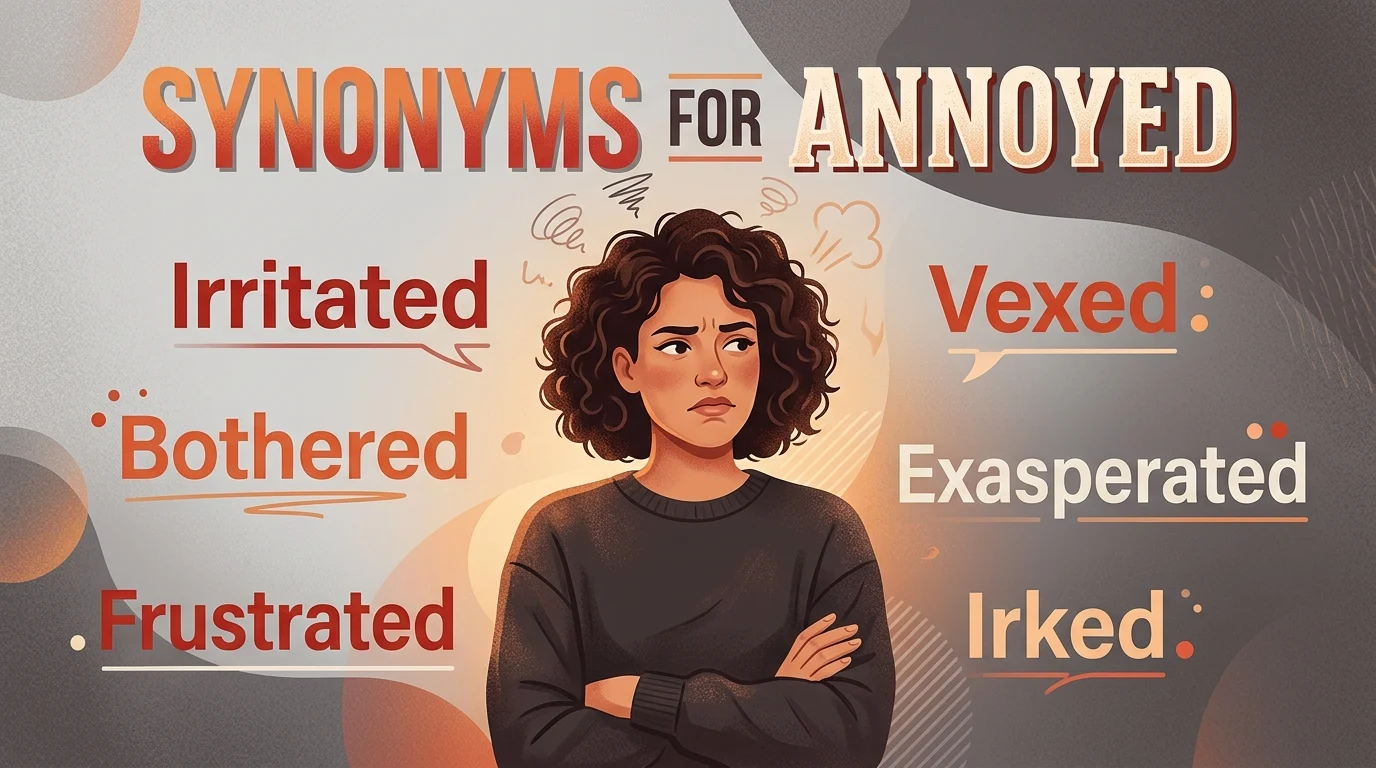
Do you keep using the word “annoyed” in essays, emails, creative writing, social media posts, or everyday conversation? While it is one of the most common and useful adjectives in English, repeating it can make your writing feel flat, repetitive, or overly simple.
The good news is that the best alternative depends on what you actually mean. You might be describing mild irritation, deep frustration, quiet exasperation, visible anger, or complete exasperation.
This guide explains synonyms for “annoyed” by meaning, tone, context, and usage. You will learn which alternatives work best in academic writing, professional communication, creative expression, and casual conversation.
Quick Answer: What Does “Annoyed” Mean?
“Annoyed” describes a feeling of mild to moderate irritation or displeasure caused by something unpleasant, repetitive, or frustrating. Depending on context, alternatives include irritated, bothered, vexed, frustrated, exasperated, irked, aggravated, peeved, miffed, and displeased.
Meaning, Tone, and Context
Simple Definition
“Annoyed” generally refers to:
- Mild irritation: slightly bothered by something
- Moderate frustration: feeling upset or impatient
- Exasperation: fed up with a repeated annoyance
- Displeasure: unhappy about a situation or behavior
- Resentment: feeling wronged or slighted
Part of Speech
“Annoyed” functions primarily as an adjective and as the past tense of the verb “annoy.”
Adjective Examples:
- “She was annoyed by the noise.”
- “He looked annoyed at the interruption.”
Verb Examples:
- “The constant delays annoyed everyone.”
- “Her behavior annoyed me.”
Related Forms:
- Annoy (verb): to irritate or bother
- Annoying (adjective): causing irritation
- Annoyance (noun): the feeling of being annoyed
- Annoyingly (adverb): in an annoying manner
Positive, Negative, or Neutral Tone
“Annoyed” is negative, but the intensity can range from mild to strong.
Mild:
- “I was a little annoyed by the delay.”
Strong:
- “She was deeply annoyed by his constant interruptions.”
Formality Level
“Annoyed” is a standard word that works in both formal and informal English. It is appropriate in academic writing, business communication, creative writing, and casual conversation.
However, more specific alternatives can add precision and variety depending on the context.
Common Use Cases
“Annoyed” commonly refers to:
- Everyday frustrations: traffic, noise, delays
- Interpersonal conflicts: rudeness, interruptions, repeated questions
- Workplace situations: micromanagement, unclear instructions
- Customer service: poor service, long wait times
- Creative writing: character emotions and reactions
- Social media: expressing mild frustration
Important Word Forms
- Annoyed (adjective): feeling irritation
- Annoy (verb): to irritate
- Annoying (adjective): causing irritation
- Annoyance (noun): the feeling of being annoyed
- Annoyingly (adverb): in an annoying manner
When and How to Use “Annoyed”
Use “annoyed” when you want to describe mild to moderate irritation caused by something unpleasant or frustrating. Because the word is broad, more specific alternatives can add precision depending on the context.
Professional
“I was annoyed by the lack of communication from the team.”
This works in business communication, though stronger alternatives may be more appropriate.
Academic
Avoid “annoyed” in formal academic writing. Use dissatisfied, frustrated, or displeased.
Personal
“I’m so annoyed that I forgot my keys.”
The word sounds natural in everyday conversation.
Creative
“She was annoyed by his constant questions.”
The word creates a relatable emotional state.
Social Media
“So annoyed right now.”
This is common in casual social media posts.
Customer Service
“The customer was annoyed by the delay.”
This is appropriate in professional contexts.
Another Word for “Annoyed”
There is no single perfect synonym because “annoyed” can refer to mild irritation, frustration, exasperation, or displeasure.
- Mild irritation: bothered, irked, peeved, miffed
- Moderate frustration: frustrated, aggravated, vexed
- Exasperation: exasperated, fed up, tired of
- Displeasure: displeased, dissatisfied, unhappy
- Anger: angry, furious, irate, incensed
If you need one broad alternative, “irritated” works in most contexts, while “frustrated” works for blocked goals.
When Not to Use “Annoyed”
“Annoyed” can become too mild when a stronger word is needed, or too strong when a milder word would be more appropriate.
Consider:
“She was annoyed by the death of her pet.”
This is too mild. A stronger word like devastated or heartbroken would be more appropriate.
Similarly, avoid using “annoyed” when you mean “angry” in a serious context. Use “angry”, “furious”, or “irate” instead.
Words Commonly Confused With “Annoyed”
Annoyed vs. Angry
Angry is stronger and often involves a desire to confront. Annoyed is milder.
Example:
“She was angry about the injustice.” (strong)
“She was annoyed by the noise.” (mild)
Annoyed vs. Frustrated
Frustrated implies being blocked from achieving a goal. Annoyed is broader.
Example:
“He was frustrated by the slow internet.” (blocked)
“He was annoyed by the slow internet.” (mild irritation)
Annoyed vs. Irritated
Irritated is very similar but often implies a physical or sensory trigger. Annoyed is broader.
Example:
“Her skin was irritated by the fabric.” (physical)
“She was annoyed by his comments.” (emotional)
Annoyed vs. Exasperated
Exasperated implies being fed up after repeated annoyance. Annoyed can be a single instance.
Example:
“She was exasperated by his constant excuses.” (repeated)
“She was annoyed by his excuse.” (single)
Annoyed vs. Bothered
Bothered is milder and can mean merely disturbed. Annoyed implies irritation.
Example:
“He was bothered by the noise.” (disturbed)
“He was annoyed by the noise.” (irritated)
Annoyed vs. Vexed
Vexed is more formal and literary. Annoyed is standard.
Example:
“She was vexed by the delay.” (formal)
“She was annoyed by the delay.” (standard)
Best Synonym by Context for “Annoyed”
| Context | Best Synonym | Why It Works | Example |
|---|---|---|---|
| Formal writing | Displeased, vexed | Precise and professional | The board was displeased with the results. |
| Academic writing | Dissatisfied, frustrated | Standard academic usage | Participants were dissatisfied with the process. |
| Business/Professional | Frustrated, irritated | Professional and clear | The client was frustrated by the delays. |
| Creative writing | Irked, peeved, miffed | Adds literary depth | She was irked by his constant interruptions. |
| Casual conversation | Annoyed, bothered | Natural and informal | I’m so annoyed right now. |
| Strong irritation | Exasperated, aggravated | Emphasizes intensity | He was exasperated by the repeated errors. |
| Mild irritation | Bothered, irked | Mild and precise | She was irked by his tone. |
| Customer service | Frustrated, dissatisfied | Professional and empathetic | The customer was frustrated with the service. |
| Social media | Annoyed, peeved | Casual and relatable | So peeved right now. |
| Interpersonal | Miffed, offended | Emphasizes personal slight | She was miffed by his comment. |
| Repeated annoyance | Exasperated, fed up | Emphasizes repetition | She was fed up with his excuses. |
| Anger | Angry, irate, furious | Stronger emotion | He was furious about the mistake. |
Which Synonym Should You Choose?
Start by identifying what level of annoyance you are describing.
- Mild irritation: bothered, irked, peeved, miffed
- Moderate frustration: annoyed, irritated, frustrated, aggravated
- Exasperation: exasperated, fed up, tired of
- Displeasure: displeased, dissatisfied, unhappy
- Anger: angry, furious, irate, incensed
10 Key Synonyms for “Annoyed”
The table below includes accurate alternatives with clear meanings and usage contexts.
| Synonym | Simple Meaning | Best Used For | Example Sentence |
|---|---|---|---|
| Irritated | Slightly angry or bothered | General, mild | She was irritated by the noise. |
| Bothered | Disturbed or concerned | Mild, general | He was bothered by the comment. |
| Vexed | Annoyed or worried | Formal, literary | She was vexed by the delay. |
| Frustrated | Blocked from achieving something | Goals, situations | He was frustrated by the lack of progress. |
| Exasperated | Fed up after repeated annoyance | Repeated annoyance | She was exasperated by his excuses. |
| Irked | Slightly annoyed | Mild, general | He was irked by her tone. |
| Aggravated | Annoyed or worsened | Moderate, casual | She was aggravated by the traffic. |
| Peeved | Slightly annoyed (informal) | Casual, mild | He was peeved about the change. |
| Miffed | Slightly offended or annoyed | Personal slight | She was miffed by his comment. |
| Displeased | Unhappy or dissatisfied | Formal, professional | The board was displeased with the results. |
Synonym Groups and Usage Differences
Professional vs. Personal Synonyms
Professional writing benefits from specific terms such as displeased, dissatisfied, frustrated, and concerned.
Personal communication often uses annoyed itself or casual alternatives like peeved, irked, or bothered.
Compare:
“I’m so peeved right now.” (personal)
“The client was dissatisfied with the service.” (professional)
Formal vs. Conversational Synonyms
Annoyed works in both formal and conversational English.
Formal alternatives: displeased, vexed, dissatisfied, exasperated
Conversational alternatives: peeved, irked, miffed, bothered
Examples:
“The board was displeased with the results.” (formal)
“I’m really peeved about this.” (conversational)
Academic Synonyms
Academic writing should use precise terms like dissatisfied, frustrated, or displeased rather than the more casual “annoyed.”
For example:
“Participants reported feeling frustrated by the unclear instructions.”
“Customers were dissatisfied with the service quality.”
Professional and Business Synonyms
Business writing often benefits from phrases such as frustrated, dissatisfied, concerned, and displeased.
Instead of:
“The customer was annoyed.”
Consider:
“The customer was frustrated by the repeated delays.”
Creative or Literary Synonyms
Creative writing can use irked, peeved, miffed, vexed, exasperated, and rankled depending on the context.
For example:
“She was irked by his casual dismissal of her concerns.”
“A deep sense of vexation settled over him.”
Slang or Modern Synonyms
Peeved is common casual.
Irked is casual and mild.
Miffed is casual and slightly old-fashioned.
Ticked off is American slang.
Pissed off is strong slang (vulgar).
Examples:
“She was ticked off about the delay.” (American slang)
“He was really irked by the comment.” (casual)
Strongest vs. Weaker Synonyms
“Annoyed” synonyms vary in intensity:
Milder: bothered, irked, peeved
Moderate: annoyed, irritated, frustrated
Strong: exasperated, aggravated, vexed
Very Strong: furious, irate, incensed
Emotional vs. Neutral Synonyms
“Annoyed” is generally emotional but mild.
Emotional alternatives: exasperated, miffed, vexed
Neutral alternatives: displeased, dissatisfied, bothered
Examples:
“She was exasperated by his behavior.” (emotional)
“The board was displeased with the results.” (neutral, formal)
Antonyms of “Annoyed”
“Annoyed” has several antonyms depending on context:
| Antonym | Context | Meaning | Example Sentence |
|---|---|---|---|
| Pleased | General | Happy and satisfied | She was pleased with the result. |
| Content | General | Peaceful and satisfied | He was content with the outcome. |
| Calm | Emotion | Not agitated | She remained calm despite the noise. |
| Relaxed | Emotion | Free from tension | He felt relaxed after the massage. |
| Delighted | General | Very happy | She was delighted by the surprise. |
| Satisfied | General | Fulfilled | The customer was satisfied with the service. |
| Grateful | Emotion | Thankful | He was grateful for the help. |
Comparison: “Annoyed” vs. Similar Words
Annoyed vs. Angry
Main difference: Angry is stronger and often involves a desire to confront. Annoyed is milder.
Examples:
“She was angry about the injustice.” (strong)
“She was annoyed by the noise.” (mild)
Annoyed vs. Frustrated
Main difference: Frustrated implies being blocked from achieving a goal. Annoyed is broader.
Examples:
“He was frustrated by the slow internet.” (blocked)
“He was annoyed by the slow internet.” (mild irritation)
Annoyed vs. Irritated
Main difference: Irritated is very similar but often implies a physical or sensory trigger. Annoyed is broader.
Examples:
“Her skin was irritated by the fabric.” (physical)
“She was annoyed by his comments.” (emotional)
Annoyed vs. Exasperated
Main difference: Exasperated implies being fed up after repeated annoyance. Annoyed can be a single instance.
Examples:
“She was exasperated by his constant excuses.” (repeated)
“She was annoyed by his excuse.” (single)
Annoyed vs. Bothered
Main difference: Bothered is milder and can mean merely disturbed. Annoyed implies irritation.
Examples:
“He was bothered by the noise.” (disturbed)
“He was annoyed by the noise.” (irritated)
Annoyed vs. Vexed
Main difference: Vexed is more formal and literary. Annoyed is standard.
Examples:
“She was vexed by the delay.” (formal)
“She was annoyed by the delay.” (standard)
Common Phrases and Expressions with “Annoyed”
1. Annoyed with
Meaning:
Irritated by someone or something.
Example:
“She was annoyed with her brother.”
2. Annoyed at
Meaning:
Irritated by a situation.
Example:
“He was annoyed at the delay.”
3. Annoyed by
Meaning:
Irritated by a specific thing.
Example:
“She was annoyed by the constant noise.”
4. Get annoyed
Meaning:
Become irritated.
Example:
“He gets annoyed easily.”
5. Really annoyed
Meaning:
Very irritated.
Example:
“I was really annoyed by his behavior.”
6. Slightly annoyed
Meaning:
A little irritated.
Example:
“She was slightly annoyed by the interruption.”
7. Annoyed expression
Meaning:
A facial expression showing irritation.
Example:
“He had an annoyed expression on his face.”
8. Annoyed tone
Meaning:
A voice showing irritation.
Example:
“She spoke in an annoyed tone.”
9. Annoyed sigh
Meaning:
A sigh showing irritation.
Example:
“He let out an annoyed sigh.”
10. More annoyed than
Meaning:
Comparing levels of irritation.
Example:
“She was more annoyed than angry.”
Common Mistakes to Avoid
1. Using “annoyed” when a stronger word is needed
If the emotion is strong, use angry, furious, or irate.
Too mild: “She was annoyed by the betrayal.”
Better: “She was furious about the betrayal.”
2. Confusing “annoyed” with “angry”
Angry is stronger and often involves a desire to confront. Annoyed is milder.
Incorrect: “He was annoyed and started shouting.” (if strong)
Correct: “He was angry and started shouting.”
3. Using “annoyed” in formal writing when “dissatisfied” is needed
Formal writing benefits from precise terms like dissatisfied, displeased, and concerned.
Informal: “The customer was annoyed.”
Formal: “The customer was dissatisfied with the service.”
4. Overusing “annoyed” in writing
Repetition can make content feel dull. Use alternatives such as irritated, frustrated, vexed, irked, and exasperated.
5. Choosing a synonym that changes the meaning
Do not replace annoyed with frustrated unless you mean blocked from a goal.
Do not replace annoyed with exasperated unless you mean fed up after repetition.
FAQs
What is the best synonym for “annoyed”?
The best synonym depends on context. Irritated works for general use, frustrated for blocked goals, exasperated for repeated annoyance, irked for mild irritation, and displeased for formal contexts.
What is a formal synonym for “annoyed”?
Displeased, dissatisfied, vexed, and concerned are formal synonyms.
What is an informal synonym for “annoyed”?
Peeved, irked, miffed, bothered, and ticked off are common informal alternatives.
What is another word for “annoyed” in creative writing?
Irked, peeved, miffed, vexed, exasperated, and rankled work well in creative writing.
What is the difference between “annoyed” and “angry”?
Angry is stronger and often involves a desire to confront. Annoyed is milder.
What is the opposite of “annoyed”?
Depending on context, opposites include pleased, content, calm, relaxed, delighted, and satisfied.
What does “annoyed” mean in a professional context?
In professional contexts, “annoyed” often means frustrated, dissatisfied, or concerned about a situation or behavior.
Conclusion
“Annoyed” is a versatile word that can describe mild irritation, moderate frustration, exasperation, and displeasure. The best synonym depends on what you actually mean.
Choose irritated for general use, frustrated for blocked goals, exasperated for repeated annoyance, irked for mild irritation, displeased for formal contexts, and angry for stronger emotions.
Most importantly, do not replace “annoyed” simply to avoid repetition. First identify what level of annoyance—mild, moderate, or strong—you are actually describing. Then choose the alternative that communicates that idea most clearly.
For academic, professional, and formal writing, precision is usually more valuable than vocabulary variety. A specific term such as dissatisfied, frustrated, vexed, or exasperated can tell readers much more than the broad word annoyed.
Before publishing a vocabulary guide, verify definitions and usage with trusted dictionaries such as Cambridge, Oxford, Merriam-Webster, Collins, or Britannica. This helps ensure that each alternative accurately matches its intended meaning and context.
The practical takeaway is simple: when “annoyed” feels too mild or too general, ask yourself what level of irritation—mild, moderate, or strong—you are actually describing. Then use the most precise word available.
