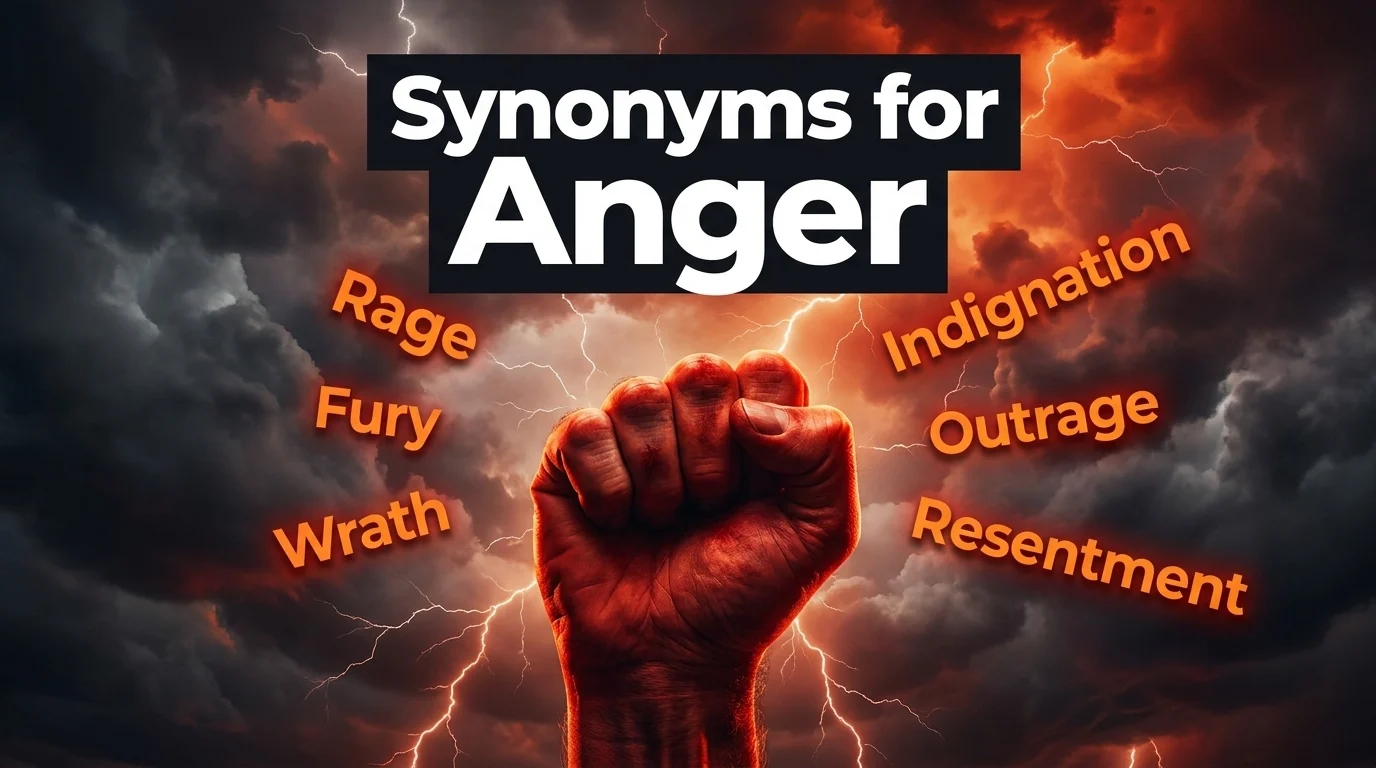
Do you keep using the word “anger” in essays, creative writing, professional emails, or everyday conversation? While it is a powerful and direct word, repeating it can make your writing feel flat and fail to capture the full range of this complex emotion.
The good news is that the best alternative depends on what you actually mean. You might be describing mild irritation, intense rage, quiet resentment, sudden fury, or moral outrage.
This guide explains synonyms for “anger” by meaning, tone, context, and usage. You will learn which alternatives work best in academic writing, professional communication, creative expression, and casual conversation.
Quick Answer: What Does “Anger” Mean?
“Anger” is a strong emotion characterized by feelings of displeasure, hostility, or antagonism toward someone or something you feel has deliberately done you wrong. Depending on context and intensity, alternatives include rage, fury, wrath, ire, indignation, outrage, resentment, irritation, annoyance, and hostility.
Meaning, Tone, and Context
Simple Definition
“Anger” generally refers to:
- A strong feeling of displeasure or hostility
- An emotional response to a perceived wrong, threat, or injustice
- A range of intensity from mild irritation to violent rage
- A state that can be brief (a flash of anger) or prolonged (simmering anger)
Part of Speech
“Anger” functions primarily as a noun and a verb.
Noun Examples:
- “His anger was evident from his clenched fists.”
- “She struggled to control her anger.”
Verb Examples:
- “The decision angered many employees.”
- “His comments angered the crowd.”
Related Forms:
- Angry (adjective): feeling or showing anger
- Angrily (adverb): in an angry manner
- Angered (verb past tense): made angry
Positive, Negative, or Neutral Tone
“Anger” is generally negative, though it can sometimes be neutral or even constructive (as in “righteous anger” against injustice).
Negative associations:
- “His anger got the best of him.”
- “She was consumed by anger.”
Constructive contexts:
- “Their anger fueled their fight for justice.”
- “Righteous anger drove the protests.”
Formality Level
“Anger” is a standard word that works in both formal and informal English. It is appropriate in academic papers, professional communication, creative writing, and everyday conversation.
However, more specific alternatives can add intensity, nuance, and variety.
Common Use Cases
“Anger” commonly refers to:
- Mild irritation: annoyance, vexation, irritation, pique
- Moderate anger: resentment, indignation, displeasure
- Intense anger: rage, fury, wrath, ire, outrage
- Sudden anger: flare-up, outburst, fit of rage
- Prolonged anger: resentment, bitterness, grudge
- Moral anger: indignation, outrage, righteous anger
- Physical expression: temper, hostility, aggression
Important Word Forms
- Anger (noun): the emotion
- Anger (verb): to make someone angry
- Angry (adjective): feeling or showing anger
- Angrily (adverb): in an angry manner
- Angriness (noun): the state of being angry (less common)
When and How to Use “Anger”
Use “anger” when you want to describe a strong feeling of displeasure or hostility. Because the word covers a wide range of intensities, more specific alternatives can add precision.
Professional
“The customer expressed anger over the delayed shipment.”
This works in business communication, though softer alternatives may be preferred.
Academic
“The study examined the relationship between anger and cardiovascular health.”
The term is appropriate in academic research.
Personal
“He couldn’t hide his anger when he saw the damage.”
The word sounds natural in everyday conversation.
Creative
“Her anger burned like a wildfire, consuming everything in its path.”
The word creates a vivid emotional image in creative writing.
Conflict Resolution
“Learning to manage anger is an important life skill.”
The term is appropriate in educational or therapeutic contexts.
News/Journalism
“Public anger over the decision led to widespread protests.”
The term is standard in news reporting.
Another Word for “Anger”
There is no single perfect synonym because “anger” covers a wide range of intensities and types.
- Mild anger: irritation, annoyance, vexation, pique, displeasure
- Moderate anger: resentment, indignation, umbrage, dudgeon
- Intense anger: rage, fury, wrath, ire, outrage, frenzy
- Sudden anger: flare, outburst, fit, tantrum
- Prolonged anger: resentment, bitterness, grudge, spite
- Moral anger: indignation, outrage, righteous anger
- Physical/behavioral: temper, hostility, aggression, violence
If you need one broad alternative, “rage” works for intense anger, “indignation” for moral anger, and “resentment” for prolonged anger.
When Not to Use “Anger”
“Anger” can become too vague when you need to specify the intensity or type of emotion.
Consider:
“He felt anger.”
This statement does not tell readers whether he was mildly annoyed, deeply resentful, or violently enraged.
A more precise sentence could be:
“He felt a deep resentment that had been building for years.”
Similarly, avoid using “anger” in professional contexts when softer alternatives like displeasure, frustration, or concern might be more appropriate.
Words Commonly Confused With “Anger”
Anger vs. Rage
Rage is intense, uncontrolled anger. Anger is broader and can range from mild to intense.
Example:
“He flew into a rage.” (extreme, uncontrolled)
“She felt a flash of anger.” (brief, moderate)
Anger vs. Fury
Fury is violent, intense anger. Anger is more general.
Example:
“Her fury was terrifying.” (extreme)
“He struggled with anger issues.” (general)
Anger vs. Indignation
Indignation is anger caused by injustice or unfair treatment. It is often moral or righteous.
Example:
“She felt indignation at the unfair treatment.” (moral)
“He couldn’t control his anger.” (general)
Anger vs. Resentment
Resentment is prolonged anger or bitterness, often from feeling wronged.
Example:
“He harbored resentment for years.” (prolonged)
“She expressed her anger immediately.” (immediate)
Anger vs. Irritation
Irritation is mild anger or annoyance. Anger is stronger.
Example:
“His constant tapping caused irritation.” (mild)
“She felt anger at the betrayal.” (stronger)
Anger vs. Hostility
Hostility is unfriendly or aggressive behavior driven by anger. Anger is the emotion; hostility is the behavior.
Example:
“He showed hostility toward his coworkers.” (behavior)
“He felt anger toward his coworkers.” (emotion)
Best Synonym by Context for “Anger”
| Context | Best Synonym | Why It Works | Example |
|---|---|---|---|
| Formal writing | Indignation, outrage | Precise and professional | The proposal sparked widespread indignation. |
| Academic writing | Hostility, aggression | Standard academic usage | The study measured levels of hostility. |
| Mild anger | Irritation, annoyance | Describes low-intensity anger | His constant interruptions caused irritation. |
| Intense anger | Rage, fury, wrath | Describes extreme anger | She was consumed by rage. |
| Sudden anger | Flare, outburst | Describes brief, explosive anger | He had an angry outburst. |
| Prolonged anger | Resentment, bitterness | Describes long-lasting anger | She harbored deep resentment. |
| Moral anger | Indignation, outrage | Describes anger at injustice | The community expressed outrage. |
| Casual conversation | Mad, annoyed, ticked off | Natural and informal | I was so mad at him. |
| Creative writing | Ire, wrath, fury | Literary and dramatic | His wrath knew no bounds. |
| Behavioral context | Temper, hostility | Describes outward expression | He has a bad temper. |
| Professional context | Displeasure, frustration | Professional and measured | The client expressed displeasure. |
| News/Journalism | Outrage, fury | Standard news terminology | Public outrage grew over the scandal. |
Which Synonym Should You Choose?
Start by identifying what kind of anger you are describing.
- Mild anger: irritation, annoyance, vexation, pique, displeasure, aggravation
- Moderate anger: resentment, indignation, umbrage, dudgeon, disgruntlement
- Intense anger: rage, fury, wrath, ire, outrage, frenzy, ferocity
- Sudden anger: flare, outburst, fit, tantrum, explosion
- Prolonged anger: resentment, bitterness, grudge, spite, animosity
- Moral anger: indignation, outrage, righteous anger
- Behavioral expression: temper, hostility, aggression, violence
- Quiet anger: simmering, seething, brooding, smoldering
10 Key Synonyms for “Anger”
The table below includes accurate alternatives with clear meanings and usage contexts.
| Synonym | Simple Meaning | Best Used For | Example Sentence |
|---|---|---|---|
| Rage | Intense, uncontrolled anger | Extreme anger, violence | He was shaking with rage. |
| Fury | Violent, intense anger | Extreme anger, dramatic | Her fury was terrifying to witness. |
| Wrath | Extreme anger, often vengeful | Literary, formal, dramatic | The king’s wrath was feared by all. |
| Ire | Anger, often righteous | Literary, formal | His ire was raised by the injustice. |
| Indignation | Anger at unfairness | Moral anger, injustice | She felt indignation at the false accusations. |
| Outrage | Intense anger and shock | Public anger, scandal | The decision sparked public outrage. |
| Resentment | Prolonged bitterness | Long-lasting anger | He harbored resentment for years. |
| Irritation | Mild anger or annoyance | Minor frustrations | His constant tapping caused irritation. |
| Hostility | Unfriendly, aggressive anger | Behavior, conflict | She faced hostility from her colleagues. |
| Temper | Tendency to become angry | Personality, behavior | He has a quick temper. |
Synonym Groups and Usage Differences
Professional vs. Personal Synonyms
Professional writing benefits from specific terms such as displeasure, frustration, indignation, and concern.
Personal communication often uses anger, mad, annoyed, or ticked off.
Compare:
“I was so mad at him.” (personal)
“The client expressed displeasure with the service.” (professional)
Formal vs. Conversational Synonyms
Anger works in both formal and conversational English.
Formal alternatives: indignation, ire, wrath, outrage, displeasure
Conversational alternatives: mad, annoyed, ticked off, pissed off (vulgar), heated
Examples:
“The public expressed outrage at the decision.” (formal)
“I was really annoyed by his behavior.” (conversational)
Academic Synonyms
Academic writing should distinguish between anger (emotion), aggression (behavior), hostility (attitude), and irritability (temperament).
For example:
“The study measured trait anger and aggression in participants.”
Professional and Business Synonyms
Business writing often benefits from phrases such as displeasure, frustration, concern, and dissatisfaction.
Instead of:
“The customer was angry.”
Consider:
“The customer expressed dissatisfaction with the service.”
Creative or Literary Synonyms
Creative writing can use wrath, ire, fury, rage, frenzy, ferocity, and venom depending on the context.
For example:
“His wrath was like a storm, unstoppable and destructive.”
“The venom in her words cut deeper than any blade.”
Slang or Modern Synonyms
Mad is the most common informal alternative.
Ticked off means annoyed or angry.
Pissed off is vulgar slang for very angry.
Livid means extremely angry.
Fuming means visibly angry.
Steaming means very angry.
Examples:
“I’m so mad right now.” (casual)
“She was absolutely livid.” (emphatic)
“He was fuming after the meeting.” (visible anger)
Strongest vs. Weaker Synonyms
“Anger” synonyms vary in intensity:
Milder: irritation, annoyance, vexation, displeasure
Moderate: anger, resentment, indignation, umbrage
Strong: rage, fury, wrath, outrage, ire
Very Strong: blind rage, uncontrollable fury, apoplectic
Emotional vs. Neutral Synonyms
“Anger” is inherently emotional.
Emotional alternatives: fury, rage, wrath, indignation, outrage
Neutral alternatives: displeasure, dissatisfaction, frustration, irritation
Examples:
“She was consumed by fury.” (emotional)
“The customer expressed dissatisfaction.” (neutral)
Antonyms of “Anger”
“Anger” has several antonyms depending on context:
| Antonym | Context | Meaning | Example Sentence |
|---|---|---|---|
| Calm | General | Peaceful state | He remained calm despite the provocation. |
| Contentment | General | Satisfaction | She felt a deep sense of contentment. |
| Forgiveness | General | Pardon | Forgiveness helped heal the relationship. |
| Patience | General | Tolerance | He showed remarkable patience. |
| Pleasure | General | Enjoyment | The news brought her great pleasure. |
| Serenity | General | Peacefulness | The meditation brought her serenity. |
| Goodwill | General | Kindness | The community showed goodwill. |
| Composure | General | Self-control | She maintained her composure. |
Comparison: “Anger” vs. Similar Words
Anger vs. Rage
Main difference: Rage is intense, uncontrolled anger. Anger is broader and can range from mild to intense.
Examples:
“He flew into a rage.” (extreme, uncontrolled)
“She felt a flash of anger.” (brief, moderate)
Anger vs. Fury
Main difference: Fury is violent, intense anger. Anger is more general.
Examples:
“Her fury was terrifying.” (extreme)
“He struggled with anger issues.” (general)
Anger vs. Indignation
Main difference: Indignation is anger caused by injustice. Anger is broader.
Examples:
“She felt indignation at the unfair treatment.” (moral)
“He couldn’t control his anger.” (general)
Anger vs. Resentment
Main difference: Resentment is prolonged anger or bitterness. Anger can be brief.
Examples:
“He harbored resentment for years.” (prolonged)
“She expressed her anger immediately.” (immediate)
Anger vs. Irritation
Main difference: Irritation is mild anger or annoyance. Anger is stronger.
Examples:
“His constant tapping caused irritation.” (mild)
“She felt anger at the betrayal.” (stronger)
Anger vs. Hostility
Main difference: Hostility is unfriendly or aggressive behavior driven by anger. Anger is the emotion; hostility is the behavior.
Examples:
“He showed hostility toward his coworkers.” (behavior)
“He felt anger toward his coworkers.” (emotion)
Common Phrases and Expressions with “Anger”
1. Fit of anger
Meaning:
A sudden, brief episode of anger.
Example:
“He threw the vase in a fit of anger.”
2. Vent one’s anger
Meaning:
To express anger, often in a healthy or unhealthy way.
Example:
“She vented her anger by going for a run.”
3. Bottle up anger
Meaning:
To suppress anger.
Example:
“Bottling up anger can lead to health problems.”
4. Anger management
Meaning:
Therapeutic techniques to control anger.
Example:
“He took an anger management class.”
5. Blaze of anger
Meaning:
Intense, visible anger.
Example:
“She was in a blaze of anger after the betrayal.”
6. Slow burn
Meaning:
Anger that builds gradually.
Example:
“His anger was a slow burn that finally exploded.”
7. Seeing red
Meaning:
Becoming extremely angry.
Example:
“When he heard the news, he saw red.”
8. Fly off the handle
Meaning:
To become suddenly and unexpectedly angry.
Example:
“He flies off the handle at the smallest things.”
9. Breathe fire
Meaning:
To be extremely angry.
Example:
“She was breathing fire after the meeting.”
10. Hot under the collar
Meaning:
Angry or agitated.
Example:
“He got hot under the collar when questioned.”
Common Mistakes to Avoid
1. Using “anger” when a more precise term is available
If you mean rage, fury, indignation, or resentment, use the more specific word.
Vague: “He felt anger.”
Precise: “He felt a deep sense of indignation at the injustice.”
2. Using “anger” in professional contexts when softer terms are better
Professional writing often benefits from displeasure, frustration, or concern.
Too strong: “The customer was angry.”
Better: “The customer expressed frustration with the delay.”
3. Confusing “anger” with “aggression”
Anger is an emotion. Aggression is a behavior.
Incorrect: “He showed anger by hitting the wall.” (if describing behavior)
Correct: “He showed aggression by hitting the wall.”
4. Overusing “anger” in writing
Repetition can make content feel dull. Use a variety of alternatives such as rage, fury, indignation, resentment, and irritation.
5. Choosing a synonym that changes the meaning
Do not replace anger with aggression unless you mean behavior.
Do not replace anger with hatred unless you mean deep, lasting dislike.
Anger: “She felt anger at the comment.” (temporary emotion)
Hatred: “She felt hatred for her enemy.” (deep, lasting)
FAQs
What is the best synonym for “anger”?
The best synonym depends on context. Rage works for intense anger, indignation for moral anger, resentment for prolonged anger, and irritation for mild anger.
What is a formal synonym for “anger”?
Indignation, ire, wrath, outrage, and displeasure are formal synonyms.
What is an informal synonym for “anger”?
Mad, annoyed, ticked off, livid, and fuming are common informal alternatives.
What is another word for “anger” in creative writing?
Wrath, ire, fury, rage, frenzy, and venom work well in creative writing.
What is the difference between “anger” and “rage”?
Rage is intense, uncontrolled anger. Anger is broader and can range from mild to intense.
What is the opposite of “anger”?
Depending on context, opposites include calm, contentment, forgiveness, patience, pleasure, and serenity.
What does “anger” mean in a clinical context?
In psychology, anger is an emotional state that varies in intensity from mild irritation to intense fury. It is distinct from aggression, which is a behavior.
Conclusion
“Anger” is a powerful emotion that can range from mild irritation to violent rage. The best synonym depends on what you actually mean.
Choose irritation for mild anger, indignation for moral anger, resentment for prolonged anger, rage for intense anger, fury for violent anger, and outrage for public or moral anger.
Most importantly, do not replace “anger” simply to avoid repetition. First identify the intensity, duration, and type of anger you are actually describing. Then choose the alternative that communicates that idea most clearly.
For academic, professional, and formal writing, precision is usually more valuable than vocabulary variety. A specific term such as indignation, resentment, or hostility can tell readers much more than the broad word anger.
Before publishing a vocabulary guide, verify definitions and usage with trusted dictionaries such as Cambridge, Oxford, Merriam-Webster, Collins, or Britannica. This helps ensure that each alternative accurately matches its intended meaning and context.
The practical takeaway is simple: when “anger” feels too general, ask yourself what kind of anger—mild, intense, sudden, prolonged, or moral—you are actually describing. Then use the most precise word available.
Discover More:-
- 50+ Synonyms for Consistent: Meanings, Examples, and Best Alternatives
- 50+ Synonyms for Run: Meanings, Examples, and Best Alternatives

1 thought on “50+ Synonyms for Anger: Meanings, Examples, and Best Alternatives”