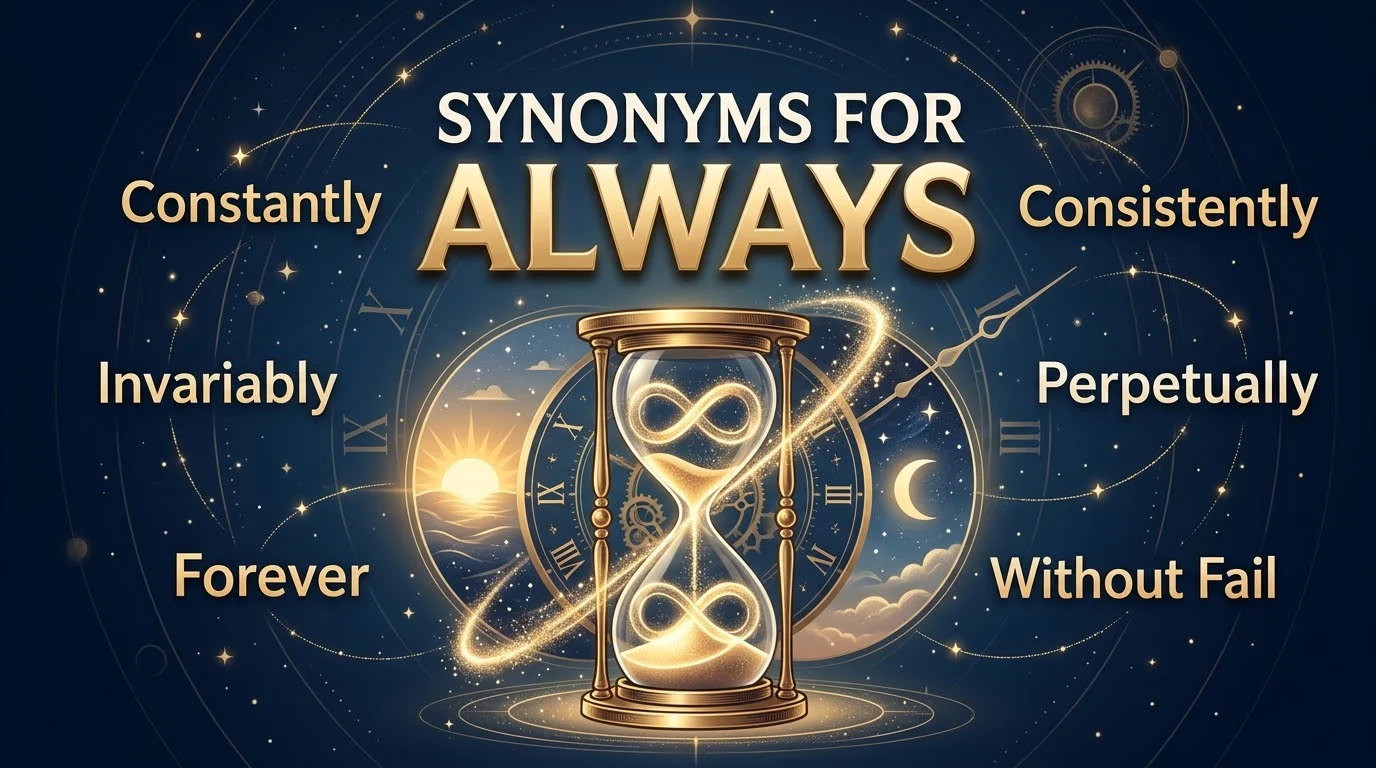
Do you keep using the word “always” in essays, emails, creative writing, business reports, or everyday conversation? While it is one of the most common and useful adverbs in English, repeating it can make your writing feel flat, repetitive, or overly absolute.
The good news is that the best alternative depends on what you actually mean. You might be describing something that happens every time, continuously, habitually, eternally, or without exception.
This guide explains synonyms for “always” by meaning, tone, context, and usage. You will learn which alternatives work best in academic writing, professional communication, creative expression, storytelling, and casual conversation.
Quick Answer: What Does “Always” Mean?
“Always” means at all times, on every occasion, forever, or consistently. It can describe habits, eternal truths, repeated actions, or continuous states. Depending on context, alternatives include constantly, continually, perpetually, invariably, consistently, forever, eternally, ceaselessly, habitually, and without fail.
Meaning, Tone, and Context
Simple Definition
“Always” generally refers to:
- Every time: on all occasions
- Continuously: without stopping
- Forever: for all time
- Habitually: as a regular habit
- Consistently: in the same way every time
- Invariably: without exception
Part of Speech
“Always” functions primarily as an adverb.
Examples:
- “She always arrives on time.”
- “The sun always rises in the east.”
- “I will always remember this day.”
Related Forms:
- Always (adverb): at all times
- All ways (phrase): in every way (different meaning)
Positive, Negative, or Neutral Tone
“Always” is generally neutral, but it can be positive or negative depending on context.
Positive associations:
- “She is always kind to everyone.”
- “I will always love you.”
Negative contexts:
- “He is always complaining.”
- “She is always late.”
Neutral contexts:
- “The train always leaves at 8 AM.”
- “Water always boils at 100°C at sea level.”
Formality Level
“Always” is a standard word that works in both formal and informal English. It is appropriate in academic papers, business communication, creative writing, and casual conversation.
However, more specific alternatives can add precision and variety depending on the context. Also, because “always” is an absolute term, more measured alternatives like usually, typically, or often may be more accurate in some contexts.
Common Use Cases
“Always” commonly refers to:
- Habits: always brushes teeth, always reads before bed
- Permanent states: always loved, always remembered
- General truths: always rises, always sets
- Frequent actions: always complaining, always helping
- Promises: always be there, always support you
- Rules: always wear a seatbelt, always check your work
Important Word Forms
- Always (adverb): at all times
- Usual (adjective): happening most of the time
- Usually (adverb): most of the time
- Constant (adjective): happening continuously
- Constantly (adverb): continuously
- Perpetual (adjective): never ending
- Perpetually (adverb): never ending
When and How to Use “Always”
Use “always” when you want to describe something that happens on every occasion, continues forever, or is consistently true. Because the word is absolute, more precise alternatives can add nuance depending on the context.
Professional
“We always strive to meet our customers’ needs.”
This works naturally in business communication.
Academic
“The study always found a correlation between the two variables.”
The term is appropriate in academic writing, though “consistently” may be more precise.
Personal
“I will always be grateful for your help.”
The word sounds natural in everyday conversation.
Creative
“The old clock always chimed at midnight.”
The word creates a sense of routine and atmosphere.
Storytelling
“She always wore a red ribbon in her hair.”
The word establishes a character trait.
Business
“Our team always delivers on time.”
This is appropriate in professional contexts.
Another Word for “Always”
There is no single perfect synonym because “always” can refer to every time, continuously, forever, habitually, or invariably.
- Every time context: invariably, without fail, consistently, unfailingly
- Continuous context: constantly, continually, perpetually, ceaselessly, endlessly
- Forever context: forever, eternally, evermore, perpetually
- Habitual context: habitually, customarily, routinely, regularly
- Consistent context: consistently, reliably, dependably, steadily
- Absolute context: universally, in all cases, without exception
If you need one broad alternative, “constantly” works for continuous actions, while “invariably” works for every-time situations. “Forever” works for eternal states.
When Not to Use “Always”
“Always” can become inaccurate or exaggerated when the situation is not truly absolute.
Consider:
“He is always late.”
This statement is probably not literally true—he may be late most of the time, but not every single time.
A more precise sentence could be:
“He is frequently late.”
“He is usually late.”
Similarly, avoid using “always” in academic or scientific writing when a more measured term like “typically”, “generally”, or “consistently” is more accurate.
Words Commonly Confused With “Always”
Always vs. Usually
Usually means most of the time. Always means every time.
Example:
“She usually arrives at 9 AM.” (most of the time)
“She always arrives at 9 AM.” (every time)
Always vs. Often
Often means frequently. Always means without exception.
Example:
“He often works late.” (frequently)
“He always works late.” (every time)
Always vs. Constantly
Constantly can mean continuously or very frequently. Always means at all times.
Example:
“She is constantly checking her phone.” (very frequently)
“She always checks her phone before bed.” (habit)
Always vs. Forever
Forever means for all time. Always can mean every time or forever.
Example:
“I will love you forever.” (for all time)
“I will always love you.” (for all time or every time)
Always vs. Continually
Continually means repeatedly over time. Always means without exception.
Example:
“He continually interrupts.” (repeatedly)
“He always interrupts.” (every time)
Always vs. Perpetually
Perpetually means never ending or continuously. Always can be broader.
Example:
“The machine runs perpetually.” (never stops)
“The machine always runs smoothly.” (every time)
Best Synonym by Context for “Always”
| Context | Best Synonym | Why It Works | Example |
|---|---|---|---|
| Formal writing | Invariably, consistently | Precise and formal | The results were invariably positive. |
| Academic writing | Consistently, typically | Standard academic usage | The study consistently found a correlation. |
| Business/Professional | Consistently, reliably | Professional and clear | Our team consistently delivers on time. |
| Creative writing | Perpetually, eternally, ceaselessly | Adds literary depth | The river flowed ceaselessly toward the sea. |
| Habitual actions | Habitually, routinely, customarily | Describes habits | She habitually reads before bed. |
| Every time | Invariably, without fail, unfailingly | Absolute frequency | He invariably arrives early. |
| Forever | Forever, eternally, evermore | Eternal states | I will love you forever. |
| Continuous | Constantly, continually, perpetually | Ongoing actions | The clock ticks constantly. |
| Casual conversation | Always (itself), all the time | Natural and informal | She’s always happy. |
| Promises | Forever, eternally, always | Emotional promises | I will always be there for you. |
| Rules | Always, invariably, without exception | Absolute rules | Always wear a seatbelt. |
| General truths | Always, universally | Timeless truths | The sun always rises in the east. |
Which Synonym Should You Choose?
Start by identifying what kind of “always” you are describing.
- Every time: invariably, without fail, consistently, unfailingly
- Continuous: constantly, continually, perpetually, ceaselessly
- Forever: forever, eternally, evermore, perpetually
- Habitual: habitually, customarily, routinely, regularly
- Consistent: consistently, reliably, dependably, steadily
- Absolute: universally, in all cases, without exception
10 Key Synonyms for “Always”
The table below includes accurate alternatives with clear meanings and usage contexts.
| Synonym | Simple Meaning | Best Used For | Example Sentence |
|---|---|---|---|
| Constantly | Continuously or very frequently | Ongoing actions | She is constantly checking her phone. |
| Continually | Repeatedly over time | Repeated actions | He continually interrupts. |
| Perpetually | Never ending or continuously | Eternal states | The machine runs perpetually. |
| Invariably | Without exception | Every-time situations | He invariably arrives early. |
| Consistently | In the same way every time | Reliable actions | She consistently performs well. |
| Forever | For all time | Eternal states | I will love you forever. |
| Eternally | Forever, without end | Eternal states | The stars shine eternally. |
| Ceaselessly | Without stopping | Continuous actions | The river flows ceaselessly. |
| Habitually | As a regular habit | Habits | She habitually reads before bed. |
| Without fail | Every time, no exception | Reliable actions | He calls his mother without fail. |
Synonym Groups and Usage Differences
Professional vs. Personal Synonyms
Professional writing benefits from specific terms such as consistently, invariably, reliably, and without fail.
Personal communication often uses always itself or casual alternatives like all the time, every time, or constantly.
Compare:
“She’s always happy.” (personal)
“She consistently maintains a positive attitude.” (professional)
Formal vs. Conversational Synonyms
Always works in both formal and conversational English.
Formal alternatives: invariably, consistently, perpetually, ceaselessly
Conversational alternatives: always, all the time, every time
Examples:
“The results were invariably positive.” (formal)
“She’s always happy.” (conversational)
Academic Synonyms
Academic writing should distinguish between always (every time), typically (usually), consistently (in the same way), and generally (in most cases).
For example:
“The study consistently found a correlation.”
“Typically, participants responded within 24 hours.”
Professional and Business Synonyms
Business writing often benefits from phrases such as consistently, reliably, without fail, and invariably.
Instead of:
“We always deliver on time.”
Consider:
“We consistently deliver on time.”
Creative or Literary Synonyms
Creative writing can use perpetually, eternally, ceaselessly, endlessly, and evermore depending on the context.
For example:
“The river flowed ceaselessly toward the sea.”
“The stars shine eternally in the night sky.”
Slang or Modern Synonyms
All the time is a common casual alternative.
24/7 means all the time.
Nonstop means continuously.
Every single time is emphatic casual.
Examples:
“She’s on her phone all the time.” (casual)
“He works nonstop.” (casual)
Strongest vs. Weaker Synonyms
“Always” synonyms vary in intensity:
Milder: usually, typically, generally
Moderate: often, frequently, regularly
Strong: always, consistently, invariably
Very Strong: perpetually, eternally, ceaselessly
Emotional vs. Neutral Synonyms
“Always” is generally neutral but can be emotional.
Emotional alternatives: forever, eternally, evermore
Neutral alternatives: consistently, invariably, habitually
Examples:
“I will love you forever.” (emotional)
“He consistently arrives early.” (neutral)
Antonyms of “Always”
“Always” has several antonyms depending on context:
| Antonym | Context | Meaning | Example Sentence |
|---|---|---|---|
| Never | General | Not at any time | She never arrives late. |
| Sometimes | Frequency | Occasionally | He sometimes works late. |
| Rarely | Frequency | Seldom | She rarely complains. |
| Occasionally | Frequency | Now and then | They occasionally visit. |
| Seldom | Frequency | Not often | He seldom eats meat. |
| Never | General | At no time | I never forget a face. |
| Intermittently | Continuity | Stopping and starting | The signal was intermittently lost. |
| Sporadically | Continuity | Occasionally | He sporadically attends meetings. |
Comparison: “Always” vs. Similar Words
Always vs. Usually
Main difference: Usually means most of the time. Always means every time.
Examples:
“She usually arrives at 9 AM.” (most of the time)
“She always arrives at 9 AM.” (every time)
Always vs. Often
Main difference: Often means frequently. Always means without exception.
Examples:
“He often works late.” (frequently)
“He always works late.” (every time)
Always vs. Constantly
Main difference: Constantly can mean continuously or very frequently. Always means at all times.
Examples:
“She is constantly checking her phone.” (very frequently)
“She always checks her phone before bed.” (habit)
Always vs. Forever
Main difference: Forever means for all time. Always can mean every time or forever.
Examples:
“I will love you forever.” (for all time)
“I will always love you.” (for all time or every time)
Always vs. Continually
Main difference: Continually means repeatedly over time. Always means without exception.
Examples:
“He continually interrupts.” (repeatedly)
“He always interrupts.” (every time)
Always vs. Perpetually
Main difference: Perpetually means never ending or continuously. Always can be broader.
Examples:
“The machine runs perpetually.” (never stops)
“The machine always runs smoothly.” (every time)
Common Phrases and Expressions with “Always”
1. Always and forever
Meaning:
For all time; eternally.
Example:
“I will love you always and forever.”
2. As always
Meaning:
As usual; as has happened before.
Example:
“As always, she was the first to arrive.”
3. Always there for you
Meaning:
Always available to support.
Example:
“I will always be there for you.”
4. Always on my mind
Meaning:
Constantly thinking about someone or something.
Example:
“You’re always on my mind.”
5. Always the case
Meaning:
Consistently true.
Example:
“That’s always the case with him.”
6. Always a pleasure
Meaning:
Consistently enjoyable.
Example:
“It’s always a pleasure to see you.”
7. Always in my heart
Meaning:
Forever remembered or loved.
Example:
“You’ll always be in my heart.”
8. Always right
Meaning:
Consistently correct (sometimes ironic).
Example:
“She thinks she’s always right.”
9. Always welcome
Meaning:
Always accepted or appreciated.
Example:
“You’re always welcome here.”
10. Always the optimist
Meaning:
Consistently optimistic.
Example:
“He’s always the optimist, even in hard times.”
Common Mistakes to Avoid
1. Overusing “always” in writing
Repetition can make content feel dull. Use alternatives such as consistently, invariably, constantly, perpetually, and habitually.
2. Using “always” when it’s not literally true
Always means every time. If something happens most of the time, use usually, often, or typically.
Inaccurate: “He is always late.” (if only sometimes)
Accurate: “He is often late.”
3. Confusing “always” with “constantly”
Constantly can mean continuously or very frequently. Always means without exception.
Incorrect: “She is always checking her phone.” (if frequent but not constant)
Correct: “She is constantly checking her phone.”
4. Using “always” in academic writing when “consistently” is more precise
Academic writing benefits from precise frequency terms.
Vague: “The study always found a correlation.”
Precise: “The study consistently found a correlation.”
5. Choosing a synonym that changes the meaning
Do not replace always with never unless you mean not at any time.
Do not replace always with usually unless you mean most of the time.
FAQs
What is the best synonym for “always”?
The best synonym depends on context. Consistently works for reliable actions, invariably for every-time situations, constantly for continuous actions, forever for eternal states, and habitually for habits.
What is a formal synonym for “always”?
Invariably, consistently, perpetually, ceaselessly, and without fail are formal synonyms.
What is an informal synonym for “always”?
All the time, every time, 24/7, and nonstop are common informal alternatives.
What is another word for “always” in creative writing?
Perpetually, eternally, ceaselessly, endlessly, and evermore work well in creative writing.
What is the difference between “always” and “usually”?
Usually means most of the time. Always means every time.
What is the opposite of “always”?
Depending on context, opposites include never, sometimes, rarely, occasionally, and seldom.
Can “always” be used in academic writing?
Yes, but it should be used carefully. In academic writing, more precise frequency terms like consistently, typically, or generally are often preferred.
Conclusion
“Always” is a versatile and essential adverb that can describe habits, eternal states, general truths, frequent actions, promises, and rules. The best synonym depends on what you actually mean.
Choose consistently for reliable actions, invariably for every-time situations, constantly for continuous actions, forever for eternal states, habitually for habits, and without fail for absolute reliability.
Most importantly, do not replace “always” simply to avoid repetition. First identify what kind of frequency—every time, continuously, forever, or habitually—you are actually describing. Then choose the alternative that communicates that idea most clearly.
For academic, professional, and formal writing, precision is usually more valuable than vocabulary variety. A specific term such as consistently, invariably, typically, or generally can tell readers much more than the broad word always.
Before publishing a vocabulary guide, verify definitions and usage with trusted dictionaries such as Cambridge, Oxford, Merriam-Webster, Collins, or Britannica. This helps ensure that each alternative accurately matches its intended meaning and context.
The practical takeaway is simple: when “always” feels too absolute or repetitive, ask yourself what kind of frequency—every time, continuously, forever, or habitually—you are actually describing. Then use the most precise word available.
