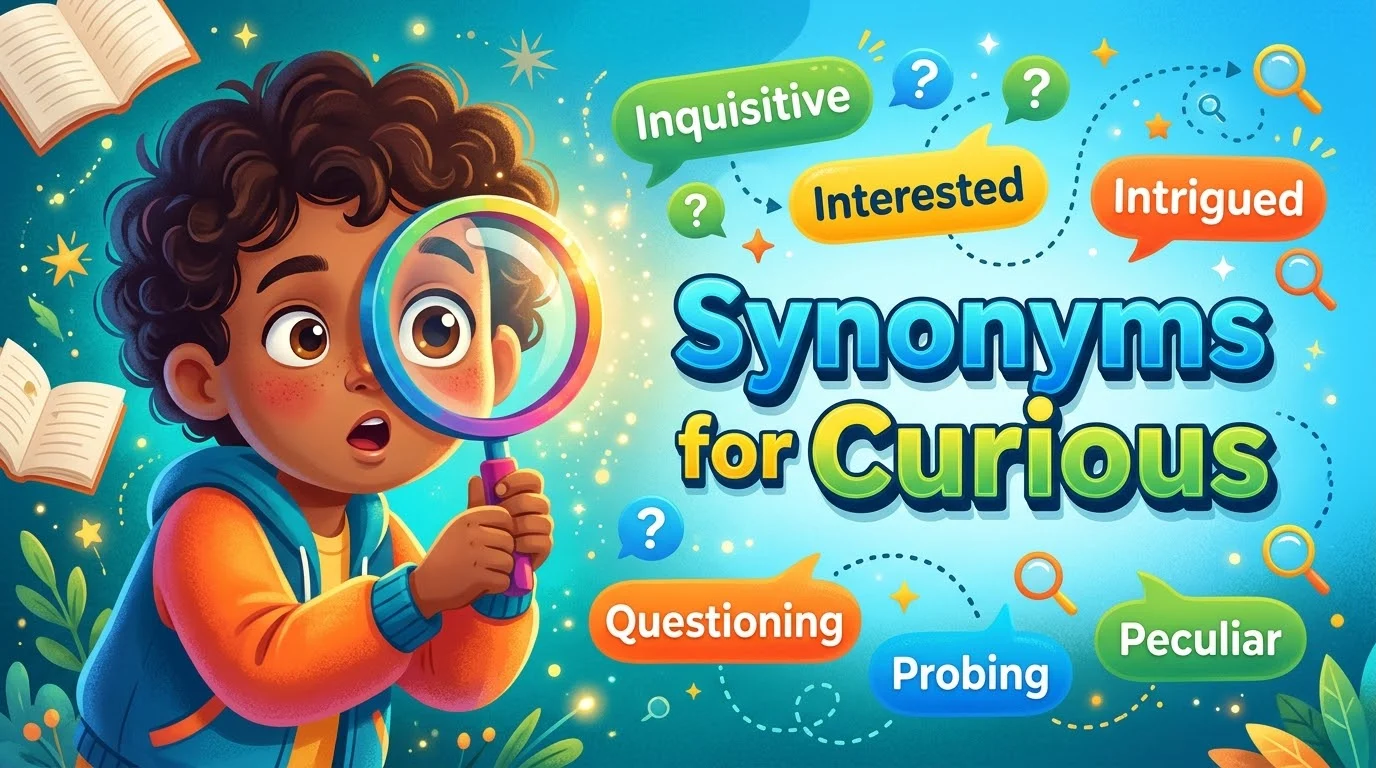
Do you keep using the word “curious” in essays, stories, classroom materials, performance reviews, or everyday conversation? While it is one of the most natural and engaging adjectives in English, repeating it can make your writing feel flat, repetitive, or overly simple.
The good news is that the best alternative depends on what you actually mean. You might be describing a genuine desire to learn, an intrusive interest in others’ affairs, a sense of wonder, or something simply strange and unusual.
This guide explains synonyms for “curious” by meaning, tone, context, and usage. You will learn which alternatives work best in academic writing, professional communication, creative expression, education, and casual conversation.
Quick Answer: What Does “Curious” Mean?
“Curious” describes a strong desire to know or learn something, an interest in others’ affairs, or something strange and unusual. Depending on context, alternatives include inquisitive, interested, intrigued, eager to learn, questioning, probing, nosy, peculiar, odd, and unusual.
Meaning, Tone, and Context
Simple Definition
“Curious” generally refers to:
- Desire to learn: wanting to know or understand something
- Interest: being intrigued by a topic or person
- Questioning nature: asking many questions
- Intrusiveness: being nosy about others’ affairs (negative)
- Strangeness: something odd or unusual (a different sense)
Part of Speech
“Curious” functions primarily as an adjective.
Examples:
- “She was curious about the new student.”
- “He has a curious mind.”
- “It was a curious coincidence.”
Related Forms:
- Curiously (adverb): in a curious manner
- Curiosity (noun): the desire to know
- Curiousness (noun): the quality of being curious
- Incurious (adjective): not curious
Positive, Negative, or Neutral Tone
“Curious” is generally positive but can be negative depending on context.
Positive associations:
- “She has a curious mind and loves learning.”
- “The children were curious about the world.”
Negative contexts:
- “He was curious about his neighbor’s affairs.” (nosy)
- “The curious smell made her gag.” (strange)
Neutral contexts:
- “I’m curious to know the results.”
- “It was a curious coincidence.”
Formality Level
“Curious” is a standard word that works in both formal and informal English. It is appropriate in academic papers, business communication, creative writing, and casual conversation.
However, more specific alternatives can add precision and variety depending on the context.
Common Use Cases
“Curious” commonly appears in:
- Education: curious students, curious minds
- Science: curious about the natural world
- Everyday conversation: curious about news, curious to know
- Creative writing: curious characters, curious events
- Negative contexts: nosy neighbors, prying questions
- Descriptive writing: curious objects, curious behavior
Important Word Forms
- Curious (adjective): eager to know or learn
- Curiously (adverb): in a curious manner
- Curiosity (noun): the desire to know
- Curiousness (noun): the quality of being curious
- Incurious (adjective): not curious
When and How to Use “Curious”
Use “curious” when you want to describe a desire to learn, an interest in something, or something strange. Because the word is broad, more specific alternatives can add precision depending on the context.
Professional
“We are curious to hear your feedback on the proposal.”
This works naturally in business communication.
Academic
“The study examines how curious children develop problem-solving skills.”
The term is appropriate in academic research.
Personal
“I’m curious about what happened at the meeting.”
The word sounds natural in everyday conversation.
Creative
“The curious stranger asked endless questions about the town.”
The word creates intrigue in creative writing.
Education
“Teachers should encourage curious students to ask questions.”
This is appropriate in educational contexts.
Negative Context
“The curious neighbor was always peering through the curtains.”
This implies nosiness.
Another Word for “Curious”
There is no single perfect synonym because “curious” can refer to a desire to learn, interest, intrusiveness, or strangeness.
- Desire to learn: inquisitive, interested, eager to learn, questioning, probing
- Interest: intrigued, fascinated, absorbed, captivated
- Intrusiveness: nosy, prying, meddlesome, intrusive
- Strangeness: peculiar, odd, unusual, strange, bizarre
If you need one broad alternative, “inquisitive” works for a desire to learn, while “intrigued” works for interest. “Peculiar” works for strangeness.
When Not to Use “Curious”
“Curious” can become too vague when you need to specify exactly what kind of curiosity you are describing.
Consider:
“She was curious.”
This statement does not tell readers whether she wanted to learn, was being nosy, or found something strange.
A more precise sentence could be:
“She was inquisitive and asked thoughtful questions about the experiment.”
Similarly, avoid using “curious” when you mean “strange” in a formal context. Use “peculiar”, “unusual”, or “odd” instead.
Words Commonly Confused With “Curious”
Curious vs. Inquisitive
Inquisitive emphasizes asking questions and seeking knowledge. Curious is broader.
Example:
“The inquisitive student asked many questions.” (questioning)
“The curious child explored the garden.” (broader)
Curious vs. Interested
Interested means wanting to know more about something. Curious can be stronger.
Example:
“I’m interested in art.” (general interest)
“I’m curious about how it works.” (desire to know)
Curious vs. Nosy
Nosy is negative and means prying into others’ affairs. Curious is neutral or positive.
Example:
“The nosy neighbor asked personal questions.” (negative)
“The curious neighbor asked about the new family.” (neutral)
Curious vs. Peculiar
Peculiar means strange or unusual. Curious can also mean strange but is more often about wanting to know.
Example:
“A peculiar smell.” (strange)
“A curious smell.” (strange, literary)
Curious vs. Fascinated
Fascinated means extremely interested. Curious is broader.
Example:
“She was fascinated by the stars.” (extremely interested)
“She was curious about the stars.” (wanting to know)
Curious vs. Eager
Eager means strongly wanting to do something. Curious means wanting to know something.
Example:
“She was eager to start.” (wanting to act)
“She was curious to learn.” (wanting to know)
Best Synonym by Context for “Curious”
| Context | Best Synonym | Why It Works | Example |
|---|---|---|---|
| Formal writing | Inquisitive, probing | Precise and professional | The inquisitive researcher asked probing questions. |
| Academic writing | Inquisitive, questioning | Standard academic usage | The study examines inquisitive behavior in children. |
| Business/Professional | Interested, intrigued | Professional and clear | We are interested in your feedback. |
| Education | Eager to learn, inquisitive | Educational context | Teachers encourage inquisitive students. |
| Creative writing | Intrigued, questioning | Adds literary depth | The stranger was intrigued by the town’s secrets. |
| Negative context | Nosy, prying, meddlesome | Negative or humorous | The nosy neighbor watched from the window. |
| Strangeness | Peculiar, odd, unusual | Strange or unusual | It was a peculiar coincidence. |
| Casual conversation | Interested, wondering | Natural and informal | I’m wondering what happened. |
| Science | Inquisitive, investigative | Scientific context | The inquisitive mind seeks answers. |
| Leadership | Open-minded, questioning | Leadership and growth | Good leaders are open-minded and questioning. |
| Personal growth | Eager to learn, open-minded | Personal development | She is eager to learn new skills. |
| Descriptive writing | Bizarre, strange, curious | Descriptive and literary | The curious object glowed in the dark. |
Which Synonym Should You Choose?
Start by identifying what kind of curiosity you are describing.
- Desire to learn: inquisitive, interested, eager to learn, questioning, probing
- Interest: intrigued, fascinated, absorbed, captivated
- Intrusiveness: nosy, prying, meddlesome, intrusive
- Strangeness: peculiar, odd, unusual, strange, bizarre
10 Key Synonyms for “Curious”
The table below includes accurate alternatives with clear meanings and usage contexts.
| Synonym | Simple Meaning | Best Used For | Example Sentence |
|---|---|---|---|
| Inquisitive | Eager to learn or ask questions | Education, general | The inquisitive student asked many questions. |
| Interested | Wanting to know more | General, professional | I’m interested in learning more about the role. |
| Intrigued | Fascinated or curious | Creative, professional | She was intrigued by the mysterious letter. |
| Eager to learn | Wanting to gain knowledge | Education, personal growth | The intern is eager to learn new skills. |
| Questioning | Asking many questions | Academic, education | The questioning mind seeks answers. |
| Probing | Investigating deeply | Academic, investigative | The reporter asked probing questions. |
| Nosy | Prying into others’ affairs | Negative, informal | The nosy neighbor watched from the window. |
| Peculiar | Strange or unusual | Descriptive, formal | It was a peculiar coincidence. |
| Odd | Unusual or strange | General, casual | The machine made an odd noise. |
| Unusual | Not common or typical | General, formal | It was an unusual sight. |
Synonym Groups and Usage Differences
Professional vs. Personal Synonyms
Professional writing benefits from specific terms such as interested, inquisitive, probing, and open-minded.
Personal communication often uses curious itself or casual alternatives like wondering, interested, or nosy.
Compare:
“I’m wondering what happened.” (personal)
“We are interested in your feedback.” (professional)
Formal vs. Conversational Synonyms
Curious works in both formal and conversational English.
Formal alternatives: inquisitive, probing, peculiar, questioning
Conversational alternatives: wondering, interested, nosy
Examples:
“The inquisitive researcher asked probing questions.” (formal)
“I’m just wondering what happened.” (conversational)
Academic Synonyms
Academic writing should distinguish between curious (general), inquisitive (questioning), investigative (researching), and questioning (challenging).
For example:
“The study examines inquisitive behavior in young children.”
“The investigative reporter uncovered new evidence.”
Professional and Business Synonyms
Business writing often benefits from phrases such as interested, open to learning, proactive, and engaged.
Instead of:
“We are curious about your feedback.”
Consider:
“We are interested in your feedback and would appreciate your insights.”
Creative or Literary Synonyms
Creative writing can use intrigued, fascinated, captivated, questioning, and mystified depending on the context.
For example:
“The stranger was intrigued by the town’s secrets.”
“She was captivated by the mysterious painting.”
Slang or Modern Synonyms
Nosy is common in casual negative contexts.
Curious itself is common in casual speech.
Wondering is casual for wanting to know.
Nosey (British spelling) is common.
Examples:
“I’m just wondering what happened.” (casual)
“Don’t be so nosy!” (casual, negative)
Strongest vs. Weaker Synonyms
“Curious” synonyms vary in intensity:
Milder: interested, wondering
Moderate: curious, inquisitive, questioning
Strong: intrigued, fascinated, probing
Very Strong: obsessed, consumed, captivated
Emotional vs. Neutral Synonyms
“Curious” is generally neutral but can be emotional.
Emotional alternatives: intrigued, fascinated, captivated
Neutral alternatives: interested, questioning, probing
Examples:
“She was fascinated by the discovery.” (emotional)
“The reporter asked probing questions.” (neutral)
Antonyms of “Curious”
“Curious” has several antonyms depending on context:
| Antonym | Context | Meaning | Example Sentence |
|---|---|---|---|
| Indifferent | Interest | Having no interest | He was indifferent to the news. |
| Uninterested | Interest | Not interested | She seemed uninterested in the topic. |
| Apathetic | Interest | Showing no interest | The students were apathetic about the project. |
| Incurious | Learning | Not curious | He was incurious about the world. |
| Bored | Interest | Not interested | She was bored by the lecture. |
| Ordinary | Strangeness | Normal | It was an ordinary day. |
| Common | Strangeness | Usual | It was a common mistake. |
Comparison: “Curious” vs. Similar Words
Curious vs. Inquisitive
Main difference: Inquisitive emphasizes asking questions and seeking knowledge. Curious is broader.
Examples:
“The inquisitive student asked many questions.” (questioning)
“The curious child explored the garden.” (broader)
Curious vs. Interested
Main difference: Interested means wanting to know more about something. Curious can be stronger.
Examples:
“I’m interested in art.” (general interest)
“I’m curious about how it works.” (desire to know)
Curious vs. Nosy
Main difference: Nosy is negative and means prying into others’ affairs. Curious is neutral or positive.
Examples:
“The nosy neighbor asked personal questions.” (negative)
“The curious neighbor asked about the new family.” (neutral)
Curious vs. Peculiar
Main difference: Peculiar means strange or unusual. Curious can also mean strange but is more often about wanting to know.
Examples:
“A peculiar smell.” (strange)
“A curious smell.” (strange, literary)
Curious vs. Fascinated
Main difference: Fascinated means extremely interested. Curious is broader.
Examples:
“She was fascinated by the stars.” (extremely interested)
“She was curious about the stars.” (wanting to know)
Curious vs. Eager
Main difference: Eager means strongly wanting to do something. Curious means wanting to know something.
Examples:
“She was eager to start.” (wanting to act)
“She was curious to learn.” (wanting to know)
Common Phrases and Expressions with “Curious”
1. Curious about
Meaning:
Wanting to know about something.
Example:
“I’m curious about your experience.”
2. Curious to know
Meaning:
Wanting to find out.
Example:
“I’m curious to know the results.”
3. Curious mind
Meaning:
A mind eager to learn.
Example:
“She has a curious mind.”
4. Curious glance
Meaning:
A look of interest or questioning.
Example:
“He gave her a curious glance.”
5. Curious coincidence
Meaning:
A strange but coincidental event.
Example:
“It was a curious coincidence that they met again.”
6. Curious case
Meaning:
An unusual situation.
Example:
“It was a curious case that puzzled the detectives.”
7. Curious behavior
Meaning:
Strange or unusual behavior.
Example:
“The animal’s curious behavior surprised the researchers.”
8. Just curious
Meaning:
Only wanting to know (often used to soften a question).
Example:
“I’m just curious—why did you choose that?”
9. Curiosity killed the cat
Meaning:
Being too curious can lead to trouble.
Example:
“Remember, curiosity killed the cat.”
10. Burning curiosity
Meaning:
An intense desire to know.
Example:
“She had a burning curiosity about the world.”
Common Mistakes to Avoid
1. Using “curious” when a more precise term is available
If you mean inquisitive, interested, nosy, or peculiar, use the more specific word.
Vague: “She was curious.”
Precise: “She was inquisitive and asked thoughtful questions.”
2. Confusing “curious” with “interested”
Interested means wanting to know more about something. Curious can be stronger.
Incorrect: “I’m curious in art.” (if general interest)
Correct: “I’m interested in art.”
3. Using “curious” in negative contexts when “nosy” is needed
Nosy is negative and means prying into others’ affairs.
Neutral: “The curious neighbor asked about the new family.”
Negative: “The nosy neighbor asked personal questions.”
4. Overusing “curious” in writing
Repetition can make content feel dull. Use alternatives such as inquisitive, interested, intrigued, questioning, and peculiar.
5. Choosing a synonym that changes the meaning
Do not replace curious with peculiar unless you mean strange.
Do not replace curious with nosy unless you mean prying.
FAQs
What is the best synonym for “curious”?
The best synonym depends on context. Inquisitive works for a desire to learn, interested for general interest, intrigued for fascination, nosy for intrusiveness, and peculiar for strangeness.
What is a formal synonym for “curious”?
Inquisitive, probing, questioning, and peculiar are formal synonyms.
What is an informal synonym for “curious”?
Wondering, interested, and nosy are common informal alternatives.
What is another word for “curious” in academic writing?
Inquisitive, investigative, questioning, and probing work well in academic writing.
What is the difference between “curious” and “inquisitive”?
Inquisitive emphasizes asking questions and seeking knowledge. Curious is broader.
What is the opposite of “curious”?
Depending on context, opposites include indifferent, uninterested, apathetic, incurious, and bored.
What does “curious” mean in a negative context?
In a negative context, curious often means nosy or prying—showing too much interest in others’ affairs.
Conclusion
“Curious” is a versatile and engaging word that can describe a desire to learn, interest in something, intrusiveness, or strangeness. The best synonym depends on what you actually mean.
Choose inquisitive for a desire to learn, interested for general interest, intrigued for fascination, nosy for intrusiveness, and peculiar for strangeness.
