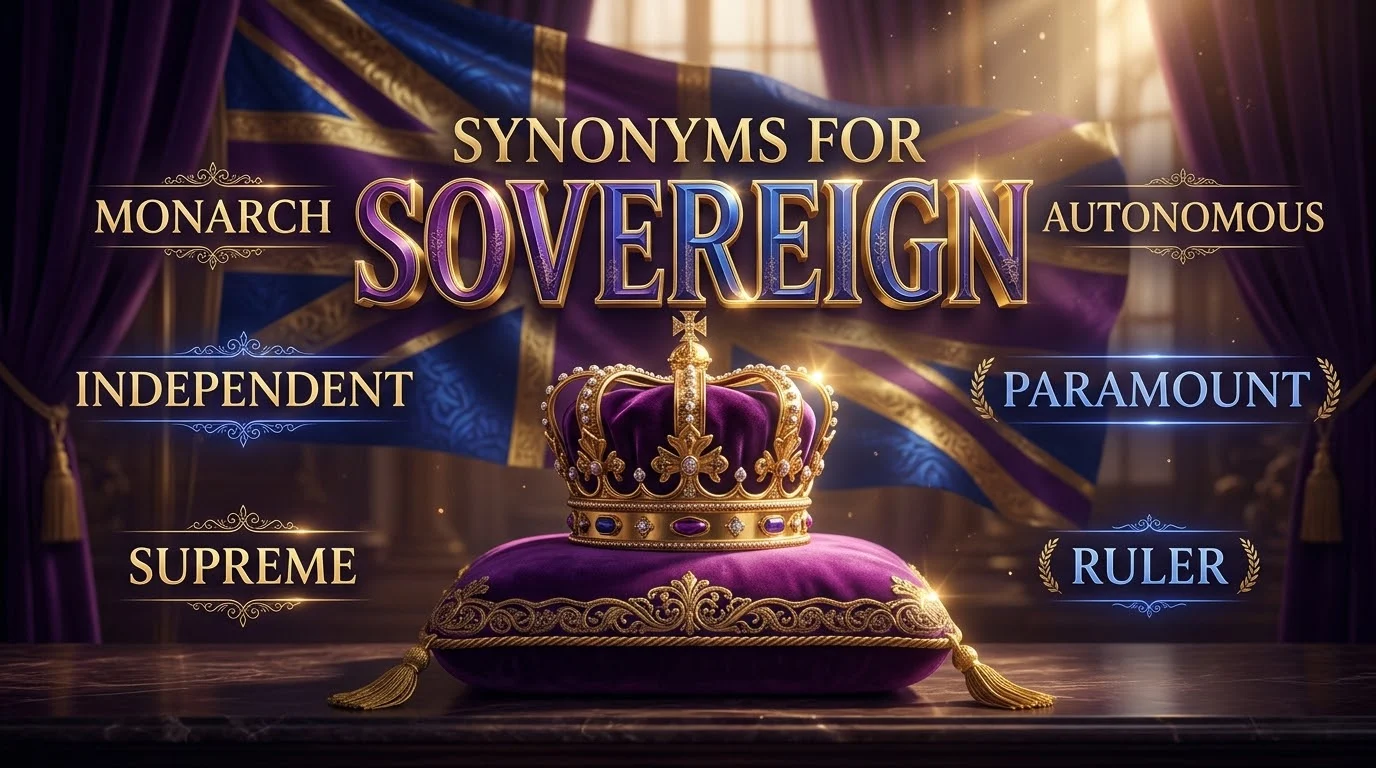
Do you keep using the word “sovereign” in essays, political analyses, legal documents, historical writing, or everyday conversation? While it is one of the most authoritative and precise words in English, repeating it can make your writing feel flat, repetitive, or overly formal.
The good news is that the best alternative depends on what you actually mean. You might be describing a monarch, a nation’s independence, supreme authority, or something of the highest excellence. “Sovereign” can function as both a noun and an adjective, and each use has its own set of alternatives.
This guide explains synonyms for “sovereign” by meaning, tone, context, and usage. You will learn which alternatives work best in academic writing, political discourse, legal contexts, historical writing, and casual conversation.
Quick Answer: What Does “Sovereign” Mean?
“Sovereign” describes a person or institution with supreme authority, a nation that is independent and self-governing, or something of the highest rank or excellence. As a noun, it refers to a king, queen, or other supreme ruler. Depending on context, alternatives include monarch, ruler, supreme, absolute, independent, autonomous, self-governing, paramount, chief, and unrestricted.
Meaning, Tone, and Context
Simple Definition
“Sovereign” generally refers to:
- A supreme ruler: a king, queen, emperor, or other monarch
- Supreme authority: having unlimited power or the highest rank
- Independence: a state or nation that governs itself without external control
- Highest importance: paramount or most significant
- Excellence: of the highest quality (archaic or formal)
Part of Speech
“Sovereign” functions as both a noun and an adjective.
Noun Examples:
- “The sovereign addressed the nation.”
- “Queen Elizabeth II was Britain’s longest-reigning sovereign.”
Adjective Examples:
- “The country is a sovereign state.”
- “The king held sovereign power.”
- “This is a matter of sovereign importance.”
Related Forms:
- Sovereignty (noun): supreme power or authority
- Sovereignly (adverb): in a sovereign manner
- Suzerain (noun): a sovereign or overlord (historical)
Positive, Negative, or Neutral Tone
“Sovereign” is generally neutral or positive, but it can be negative when describing absolute or unchecked power.
Positive associations:
- “The nation is proud of its sovereign status.”
- “She ruled with sovereign grace.”
Negative contexts:
- “The sovereign’s absolute power was criticized.”
- “He acted with sovereign contempt for the rules.”
Formality Level
“Sovereign” is a formal word that works well in academic papers, political analyses, legal documents, and historical writing. In casual conversation, simpler alternatives like king, queen, ruler, or independent may be more natural.
However, more specific alternatives can add precision and variety depending on the context.
Common Use Cases
“Sovereign” commonly appears in:
- Politics: sovereign state, sovereign government, sovereign rights
- Monarchy: the sovereign, the reigning sovereign
- Law: sovereign immunity, sovereign power
- Finance: sovereign debt, sovereign wealth fund
- Philosophy: sovereign individual, sovereign authority
- History: sovereign rulers, sovereign nations
Important Word Forms
- Sovereign (noun): a supreme ruler
- Sovereign (adjective): supreme, independent, paramount
- Sovereignty (noun): supreme power or authority
- Sovereignly (adverb): in a sovereign manner
When and How to Use “Sovereign”
Use “sovereign” when you want to describe a supreme ruler, a nation’s independence, supreme authority, or something of paramount importance. Because the word is formal and powerful, more specific alternatives can add precision depending on the context.
Professional (Politics)
“The country is recognized as a sovereign state by the international community.”
This works naturally in political and diplomatic contexts.
Academic
“The study examines the concept of sovereign power in early modern Europe.”
The term is appropriate in academic research.
Legal
“The court ruled that the sovereign immunity doctrine applied.”
This is standard in legal writing.
Historical
“The sovereign’s decree was absolute.”
The word creates a sense of historical authority.
Financial
“The country’s sovereign debt reached record levels.”
This is common in economic and financial reporting.
Personal (Formal)
“She handled the situation with sovereign composure.”
The word adds a formal, elevated tone.
Another Word for “Sovereign”
There is no single perfect synonym because “sovereign” can refer to a monarch, independence, supreme authority, or paramount importance.
- Monarch context: monarch, ruler, king/queen, emperor/empress, potentate
- Independence context: independent, autonomous, self-governing, free
- Supreme authority context: supreme, absolute, unlimited, paramount
- Highest importance context: paramount, chief, principal, predominant
- Excellence context: excellent, outstanding, efficacious (archaic)
If you need one broad alternative, “monarch” works for the noun, while “independent” works for the adjective describing states. “Supreme” works for authority.
When Not to Use “Sovereign”
“Sovereign” can become too formal or vague when you need to specify exactly what you mean.
Consider:
“The sovereign made a decision.”
This statement does not tell readers whether you mean a king, a queen, a government, or a parliament.
A more precise sentence could be:
“The monarch made a decision.”
Similarly, avoid using “sovereign” when you mean “independent” in a simple context. Use “independent” or “self-governing” instead.
Words Commonly Confused With “Sovereign”
Sovereign vs. Monarch
Monarch is a specific type of sovereign (a king or queen). Sovereign is broader and can refer to any supreme ruler or a state itself.
Example:
“The monarch waved to the crowd.” (specific)
“The sovereign addressed the nation.” (broader)
Sovereign vs. Independent
Independent is the general term for self-governance. Sovereign is more formal and political.
Example:
“The country became independent in 1960.” (general)
“The country is a sovereign state.” (formal)
Sovereign vs. Supreme
Supreme means highest in rank or authority. Sovereign can mean supreme but also refers to independence or a ruler.
Example:
“The supreme court made the ruling.” (highest court)
“The sovereign power lies with the people.” (political authority)
Sovereign vs. Absolute
Absolute means unlimited in power. Sovereign can mean absolute but also independence.
Example:
“The king had absolute power.” (unlimited)
“The king was a sovereign ruler.” (broader)
Sovereign vs. Autonomous
Autonomous means self-governing within a larger system. Sovereign means fully independent.
Example:
“The region is autonomous but not sovereign.” (self-governing)
“The nation is a sovereign state.” (fully independent)
Sovereign vs. Paramount
Paramount means most important. Sovereign can mean paramount but also refers to rulers or states.
Example:
“Safety is paramount.” (most important)
“This is a matter of sovereign importance.” (formal, highest)
Best Synonym by Context for “Sovereign”
| Context | Best Synonym | Why It Works | Example |
|---|---|---|---|
| Formal writing | Supreme, paramount | Precise and formal | The matter is of supreme importance. |
| Academic writing | Autonomous, independent | Standard academic usage | The study examines autonomous regions. |
| Political context | Independent, self-governing | Political and diplomatic | The nation is an independent state. |
| Monarchy context | Monarch, ruler | Historical and royal | The monarch addressed the parliament. |
| Legal context | Supreme, absolute | Legal and authoritative | The court has supreme authority. |
| Financial context | Sovereign, national | Economic and financial | The country’s sovereign debt is rising. |
| Casual conversation | King, queen, ruler | Natural and informal | The king visited the town. |
| Creative writing | Regal, imperial, majestic | Adds literary depth | The regal figure commanded the room. |
| Independence context | Free, self-determining | Political and historical | The nation is finally free. |
| Authority context | Chief, principal, dominant | Leadership and authority | The chief authority rests with the council. |
| Excellence context | Excellent, outstanding | Formal and archaic | A sovereign remedy for all ills. |
Which Synonym Should You Choose?
Start by identifying what kind of sovereign you are describing.
- Monarch: monarch, ruler, king/queen, emperor/empress, potentate
- Independence: independent, autonomous, self-governing, free
- Supreme authority: supreme, absolute, unlimited, paramount
- Highest importance: paramount, chief, principal, predominant
- Excellence: excellent, outstanding, efficacious
10 Key Synonyms for “Sovereign”
The table below includes accurate alternatives with clear meanings and usage contexts.
| Synonym | Simple Meaning | Best Used For | Example Sentence |
|---|---|---|---|
| Monarch | A king or queen | Monarchy, royalty | The monarch addressed the nation. |
| Ruler | A person who governs | General, political | The ruler held absolute power. |
| Independent | Self-governing | Politics, states | The country is an independent state. |
| Autonomous | Self-governing within a system | Politics, regions | The region is autonomous but not sovereign. |
| Supreme | Highest in authority | Authority, law | The court has supreme authority. |
| Absolute | Unlimited in power | Monarchy, authority | The king had absolute power. |
| Paramount | Most important | Importance, priority | Safety is paramount. |
| Chief | Most important or highest | Leadership, authority | The chief authority rests with the council. |
| Self-governing | Governing itself | Politics, independence | The territory is self-governing. |
| Potentate | A powerful ruler | Formal, historical | The potentate ruled with an iron fist. |
Synonym Groups and Usage Differences
Professional vs. Personal Synonyms
Professional writing benefits from specific terms such as independent, autonomous, supreme, paramount, and self-governing.
Personal communication often uses simpler alternatives like king, queen, ruler, or independent.
Compare:
“The king visited the town.” (personal)
“The sovereign state has the right to self-determination.” (professional)
Formal vs. Conversational Synonyms
Sovereign is formal. Simpler alternatives work better in casual conversation.
Formal alternatives: supreme, paramount, autonomous, potentate
Conversational alternatives: king, queen, ruler, independent
Examples:
“The potentate ruled with absolute authority.” (formal)
“The queen waved to the crowd.” (conversational)
Academic Synonyms
Academic writing should distinguish between sovereign (general), autonomous (self-governing within a system), independent (free from external control), and supreme (highest authority).
For example:
“The study examines autonomous regions within sovereign states.”
“The concept of supreme authority is central to political theory.”
Professional and Business Synonyms
Business and financial writing often benefits from phrases such as sovereign debt, sovereign wealth fund, and sovereign risk.
Instead of:
“The country’s sovereign debt is rising.”
Consider:
“The nation’s sovereign debt levels have reached record highs.”
Creative or Literary Synonyms
Creative writing can use regal, imperial, majestic, kingly, queenly, and monarchical depending on the context.
For example:
“The regal figure commanded the room.”
“She carried herself with a queenly grace.”
Slang or Modern Synonyms
King and queen are common casual terms.
Ruler is common in casual and formal contexts.
Boss is slang for a person in charge (not a true synonym for sovereign).
Examples:
“The king is visiting today.” (casual)
“She’s the boss around here.” (slang, not political)
Strongest vs. Weaker Synonyms
“Sovereign” synonyms vary in intensity:
Milder: ruler, chief, principal
Moderate: sovereign, independent, autonomous
Strong: supreme, absolute, paramount
Very Strong: omnipotent, absolute, unlimited
Emotional vs. Neutral Synonyms
“Sovereign” is generally neutral or formal.
Emotional alternatives: regal, majestic, imperial (positive)
Neutral alternatives: independent, autonomous, supreme
Examples:
“The regal ceremony was breathtaking.” (emotional, positive)
“The state is independent.” (neutral)
Antonyms of “Sovereign”
“Sovereign” has several antonyms depending on context:
| Antonym | Context | Meaning | Example Sentence |
|---|---|---|---|
| Dependent | Independence | Relying on others | The territory is dependent on the mainland. |
| Subordinate | Authority | Lower in rank | The local council is subordinate to the national government. |
| Subject | Monarchy | Under the rule of another | The people were subjects of the king. |
| Colonial | Independence | Ruled by another country | The colonial government was overthrown. |
| Inferior | Rank | Lower in status | The position is inferior to the director. |
Comparison: “Sovereign” vs. Similar Words
Sovereign vs. Monarch
Main difference: Monarch is a specific type of sovereign (a king or queen). Sovereign is broader and can refer to any supreme ruler or a state itself.
Examples:
“The monarch waved to the crowd.” (specific)
“The sovereign addressed the nation.” (broader)
Sovereign vs. Independent
Main difference: Independent is the general term for self-governance. Sovereign is more formal and political.
Examples:
“The country became independent in 1960.” (general)
“The country is a sovereign state.” (formal)
Sovereign vs. Supreme
Main difference: Supreme means highest in rank or authority. Sovereign can mean supreme but also refers to independence or a ruler.
Examples:
“The supreme court made the ruling.” (highest court)
“The sovereign power lies with the people.” (political authority)
Sovereign vs. Absolute
Main difference: Absolute means unlimited in power. Sovereign can mean absolute but also independence.
Examples:
“The king had absolute power.” (unlimited)
“The king was a sovereign ruler.” (broader)
Sovereign vs. Autonomous
Main difference: Autonomous means self-governing within a larger system. Sovereign means fully independent.
Examples:
“The region is autonomous but not sovereign.” (self-governing)
“The nation is a sovereign state.” (fully independent)
Sovereign vs. Paramount
Main difference: Paramount means most important. Sovereign can mean paramount but also refers to rulers or states.
Examples:
“Safety is paramount.” (most important)
“This is a matter of sovereign importance.” (formal, highest)
Common Phrases and Expressions with “Sovereign”
1. Sovereign state
Meaning:
An independent country with its own government.
Example:
“The country is recognized as a sovereign state.”
2. Sovereign power
Meaning:
Supreme authority.
Example:
“Sovereign power lies with the people.”
3. Sovereign immunity
Meaning:
A legal doctrine that protects a government from lawsuits.
Example:
“The court invoked sovereign immunity.”
4. Sovereign debt
Meaning:
A country’s national debt.
Example:
“The country’s sovereign debt is a major concern.”
5. Sovereign wealth fund
Meaning:
A state-owned investment fund.
Example:
“Norway’s sovereign wealth fund is the largest in the world.”
6. Sovereign rights
Meaning:
The rights of an independent state.
Example:
“The country asserted its sovereign rights over the territory.”
7. The sovereign
Meaning:
The reigning monarch.
Example:
“The sovereign opened parliament.”
8. Sovereign remedy
Meaning:
A cure-all (archaic).
Example:
“The herb was considered a sovereign remedy.”
9. Sovereign contempt
Meaning:
Utter contempt.
Example:
“He regarded the proposal with sovereign contempt.”
10. Sovereign individual
Meaning:
A person who governs themselves; an autonomous person.
Example:
“The philosophy emphasizes the sovereign individual.”
Common Mistakes to Avoid
1. Using “sovereign” when a more precise term is available
If you mean monarch, independent, supreme, or paramount, use the more specific word.
Vague: “The sovereign made a decision.”
Precise: “The monarch made a decision.”
2. Confusing “sovereign” with “independent”
Independent is the general term. Sovereign is more formal and political.
Incorrect: “The country became sovereign in 1960.” (less common)
Correct: “The country became independent in 1960.”
3. Using “sovereign” in casual writing
Casual writing benefits from simpler terms.
Formal: “The sovereign addressed the nation.”
Casual: “The king addressed the nation.”
4. Overusing “sovereign” in writing
Repetition can make content feel dull. Use alternatives such as monarch, independent, supreme, paramount, and autonomous.
5. Choosing a synonym that changes the meaning
Do not replace sovereign with autonomous unless you mean self-governing within a system.
Do not replace sovereign with absolute unless you mean unlimited power.
FAQs
What is the best synonym for “sovereign”?
The best synonym depends on context. Monarch works for a ruler, independent for a state, supreme for authority, and paramount for importance.
What is a formal synonym for “sovereign”?
Supreme, paramount, autonomous, potentate, and self-governing are formal synonyms.
What is an informal synonym for “sovereign”?
King, queen, ruler, and independent are common informal alternatives.
What is another word for “sovereign” in political writing?
Independent, autonomous, self-governing, and supreme work well in political writing.
What is the difference between “sovereign” and “monarch”?
Monarch is a specific type of sovereign (a king or queen). Sovereign is broader.
What is the opposite of “sovereign”?
Depending on context, opposites include dependent, subordinate, subject, colonial, and inferior.
What does “sovereign” mean in a financial context?
In finance, sovereign often refers to a country’s national debt, wealth fund, or risk—as in “sovereign debt.”
Conclusion
“Sovereign” is a powerful and formal word that can describe a supreme ruler, a nation’s independence, supreme authority, or something of paramount importance. The best synonym depends on what you actually mean.
Choose monarch for a ruler, independent for a state, supreme for authority, paramount for importance, autonomous for self-governance within a system, and potentate for a powerful ruler.

2 thoughts on “50+ Synonyms for Sovereign: Meanings, Examples, and Best Alternatives”