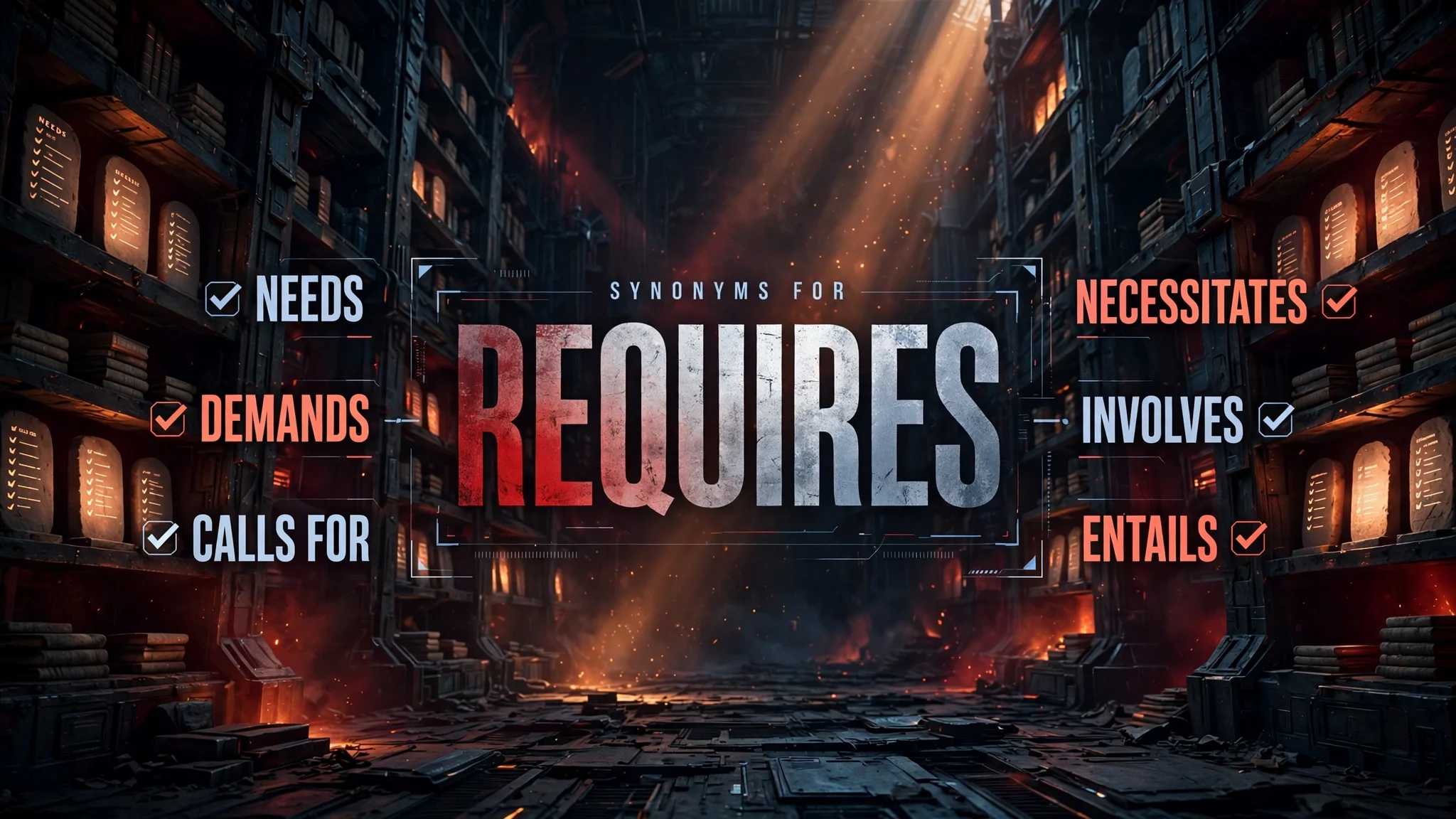
Do you keep writing requires in essays, emails, job descriptions, instructions, or reports, and then worrying that it sounds stiff, repetitive, or a little too formal? However, it is a useful verb, but it is not always the best one. For example, sometimes you mean that something is necessary, sometimes that a rule demands it, and sometimes that a task simply calls for a particular skill.
In short, the good news is that English gives you plenty of room to be precise. In fact, the best synonym for requires depends on whether you are talking about a need, an obligation, a qualification, or a condition. Therefore, this guide walks through those differences with clear meanings, realistic examples, and practical tips, so you can choose a word that fits the sentence instead of forcing the same verb into every situation.
Quick Answer: What Does “Requires” Mean?
“Requires” means that something is needed, demanded, or made necessary by a rule, a situation, or a person. The closest everyday synonyms are needs, demands, calls for, and necessitates, while the best formal choice is often necessitates or mandates.
Meaning, Tone, and Context
Simple Definition
Requires generally refers to:
- A need: something that cannot be done without a particular thing or quality.
- An obligation: something that a rule, law, or agreement insists on.
- A qualification: a skill, certificate, or experience that an applicant must have.
- A condition: a step that must be met first.
Part of Speech
Requires is the third-person singular present form of the verb require, used with he, she, it, and singular nouns. For example, it appears in the sentence “This course requires a laptop.”
- This course requires a laptop.
- The job requires two years of experience.
- The recipe requires fresh herbs, not dried ones.
Related forms: require (verb), required (adjective or past form), requirement (noun), requiring (present participle). For example, a course description might list required reading.
Positive, Negative, or Neutral Tone
Requires is usually neutral. However, it becomes firm when it comes from an authority, and simply practical when it describes what a task needs. For example, the licence requires an eye test is factual; the contract requires payment within fourteen days is firm; good bread requires patience is practical, almost warm.
Formality Level
Also, requires works in formal and neutral writing, and it is common in academic, business, legal, and technical English. However, in casual speech, people usually say needs instead: This needs a bit more salt sounds more natural than This requires a bit more salt at the dinner table.
Common Use Cases
- Job adverts: requires experience, a driving licence, or weekend work.
- Academic writing: the study requires careful sampling and clear controls.
- Rules and safety: the site requires a helmet and high-visibility clothing.
- Recipes and crafts: the dough requires a long, slow rise.
- Technology: the update requires at least 2 GB of free space.
Important Word Forms
- Require (verb): I require, you require, they require.
- Requires (verb): he requires, the course requires.
- Required (adjective): required reading, required fields.
- Requirement (noun): entry requirements, course requirements.
When and How to Use Requires
Use requires when you want to say, clearly and without apology, that something is necessary. In particular, it suits rules, standards, and tasks where there is no real shortcut. For example, a safety notice uses requires for a helmet, not a preference.
Academic
For example, the experiment requires a control group and a consistent measuring method. Therefore, this is standard in academic writing because it states a condition plainly.
Social
For example, the club requires members to sign in at the door. However, in everyday social settings, needs or asks for often sounds friendlier.
Literary
The journey requires more courage than she expected. For example, in fiction, a more vivid verb such as demands or calls for can carry extra weight. Therefore, a vivid verb can make the necessity feel personal rather than formal.
Creative
For example, the painting requires a steady hand and a very patient eye. Therefore, creative writing benefits from synonyms that show effort, not just obligation.
Casual
For example, this recipe needs, rather than requires, an hour in the oven. Therefore, casual writing usually prefers needs, takes, or calls for.
Another Word for Requires
There is no single perfect synonym because requires covers several ideas. However, if you need one broad alternative, needs is the most natural everyday choice, demands is stronger, and necessitates is the most formal. Therefore, match the synonym to the kind of necessity you mean.
- Simple need: needs, takes, involves, calls for.
- Strong obligation: demands, mandates, stipulates, obliges.
- Formal necessity: necessitates, entails, presupposes.
- Qualification: calls for, asks for, expects, specifies.
When Not to Use Requires
Requires can sound cold or bureaucratic when a softer word would do, and it can be vague when you do not say who requires it or why. Therefore, avoid it when you simply mean would be nice, usually involves, or might help. Vague: The project requires teamwork. Clearer: The project calls for close teamwork, because design, testing, and launch all overlap. In addition, do not use requires for a preference: The report requires a blue cover is misleading if a blue cover is only a house style, not a rule. Therefore, name the rule or the person behind it whenever you keep requires.
Words Commonly Confused With Requires
Requires vs. Needs
Needs is broader and more casual; requires often implies a rule or fixed condition. For example, the plant needs water. (general) / The visa requires a valid passport. (rule) Therefore, choose needs for casual contexts and requires for rules.
Requires vs. Demands
Demands is stronger and more forceful, often with a person insisting. For example, the manager demands a reply by Friday. (insistence) / The form requires a signature. (condition) Therefore, reserve demands for forceful insistence.
Requires vs. Necessitates
Necessitates is the formal, almost technical twin of requires. For example, the delay necessitates a new timetable. (formal) / The course requires a laptop. (plain) Therefore, use necessitates in formal or technical writing.
Requires vs. Entails
Entails means that something is involved as a necessary part, not necessarily ordered by someone. For example, the job entails travel. / The job requires a licence. Therefore, use entails when describing a necessary part.
Requires vs. Calls For
Calls for is idiomatic and often about qualities or action. For example, this moment calls for honesty. / The exam requires photo ID.
Requires vs. Involves
Involves is softer: it says something is part of a process, not that it is compulsory. For example, the role involves training new staff. / The role requires a teaching certificate.
Best Synonym by Context for Requires
| Context | Best Synonym | Why It Works | Example |
|---|---|---|---|
| Everyday speech | Needs | Natural and simple | “This needs a little more time.” |
| Academic writing | Necessitates | Formal and precise | “The method necessitates careful sampling.” |
| Job adverts | Calls for | Clear about qualities | “The role calls for strong communication skills.” |
| Legal and rules | Mandates | Official and binding | “The law mandates safety checks.” |
| Business | Demands | Firm and direct | “The deadline demands quick decisions.” |
| Creative writing | Calls for, demands | Vivid and emotional | “The scene demands total honesty.” |
| Technical writing | Entails | Describes a necessary part | “The update entails a restart.” |
| Casual writing | Takes | Light and idiomatic | “This takes a bit of practice.” |
Which Synonym Should You Choose?
Start by asking what kind of necessity you mean. For example, a simple need suits needs or takes, a rule suits mandates or stipulates, a quality or skill suits calls for, formal necessity suits necessitates, and forceful insistence suits demands.
- Simple need: needs, takes, involves.
- Rule or law: mandates, stipulates, obliges.
- Skill or quality: calls for, asks for, expects.
- Formal necessity: necessitates, entails, presupposes.
10 Key Synonyms for Requires
| Synonym | Simple Meaning | Best Used For | Example Sentence |
|---|---|---|---|
| Needs | Is in need of | Everyday, general | The garden needs watering. |
| Demands | Insists on | Strong, formal | The job demands accuracy. |
| Necessitates | Makes necessary | Academic, formal | The change necessitates new training. |
| Calls for | Needs, especially a quality | General, creative | Leadership calls for patience. |
| Mandates | Orders by authority | Legal, official | The policy mandates helmets on site. |
| Entails | Involves as a necessary part | Business, technical | The role entails some travel. |
| Involves | Includes as part | General, softer | The course involves group work. |
| Takes | Needs in time or effort | Casual | It takes two hours to finish. |
| Stipulates | States as a condition | Legal, contracts | The contract stipulates payment in advance. |
| Asks for | Requests as a condition | Everyday, job adverts | The post asks for a degree. |
Synonym Groups and Usage Differences
Professional vs. Personal Synonyms
Professional writing favours necessitates, mandates, and stipulates. In contrast, personal writing favours needs, takes, and calls for. For example, the move necessitates a new budget. (professional) / Moving takes a lot of planning. (personal)
Formal vs. Conversational Synonyms
Formal: necessitates, mandates, stipulates, entails. In contrast, conversational: needs, takes, asks for, calls for. For example, a formal report might say The project necessitates external review, while a team chat would say This needs a second pair of eyes.
Academic Synonyms
Therefore, academic writing should distinguish requires (a stated condition) from necessitates (a logical consequence) and entails (something involved by definition). For example: Valid results necessitate random sampling, while the module requires attendance at all labs.
Professional and Business Synonyms
Also, in business, mandates and stipulates carry legal weight, while demands signals urgency. Instead of The audit requires access, try The audit mandates full access to records when the access is truly compulsory.
Creative or Literary Synonyms
Creative writing can use demands, exact, and calls for to show pressure or character: The mountain demanded everything she had left. Therefore, that is stronger than a flat statement of need.
Slang or Modern Synonyms
There is no true slang synonym for requires. Instead, modern informal English often drops the verb altogether: Laptop needed for this course, or No experience needed, both common in short adverts and messages.
Strongest vs. Weaker Synonyms
Milder: involves, takes, asks for. Moderate: requires, needs, calls for. Strong: demands, mandates, necessitates. Finally, very strong: stipulates, obliges, exacts.
Emotional vs. Neutral Synonyms
Emotional: demands, exacts. Neutral: needs, entails, involves, necessitates. For example, the illness demanded rest feels personal; Recovery entails rest feels clinical. In contrast, neutral wording sounds clinical rather than personal.
Antonyms of Requires
| Antonym | Context | Meaning | Example Sentence |
|---|---|---|---|
| Allows | General | Permits | The ticket allows one bag. |
| Permits | Rules | Gives permission | The rule permits late entry. |
| Waives | Formal | Removes a requirement | The university waives the fee. |
| Excuses | Personal | Frees from a duty | She was excused from the test. |
| Optional | General | Not required | Homework is optional this week. |
| Forgoes | Formal | Does without | He forgoes the extra training. |
Comparison: Requires vs. Similar Words
Requires vs. Needs
Main difference: needs is general and casual, while requires often points to a rule or fixed condition. For example, the baby needs sleep. In contrast, the course requires a pass mark of 60 percent.
Requires vs. Demands
Main difference: demands adds insistence and urgency. For example, the client demands an answer today. In contrast, the application requires two references.
Requires vs. Necessitates
Main difference: necessitates is formal and often describes a logical result, not a person giving an order. For example, the delay necessitates a new plan. In contrast, the plan requires approval.
Requires vs. Entails
Main difference: entails describes what is involved, while requires states what must be present. For example, the job entails weekend work. In contrast, the job requires a licence.
Requires vs. Calls For
Main difference: calls for is idiomatic and often about qualities. For example, this calls for bravery. In contrast, this requires a ticket.
Requires vs. Involves
Main difference: involves is softer and does not imply compulsion. For example, the course involves fieldwork. In contrast, the course requires fieldwork boots.
Common Phrases and Expressions with Requires
1. Requires attention
Meaning: needs to be dealt with. For example, this leak requires attention today.
2. Requires experience
Meaning: cannot be done well without prior experience. For example, the role requires experience with data tools.
3. Requires approval
Meaning: must be approved first. For example, any spending over 500 pounds requires approval.
4. Requires patience
Meaning: takes time and calm effort. For example, learning an instrument requires patience.
5. Requires no experience
Meaning: open to beginners. For example, this volunteer role requires no experience.
6. Requires a licence
Meaning: a licence is a legal condition. For example, driving a lorry requires a special licence.
7. Requires careful handling
Meaning: must be treated with care. For example, glassware requires careful handling.
8. Requires further study
Meaning: more research is needed. For example, this result requires further study.
9. Requires a signature
Meaning: signing is compulsory. For example, the delivery requires a signature.
10. Requires little effort
Meaning: is easy to do. For example, this salad requires little effort.
Common Mistakes to Avoid
1. Using requires for a preference
Therefore, if something is only preferred, say prefers or works best with. Vague: The essay requires a clear font. Precise: The essay should use a clear font.
2. Confusing requires with requests
In contrast, requests asks politely; requires insists. Incorrect: The form requires your opinion. Correct: The form requests your opinion.
3. Overusing requires in job adverts
Therefore, repeating requires in every bullet point sounds rigid. Instead, mix in calls for, involves, and you will need to keep adverts readable.
4. Forgetting who requires it
Passive, agentless requirements confuse readers. Therefore, say who sets the rule where it matters: The council requires planning permission for extensions.
5. Choosing a synonym that changes the meaning
Do not replace requires with involves when the thing is compulsory, or with demands when no one is insisting. Therefore, check whether you mean need, rule, or insistence.
FAQs
What is the best synonym for requires?
Therefore, needs is the best everyday synonym, demands is stronger, and necessitates is the best formal synonym.
What is a formal synonym for requires?
For example, necessitates, mandates, and stipulates are formal synonyms.
What is an informal synonym for requires?
In other words, needs, takes, and asks for are common informal alternatives.
What is another word for requires in a job advert?
Therefore, calls for works well for skills and qualities, while involves works for duties.
What is the difference between requires and demands?
In contrast, demands is more forceful and personal; requires states a condition, often from a rule or a task itself.
What is the opposite of requires?
Therefore, opposites include allows, permits, and waives, and the adjective optional.
What does requires mean in a contract?
In a contract, it means a party must do something, or a condition must be met, for the agreement to hold. In addition, for related word choices, see our guides to synonyms for required and synonyms for possible, and the dystopian synonym guide for a model of precise, context-based choices.
Conclusion
Requires is a clear, useful verb, but it works best when you know exactly what kind of necessity you mean. Therefore, choose needs for everyday needs, calls for for qualities and skills, mandates for rules, demands for urgency, and necessitates for formal writing. In addition, that small choice makes instructions clearer, job adverts friendlier, and essays more precise. Finally, for a dictionary definition, see Merriam-Webster on require.
