Do you keep using the word “middle” in essays, business reports, creative writing, or everyday conversation? While it is one of the most common and useful nouns in English, repeating it can make your writing feel flat, vague, or overly generic.
The good news is that the best alternative depends on what you actually mean. You might be describing a central point in space, the midpoint of time, a moderate position between extremes, the interior of something, or the waist area of the body.
This guide explains synonyms for “middle” by meaning, tone, context, and usage. You will learn which alternatives work best in academic writing, professional communication, creative expression, technical documentation, and casual conversation.
Quick Answer: What Does “Middle” Mean?
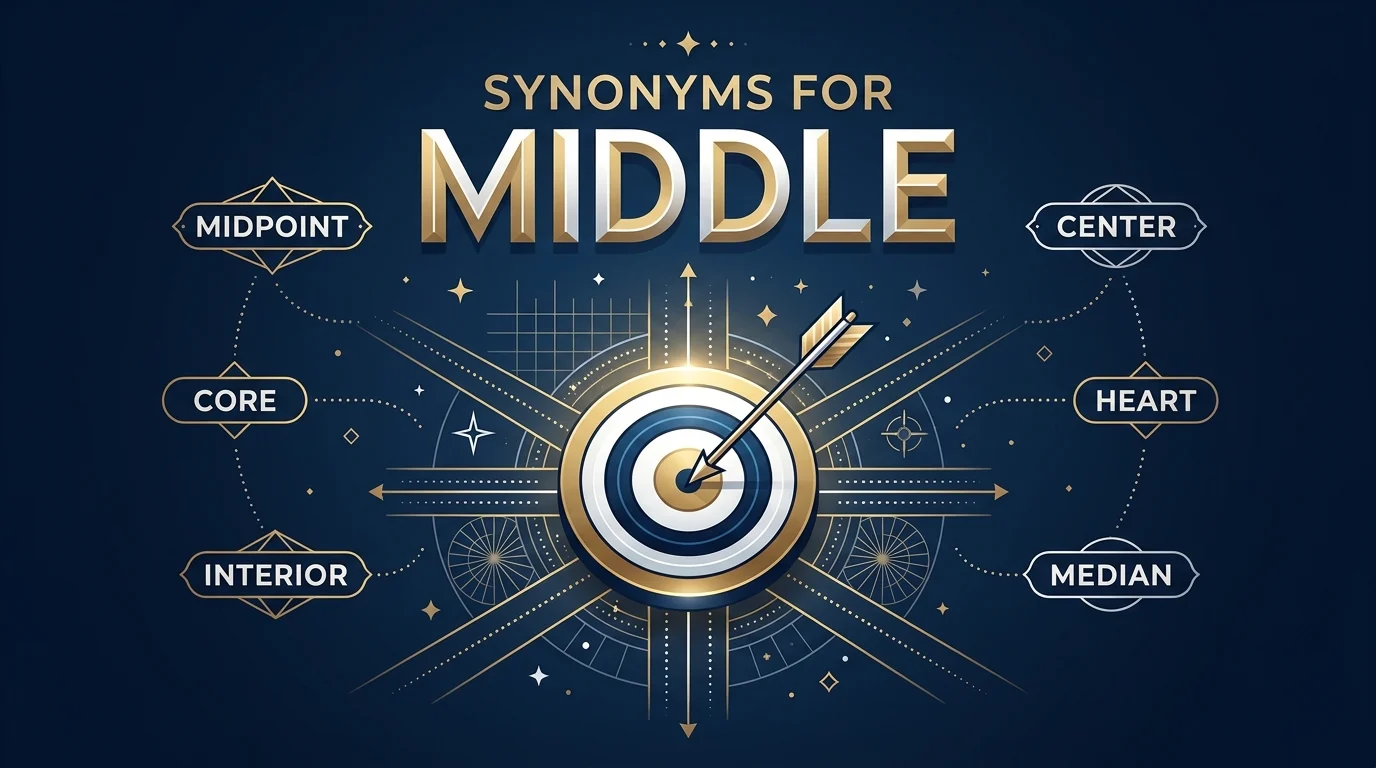
“Middle” refers to the central point or part of something, a position between two extremes, the midpoint in time or space, or the interior of an object. Depending on context, alternatives include center, midpoint, core, heart, interior, median, midst, mean, average, and central.
Meaning, Tone, and Context
Simple Definition
“Middle” generally refers to:
- Central point: the point equidistant from the edges
- Midpoint in time: the halfway point of a period
- Moderate position: between two extremes
- Interior: the inside part of something
- Waist area: the middle of the body
Part of Speech
“Middle” functions primarily as a noun and an adjective.
Noun Examples:
- “The middle of the room was empty.”
- “We are in the middle of a crisis.”
Adjective Examples:
- “The middle seat is available.”
- “She is in her middle years.”
Related Forms:
- Middle (noun/adjective): central point
- Midst (noun): the middle of a group or situation
- Midpoint (noun): the exact middle
- Median (noun/adjective): the middle value
- Intermediate (adjective): between two levels
Positive, Negative, or Neutral Tone
“Middle” is generally neutral. Its tone depends on context.
Positive associations:
- “A middle ground was reached.” (compromise)
- “The middle of the garden was a peaceful spot.”
Negative contexts:
- “He was stuck in the middle of the conflict.” (difficult)
- “The middle class is shrinking.” (economic concern)
Formality Level
“Middle” is a standard word that works in both formal and informal English. It is appropriate in academic papers, business reports, creative writing, and casual conversation.
However, more specific alternatives can add precision and variety depending on the context.
Common Use Cases
“Middle” commonly refers to:
- Space: middle of the room, middle of the road
- Time: middle of the night, middle of the century
- Social class: middle class, middle income
- Body: middle-aged, middle of the back
- Compromise: middle ground, middle way
- Position: middle child, middle seat
Important Word Forms
- Middle (noun): central point
- Middle (adjective): central
- Midst (noun): the middle of a group or situation
- Midpoint (noun): the exact middle
- Median (noun/adjective): the middle value
- Intermediate (adjective): between two levels
- Middle-aged (adjective): between young and old
When and How to Use “Middle”
Use “middle” when you want to describe a central point, a position between extremes, or the interior of something. Because the word is broad, more specific alternatives can add precision depending on the context.
Professional
“The company is in the middle of a major restructuring.”
This works naturally in business communication.
Academic
“The study examines the middle class in urban areas.”
The term is appropriate in academic research.
Personal
“The keys are in the middle drawer.”
The word sounds natural in everyday conversation.
Creative
“The middle of the forest was silent and dark.”
The word creates atmosphere in creative writing.
Business
“We need to find a middle ground between cost and quality.”
This is appropriate in business negotiations.
Time
“The power went out in the middle of the night.”
This is standard in everyday contexts.
Another Word for “Middle”
There is no single perfect synonym because “middle” can refer to a central point, midpoint in time, moderate position, interior, or waist area.
- Central point: center, midpoint, heart, core, hub
- Midpoint in time: midpoint, halfway point, midst
- Moderate position: mean, average, middle ground, compromise
- Interior: inside, interior, inner part, depths
- Waist area: waist, midsection, midriff
If you need one broad alternative, “center” works in most spatial contexts, while “midpoint” works for exact middles and “core” works for the central part of something.
When Not to Use “Middle”
“Middle” can become too vague when you need to specify exactly what kind of middle you are describing.
Consider:
“He was in the middle.”
This statement does not tell readers whether he was in the middle of a room, a conversation, a crisis, or a process.
A more precise sentence could be:
“He was in the middle of a difficult conversation.”
Similarly, avoid using “middle” when you mean “average” in a statistical context. Use “median” or “mean” instead.
Words Commonly Confused With “Middle”
Middle vs. Center
Center often refers to the exact middle point of a shape or area. Middle can be broader.
Example:
“The center of the circle was marked.” (geometric)
“The middle of the room was empty.” (broader)
Middle vs. Midpoint
Midpoint refers to the exact halfway point. Middle can be broader.
Example:
“The midpoint of the journey was a small town.” (exact)
“The middle of the journey was tiring.” (broader)
Middle vs. Core
Core refers to the central or most important part. Middle can be physical or temporal.
Example:
“The core of the issue is trust.” (central importance)
“The middle of the apple was rotten.” (physical)
Middle vs. Median
Median refers to the middle value in a statistical set. Middle is broader.
Example:
“The median income is $50,000.” (statistical)
“The middle income bracket is growing.” (broader)
Middle vs. Intermediate
Intermediate refers to a level between two others. Middle can be physical or temporal.
Example:
“She is at an intermediate level.” (level)
“She is in the middle of the process.” (position)
Middle vs. Midst
Midst refers to being surrounded by something. Middle can be physical or temporal.
Example:
“He was in the midst of a crowd.” (surrounded)
“He was in the middle of the road.” (position)
Best Synonym by Context for “Middle”
| Context | Best Synonym | Why It Works | Example |
|---|---|---|---|
| Formal writing | Center, midpoint | Precise and professional | The center of the room was empty. |
| Academic writing | Median, midpoint | Standard academic usage | The median value was calculated. |
| Business/Professional | Middle ground, compromise | Professional and clear | We need to find a middle ground. |
| Physical location | Center, heart, core | Physical location | The heart of the city was busy. |
| Time context | Midpoint, midst | Time and duration | The midpoint of the journey was a small town. |
| Interior | Inside, interior, inner part | Interior spaces | The interior of the building was modern. |
| Body | Waist, midsection, midriff | Body parts | He had a pain in his midsection. |
| Social class | Middle, median, intermediate | Social and economic | The middle class is growing. |
| Casual conversation | Middle (itself), center | Natural and informal | It’s in the middle drawer. |
| Compromise | Middle ground, mean | Negotiation | Both sides found a middle ground. |
| Group context | Midst, center | Group contexts | She was in the midst of the crowd. |
| Statistical | Median, mean, average | Statistical contexts | The median score was 75. |
Which Synonym Should You Choose?
Start by identifying what kind of middle you are describing.
- Central point: center, midpoint, heart, core, hub
- Midpoint in time: midpoint, halfway point, midst
- Moderate position: mean, average, middle ground, compromise
- Interior: inside, interior, inner part, depths
- Waist area: waist, midsection, midriff
10 Key Synonyms for “Middle”
The table below includes accurate alternatives with clear meanings and usage contexts.
| Synonym | Simple Meaning | Best Used For | Example Sentence |
|---|---|---|---|
| Center | The exact middle point | General, physical | The center of the room was empty. |
| Midpoint | The exact halfway point | Time, distance | The midpoint of the journey was a small town. |
| Core | The central or most important part | Importance, physical | The core of the issue is trust. |
| Heart | The central or most important part | Cities, importance | The heart of the city was busy. |
| Interior | The inside part | Spaces, buildings | The interior of the building was modern. |
| Median | The middle value | Statistics, data | The median score was 75. |
| Midst | The middle of a group or situation | Groups, situations | She was in the midst of the crowd. |
| Mean | The average value | Statistics, data | The mean score was 80. |
| Average | The typical or middle value | General, statistics | The average temperature was 20°C. |
| Central | Located in the middle | Location, importance | The central location was convenient. |
Synonym Groups and Usage Differences
Professional vs. Personal Synonyms
Professional writing benefits from specific terms such as center, midpoint, median, core, and compromise.
Personal communication often uses middle itself or casual alternatives like center, inside, or midst.
Compare:
“It’s in the middle drawer.” (personal)
“The median income is $50,000.” (professional)
Formal vs. Conversational Synonyms
Middle works in both formal and conversational English.
Formal alternatives: center, midpoint, median, core, intermediate
Conversational alternatives: middle, center, inside
Examples:
“The midpoint of the journey was a small town.” (formal)
“It’s in the middle.” (conversational)
Academic Synonyms
Academic writing should distinguish between middle (general), median (statistical), midpoint (exact halfway), and core (central importance).
For example:
“The median value was calculated from the data.”
“The midpoint of the study period was marked by a significant change.”
Professional and Business Synonyms
Business writing often benefits from phrases such as middle ground, compromise, core, and center.
Instead of:
“We need a middle solution.”
Consider:
“We need to find a middle ground that balances cost and quality.”
Creative or Literary Synonyms
Creative writing can use heart, core, midst, depths, and center depending on the context.
For example:
“The heart of the forest was silent and dark.”
“She found herself in the midst of chaos.”
Slang or Modern Synonyms
Middle is common in casual speech.
Dead center is casual for exact middle.
Mid is slang for mediocre or middle.
In the thick of is casual for in the middle of.
Examples:
“It’s dead center.” (casual)
“We’re in the thick of it now.” (casual)
Strongest vs. Weaker Synonyms
“Middle” synonyms vary in intensity:
Milder: average, mean, intermediate
Moderate: middle, center, midpoint
Strong: core, heart, central
Very Strong: epicenter, hub, nucleus
Emotional vs. Neutral Synonyms
“Middle” is generally neutral.
Emotional alternatives: heart (emotional significance), thick (difficult situation)
Neutral alternatives: center, midpoint, median
Examples:
“The heart of the matter was trust.” (emotional)
“The center of the circle was marked.” (neutral)
Antonyms of “Middle”
“Middle” has several antonyms depending on context:
| Antonym | Context | Meaning | Example Sentence |
|---|---|---|---|
| Edge | Space | The outer boundary | The edge of the table was sharp. |
| Periphery | Space | The outer limits | The periphery of the city was quiet. |
| Beginning | Time | The start | The beginning of the story was slow. |
| End | Time | The finish | The end of the journey was tiring. |
| Extreme | Position | The furthest point | The extreme left was the most radical. |
| Exterior | Interior | The outside | The exterior of the building was modern. |
Comparison: “Middle” vs. Similar Words
Middle vs. Center
Main difference: Center often refers to the exact middle point of a shape or area. Middle can be broader.
Examples:
“The center of the circle was marked.” (geometric)
“The middle of the room was empty.” (broader)
Middle vs. Midpoint
Main difference: Midpoint refers to the exact halfway point. Middle can be broader.
Examples:
“The midpoint of the journey was a small town.” (exact)
“The middle of the journey was tiring.” (broader)
Middle vs. Core
Main difference: Core refers to the central or most important part. Middle can be physical or temporal.
Examples:
“The core of the issue is trust.” (central importance)
“The middle of the apple was rotten.” (physical)
Middle vs. Median
Main difference: Median refers to the middle value in a statistical set. Middle is broader.
Examples:
“The median income is $50,000.” (statistical)
“The middle income bracket is growing.” (broader)
Middle vs. Intermediate
Main difference: Intermediate refers to a level between two others. Middle can be physical or temporal.
Examples:
“She is at an intermediate level.” (level)
“She is in the middle of the process.” (position)
Middle vs. Midst
Main difference: Midst refers to being surrounded by something. Middle can be physical or temporal.
Examples:
“He was in the midst of a crowd.” (surrounded)
“He was in the middle of the road.” (position)
Common Phrases and Expressions with “Middle”
1. Middle ground
Meaning:
A compromise between two positions.
Example:
“Both sides found a middle ground.”
2. In the middle of
Meaning:
In the center or during something.
Example:
“She was in the middle of a meeting.”
3. Middle class
Meaning:
A social class between upper and lower.
Example:
“The middle class is growing.”
4. Middle-aged
Meaning:
Between young and old.
Example:
“He is a middle-aged man.”
5. Middle of nowhere
Meaning:
A remote or isolated place.
Example:
“The car broke down in the middle of nowhere.”
6. Middle child
Meaning:
The child between the eldest and youngest.
Example:
“She is the middle child of three.”
7. Middle school
Meaning:
A school between elementary and high school.
Example:
“He teaches at the middle school.”
8. Split down the middle
Meaning:
Divided equally.
Example:
“The vote split down the middle.”
9. Caught in the middle
Meaning:
Involved in a conflict between others.
Example:
“She was caught in the middle of their argument.”
10. The middle of the night
Meaning:
Late at night.
Example:
“The phone rang in the middle of the night.”
Common Mistakes to Avoid
1. Using “middle” when a more precise term is available
If you mean center, midpoint, median, or core, use the more specific word.
Vague: “It’s in the middle.”
Precise: “It’s in the center of the room.”
2. Confusing “middle” with “center”
Center often refers to the exact middle point. Middle can be broader.
Incorrect: “The middle of the circle was marked.” (if exact)
Correct: “The center of the circle was marked.”
3. Using “middle” in academic writing when “median” is needed
In statistical writing, median has a specific meaning.
Vague: “The middle income was $50,000.”
**Precise:** “The median income was $50,000.”
4. Overusing “middle” in writing
Repetition can make content feel dull. Use alternatives such as center, midpoint, core, heart, and interior.
5. Choosing a synonym that changes the meaning
Do not replace middle with average unless you mean typical or statistical.
Do not replace middle with core unless you mean central importance.
FAQs
What is the best synonym for “middle”?
The best synonym depends on context. Center works for spatial contexts, midpoint for exact halfway, core for central importance, median for statistics, and interior for inside spaces.
What is a formal synonym for “middle”?
Center, midpoint, median, core, and intermediate are formal synonyms.
What is an informal synonym for “middle”?
Middle itself, center, inside, and mid are common informal alternatives.
What is another word for “middle” in creative writing?
Heart, core, midst, depths, and center work well in creative writing.
What is the difference between “middle” and “center”?
Center often refers to the exact middle point of a shape or area. Middle can be broader.
What is the opposite of “middle”?
Depending on context, opposites include edge, periphery, beginning, end, extreme, and exterior.
What does “middle” mean in a social context?
In a social context, middle often refers to the middle class—a socioeconomic group between upper and lower classes.
Conclusion
“Middle” is a versatile and essential word that can describe a central point, a midpoint in time, a moderate position, the interior of something, or the waist area. The best synonym depends on what you actually mean.
Choose center for spatial contexts, midpoint for exact halfway, core for central importance, median for statistics, interior for inside spaces, and middle ground for compromise.
