Do you keep using the word “be” in essays, business reports, creative writing, or everyday conversation? While it is the most fundamental verb in English, repeating it—or its forms—can make your writing feel flat, passive, or monotonous.
The good news is that the best alternative depends on what you actually mean. “Be” can indicate existence, identity, a state, a location, or serve as an auxiliary verb. Replacing it with stronger, more precise verbs can dramatically improve your writing.
This guide explains synonyms and alternatives for “be” by meaning, tone, context, and usage. You will learn which alternatives work best in academic writing, professional communication, creative expression, and casual conversation.
Quick Answer: What Does “Be” Mean?
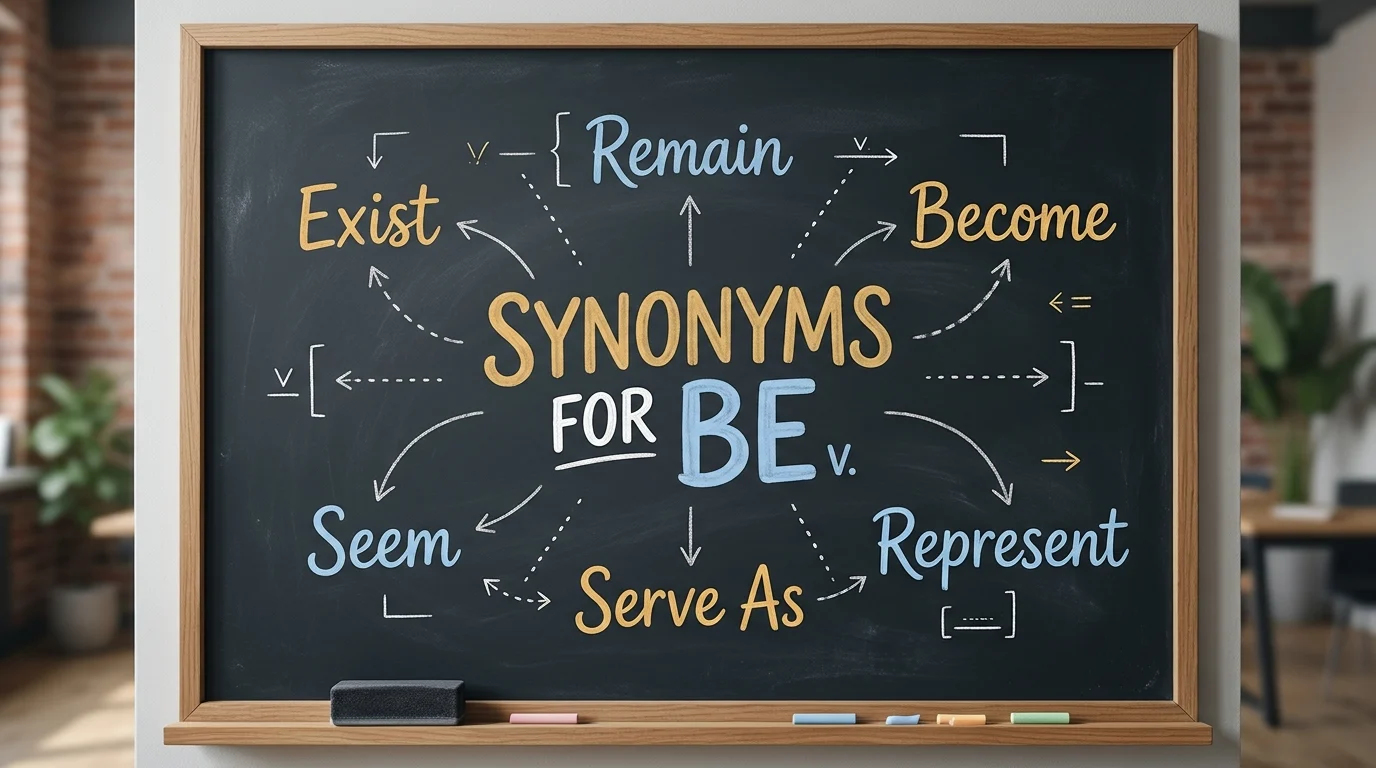
“Be” is the most basic English verb. It means to exist, to have a certain identity or quality, to occupy a position, or to function as an auxiliary verb. Depending on context, alternatives include exist, remain, become, seem, appear, stand, serve as, represent, constitute, and act as.
Meaning, Tone, and Context
Simple Definition
“Be” generally refers to:
- Existence: to exist or live (“I think, therefore I am.”)
- Identity: to have a particular name, role, or quality (“She is a doctor.”)
- State: to be in a particular condition (“He is tired.”)
- Location: to occupy a position (“The book is on the table.”)
- Auxiliary use: helping form continuous tenses and passive voice (“She is running.” / “It was written.”)
- Time: to happen or occur (“The meeting is at noon.”)
Part of Speech
“Be” is a verb—specifically the infinitive form of the most irregular verb in English.
Forms of “Be”:
- Base/infinitive: be
- Present: am, is, are
- Past: was, were
- Past participle: been
- Present participle: being
Examples:
- “To be or not to be.” (infinitive)
- “She is happy.” (present)
- “They were late.” (past)
- “He has been working.” (past participle)
- “Being kind is important.” (present participle)
Positive, Negative, or Neutral Tone
“Be” is neutral. Its tone depends entirely on context.
Positive:
- “She is a wonderful person.”
Negative:
- “The situation is terrible.”
Neutral:
- “The meeting is at 3 PM.”
Formality Level
“Be” works in all levels of English. However, overuse—especially in the passive voice—can make writing feel weak, vague, or bureaucratic.
Stronger verbs make writing more dynamic and precise.
Common Use Cases
“Be” commonly appears in:
- Identity statements: “He is an engineer.”
- Descriptions: “The sky is blue.”
- Locations: “The keys are on the table.”
- States: “She is tired.”
- Passive voice: “The report was written.”
- Continuous tenses: “They are studying.”
Important Word Forms
- Be (verb): the base form
- Am/Is/Are (verb): present tense
- Was/Were (verb): past tense
- Been (verb): past participle
- Being (verb): present participle
When and How to Use “Be”
Use “be” when you want to indicate existence, identity, state, or location, or when forming continuous tenses and passive voice. Because “be” is often weak or passive, stronger alternatives can make writing more vivid and precise.
Professional
“The meeting is at 3 PM.”
This is clear but can often be strengthened.
Academic
“The experiment was conducted over six months.”
Passive voice with “be” is standard in academic writing.
Personal
“She is my sister.”
The word is natural in everyday conversation.
Creative
“The night was dark and silent.”
Creative writing often benefits from stronger verbs instead of “be.”
Technical
“The server is online.”
This is standard in technical documentation.
Another Word for “Be”
There is no single perfect synonym because “be” has many functions. The best alternative depends on meaning and context.
- Existence: exist, live, occur
- Identity: serve as, act as, function as, represent, constitute
- State: remain, stay, become, seem, appear, feel
- Location: stand, sit, lie, rest, be situated
- Continuous action: keep, continue, go on
- Passive voice: (rewrite in active voice)
If you need one broad alternative, “exist” works for existence, “remain” for continuing state, and “serve as” for identity.
When Not to Use “Be”
“Be” can weaken writing when a stronger verb would be more effective.
Consider:
“The report was written by the team.”
This is passive. A stronger version:
“The team wrote the report.”
Similarly, avoid “be” in descriptive writing:
“The sky was blue and the grass was green.”
Consider:
“The blue sky stretched over the green grass.”
However, do not eliminate “be” entirely—it is essential for passive voice, continuous tenses, and certain constructions.
Words Commonly Confused With “Be”
Be vs. Become
Become indicates a change of state. Be indicates a current state.
Example:
“She is happy.” (state)
“She became happy.” (change)
Be vs. Seem
Seem indicates appearance. Be indicates fact.
Example:
“He is angry.” (fact)
“He seems angry.” (appearance)
Be vs. Remain
Remain indicates continuing state. Be is simpler.
Example:
“She is calm.” (state)
“She remains calm.” (continuing state)
Be vs. Exist
Exist emphasizes presence or reality. Be is broader.
Example:
“Unicorns do not exist.” (reality)
“She is a doctor.” (identity)
Be vs. Serve as
Serve as emphasizes function or role. Be is broader.
Example:
“He is a teacher.” (identity)
“He serves as the team leader.” (role)
Be vs. Have
Have indicates possession. Be indicates state or identity.
Example:
“She has a car.” (possession)
“She is a driver.” (identity)
Best Synonym by Context for “Be”
| Context | Best Synonym | Why It Works | Example |
|---|---|---|---|
| Formal writing | Serve as, constitute | Precise and professional | She serves as the committee chair. |
| Academic writing | Represent, constitute | Standard academic usage | The findings represent a breakthrough. |
| Business/Professional | Function as, remain | Professional and clear | The department functions as a support unit. |
| Existence | Exist, live, occur | Philosophical, factual | Dinosaurs no longer exist. |
| Identity | Serve as, act as, function as | Role or identity | He acts as the team leader. |
| State | Remain, stay, become, seem | State or change | She remained calm. |
| Location | Stand, sit, lie, rest | Physical position | The statue stands in the square. |
| Continuous action | Keep, continue | Ongoing action | She kept walking. |
| Passive voice | (Rewrite in active voice) | Active writing | The team wrote the report. |
| Creative writing | Loom, gleam, shimmer, stretch | More vivid description | The castle loomed in the distance. |
| Casual conversation | Be (itself) | Natural and simple | She is my sister. |
| Descriptive writing | Seem, appear, feel | Atmospheric description | The house seemed empty. |
Which Synonym Should You Choose?
Start by identifying what function “be” is serving.
- Existence: exist, live, occur
- Identity: serve as, act as, function as, represent, constitute
- State: remain, stay, become, seem, appear, feel
- Location: stand, sit, lie, rest, be situated
- Continuous action: keep, continue, go on
- Passive voice: rewrite in active voice
10 Key Synonyms for “Be”
The table below includes accurate alternatives with clear meanings and usage contexts.
| Synonym | Simple Meaning | Best Used For | Example Sentence |
|---|---|---|---|
| Exist | To be real or present | Philosophy, existence | Dinosaurs no longer exist. |
| Remain | To continue to be | Continuing state | She remained calm. |
| Become | To come to be | Change of state | He became a doctor. |
| Seem | To appear to be | Appearance | She seems tired. |
| Appear | To seem | Appearance | The task appears difficult. |
| Stand | To be positioned upright | Location | The tower stands on the hill. |
| Serve as | To function as | Role or identity | She serves as the chairperson. |
| Represent | To stand for | Academic, formal | The findings represent a breakthrough. |
| Constitute | To make up | Formal, academic | The changes constitute a major shift. |
| Act as | To function as | Role | He acts as the team leader. |
Synonym Groups and Usage Differences
Professional vs. Personal Synonyms
Professional writing benefits from specific terms such as serve as, represent, constitute, function as, and remain.
Personal communication often uses be itself or casual alternatives like seem, feel, or stay.
Compare:
“She is my sister.” (personal)
“She serves as the department head.” (professional)
Formal vs. Conversational Synonyms
Be works in both formal and conversational English.
Formal alternatives: constitute, represent, serve as, function as
Conversational alternatives: be, stay, feel
Examples:
“The findings constitute a major breakthrough.” (formal)
“She feels tired.” (conversational)
Academic Synonyms
Academic writing often uses be in passive voice. When possible, rewrite in active voice or use precise alternatives like represent, constitute, and demonstrate.
For example:
“The findings represent a significant advance.”
“The data constitute strong evidence.”
Professional and Business Synonyms
Business writing often benefits from phrases such as serve as, function as, remain, and represent.
Instead of:
“She is the team leader.”
Consider:
“She serves as the team leader.”
Creative or Literary Synonyms
Creative writing can use loom, gleam, shimmer, stretch, linger, and seem depending on the context.
For example:
“The castle loomed against the sky.”
“The silence lingered in the empty room.”
Slang or Modern Synonyms
Stay is casual for remain.
Feel is casual for seem.
Be itself is common in casual speech.
Examples:
“Stay calm.” (casual)
“She feels tired.” (casual)
Strongest vs. Weaker Synonyms
“Be” alternatives vary in strength:
Weaker: be, seem, appear
Moderate: become, remain, feel
Stronger: serve as, represent, constitute, stand
Emotional vs. Neutral Synonyms
“Be” is neutral. Alternatives can be vivid or emotional.
Emotional alternatives: linger, loom, gleam
Neutral alternatives: exist, remain, constitute
Examples:
“The memory lingered.” (emotional)
“The data constitute evidence.” (neutral)
Antonyms of “Be”
“Be” does not have exact antonyms, but contrasts include:
| Antonym | Context | Meaning | Example Sentence |
|---|---|---|---|
| Not be | General | Negative existence | The store is not open. |
| Cease to be | Existence | Stop existing | The empire ceased to be. |
| Become | State | Change from being | He became angry. |
| Leave | Location | Move away from | She left the room. |
Comparison: “Be” vs. Similar Words
Be vs. Become
Main difference: Become indicates a change of state. Be indicates a current state.
Examples:
“She is happy.” (state)
“She became happy.” (change)
Be vs. Seem
Main difference: Seem indicates appearance. Be indicates fact.
Examples:
“He is angry.” (fact)
“He seems angry.” (appearance)
Be vs. Remain
Main difference: Remain indicates continuing state. Be is simpler.
Examples:
“She is calm.” (state)
“She remains calm.” (continuing state)
Be vs. Exist
Main difference: Exist emphasizes presence or reality. Be is broader.
Examples:
“Unicorns do not exist.” (reality)
“She is a doctor.” (identity)
Be vs. Serve as
Main difference: Serve as emphasizes function or role. Be is broader.
Examples:
“He is a teacher.” (identity)
“He serves as the team leader.” (role)
Be vs. Have
Main difference: Have indicates possession. Be indicates state or identity.
Examples:
“She has a car.” (possession)
“She is a driver.” (identity)
Common Phrases and Expressions with “Be”
1. To be or not to be
Meaning:
A famous existential question from Shakespeare’s Hamlet.
Example:
“To be or not to be, that is the question.”
2. Be that as it may
Meaning:
Even so; nevertheless.
Example:
“Be that as it may, we still need to act.”
3. Be yourself
Meaning:
Act naturally; don’t pretend.
Example:
“Just be yourself at the interview.”
4. Be that as it may
Meaning:
Even if that is true.
Example:
“Be that as it may, the decision stands.”
5. Let it be
Meaning:
Leave it alone; accept it.
Example:
“Let it be—there’s nothing we can do.”
6. Be in
Meaning:
To be fashionable or popular.
Example:
“Minimalism is in this year.”
7. Be on
Meaning:
To be scheduled or happening.
Example:
“The meeting is on for tomorrow.”
8. Be off
Meaning:
To be canceled or leaving.
Example:
“The event is off due to rain.”
9. Be up to
Meaning:
To be doing something; to be someone’s responsibility.
Example:
“What are you up to?”
10. Be about to
Meaning:
To be ready to do something soon.
Example:
“She is about to leave.”
Common Mistakes to Avoid
1. Overusing “be” in writing
Repetition can make writing feel dull. Use alternatives such as become, remain, seem, serve as, and represent.
Repetitive: “The sky was blue. The sun was bright. The air was warm.”
Improved: “The blue sky gleamed. The sun shone brightly. The air felt warm.”
2. Using passive voice when active voice is stronger
Passive voice with “be” can weaken writing.
Passive: “The report was written by the team.”
Active: “The team wrote the report.”
3. Confusing “be” with “become”
Become indicates change. Be indicates state.
Incorrect: “She was happy after the news.” (if change)
Correct: “She became happy after the news.”
4. Using “be” when “serve as” is more precise
Serve as emphasizes role or function.
Vague: “She is the chairperson.”
Precise: “She serves as the chairperson.”
5. Choosing a synonym that changes the meaning
Do not replace be with seem unless you mean appearance.
Do not replace be with remain unless you mean continuing state.
FAQs
What is the best synonym for “be”?
The best synonym depends on context. Exist works for existence, remain for continuing state, become for change, seem for appearance, and serve as for role.
What is a formal synonym for “be”?
Constitute, represent, serve as, and function as are formal alternatives.
What is an informal synonym for “be”?
Stay and feel are common informal alternatives.
What is another word for “be” in creative writing?
Loom, gleam, shimmer, stretch, linger, and seem work well in creative writing.
What is the difference between “be” and “become”?
Become indicates a change of state. Be indicates a current state.
What is the opposite of “be”?
Depending on context, contrasts include not be, cease to be, become, and leave.
Can “be” always be replaced?
No. “Be” is essential for passive voice, continuous tenses, and certain constructions. Replace it only when a stronger, more precise verb improves clarity.
Conclusion
“Be” is the most fundamental verb in English, but overusing it can weaken your writing. The best alternative depends on what you actually mean.
Choose exist for existence, remain for continuing state, become for change, seem for appearance, serve as for role, and represent or constitute for formal contexts.
For academic, professional, and formal writing, precision is usually more valuable than vocabulary variety. A specific term such as represent, constitute, serve as, or remain can tell readers much more than the broad word be.
Before publishing a vocabulary guide, verify definitions and usage with trusted dictionaries such as Cambridge, Oxford, Merriam-Webster, Collins, or Britannica. This helps ensure that each alternative accurately matches its intended meaning and context.
The practical takeaway is simple: when “be” feels weak or repetitive, ask yourself what kind of existence, state, or identity you are actually describing. Then use the most precise word available.
